Scholarships from the government, 1892

ANNOUNCING.

This is a list of the few children who are at some schools, with the names of their parents and where they came from. Whereas the Legislature set aside $6,000 for the tuition of these children.

Oahu College [Punahou], 9.

E. A. Rosa, Samuel Mahelona, R. Ross, Margaret Mossman, Florence Carter; Edward Woodward of Honolulu, Oahu.

C. K. Farden, Makawao, Maui; M. Sunter, Kona, Hawaii; Edward Hapai, G. W. A. Hapai, Hilo, Hawaii.

Kamehameha School.

Robert Baker, H. R. Baker, Honolulu, Oahu; S. Kupau, J. K. Kupau, Waianae, Oahu; Eli Pihi, Rev. S. Kapu, Wailuku Maui; W. Makakoa, W. K. Makakoa, Waihee, Maui; J. Kauka, Kauka, Makawao, Maui; Alfred Kahilialau, M. Kane, Halawa; William Beers, J. W. Moanauli, Honokaa, Hamakua. Continue reading
Fourth of July in Hawaii, 1894.

THE FOURTH OF JULY.

A Very Tame Celebration.

All true Americans residing in Honolulu, regret the manner in which their national holiday was celebrated. The bastard attempt of Mr. Dole to mix local politics into the ceremony with which Americans at home or absent remember the day on which a legitimate and a truly popular republic was born, resulted in a dead failure.

The town has never on a similar day presented a more quiet and peaceful front. The Hawaiians who generally have been lively participators in celebration of America’s National day staid at home, and refused to join the crowd who were forgetting the lofty principles of the great republic by rejoicing in the establishing of a rich man’s oligarchy. Continue reading

Mele and education according to Andrew K. Poepoe, 1930.

Modern Teacher Tells How Old Hawaiians Were Taught

By A. K. POEPOE

(This is the second article by Mr. Poepoe, a Normal school instructor, telling of Hawaiian tone production methods.)

A story obtained from Kona, Hawaii, and recorded by the late Dr. Emerson, mentioning one of the methods used for the training of the chanters conveys to me several fundamental principles vital to vocal art, that aid in verifying the distinct tone focus and timbre in the Hawaiian voice.

“It refers to a little pool of shallow water in the rocks by the sea at Kailua, Hawaii, where the sun was reflected late every afternoon for a considerable interval. This and similar pools were called ‘poho na’u,’ poho, meaning both a depression in the surface and to blow gently. These pools were great swimming centers in olden times. Continue reading

Andrew K. Poepoe on retaining traditional mele styles, 1930.

Hawaiian Singers Urged to Preserve Native Characteristic Song Tones

By A. K. POEPOE

With the advent of various mechanical music devices in the homes and public places, foreign tone qualities are being heard and are gradually replacing the distinct Hawaiian tones, so noticeable in Hawaiian songs. I feel it my duty to call the attention of the Hawaiian singers and lovers of Hawaiian vocal art to the fact that the peculiar Hawaiian tone quality that made Hawaii famous has a distinct focus in the vocal organs.

I feel that unless we distinguish the placement of our tones with its characteristics, and our phonetic system, in the vocal organs, from those we hear, the future generations will sing Hawaiian compositions, Hawaiian words, Hawaiian interpretation, with a foreign tone quality.

In written music we have artificial means of preserving the music by musical notations, whereas, in vocal singing we have to depend upon sensations felt in the vocal organs. Continue reading

Now this is how it is done, 1919.

MAUI BEAUTY SONG

I Maui au a huli hoi mai,
Loheia mai ana ua meahou,
Ma ka leka au a i ike iho ai,
Na hana hakuepa a ka lokoino;
Owau ka i lawe olelo ia,
He kahuna lapaau hoopunipuni,
O ko’u Makua lani maluna,
O ko’u mua ia ma ka’u hana.
O Kona mana piha ko’u aahu,
O Kana olelo ka’u ai ia,
Ka Uhane Hemolele ko’u Alakai,
A kuu kino a e haaheo nei. Continue reading

Fishponds seen on travels around Molokai, 1893.

[Found under: “Huakai Makaikai i ka Mokupuni o Molokainui a Hina.”]

FISHPONDS.

When I travelled from Kawela to Pukoo, it was perhaps ten or so miles, I saw 30 or more fishponds [loko ia] in the ocean, set apart by rock walls like the ponds at Kualoa, Koolau, Oahu. Some of the ponds I saw were almost a mile long. They [the walls] were five feet tall and four feet wide. Continue reading

“He make no ka ka haole, a he ola no hoi; pela no na Kahuna Hawaii.” 1872.

ANNOUNCEMENT.

LET ALL MEN know the thoughts of the Hawaiian Medical Practitioners [Kahuna Lapaau Hawaii], they who number one hundred and fifty. O Ke Au Okoa, speak their thoughts. About how we will bear this immense right of ours impeccably, without deceit. Let them be instructed to put behind these evil thing: evil sorcery [anaana], imitative magic [hoopiopio], sending spirits [hoounauna], and the deification of all evil things; Continue reading

Aloha is a reciprocal thing, 1779, 1867 and beyond.

[From: S. M. Kamakau’s “Ka Moolelo o Kamehameha I: Ke Au ia Kalaniopuu A. D. 1779. No ka Make ana o Kapena Kuke, Oia Hoi o Lono.”]

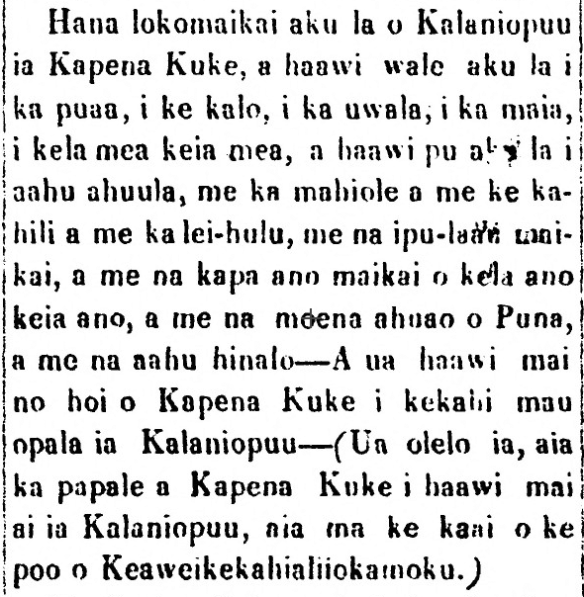
Kalaniopuu treated Captain Cook generously, and gave him pigs, taro, sweet potato, bananas, and other things; he also gave him ahuula capes, mahiole, kahili, feather lei, fine wooden bowls, various fine kapa, ahu ao mats from Puna, and garments of hinalo—Captain Cook gave Kalaniopuu some rubbish—(It is said that the hat that Captain Cook gave to Kalaniopuu is in the head of the kaai of Keaweikekahialiiokamoku.)

(Kuokoa, 2/2/1867, p. 1)

Kuokoa_2_2_1867_1.png

Ka Nupepa Kuokoa, Buke VI, Helu 5, Aoao 1. Feberuari 2, 1867.

Let’s move forward, and not backward. 1897.

[Found under: “KE ALEALE NEI KA WAI.”]

All the while the circle of annexationists are reviling the Asians, they majority of them are employing those people as servants. How are you being deceived of the truth of their desires, O United States of America? What hypocrites!

(Makaainana, 2/8/1897, p. 4)

Makaainana_2_8_1897_4.png

Ka Makaainana, Buke VII—-Ano Hou, Helu 6, Aoao 4. Feberuari 8, 1897.

Pressured by their teachers, 1893.

THE SCHOOLS OF SAINT LOUIS AND KAMEHAMEHA.

We were told that the students of Saint Louis School [ke Kula o Sana Lui] were prohibited from placing the ribbon of the annexationists upon their chests. And we were also informed that the students of Kamehameha

Continue reading