Loaa Ko Puni Kauoha.
Lihilihi o ka Lehua
Aala o ka Hinano
He nahele kii wai a ka ua
Koolua e lia mau nei. Continue reading
Lihilihi o ka Lehua
Aala o ka Hinano
He nahele kii wai a ka ua
Koolua e lia mau nei. Continue reading
Talking about Welo Hou and the Roberts Collection of mele at the Bishop Museum, here is a post put up a while ago!
In this past Legislative session, $5,000 was set aside for the cost to prepare a book of “Ancient Hawaiian Music”. This endeavor has been given to Kamehameha School, and they are now utilizing this to preserve the “old mele olioli” of Hawaii nei. Miss Helen H. Roberts has been sent by the Trustees of the Kamehameha School to go amongst the Hawaiians and to search out ancient mele of Hawaii nei.
She is accompanied by a phonograph [ponotalapa (ipu malama olelo)], and is looking to have people chant ancient mele into the phonograph and to record and save it for generations to come. Not only mele olioli are being sought after, but also wanted are mele hula hoaeae of the Hawaiians. Many years from now the people who know these old mele will be gone, but these mele olioli and mele hoaeae will become something to look…
View original post 265 more words
Click the link below for the blog post I referred to in the Kapiolani mele post earlier today. Check out the Mary Kawena Pukui translation for the Mokumanu oki!
Give ear Hawaii o Keawe! Maui o Kama! Oahu o Kuihewa! Kauai o Mano!
In the providence of God, and by the will of his late Majesty Kamehameha III, this day read in your hearing, I have been called to the high and responsible position of the Chief Ruler of this nation. I am deeply sensible of the importance and sacredness of the great trust committed to my hands, and, in the discharge of this trust I shall abide by the Constitution and laws which I have just sworn to maintain and support. It is not my wish to entertain you on the present occasion with pleasant promises for the future; but I trust the close of my career will show that I have not been raised to the head of this nation to oppress it and curse it, but on the contrary to cheer and bless it, and that when I come to my end I may, like the beloved chief whose funeral we yesterday celebrated, pass from earth amid the bitter lamentation of my people. Continue reading
A petition was put before the Board of Supervisors [Papa Lunakiai] of Maui on this past Monday, May 15, and it was about the obvious truth of the sad acknowledgement by the kamaaina of Hawaii, about the quiet decline of the Hawaiian language.
This document was sent from Molokai, one of the bastions of the old Hawaiians, and the document was written in the Hawaiian language, and it is something important taken and considered by the members of the board, the press, and others who went to observe the meeting. Continue reading
With a heavy heart for my Heavenly Lord, who has passed on the path of no return, for you, O George Kaiwalani Dwight, you are a heavenly one, a first born of the alii of Maui, a navel string and umbilical cord from Kekaulike (m) and Kekuiapoiwanui (f), who gave birth to Kamehameha-nui, who was raised on luau [Kamehamehanuiailuau], and Keaka (f), an alii, a wohi, a sacred one. Continue reading
Think for yourself.
As a spokesperson for the people, and being that we are all angered by the contemptuous words of the people who stole our beloved land; we continue to protest these acts to this day; therefore, we speak on something we saw which is stealing once again; and that is this:
October 24, Bulletin Newspaper²; the newspaper stated:—Professor Berger of the Government Band [Bana Aupuni] has put a request before all the members of the National Band [Bana Lahui Hawaii] for the boys to agree to give time to teach his musicians to sing; time to sing will be made between the first and second parts and so forth.
And being the boys of the National Band will join with the “Peacock government [aupuni Pikake]³” Band, it shows those on the outside that the two sides have joined together and the disagreements have become as naught.
That is the gist of this report which we saw; and those rights of yours, O Hawaii, will be stolen once again.
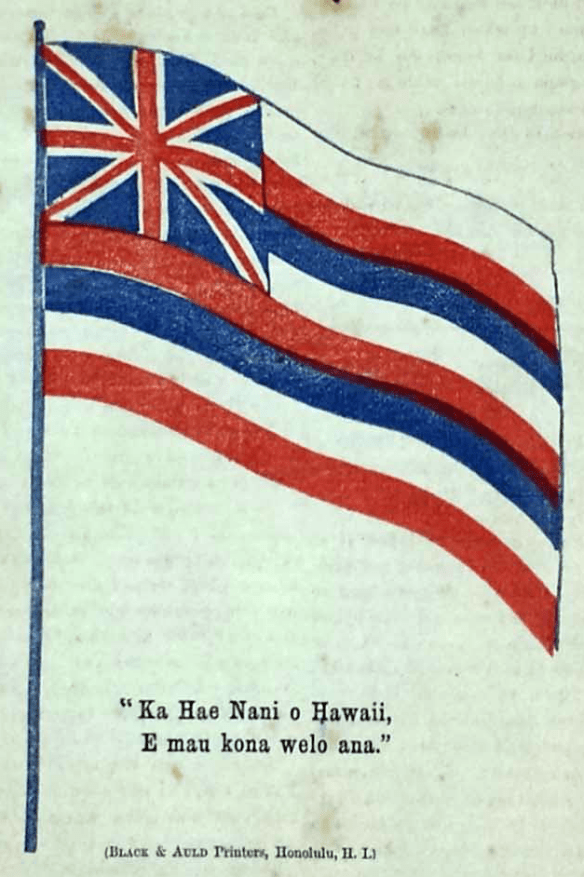
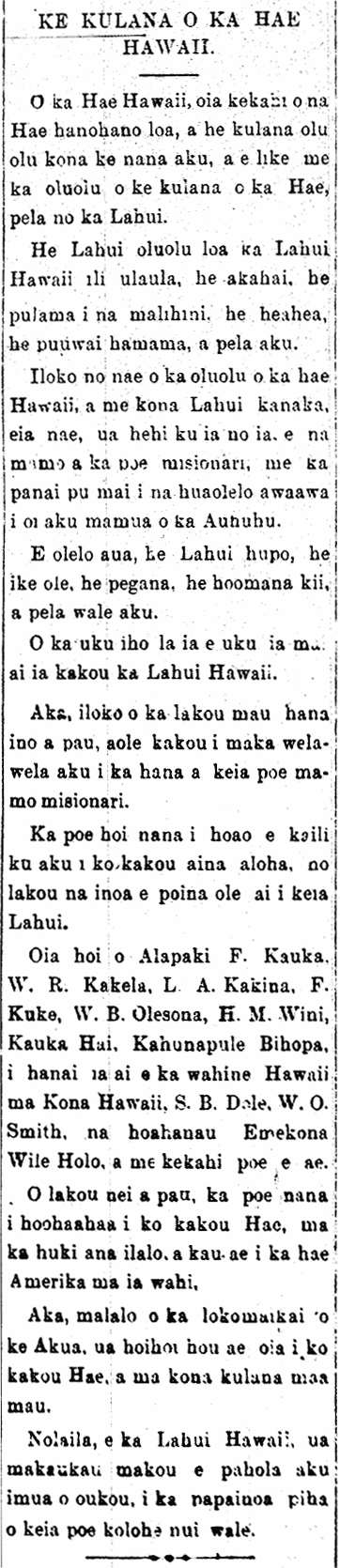
The Hawaiian Flag is one of the most glorious Flags, and it is so pleasant to look upon, and like the nature of the Flag, so too the People.
The brown-skinned [ili ulaula] Hawaiian Lahui are a kind People, are modest, treasure malihini, are welcoming, have open hearts, and so forth.
But even if the Hawaiian Flag and her People are kindhearted, they have been trampled upon by the descendants of the missionaries, and are being paid back with poisonous words, even more so than the Auhuhu.¹
It is being said that they are a Lahui that is stupid, know nothing, pagan, idol worshiper, and on and on.
That is what we the Hawaiian People get in return.
But despite all of their abuse, we are not full of hate at the actions of these missionary descendants.
The people who tried to grab our beloved land; and their names shall not be forgotten by this Lahui.
They being: Albert Francis Judd [Alapaki F. Kauka]; William Richards Castle [W. R. Kakela]; Lorrin Andrews Thurston [L. A. Kakina]; Amos Francis Cooke [F. Kuke]; William Brewster Oleson [W. B. Olesona]; Henry Martyn Whitney [H. M. Wini]; Dr. Charles M. Hyde [Kauka Hai]; Sereno Edwards Bishop [Kahunapule Bihopa], who was raised by a Hawaiian woman at Kona, Hawaii; Sanford Ballard Dole [S. B. Dole]; William Owen Smith [W. O. Smith]; the Emerson brothers [na hoahanau Emekona]; William W. Hall [Wile Holo]; and some others.
All of them is who brought down our Flag, by lowering it and raising the American flag in its place.
However, under God’s benevolence, our flag has been returned to its rightful place.
So therefore, O Hawaiian People, we are prepared to lay out before you the full list of names of these great transgressors.
¹Auhuhu is a plant that was used in fishing as a fish poison.
(Leo o ka Lahui, 10/13/1893, p. 2)

 nupepa