TABLEAU IN LAIE.
On the Saturday night, the 26th of this month, the Kaonohiokala Club [Kalapu Kaonohiokala] will put on a beautiful pageant at Laie for the benefit of the Hoolaulea Hall of the Mormons of Honolulu nei. Continue reading

On the Saturday night, the 26th of this month, the Kaonohiokala Club [Kalapu Kaonohiokala] will put on a beautiful pageant at Laie for the benefit of the Hoolaulea Hall of the Mormons of Honolulu nei. Continue reading
Keaulana: ‘It was beautiful.’
By BUNKY BAKUTIS
Advertiser Staff Writer
After the dust had settled from the day’s ceremony and the crew relaxed around beer coolers and luau food, Buffalo Keaulana, one of the two steersmen for the sailing canoe’s maiden voyage, summed up the brief cruise: “It was beautiful.
“It (the canoe) turned real easy. And when the paddling was right and the canoe was moving, it was a breeze to handle,” said Keaulana, who has been practicing sailing a smaller version of the double-hulled canoe this past year in preparation for the Tahiti trip.
SOME OF THE PADDLERS for yesterday’s ceremonial cruise into Kaneohe Bay also sung the craft’s praises. Continue reading
In the Helen Roberts audio collection at the Bishop Museum, it seems that there is an actual recording of Wahinekeouli Pa performing this mele! [Haw 1.5a, track ] Wow.
Nani wale ka uwila i Kilauea,
E anapa mai la i ka paia lani;
Hoike mai ana i kona nani,
He malamalama oi kelakela;
Helu ekahi a o Hawaii nei.
Ma ka lihi kai o ka Pakipika;
Ua ana pono ia kona enekini,
No kanaha mile kona mamao;
Kaomi lima ia iho ke pihi,
E niniu ia no umi kekona;
Hihiu na hana a ka Puakea,
He oi pakela a ke akamai;
I hana noeau ia e Palani,
Me na waihooluu like ole;
He kinohinohi ke ike aku,
Ka anapa a ka onohi kaimana,
Ua hanaia a ku i ka nani,
Molina wai gula anapanapa;
Ka papa dala ke kahua ia,
Ka hulali a ka wai hoohinuhinu;
Ua kohu lihilihi anuenue,
Ka alohi, ka anapa ke ike aku,
Haina ia mai ana ka puana,
Hale kukui nani…
View original post 27 more words
Candidate for Sheriff.
As I announce my candidacy for Sheriff on the Republican Ballot in the upcoming Election Season, I would like to make clear that I stand on the platform of good, and should I be elected, I will carry out all things so that everyone will be pleased. I ask humbly for your support.
(Puuhonua o na Hawaii, 5/25/1917, p. 4)
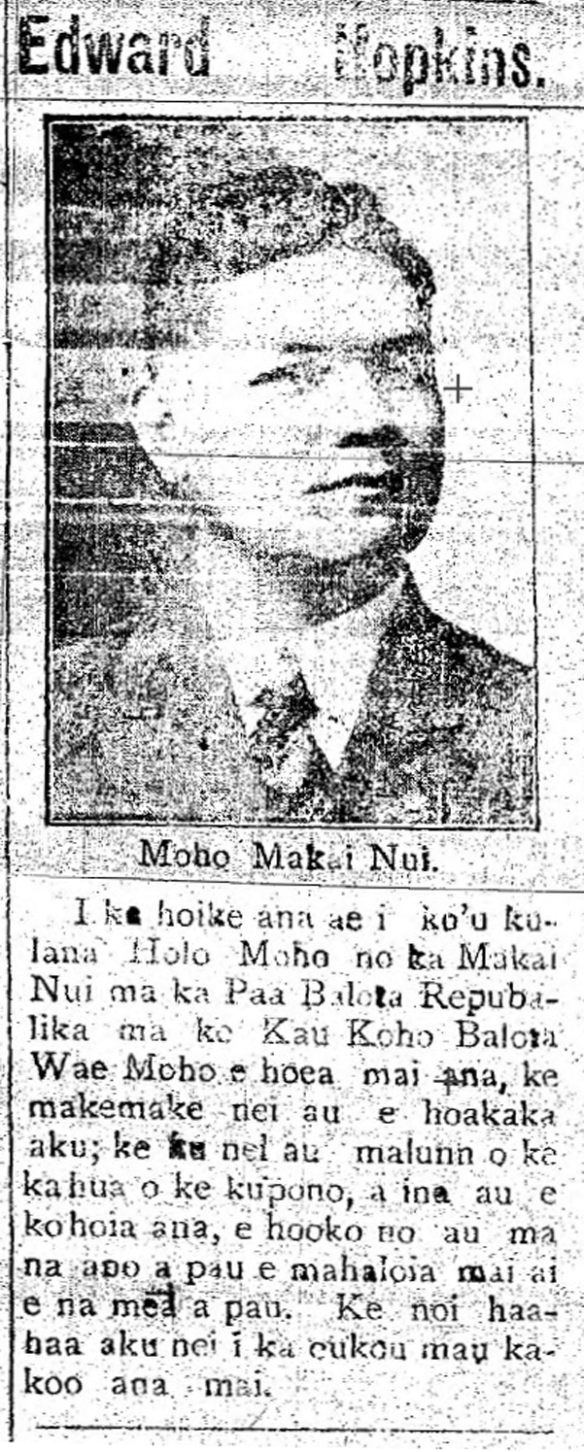
Ka Puuhonua o na Hawaii, Buke IV, Helu 21, Aoao 4. Mei 25, 1917.
HAS OPENED
a Poi Shop at the Market. Go and see him and His Delicious Poi. Liliha and Kukui.
(Puuhonua o na Hawaii, 5/25/1917, p. 3)
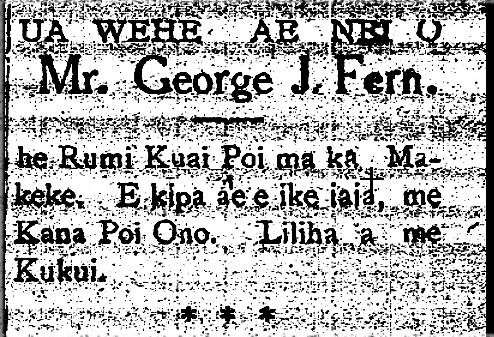
Ka Puuhonua o na Hawaii, Buke IV, Helu 21, Aoao 3. Mei 25, 1917.
A feature of yesterday’s birthday luncheon of the Outdoor Circle was the reading of a Hawaiian poem, written by Mrs. Mary Jane Kulani F. Montana [Montano], author of the verses of “The Old Plantation,” and dedicated to the Circle. The original verses and an English translation were read by Mrs. Webb. These were:
HONOLULU AINA KUPUA.
I.
I ka puu wau o Manoa,
I ka wai ola a Kanaloa,
E kilohi i ka nani punono
O Honolulu Aina Kupua.
Ua nani mai ka uka a ke kai
He mele aloha i ana ka puuwai,
Me he ala e i mai ana,
Honolulu Aina Kupua.
II.
Ua kini a lau na pua,
Kumoana la i kanahele,
Kanahele ohai pua ala,
I kanu ia e na lima aulii.
Aloha i ke oho o ka niu,
I ka holu nape i ke ehu kai,
Me he ala e i aku ana,
Honolulu Aina Kupua. Continue reading
The words and music of the Hawaiian national anthem are both the composition of Mrs. Lila K. Dominis, the sister of King Kalakaua. The first part of the hymn we transcribe for the edification of our readers:
Ka Makua Mana Loa,
Malin wai ia wakou,
E haliu aku rei.
We wa hian haahan,
E wan ka waluhia
O rei Pae Alna,
Wal Hawaiia Nuhan,
Mololo o Kou Malu. Continue reading
Through mele, one can understand the way of life of the people of very long ago, and the stories of the land as well!
Don’t forget to answer this short survey from the Bishop Museum Library and Archives. And if you are in a language class, in a hula class, in a history class. Why do you look at mele? Why don’t you look at mele? Send this survey around.
[Click the link below:]
Perhaps the mele of old are almost all lost; those who know them are but few. This is something to be regretful of for in those mele, one can understand the way of life of the people of very long ago, and the stories of the land as well. The means for these mele to continue and not to be lost is by printing them in books and newspapers perhaps; in that way, the new generations can read them and contemplate over it and see the misconceptions of their kupuna and to not follow in their misguided ways. We wish to print the old mele and new mele, as long as they are good, and we ask of those who have mele and the composers of mele to send them to us and we will print them. Write the letters very clearly, and insert punctuation where they…
View original post 412 more words
For all of you lucky people in Hilo of the famous Kanilehua rain!
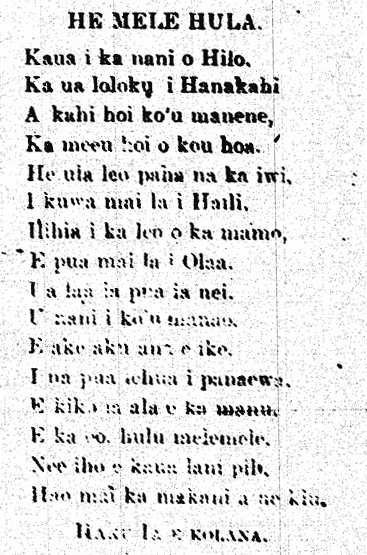
Ka Leo o ka Lahui, Buke II, Helu 501, Aoao 2. Iuali 18, 1892.
Seldom does the historian of passing events have a sadder task to perform than when penning obituary notices of his contemporaries; but when the subject of his notice is a person of mark,—of innocent and upright character,—the victim of a dastardly assassin; it becomes a melancholy duty to lay a last mark of esteem upon the tomb of the outraged, especially when venerable for age, and honorable for past services. Continue reading

 nupepa