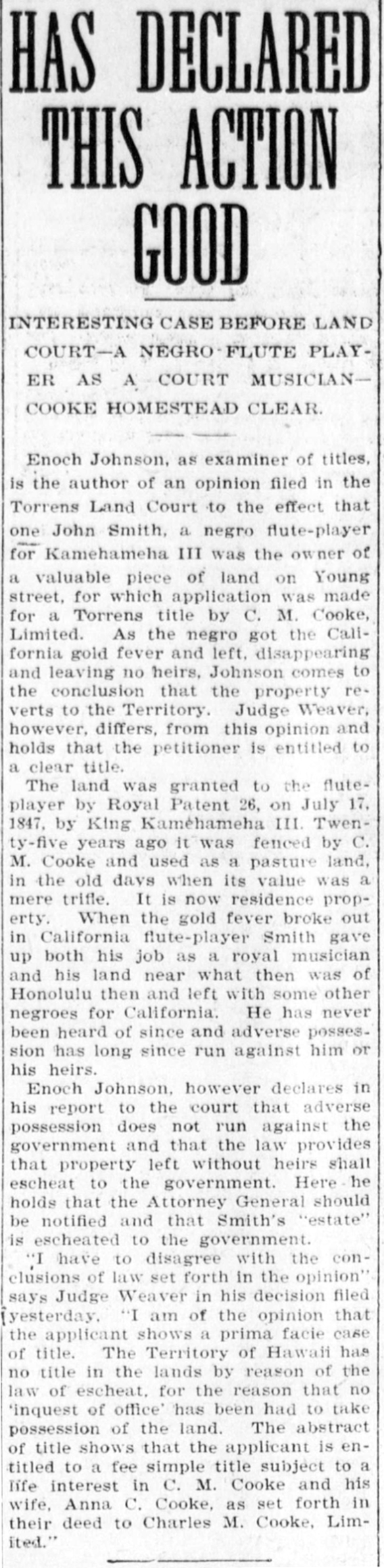
John Smith, flautist for Kamehameha III, and land rights, 1904.

HAS DECLARED THIS ACTION GOOD

INTERESTING CASE BEFORE LAND COURT—A NEGRO FLUTE PLAYER AS A COURT MUSICAN—COOKE HOMESTEAD CLEAR.

Enoch Johnson, as examiner of titles, is the author of an opinion filed in the Torrens Land Court to the effect that one John Smith, a negro flute-player for Kamehameha III was owner of a valuable piece of land on Young street, for which application was made for a Torrens title by C. M. Cooke, Limited. As the negro got the California gold fever and left, disappearing and leaving no heirs, Johnson comes to the conclusion that the property reverts to the Territory. Judge Weaver, however, differs, from this opinion and holds that the petitioner is entitled to a clear title.

The land was granted to the flute-player by Royal Patent 26, on July 17, 1847, by King Kamehameha III. Twenty-five years ago it was used as a pasture land, in the old days when its value was a mere trifle. It is now residence property. When the gold fever broke out in California flute-player Smith gave up both his job as a royal musician and his land near what then was of Honolulu then and left with some other negroes for California. He has never been heard of since and adverse possession has long since run against him or his heirs.

Enoch Johnson, however declares in his report to the court that adverse possession does not run against the government and that the law provides that property left without heirs shall escheat to the government. Here he holds that the Attorney General should be notified and that Smith’s “estate” is escheated to the government.

“I have to disagree with the conclusions of law set forth in the opinion” says Judge Weaver in his decision filed yesterda. “I am of the opinion that the applicant shows a prima facie case of title. The Territory of Hawaii has no title in the lands by reason of the law of escheat, for the reason that no ‘inquest of office’ has been had to take possession of the land. The abstract of title shows that the applicant is entitled to a fee simple title subject to a life interest in C. M. Cooke and his wife, Anna C. Cooke, as set forth in their deed to Charles M. Cooke, Limited.”

(Hawaiian Star, 6/23/1904, p. 8)

HawaiianStar_6_23_1904_8.png

The Hawaiian Star, Volume XII, Number 3824, Page 8. June 23, 1904.

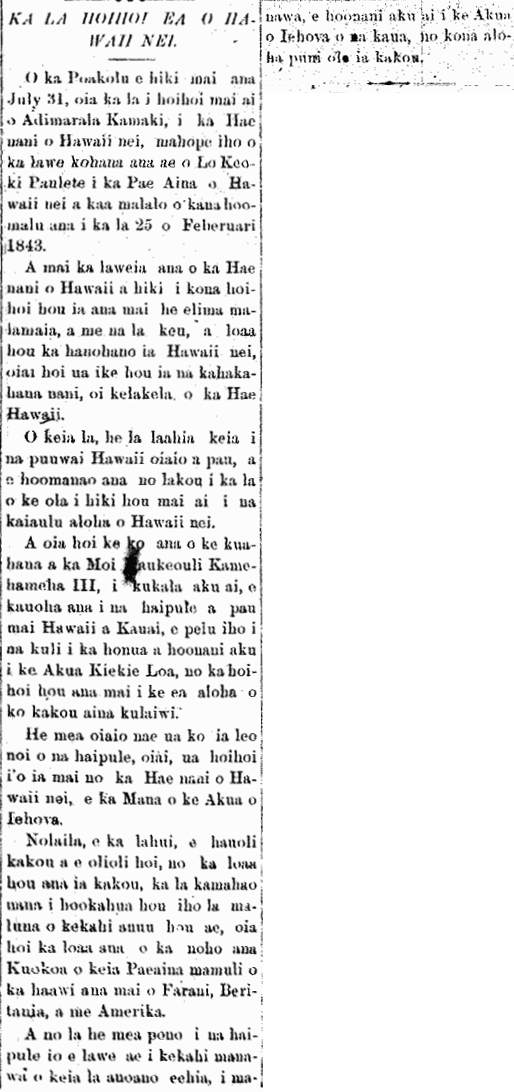
La Hoihoi Ea, 1895.

RESTORATION DAY OF HAWAII.

The coming Wednesday, July 31, is the day that Admiral Thomas restored the glorious Flag of Hawaii nei, after he stripped these Hawaiian Islands and took them under his power on the 25th of February 1843.

And from the taking of the beautiful Flag of Hawaii until its return was five months and some days, and the glory of Hawaii was regained, for the beautiful, magnificent stripes of the Hawaiian Flag was seen once more.

This day is a sacred day in the hearts of all true Hawaiians, and they commemorate the day that the life returned to the loving communities of Hawaii nei.

And the proclamation proclaimed by the King, Kauikeaouli Kamehameha III was fulfilled, as he commanded all the devout from Hawaii to Kauai to kneel down and give glory to God Almighty for returning the beloved sovereignty to our homeland.

It is true that the supplication of the devout was heard, for the beautiful Flag of Hawaii nei was indeed restored by the Power of God, Jehovah.

Therefore, O Lahui, let us be happy and rejoice, for gaining this glorious day which established the foundation for a new step, that being the Independence of these Islands given by France, Britain, and America.

Now all true faithful ones should take some time on this awesome and sacred day as time to glorify God, Jehovah almighty for his true love for us.

(Oiaio, 8/2/1895, p. 4)

Oiaio_8_2_1895_4.png

Ka Oiaio, Buke VII, Helu 22, Aoao 4. Augate 2, 1895.

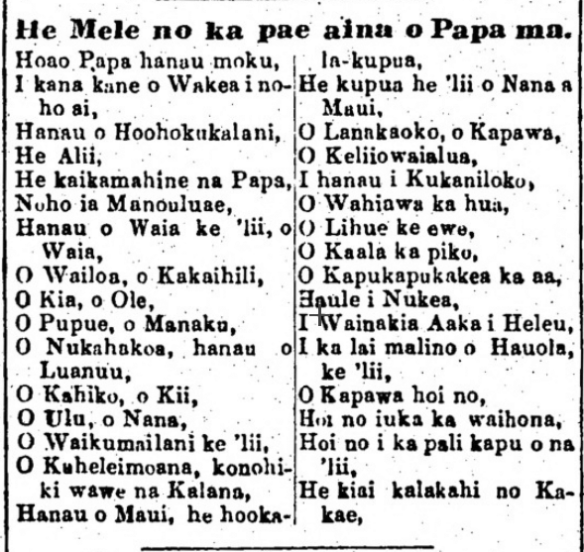
Mele for the island chain of Papa and Wakea: a response to the Armstrong call, 1860.

He Mele no ka pae aina o Papa ma.

Hoao Papa hanau moku,
I kana kane o Wakea i noho ai,
Hanau o Hoohokukalani,
He Alii,
He kaikamahine na Papa,
Noho ia Manouluae,
Hanau o Waia ke ’lii, o Waia,
O Wailoa, o Kakaihili,
O Kia, o Ole,
O Pupue, o Manaku,
O Nukahakoa, hanau o Luanuu,
O Kahiko, o Kii,
O Ulu, o Nana,
O Waikumailani ke ’lii,
O Kuheleimoana, konohiki wawe na Kaloana,
Hanau o Maui, he hookala-kupua,
He kupua he ’lii o Nana a Maui,
O Lanakaoko, o Kapawa,
O Keliiowaialua,
I hanau i Kukaniloko,
O Wahiawa ka hua,
O Lihue ke ewe,
O Kaala ka piko,
O Kapukapukakea ka aa,
Haule i Nukea,
I Wainakia Aaka i Heleu,
I ka lai malino o Hauola, ke ’lii,
O Kapawa hoi no,
Hoi no iuka ka waihona,
Hoi no i ka pali kapu o na ’lii,
He kiai kalakahi no Kakae,

[This is but one of the many mele submitted to the Hae Hawaii in response to the calls put out by Samuel Chapman Armstrong.]

(Hae Hawaii, 8/8/1860, p. 77)

HaeHawaii_8_8_1860_77

Ka Hae Hawaii, Buke 5, Ano Hou.—Helu 19, Aoao 77. Augate 8, 1860.

The call for information on traditional knowledge, 1860.

ANCIENT MELE.

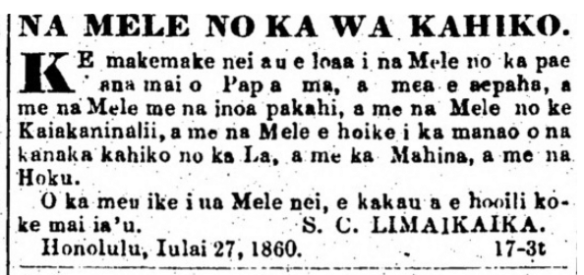
I want to obtain Mele about the arrival of Papa folks, and perhaps others, and Mele with each individual name, and Mele about the Kaiakahinalii [Great Flood], and Mele showing what the ancient people thought about the Sun, the Moon, and the Stars.

For those who know these Mele, write them down and send them to me. S. C. ARMSTRONG.

Honolulu, July 27, 1860.

[There was a broader request earlier that year. See: No na Mele!]

(Hae Hawaii, 7/25/1860, p. 71)

HaeHawaii_7_25_1860_71

Ka Hae Hawaii, Buke 5, Ano Hou.—Helu 17, Aoao 71. Iulai 25, 1860.

Keep politics off of the pulpit, 1894.

THE DOORS OF WAINEE CHURCH ARE SHUT.

When the steamer Iwalani arrived on the morning of this past Friday, news of the Paupili rain of Lele [Lahaina] was heard, saying that the doors of Wainee Church were shut by the brethren. The story we heard was this below.

One day on the previous week, in the sermon of the kahu of that Church, A. Pali, he spoke about God, and at the very end of his talk, he revealed this:

“I am a true American, inside and out, from top to bottom;” and other inappropriate words; and the congregation began to fidget, and at the close of his prayer, the brethren told him, you are not good, O Pali, and we tell you that you will not pray in this Church from now forward.” Continue reading

Iwi found on the future site of the First National Bank, 1924.

HUMAN BONES AND A POI POUNDER FOUND.

While the site was being dug, where the First National Bank [Banako First National] will be built in the future, at King and Bishop streets, there was found human bones and a poi pounder in the earth, but as to how those bones and poi pounder got there, that is something unclear being asked today.

At about seven or eight feet, these things were found by workers digging the dirt in the earth, at the area where the old fire station stood during the time of King Kalakaua. Continue reading

Continuation of Piilani’s story, 1916.

The Story of Piilani

(Continued from last week.)

Several days later they got the news that Mr. Stolz and some policemen all armed with revolvers and guns had arrived to get the lepers and particularly to capture Koolau. When Koolau heard this he said: “It may be their idea, but the man who tries to do that will do so at the peril of his life.”

This word was brought to Stolz, and he sent the word back that Koolau would repent it if he refused to obey the orders of the authorities. Koolau took his gun, kissed it and held it to his breast and talked to the gun as if it was a friend and charged it to stand by him and shoot straight, and from that time Koolau kept guard and shortly afterwards they saw a ten being put up on the beach, and he thought it was to watch him and some of his friends went down to find out for him.

One day Koolau, Piilani and the child went makai on the path by the stream, and there they found Mr. Stolz’s raincoat with some crackers in the pocket, also a blanket, and Koolau told Piilani to take these things along with her. Shortly afterwards they met Penikala, a policeman from Waimea, and Koolau asked him, where Louis Stoltz was, and Penikala said, he did not know, but thought that Louis Stoltz had gone to Hanalei. A little later they met Peter Nowlein, a policeman from Hanalei, and Nowlein told them that Louis Stoltz had gone further up the valley to catch Koolau by surprise. Koolau and family kept going till they reached Kaumeheiwa’s house and found there a lot of their friends. Koolau told them that he was in search of Louis Stoltz and if they were afraid told them to go somewhere else. Penikila was there and Koolau upbraided him for telling a falsehood and told him he ought to be shot, but told him he would forgive him, as he was after Louis Stoltz only. The most of the people went further down towards the beach. Continue reading

Piilani, the Wife of Kaluaikoolau, 1916.

The Story of Piilani

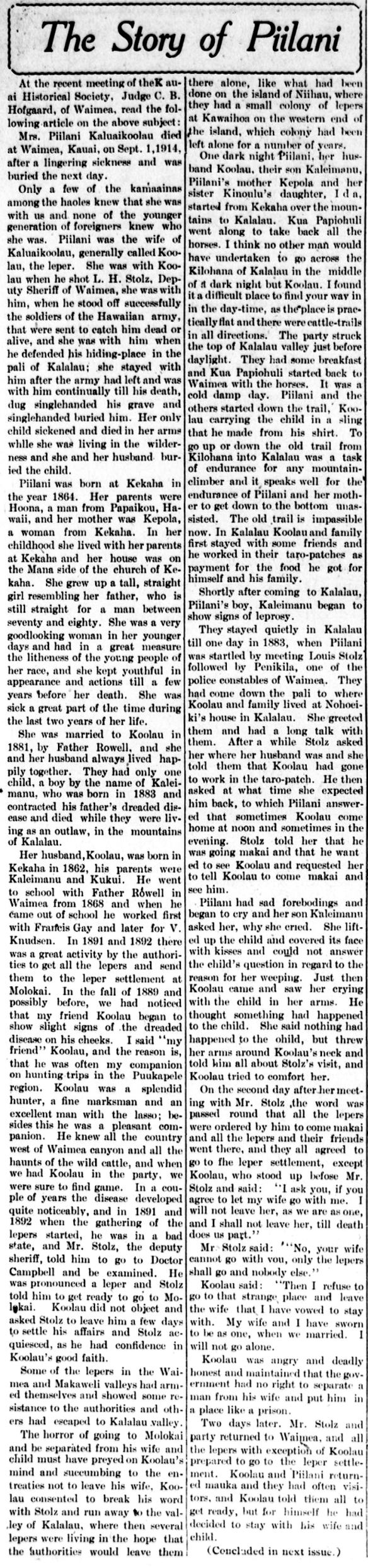
At the recent meeting of the Kauai Historical Society, Judge C. B. Hofgaard, of Waimea, read the following article on the above subject:

Mrs. Piilani Kaluaikoolau died at Waimea, Kauai, on Sept. 1, 1914, after a lingering sickness and was buried the next day.

Only a few of the kamaainas among the haoles knew that she was with us and none of the younger generation of foreigners knew who she was. Piilani was the wife of Kaluaikoolau, generally called Koolau, the leper. She was with Koolau when he shot L. H. Stolz, Deputy Sheriff of Waimea, she was with him, when he stood off successfully the soldiers of the Hawaiian army, that were sent to catch him dead or alive, and she was with him when he defended his hiding-place in the pali of Kalalau; she stayed with him after the army had left and was with him continually till his death, dug singlehanded his grave and singlehanded buried him. Her only child sickened and died in her arms while she was living in the wilderness and she and her husband buried the child.

Piilani was born at Kekaha in the year 1864. Her parents were Hoona, a man from Papaikou, Hawaii, and her mother was Kepola, a woman from Kekaha. In her childhood she lived with her parents at Kekaha and her house was on the Mana side of the church of Kekaha. She grew up a tall, straight girl resembling her father, who is still straight for a man between seventy and eighty. She was a very goodlooking woman i her younger days and had in a great measure the litheness of the young people of her race, and she kept youthful in appearance and actions till a few years before her death. She was sick a great part of the time during the last two years of her life.

She was married to Koolau in 1881, by Father Rowell, and she and her husband always lived happily together. They had only one child, a boy by the name of Kaleimanu, who was born in 1883 and contracted his father’s dreaded disease and died while they were living as an outlaw, in the mountains of Kalalau.

Her husband, Koolau, was born in Kekaha in 1862, his parents were Kaleimanu and Kukui. He went to school with Father Rowell in Waimea from 1868 and when he came out of school he worked first with Francis Gay and later for V. Knudsen. In 1891 and 1893 there was a great activity by the authorities to get all the lepers and send them to the leper settlement at Molokai. In the fall of 1889 and possibly before, we had noticed that my friend Koolau began to show slight signs of the dreaded disease on his cheeks. I said “my friend” Koolau, and the reason is, that he was often my companion on hunting trips in the Puukapele region. Koolau was a splendid hunter, a fine marksman and an excellent man with the lasso; besides this he was a pleasant companion. He knew all the country west of Waimea canyon and all the haunts of the wild cattle, and when we had Koolau in the party, we were sure to find game. In a couple of years the disease developed quite noticeably, and in 1891 and 1892 when the gathering of the lepers started, he was in a bad state, and Mr. Stolz, the deputy sheriff, told him to go to Doctor Campbell and be examined. He was pronounced a leper and Stolz told him to get ready to go to Molokai. Koolau did not object and asked Stolz to leave him a few days to settle his affairs and Stolz acquiesced, as he had confidence in Koolau’s good faith.

Some of the lepers in the Waimea and Makaweli valleys had armed themselves and showed some resistance to the authorities and others had escaped to Kalalau valley.

The horror of going to Molokai and be separated from his wife and child must have preyed on Koolau’s mind and succumbing to the entreaties not to leave his wife, Koolau consented to break his word with Sotlz and run away to the valley of Kalalau, where then several lepers were living in the hope that the authorities would leave them there alone, like what had been done on the island of Niihau, where they had a small colony of lepers at Kawaihoa on the western end of the island, which colony had been left alone for a number of years.

One dark night Piilani, her husband Koolau, their son Kaleimanu, Piilani’s mother Kepola and her sister Kinoulu’s daughter, Ida, started from Kekaha over the mountains to Kalalau. Kua Papiohuli went along to take back all the horses. I think no other man would have undertaken to go across the Kilohana of Kalalau in the middle of a dark night but Koolau. I found it a difficult place to find your way in in the day-time, as the place is practically flat and there were cattle-trails in all directions. The party struck the top of Kalalau valley just before daylight. They had some breakfast and Kua Papiohuli started back to Waimea with horses. It was a cold damp day. Piilani and the others started down the trail, Koolau carrying the child in a sling that he made from his shirt. To go up or down the old trail from Kilohana into Kalalau was a task of endurance for any mountain-climber and it speaks well for the endurance of Piilani and her mother to get down to the bottom unassisted. The old trail is impassible now. In Kalalau Koolau and family first stayed with some friends and he worked in their taro-patches as payment for the food he got for himself and his family.

Shortly after coming to Kalalau, Piilani’s boy, Kaleimanu began to show signs of leprosy.

They stayed quietly in Kalalau till one day in 1883, when Piilani was startled by meeting Louis Sotlz followed by Penikila, one of the police constables of Waimea. They had come down the pali to where Kolau and family lived at Nohoeiki’s house in Kalalau. She greeted them and had a long talk with them. After a while Stolz asked her where her husband was and she told them that Koolau had gone to work in the taro-patch. He then asked at what time she expected him back, to which Piilani answered that sometimes Koolau come home at noon and sometimes in the evening. Stolz told her that he was going makai and that he wanted to see Koolau and requested her to tell Koolau to come makai and see him.

Piilani had sad forebodings and began to cry and her son Kaleimanu asked her, why she cried. She lifted up the child and covered its face with kisses and could not answer the child’s question in regard to the reason for her weeping. Just then Koolau came and saw her crying with the child in her arms. He thought something had happened to the child. She said nothing had happened to the child, but threw her arms around Koolau’s neck and told him all about Stolz’s visit, and Koolau tried to comfort her.

On the second day after her meeting with Mr. Stolz the word was passed round that all the lepers were ordered by him to come makai and all the lepers and their friends went there, and they all agreed to go to the leper settlement, except Koolau, who stoo up before Mr. Stolz and said: “I ask you, if you agree to let my wife go with me. I will not leave her, as we are as one, and I shall not leave her, till death does us part.”

Mr. Stolz said: “No, your wife cannot go with you, only the lepers shall go  and nobody else.”

Koolau said: “Then I refuse to go to that strange place and leave the wife that I have vowed to stay with. My wife and I have sworn to be as one, when we married. I will not go alone.

Koolau was angry and deadly honest and maintained that the government had no right to separate a man from his wife and put him in a place like a prison.

Two days later, Mr. Stolz and party returned to Waimea, and all the lepers with exception of Koolau prepared to go to the leper settlement. Koolau and Piilani returned mauka and they had often visitors, and Koolau told them all to get ready, but for himself he had decided to stay with his wife and child.

(Concluded in next issue.)

(Garden Island, 12/19/1916, p. 6)

GardenIsland_12_19_1916_6.png

The Garden Island, Volume 12, Number 51, Page 6. December 19, 1916.