Piilani, the Wife of Kaluaikoolau, 1916.

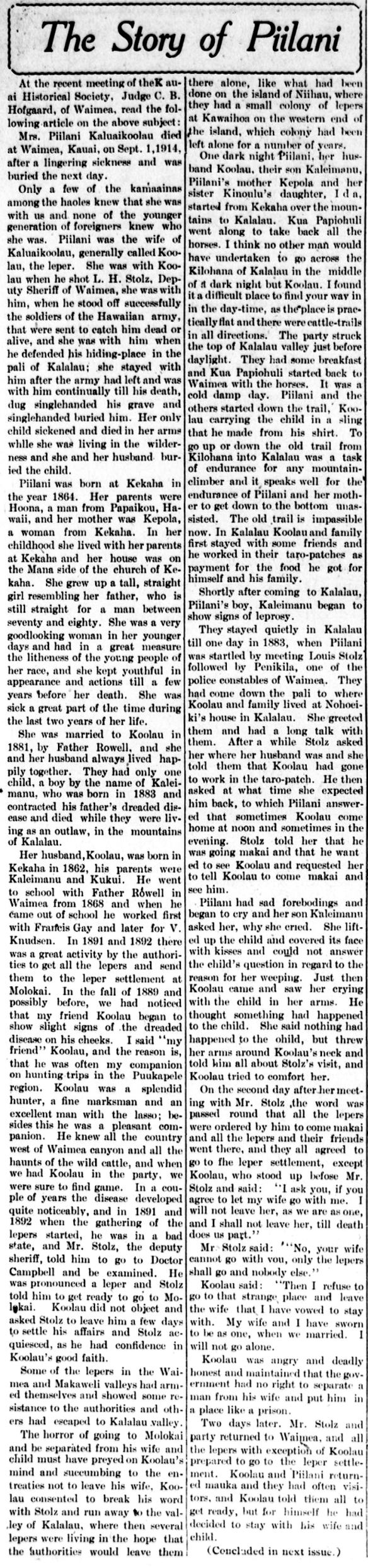
The Story of Piilani

At the recent meeting of the Kauai Historical Society, Judge C. B. Hofgaard, of Waimea, read the following article on the above subject:

Mrs. Piilani Kaluaikoolau died at Waimea, Kauai, on Sept. 1, 1914, after a lingering sickness and was buried the next day.

Only a few of the kamaainas among the haoles knew that she was with us and none of the younger generation of foreigners knew who she was. Piilani was the wife of Kaluaikoolau, generally called Koolau, the leper. She was with Koolau when he shot L. H. Stolz, Deputy Sheriff of Waimea, she was with him, when he stood off successfully the soldiers of the Hawaiian army, that were sent to catch him dead or alive, and she was with him when he defended his hiding-place in the pali of Kalalau; she stayed with him after the army had left and was with him continually till his death, dug singlehanded his grave and singlehanded buried him. Her only child sickened and died in her arms while she was living in the wilderness and she and her husband buried the child.

Piilani was born at Kekaha in the year 1864. Her parents were Hoona, a man from Papaikou, Hawaii, and her mother was Kepola, a woman from Kekaha. In her childhood she lived with her parents at Kekaha and her house was on the Mana side of the church of Kekaha. She grew up a tall, straight girl resembling her father, who is still straight for a man between seventy and eighty. She was a very goodlooking woman i her younger days and had in a great measure the litheness of the young people of her race, and she kept youthful in appearance and actions till a few years before her death. She was sick a great part of the time during the last two years of her life.

She was married to Koolau in 1881, by Father Rowell, and she and her husband always lived happily together. They had only one child, a boy by the name of Kaleimanu, who was born in 1883 and contracted his father’s dreaded disease and died while they were living as an outlaw, in the mountains of Kalalau.

Her husband, Koolau, was born in Kekaha in 1862, his parents were Kaleimanu and Kukui. He went to school with Father Rowell in Waimea from 1868 and when he came out of school he worked first with Francis Gay and later for V. Knudsen. In 1891 and 1893 there was a great activity by the authorities to get all the lepers and send them to the leper settlement at Molokai. In the fall of 1889 and possibly before, we had noticed that my friend Koolau began to show slight signs of the dreaded disease on his cheeks. I said “my friend” Koolau, and the reason is, that he was often my companion on hunting trips in the Puukapele region. Koolau was a splendid hunter, a fine marksman and an excellent man with the lasso; besides this he was a pleasant companion. He knew all the country west of Waimea canyon and all the haunts of the wild cattle, and when we had Koolau in the party, we were sure to find game. In a couple of years the disease developed quite noticeably, and in 1891 and 1892 when the gathering of the lepers started, he was in a bad state, and Mr. Stolz, the deputy sheriff, told him to go to Doctor Campbell and be examined. He was pronounced a leper and Stolz told him to get ready to go to Molokai. Koolau did not object and asked Stolz to leave him a few days to settle his affairs and Stolz acquiesced, as he had confidence in Koolau’s good faith.

Some of the lepers in the Waimea and Makaweli valleys had armed themselves and showed some resistance to the authorities and others had escaped to Kalalau valley.

The horror of going to Molokai and be separated from his wife and child must have preyed on Koolau’s mind and succumbing to the entreaties not to leave his wife, Koolau consented to break his word with Sotlz and run away to the valley of Kalalau, where then several lepers were living in the hope that the authorities would leave them there alone, like what had been done on the island of Niihau, where they had a small colony of lepers at Kawaihoa on the western end of the island, which colony had been left alone for a number of years.

One dark night Piilani, her husband Koolau, their son Kaleimanu, Piilani’s mother Kepola and her sister Kinoulu’s daughter, Ida, started from Kekaha over the mountains to Kalalau. Kua Papiohuli went along to take back all the horses. I think no other man would have undertaken to go across the Kilohana of Kalalau in the middle of a dark night but Koolau. I found it a difficult place to find your way in in the day-time, as the place is practically flat and there were cattle-trails in all directions. The party struck the top of Kalalau valley just before daylight. They had some breakfast and Kua Papiohuli started back to Waimea with horses. It was a cold damp day. Piilani and the others started down the trail, Koolau carrying the child in a sling that he made from his shirt. To go up or down the old trail from Kilohana into Kalalau was a task of endurance for any mountain-climber and it speaks well for the endurance of Piilani and her mother to get down to the bottom unassisted. The old trail is impassible now. In Kalalau Koolau and family first stayed with some friends and he worked in their taro-patches as payment for the food he got for himself and his family.

Shortly after coming to Kalalau, Piilani’s boy, Kaleimanu began to show signs of leprosy.

They stayed quietly in Kalalau till one day in 1883, when Piilani was startled by meeting Louis Sotlz followed by Penikila, one of the police constables of Waimea. They had come down the pali to where Kolau and family lived at Nohoeiki’s house in Kalalau. She greeted them and had a long talk with them. After a while Stolz asked her where her husband was and she told them that Koolau had gone to work in the taro-patch. He then asked at what time she expected him back, to which Piilani answered that sometimes Koolau come home at noon and sometimes in the evening. Stolz told her that he was going makai and that he wanted to see Koolau and requested her to tell Koolau to come makai and see him.

Piilani had sad forebodings and began to cry and her son Kaleimanu asked her, why she cried. She lifted up the child and covered its face with kisses and could not answer the child’s question in regard to the reason for her weeping. Just then Koolau came and saw her crying with the child in her arms. He thought something had happened to the child. She said nothing had happened to the child, but threw her arms around Koolau’s neck and told him all about Stolz’s visit, and Koolau tried to comfort her.

On the second day after her meeting with Mr. Stolz the word was passed round that all the lepers were ordered by him to come makai and all the lepers and their friends went there, and they all agreed to go to the leper settlement, except Koolau, who stoo up before Mr. Stolz and said: “I ask you, if you agree to let my wife go with me. I will not leave her, as we are as one, and I shall not leave her, till death does us part.”

Mr. Stolz said: “No, your wife cannot go with you, only the lepers shall go  and nobody else.”

Koolau said: “Then I refuse to go to that strange place and leave the wife that I have vowed to stay with. My wife and I have sworn to be as one, when we married. I will not go alone.

Koolau was angry and deadly honest and maintained that the government had no right to separate a man from his wife and put him in a place like a prison.

Two days later, Mr. Stolz and party returned to Waimea, and all the lepers with exception of Koolau prepared to go to the leper settlement. Koolau and Piilani returned mauka and they had often visitors, and Koolau told them all to get ready, but for himself he had decided to stay with his wife and child.

(Concluded in next issue.)

(Garden Island, 12/19/1916, p. 6)
GardenIsland_12_19_1916_6.png

The Garden Island, Volume 12, Number 51, Page 6. December 19, 1916.
May Day in Hilo Town, 1942.

Pertaining to Lei Day

Put on by the Hawaiian Civic Club

The main things on the schedule for Lei Day this year were explained by Wilfred K. Hussey, the president of the Hawaiian Civic Club [kalapu Kiwila Hawaii].

The schedule is being planned out by the committee selected for that work, and chaired by Clifford H. Bowman and assisted by Peter Mehau, Charles Murray, Ernest Fernandez, Johnson Kahili and Charles Auld. Continue reading

Uluniu, land of the former home of King Kalakaua, sold, 1915.

A PORTION OF THE HOUSE LOT OF KUHIO WAS SOLD.

That section of the land known as Uluniu which faces Kalakaua Avenue stretching from Ainahau to the area very close to the residence of Representative Kuhio, went to the new owner, Percy M. Pond, through a sale on the morning of this past Friday.

The land is almost six acres, and includes a majority of the house lot in Waikiki previously owned by Prince Kuhio. According to what is being said in public, it went for the price of $32,500. Continue reading

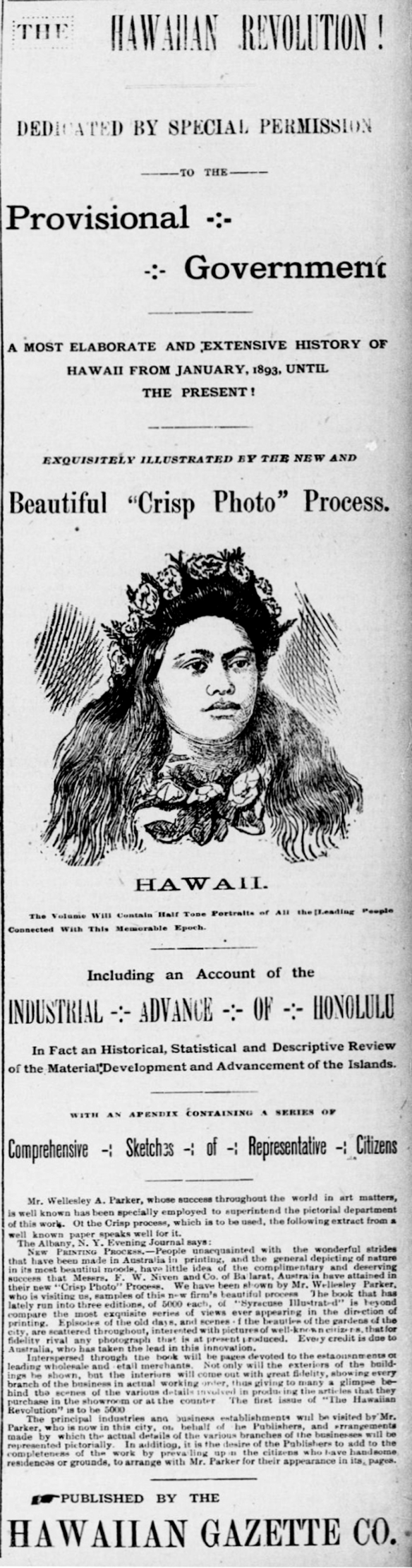
“The Hawaiian Revolution!” 1894.

THE HAWAIIAN REVOLUTION!

DEDICATED BY SPECIAL PERMISSION

TO THE

Provisional Government

A MOST ELABORATE AND EXTENSIVE HISTORY OF
HAWAII FROM JANUARY, 1893, UNTIL
THE PRESENT!

EXQUISITELY ILLUSTRATED BY THE NEW AND

Beautiful “Crisp Photo” Process.

HAWAII.

The Volume Will Contain Half Tone Portraits of All the Leading People Connected With This Memorable Epoch.

Including an Account of the

INDUSTRIAL ÷  ADVANCE ÷ OF ÷ HONOLULU

In Fact an Historical, Statistical and Descriptive Review of the Material Development and Advancement of the Islands.

WITH AN APENDIX CONTAINING A SERIES OF

Comprehensive ÷ Sketches ÷ of ÷ Representative ÷ Citizens

Mr. Wellesley A. Parker, whose success throughout the world in art matters, is well known has been specially employed to superintend the pictorial department of this work. Of the Crisp process, which is to be used, the following extract from a well known paper speaks well for it.

The Albany, N. Y. Evening Journal says:

New Printing Process.—People unacquainted with the wonderful strides that have been made in Australia in printing, and the general depicting of nature in its most beautiful moods, have little idea of the complimentary and deserving success that Messrs. F. W. Niven and Co. of Ballarat, Australia have attained in their new “Crisp Photo” Process. We have been shown by Mr. Wellesley Parker, who is visiting us, samples of this new firm’s beautiful process. The book that has lately run into three editions, of 5000 each, of “Syracuse Illustrated” is beyond compare the most exquisite series of views ever appearing in the direction of printing. Episodes of the old days, and scenes of the beauties of the gardens of the city, are scattered throughout, interented with pictures of well-known citizens, that for fidelity rival any photograph that is at present produced. Every credit is due to Australia, who has taken the lead in this innovation.

Intersperced through the book will be pages devoted to the estaousnments or leading wholesale and retail merchants. Not only will the exteriors of the buildings be shown, but the interiors will come out with great fidelity, showing every branch of the business in actual working order, thus giving to many a glimpse behind the scenes of the various details involved in producing the articles that they purchase in the showroom or at the counter. The first issue of “The Hawaiian Revolution” is to be 5000.

The principal industries and business establishments will be visited by Mr. Parker, who is now in this city, on behalf of the Publishers, and arrangements made by which the actual details of the various branches of the businesses will be represented pictorially. In addition, it is the desire of the Publishers to add to the completeness of the work by prevailing upon citizens who have handsome residences or grounds, to arrange with Mr. Parker for their appearance in its pages.

PUBLISHED BY THE

HAWAIIAN GAZETTE CO.

[Does anyone know if this book ever got published?]

(Pacific Commercial Advertiser, 4/25/1894, p. 3)

PCA_4_25_1894_3.png

The Pacific Commercial Advertiser, Volume XIX, Number 3671, Page 3. April 25, 1894.

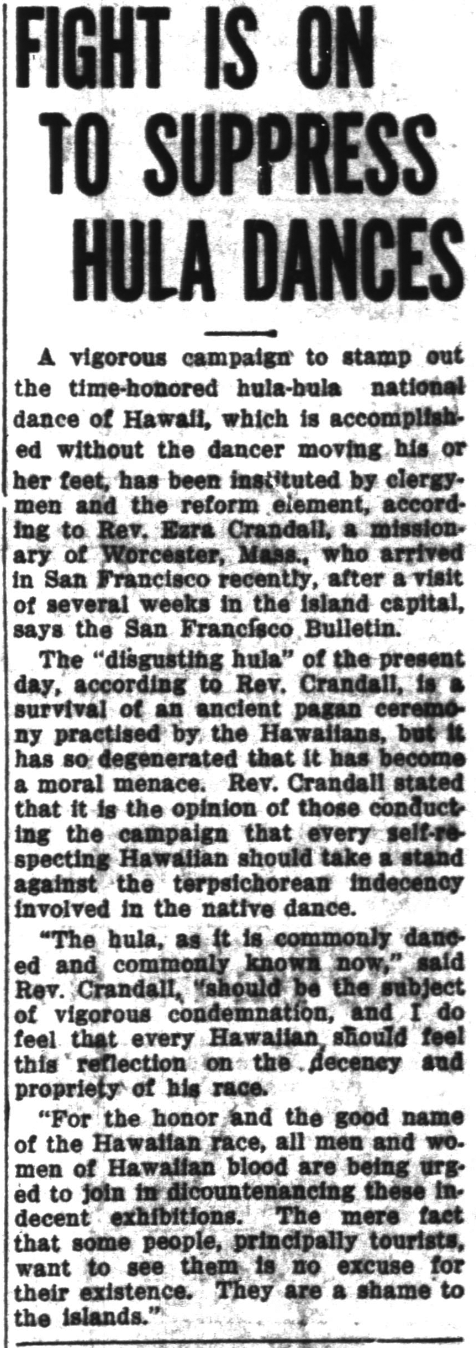
Hula fought against by the church, 1917.

FIGHT IS ON TO SUPPRESS HULA DANCES

A vigorous campaign to stamp out the time-honored hula-hula national dance of Hawaii, which is accomplished without the dancer moving his or her feet, has been instituted by clergymen and the reform element, according to Rev. Ezra Crandall, a missionary of Worcester, Mass., who arrived in San Francisco recently, after a visit of several weeks in the island capital, says the San Francisco Bulletin.

The “disgusting hula” of the present day, according to Rev. Crandall, is a survival of an ancient pagan ceremony practiced by the Hawaiians, but is has so degenerated that it has become a moral menace. Rev. Crandall stated that it is the opinion of those conducting the campaign that every self-respecting Hawaiian should take a stand against the terpsichorean indecency involved in the native dance.

“The hula, as it is commonly danced and commonly know now,” said Rev. Crandall, “should be the subject of vigorous condemnation, and I do feel that every Hawaiian should feel this reflection on the decency and propriety of his race.

“For the honor and the good name of the Hawaiian race, all men and women of Hawaiian blood are being urged to join in discountenancing these indecent exhibitions. The mere fact that some people, principally tourists, want to see them is no excuse for their existence. They are a shame to the islands.”

(Star-Bulletin, 6/15/1917, p. 14)

StarBulletin_6_15_1917_14

Honolulu Star-Bulletin, Volume XXIV, Number 7854, Page 14. June 15, 1917.

Praise for Prince Kuhio and Hawaiian Homesteads by Phillip Luahiwa, 1926.

HE INOA NO KALANIANAOLE

1 He inoa nou e Kalanianaole
He hiwahiwa oe o ka lahui.

2 Eia makou ou mau kini
I ka aina hoopulapula.

3 Ua imi oe i ka pono me [ke] ahonui
I pono au mau kini.

4 E ola mau na kini opio ou e Kalani
Mai na lani kiekie loa mai. Continue reading

Some of the battles of Kalaniopuu, 1866.

[Found under: “Ka Moolelo o Kamehameha I.”]

The battles between Kalaniopuu, the King of Hawaii, with Kahekili, the King of Maui.

The years 1775, 1776, 1777, 1778, and 1778. Kalaniopuu went to war at Kaupo on Maui, with his Alii, his war Officers, and his soldiers. Kalaniopuu first went to war at Kaupo, and he tortured the makaainana of Kaupo by clubbing their foreheads with his war club [newa]. This battle was called Kalaehohoa [“Clubbing-of-the-Forehead”] Continue reading

Birthday of King Kamehameha III, 1846.

By the Government.

AGREEMENT BY THE PRIVY COUNCIL.

At the meeting of the Privy Council [Poe Kukakuka Malu], on the 27th of February 1846, this was agreed to.

The birthday of the King will be commemorated on the coming 17th of March; the flag of the land will be flown at all of the forts from the morning until nightfall; and at noon the fort at Honolulu and all the forts in Hawaii nei will fire their guns. The Hawaiian flag will be flown from all of the ships of this Archipelago, and we believe that it will be good for the Governors and others to throw parties as they see fit, but with propriety and honor, loyal to the King of this independent Nation.

(Elele, 3/3/1846, p. 183)

Elele_3_3_1846_183.png

Ka Elele, Buke I, Pepa 24, Aoao 183. Maraki 3, 1846.

Joseph Kapaeau Aea passes on, 1911.

JOSEPH AEA PASSES AWAY

Joseph Aea, agent of Her Majesty Liliuokalani, died last evening about ten o’clock at his home in Pauoa. He had been associated with the queen’s family for many years. He leaves a widow and two sons. One of them is the protege of Queen Liliuokalani and is also the stenographer and assistant clerk in the city clerk’s office.

Joseph Aea was for many years connected with the old Royal Hawaiian band. He was the solo viol player and was an excellent musician. He became attached to the household of Queen Liliuokalani, and attended Liliuokalani when she was one of the official guests at the jubilee of Queen Victoria in London. He also attended the queen when she visited Washington in 1903. His wife was also one of the queen’s closest personal attendants, and has been particularly attentive to her since the overthrow of the monarchy.

In 1907, upon the death of Hon. J. O. Carter, Liliuokalani appointed Mr. Aea as her business agent, but the Liliuokalani Trust, formed about two years ago, transferred this important office to Col. C. P. Iaukea, who is one of the trustees under the Liliuokalani Trust.

Aea was a delegate to the Democratic territorial convention in 1900, and was nominated for the legislature by the Home Rulers in 1902, and again in 1904, by the Democrats.

(Hawaiian Star, 1/26/1911, p. 7)

HawaiianStar_1_26_1911_7.png

Hawaiian Star, Volume XVIII, Number 5866, Page 7. January 26, 1911.

More on Kalaniopuu’s ahuula and mahiole, 1887.

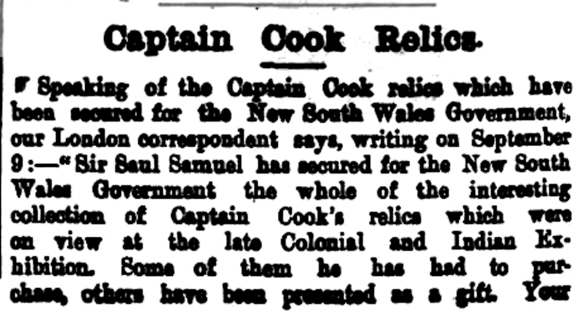
Captain Cook Relics.

Speaking of the Captain Cook relics which have been secured for the New South Wales Government, our London correspondent says, writing on September 9:—”Sir Saul Samuel has secured for the New South Wales Government the whole of the interesting collection of Captain Cook’s relics which were on view at the late Colonial and Indian Exhibition. Some of them he has had to purchase, others have been presented as gift. Your…

(Sydney Mail, 10/22/1887, p. 868)

SydneyMail_10_22_1887_868

The Sydney Mail, Volume XLIV, Number 1424, Page 868. October 22, 1887.

Continue reading