The Seas and the Channels of these Islands
Alenuihaha between Hawaii and Maui, 26 miles.
Alalakeiki between Maui and Kahoolawe, 6 miles.
Kealaikahiki between Lanai and Kahoolawe, 18 miles.
Auau between Maui and Lanai, 9 miles. Continue reading

Alenuihaha between Hawaii and Maui, 26 miles.
Alalakeiki between Maui and Kahoolawe, 6 miles.
Kealaikahiki between Lanai and Kahoolawe, 18 miles.
Auau between Maui and Lanai, 9 miles. Continue reading
INTERESTING CASE BEFORE LAND COURT—A NEGRO FLUTE PLAYER AS A COURT MUSICAN—COOKE HOMESTEAD CLEAR.
Enoch Johnson, as examiner of titles, is the author of an opinion filed in the Torrens Land Court to the effect that one John Smith, a negro flute-player for Kamehameha III was owner of a valuable piece of land on Young street, for which application was made for a Torrens title by C. M. Cooke, Limited. As the negro got the California gold fever and left, disappearing and leaving no heirs, Johnson comes to the conclusion that the property reverts to the Territory. Judge Weaver, however, differs, from this opinion and holds that the petitioner is entitled to a clear title.
The land was granted to the flute-player by Royal Patent 26, on July 17, 1847, by King Kamehameha III. Twenty-five years ago it was used as a pasture land, in the old days when its value was a mere trifle. It is now residence property. When the gold fever broke out in California flute-player Smith gave up both his job as a royal musician and his land near what then was of Honolulu then and left with some other negroes for California. He has never been heard of since and adverse possession has long since run against him or his heirs.
Enoch Johnson, however declares in his report to the court that adverse possession does not run against the government and that the law provides that property left without heirs shall escheat to the government. Here he holds that the Attorney General should be notified and that Smith’s “estate” is escheated to the government.
“I have to disagree with the conclusions of law set forth in the opinion” says Judge Weaver in his decision filed yesterda. “I am of the opinion that the applicant shows a prima facie case of title. The Territory of Hawaii has no title in the lands by reason of the law of escheat, for the reason that no ‘inquest of office’ has been had to take possession of the land. The abstract of title shows that the applicant is entitled to a fee simple title subject to a life interest in C. M. Cooke and his wife, Anna C. Cooke, as set forth in their deed to Charles M. Cooke, Limited.”
(Hawaiian Star, 6/23/1904, p. 8)
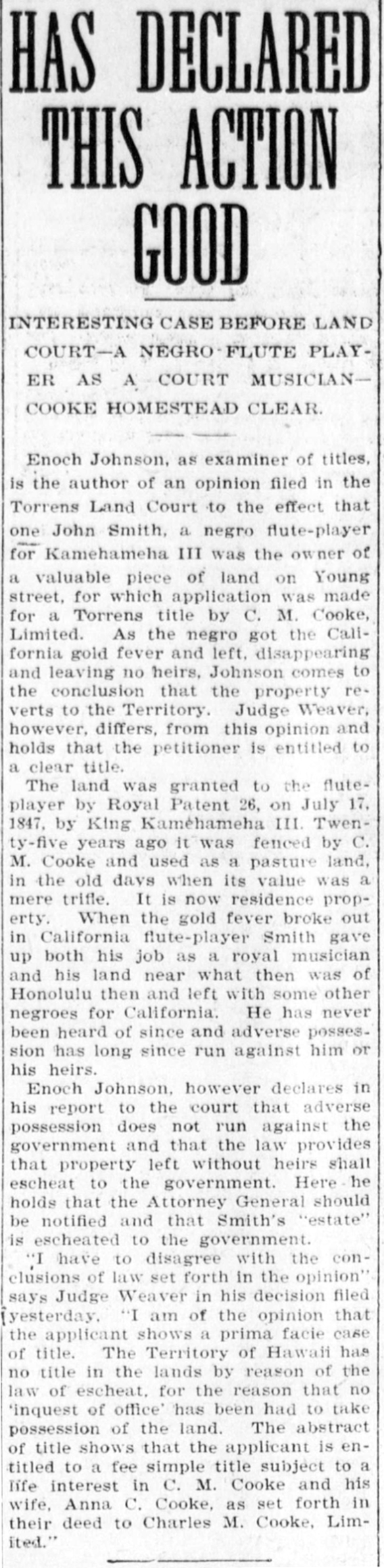
The Hawaiian Star, Volume XII, Number 3824, Page 8. June 23, 1904.
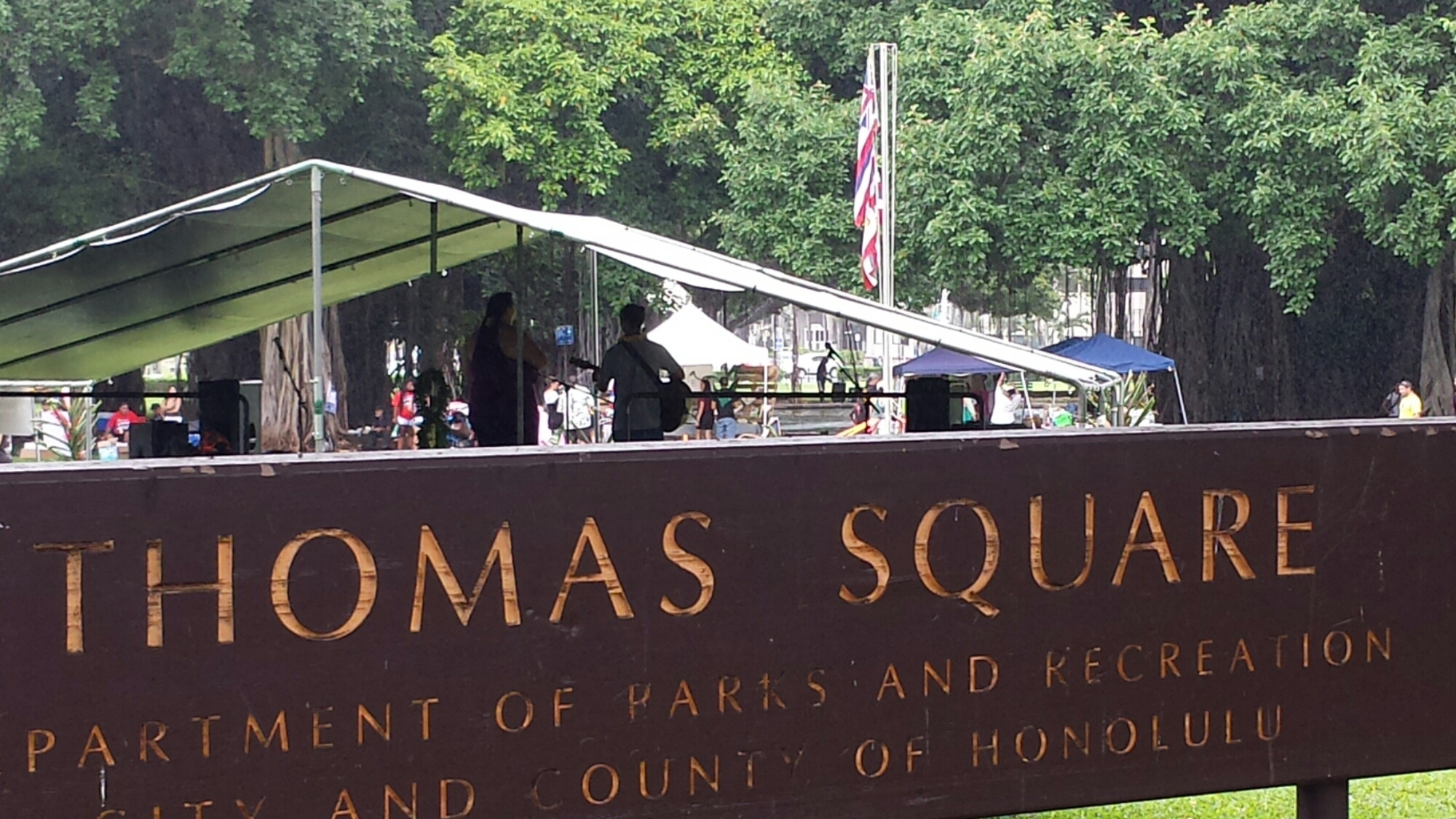
Tamaki Kuea, Iulai 31, 2016.
Go check out the events commemorating La Hoihoi Ea here at Thomas Square and around the pae aina!
The coming Wednesday, July 31, is the day that Admiral Thomas restored the glorious Flag of Hawaii nei, after he stripped these Hawaiian Islands and took them under his power on the 25th of February 1843.
And from the taking of the beautiful Flag of Hawaii until its return was five months and some days, and the glory of Hawaii was regained, for the beautiful, magnificent stripes of the Hawaiian Flag was seen once more.
This day is a sacred day in the hearts of all true Hawaiians, and they commemorate the day that the life returned to the loving communities of Hawaii nei.
And the proclamation proclaimed by the King, Kauikeaouli Kamehameha III was fulfilled, as he commanded all the devout from Hawaii to Kauai to kneel down and give glory to God Almighty for returning the beloved sovereignty to our homeland.
It is true that the supplication of the devout was heard, for the beautiful Flag of Hawaii nei was indeed restored by the Power of God, Jehovah.
Therefore, O Lahui, let us be happy and rejoice, for gaining this glorious day which established the foundation for a new step, that being the Independence of these Islands given by France, Britain, and America.
Now all true faithful ones should take some time on this awesome and sacred day as time to glorify God, Jehovah almighty for his true love for us.
(Oiaio, 8/2/1895, p. 4)
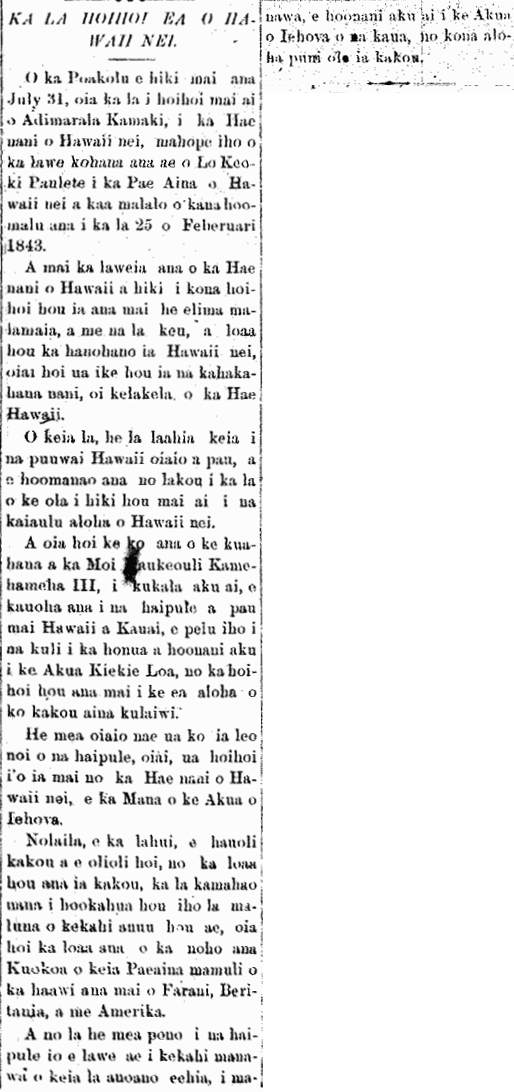
Ka Oiaio, Buke VII, Helu 22, Aoao 4. Augate 2, 1895.
Hoao Papa hanau moku,
I kana kane o Wakea i noho ai,
Hanau o Hoohokukalani,
He Alii,
He kaikamahine na Papa,
Noho ia Manouluae,
Hanau o Waia ke ’lii, o Waia,
O Wailoa, o Kakaihili,
O Kia, o Ole,
O Pupue, o Manaku,
O Nukahakoa, hanau o Luanuu,
O Kahiko, o Kii,
O Ulu, o Nana,
O Waikumailani ke ’lii,
O Kuheleimoana, konohiki wawe na Kaloana,
Hanau o Maui, he hookala-kupua,
He kupua he ’lii o Nana a Maui,
O Lanakaoko, o Kapawa,
O Keliiowaialua,
I hanau i Kukaniloko,
O Wahiawa ka hua,
O Lihue ke ewe,
O Kaala ka piko,
O Kapukapukakea ka aa,
Haule i Nukea,
I Wainakia Aaka i Heleu,
I ka lai malino o Hauola, ke ’lii,
O Kapawa hoi no,
Hoi no iuka ka waihona,
Hoi no i ka pali kapu o na ’lii,
He kiai kalakahi no Kakae,
[This is but one of the many mele submitted to the Hae Hawaii in response to the calls put out by Samuel Chapman Armstrong.]
(Hae Hawaii, 8/8/1860, p. 77)
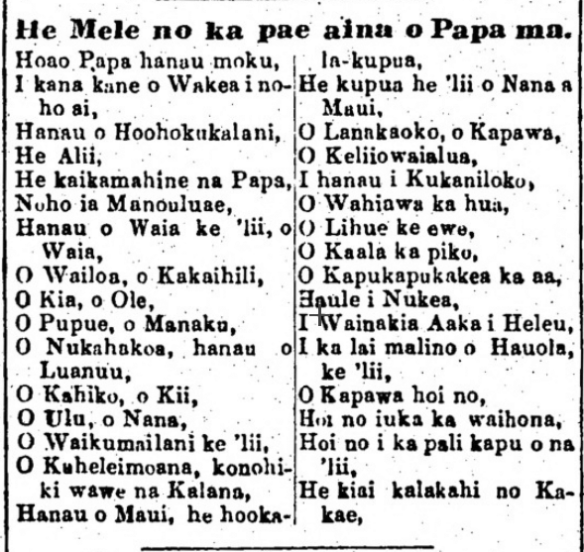
Ka Hae Hawaii, Buke 5, Ano Hou.—Helu 19, Aoao 77. Augate 8, 1860.
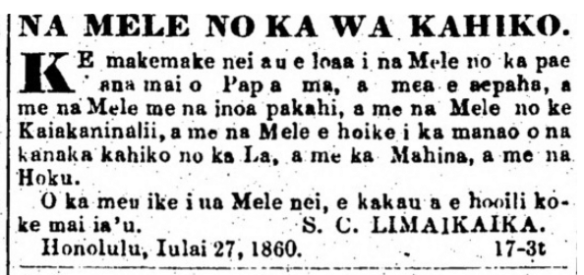
I want to obtain Mele about the arrival of Papa folks, and perhaps others, and Mele with each individual name, and Mele about the Kaiakahinalii [Great Flood], and Mele showing what the ancient people thought about the Sun, the Moon, and the Stars.
For those who know these Mele, write them down and send them to me. S. C. ARMSTRONG.
Honolulu, July 27, 1860.
[There was a broader request earlier that year. See: No na Mele!]
(Hae Hawaii, 7/25/1860, p. 71)
Ka Hae Hawaii, Buke 5, Ano Hou.—Helu 17, Aoao 71. Iulai 25, 1860.
When the steamer Iwalani arrived on the morning of this past Friday, news of the Paupili rain of Lele [Lahaina] was heard, saying that the doors of Wainee Church were shut by the brethren. The story we heard was this below.
One day on the previous week, in the sermon of the kahu of that Church, A. Pali, he spoke about God, and at the very end of his talk, he revealed this:
“I am a true American, inside and out, from top to bottom;” and other inappropriate words; and the congregation began to fidget, and at the close of his prayer, the brethren told him, you are not good, O Pali, and we tell you that you will not pray in this Church from now forward.” Continue reading
While the site was being dug, where the First National Bank [Banako First National] will be built in the future, at King and Bishop streets, there was found human bones and a poi pounder in the earth, but as to how those bones and poi pounder got there, that is something unclear being asked today.
At about seven or eight feet, these things were found by workers digging the dirt in the earth, at the area where the old fire station stood during the time of King Kalakaua. Continue reading
(Continued from last week.)
Several days later they got the news that Mr. Stolz and some policemen all armed with revolvers and guns had arrived to get the lepers and particularly to capture Koolau. When Koolau heard this he said: “It may be their idea, but the man who tries to do that will do so at the peril of his life.”
This word was brought to Stolz, and he sent the word back that Koolau would repent it if he refused to obey the orders of the authorities. Koolau took his gun, kissed it and held it to his breast and talked to the gun as if it was a friend and charged it to stand by him and shoot straight, and from that time Koolau kept guard and shortly afterwards they saw a ten being put up on the beach, and he thought it was to watch him and some of his friends went down to find out for him.
One day Koolau, Piilani and the child went makai on the path by the stream, and there they found Mr. Stolz’s raincoat with some crackers in the pocket, also a blanket, and Koolau told Piilani to take these things along with her. Shortly afterwards they met Penikala, a policeman from Waimea, and Koolau asked him, where Louis Stoltz was, and Penikala said, he did not know, but thought that Louis Stoltz had gone to Hanalei. A little later they met Peter Nowlein, a policeman from Hanalei, and Nowlein told them that Louis Stoltz had gone further up the valley to catch Koolau by surprise. Koolau and family kept going till they reached Kaumeheiwa’s house and found there a lot of their friends. Koolau told them that he was in search of Louis Stoltz and if they were afraid told them to go somewhere else. Penikila was there and Koolau upbraided him for telling a falsehood and told him he ought to be shot, but told him he would forgive him, as he was after Louis Stoltz only. The most of the people went further down towards the beach. Continue reading

