Konohi! 1868.

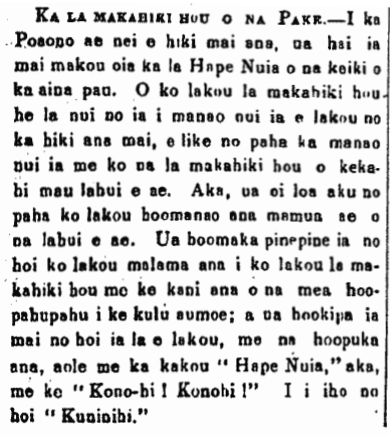
New Year’s Day of the Chinese.—This coming Saturday [1/25/1868], we were told, is the Happy New Year Day of the people of China [ka aina pua]. Their new year day is a day that is considered a very important day to arrive, perhaps just as how the new year day of other people are thought greatly of. But their celebration is probably much bigger than that of the other ethnicities. Their celebration of their new year often begins by setting off fire crackers at midnight, and you are welcomed by them with them saying not our “Hape Nuia,” but with “Kono-hi! Konohi!” And then you say “Kuninihi.” [?? I iho no hoi “Kuninihi.”]

(Au Okoa, 1/23/1868, p. 2)

AuOkoa_1_23_1868_2

Ke Au Okoa, Buke III, Helu 40, Aoao 2. Ianuari 23, 1868.

Did Lunalilo have a thing for acrostic poems? 1862.

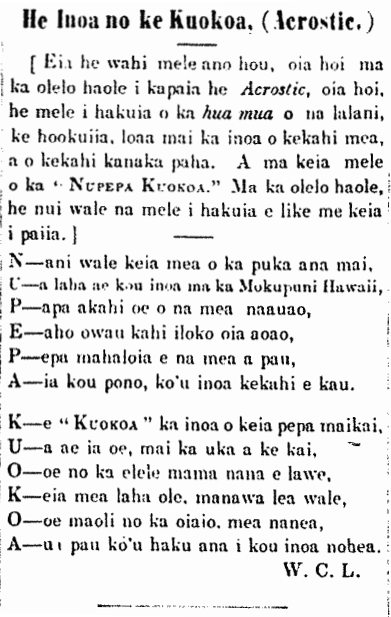
He Inoa no ke Kuokoa, (Acrostic.)

[Eia he wahi mele ano hou, oia hoi ma ka olelo haole i kapaia he Acrostic, oia hoi, he mele i hakuia o ka hua mua o na lalani, ke hookuiia, loaa mai ka inoa o kekahi mea, a o kekahi kanaka paha. A ma keia mele o ka “Nupepa Kuokoa.” Ma ka olelo haole, he nui wale na mele i hakuia e like me keia i paiia.]

N—ani wale keia mea o ka puka ana mai,
U—a laha ae kou inoa ma ka Mokupuni Hawaii,
P—apa akahi oe o na mea naauao,
E—aho owau kahi iloko oia aoao,
P—epa mahaloia e na mea a pau,
A—ia kou pono, ko’u inoa kekahi e kau.

K—e “Kuokoa” ka inoa o keia pepa maikai,
U—a ae ia oe, mai ka uka a ke kai,
O—oe no ka elele mama nana e lawe,
K—eia mea laha ole, manawa lea wale,
O—oe maoli no ka oiaio, mea nanea,
A—ua pau ko’u haku ana i kou inoa nohea.

W. C. L.

[A Name Song for the Kuokoa, (Acrostic.)

This is a new type of mele, that being what is called in English an Acrostic; that is a mele that is composed where the first letter of the lines put together make up the name of a thing or a person perhaps. And in this mele it is the “Kuokoa Newspaper.” In English, there are a lot of poems that are composed like this one that is printed.

How great is this publication,
Your name is spread across the Islands of Hawaii,
You are the first class of educational material,
It is a good thing for me to be amongst that group,
A paper that is appreciated by all,
For your well-being, I will subscribe.

The “Kuokoa” is the name of this fine paper,
You are accepted, from uplands to the sea,
You are the swift messenger who carries,
This rare thing, a thing of benevolence,
You are indeed the truth, a thing of fascination,
And I am done composing your lovely name song.]

(Kuokoa, 8/16/1862, p. 3)
Kuokoa_8_16_1862_3.png

Ka Nupepa Kuokoa, Buke I, Helu 38, Aoao 3. Augate 16, 1862.
The Prayer of the Lahui, 1893.

KA PULE A KA LAHUI HAWAII.

E—Iehova Sabaota
O—na kaua,—ke Kahikolu
L—aahia Hemolele,
A—lana ia no ko ke ao nei.
O—ka makou pule e maliu mai—
K—a puuhonua o makou nei,
A—lakai, hoopakele, nana mai,
L—awe aku i na popilikia
A—hoolilo i mea ole.
N—inini mai i Kou Hemolele,
I—ola ai makou ma Ou ‘la.
L—alau mai Kou aloha
I—hilinai manawalea,
L—aahia makamae
I—ko makou Lei Ali’aimoku.
U—hi Iaia me Kou mana,
O—ka palekana a lanakila;
N—a Kou nani e hoomohala,
A—mao ae na pilihua.
M—a Ou la—e ka Haku,
O—ko ke ao nei a pau,
K—a makou e pule nei,
U—hane Hemolele Kahikolu.

[E Ola o Kalani Liliuonamoku]

—–

E—Iehova Sabaota, Continue reading

Ship passenger list, 1893.

Passengers.

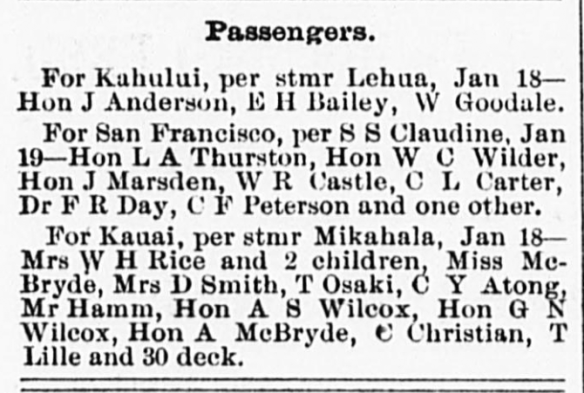
For Kahului, per stmr Lehua, Jan 18—Hon J Anderson, E H Bailey,W Goodale.

For San Francisco, per S S Claudine, Jan 19—Hon L A Thurston, Hon W C Wilder, Hon J Marsden, W R Castle, C L Carter, Dr F R Day, C F Peterson and one other.

For Kauai, per stmr Mikahala, Jan 18—Mrs W H Rice and 2 children, Miss McBryde, Mrs D Smith, T Osaki, C Y Atong, Mr Hamm, Hon A S Wilcox, Hon G N Wilcox, Hon A McBryde, C Christian, T Lille and 30 deck.

(Daily Bulletin, 1/19/1893, p. 3)

DailyBulletin_1_19_1893_3

The Daily Bulletin, Volume  V, Number 628, Page 3. January 19, 1893.

The Claudine leaves for San Francisco, 1893.

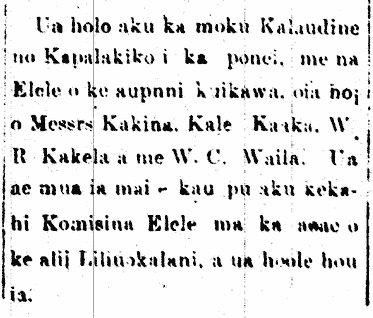
The ship Claudine [Kalaudine] left for San Francisco last night, with the Representatives of the provisional government, they being Messrs Thurston [Kakina], Charles Clark [Kale Kaaka], W. R. Castle [W. R. Kakela], and W. C. Wilder [W. C. Waila]. The Representing Commissioner for the side of the alii Liliuokalani was previously given permission to go along, but  he was denied once again.

(Leo o ka Lahui, 1/19/1893, p. 2)

LOKL_1_19_1893_2

Ka Leo o ka Lahui, Buke II, Helu 625, Aoao 2. Ianuari 19, 1893.

More on the landing of the Boston, 1893.

Of What Are They Afraid?

Editor Bulletin:—

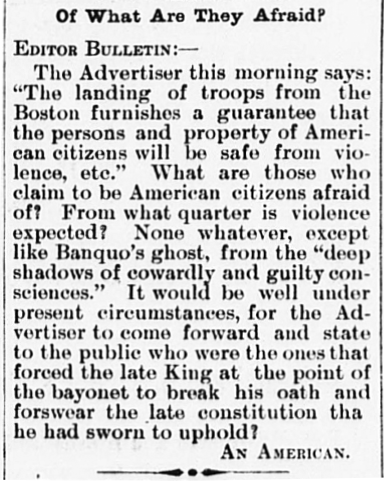
The Advertiser this morning says: “The landing of the troops from the Boston furnishes a guarantee that the persons and property of American citizens will be safe from violence, etc.” What are those who claim to be American citizens afraid of? From what quarter is violence expected? None whatever, except like Banquo’s ghost,¹ from the “deep shadows of cowardly and guilty consciences.” It would be well under present circumstances, for the Advertiser to come forward and state to the public who were the ones that forced the late King at the point of the bayonet to break his oath and forswear the late constitution that he had sworn to uphold?

An American.

¹Reference to Shakespeare’s Macbeth.

(Daily Bulletin, 1/17/1893, p. 3)

DailyBulletin_1_17_1893_3

The Daily Bulletin, Volume V, Number 626, Page 3. January 17, 1893.


For all of you hula people, 1865.

[Found under: “Na mea hou o Maui Hikina.”]

The Ku-i.

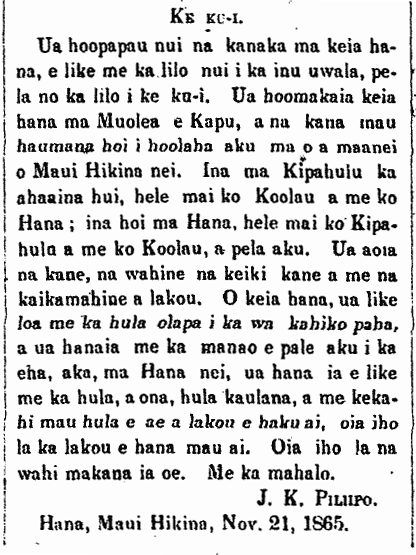
All the people are doing it, just as they are totally caught up in drinking [fermented] sweet potato, so too are they engrossed in the ku-i. This activity began at Muolea by Kapu, and it was his students who spread it all over here in East Maui. If there is a party in Kipahulu, the people from Koolau and from Hana come; if it is in Hana, people from Kipahulu and from Koolau come, and so forth. Their husbands, wives, sons and daughters are taught. This is perhaps very similar to the hula olapa in the olden days, and they are done believing it will ward off pain, but here in Hana, it is done like hula, the famous hula as well as some hula that they composed themselves, and that is what they are constantly doing. Those are my gifts to you. [That being the reporting of this story as well as the other stories that preceded it.] With thanks.

J. K. Pilipo.

Hana, East Maui, Nov. 21, 1865.

(Kuokoa, 12/9/1865, p. 3)

Kuokoa_12_9_1865_3

Ka Nupepa Kuokoa, Buke IV, Helu 49, Aoao 3. Dekemaba 9, 1865.

Death of K. Alapai of Honolii, 1915.

K. ALAPAI OF HONOLII HAS PASSED ON

This past week, death came and took away this old Kamaaina of Hilo, and his nature is well known to all the old timers of Hilo nei. He died at almost 95 years old. He was born at Pahoehoe near Paukaa, and moved and lived on the banks of the far side of Honolii; when there was no bridges on this stream, and when they first opened up the road, he took up the occupation of escorting people by Honolii Stream and escorting passengers by canoe, and after there were goats to transport people he at times helped pulling the passenger goats. When the many bridges of Honolii were built, he carried on his farming on the banks of that stream, and in his strong days, he sometimes worked in the sugar plantations while still living in the same place, and he was known by those who were familiar with him by the name “Alapai of Honolii” [Alapai o Honolii]. Continue reading