Mataio Kekuanaoa, William French, the Chinese, and sugar, 1838.

PERTAINING TO THE SUGAR MILL.

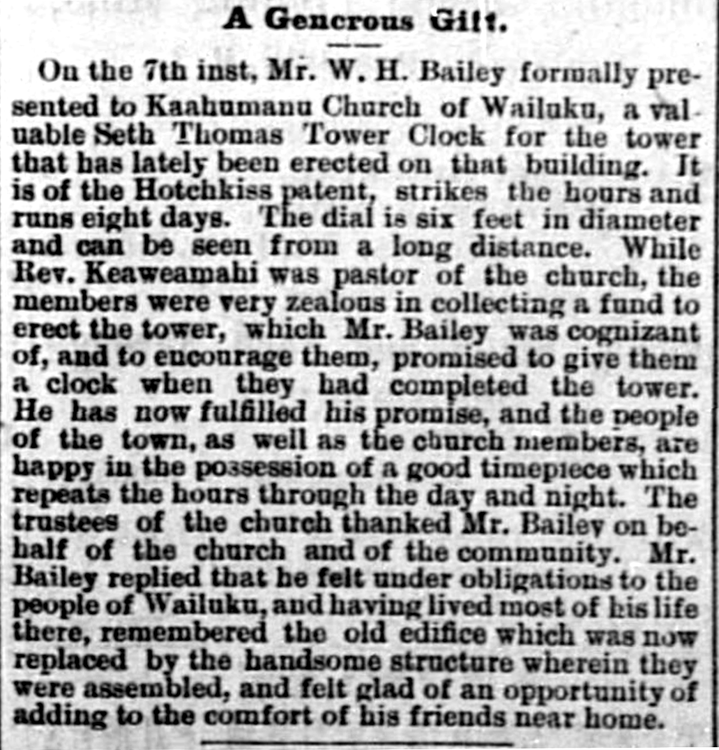
Mataio Kekuanaoa rethatched the sugar mill building at Peleula, and it is complete. So too of the storehouse and the living quarters of the Chinese. This is how sugarcane is dealt with at this facility.

Mataio deals with the buildings, raw cane, firewood, and the horses used to pull loads; Mr. French [Mr. Farani] deals with the Chinese who clean the cane and process the cane and fill the bags; and then it is divided by weight, two thirds for Kekuanaoa and one third for Mr. French. Also, there are some of Kekuanaoa’s Hawaiian men who work with the Chinese, and as for the bags [? ekeeke laulau] for the sugar, that is to be provided by the person to whom the sugar belongs.

Listen, all you farmers, chiefs, and makaainana of Honolulu nei! Should you possess raw cane, bring it to be milled, and you will receive half of the sugar [ko maloo] produced from the raw cane that you bring. Two…

(Kumu Hawaii, 12/19/1838, p. 59)

NO KA WILI KO

Ke Kumu Hawaii, Buke 4, Pepa 15, Aoao 59. Dekemaba 19, 1938.

…sixths of the sugar will go to Mr. French [Mi. Farani] for the labor, and one sixth will go to Kekuanaoa for the building and facilities, and three sixths will go to you to whom belonged the raw cane.

It is good to plant sugarcane in Honolulu now, because it is clear who has the mill and will work it. Do plant, people with land and people with oo, so that no more will you be without the basics of life, and your meager way of life will be over.

(Kumu Hawaii, 12/19/1838, p. 60)

...hapaono o ke ko...

Ke Kumu Hawaii, Buke 4, Pepa 15, Aoao 60. Dekemaba 19, 1938.


Chinese population, 1901.

NUMBER OF CHINESE IN HAWAII NEI.

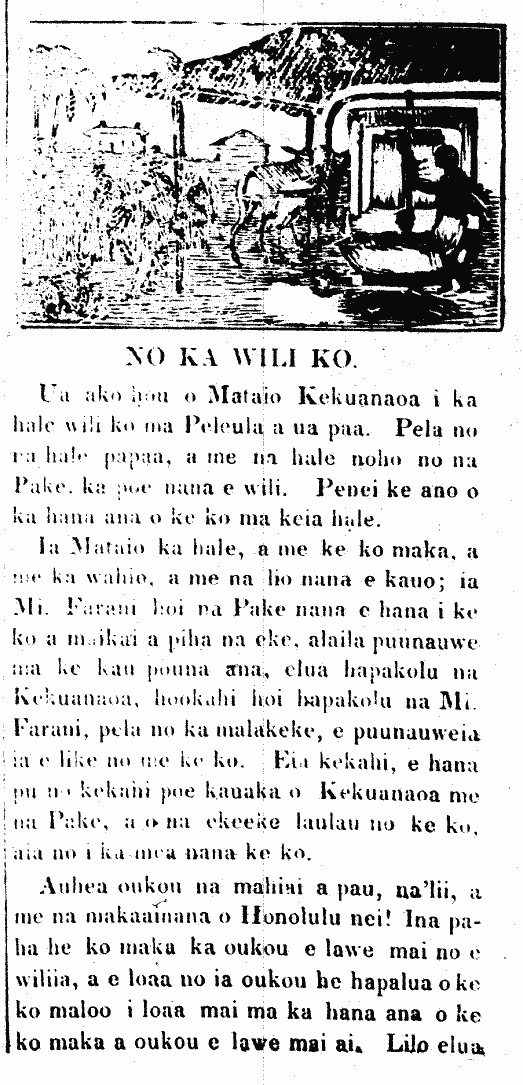
Washington, Oct. 8. There was a report received by Commissioner Yerkes pertaining to the number of Chinese who registered their names as residing in the Hawaiian Islands, which was done last June. The total of Chinese who registered were 28,925, and this was an increase of 6000 in the Chinese population from the last census. The number of Chinese on Oahu is 17,482, and 3,907 of them are living in the town of Honolulu, and being that there were many who travelled there to register their names, it is not possible to ascertain the correct number of Chinese residing in that town. For the other islands, these are the number of Chinese known:

Hawaii, 4,644; Kauai, 3,418; Maui, 3,348, and Molokai, 33.

(Aloha Aina, 10/26/1901, p. 6)

HELUNA PAKE MA HAWAII NEI.

Ke Aloha Aina, Buke VII, Helu 48, Aoao 6. Okatoba 26, 1901.

Theresa Owana Wilcox Belliveau and the Estate of Pauahi and Liliuokalani, 1918.

FIGHTING OVER THE ESTATE OF PAUAHI

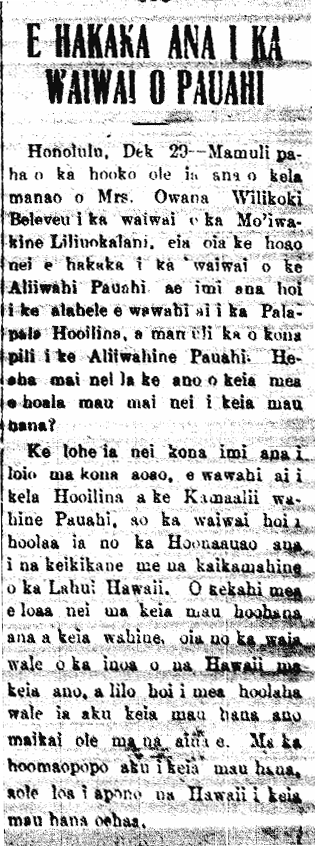
Honolulu, Dec. 29—Perhaps it is because the desires of Mrs. Owana Wilcox Beleveu [Belliveau] were not appeased over the estate of Queen Liliuokalani that here she is fighting over the estate of the Aliiwahine Pauahi and she is trying to find a way to break the Will, as if she is related to Chiefess Pauahi. What does she expect by starting all of this?

It is heard that she is looking for an attorney on her side to break the Will of Princess Pauahi, and the money to be dedicated to Educate the boys and girls of the Hawaiian Lahui. Something that will result through this action by this woman is the dishonor to the name of Hawaiians, and this improper action will be something reported in other lands. When they find out about  this, Hawaiians will definitely not approve of this deceitful act.

(Aloha Aina, 1/3/1918, p. 2)

E HAKAKA ANA I KA WAIWAI O PAUAHI

Ka Hoku o Hawaii, Buke 12, Helu 32, Aoao 2. Ianuari 3, 1918.

James Kekela reports from Tahiti, 1890.

NEWS FROM THE ISLANDS IN THE SOUTH.

The letter below is by Rev. James Kekela to Dr. C. M. Hyde, and we were given permission to publish it.

Papeete, August 6, 1890.

Rev. C. M. Hyde,

Much aloha to you and your wife, and your children. It has been a long time that we have not associated through letters. All of us Hawaiian Missionaries are in good health here in the Archipelago of Nuuhiwa, except for the wife of S. Kauwealoha, she is somewhat weak and frail; she was like this for the past four months, but she has gotten a little better now; I saw them in Uapou during the first week of this past July.

I am here these days in Papeete to fetch her (my youngest daughter) to bring her back to be a teacher at the French language school in Hivaoa for the Nuuhiwa girls. This daughter of ours has been living in Tahiti for 4 years and she is prepared to teach the French language. She was approved by the teachers and the French government officials here in Tahiti. In the last days of June, I left Puamau and travelled to Nuuhiwa and reached there, where the boat [? kusie] had left for Tahiti, and I went for a bit to Uapou to meet with S. Kauwealoha them for a whole week and returned to Taiohae in Nuuhiwa to wait for the ship from California.

July 29, I left Taiohae and left for Tahiti, on the 2nd of August I reached Papeete after a four days’ trip, and I am living here these days, waiting for a boat to go to Nuuhiwa. I met with the French Protestant [Pelosetane] missionary teachers in Papeete, Mr. Verenie and his wife, the pastor for the kamaaina, and they have a fine church, and they had me give a sermon on the Sabbath. They were very happy to hear about the works of God in the Archipelago of Nuuhiwa and Hawaii and the land of Micronesia [Maikonisia]. As for here in the archipelago of Tahiti, this was the first islands to hear the gospel of Jesus. Continue reading

Mele by Liliuonamoku Club, 1877.

Alo Ehukai.

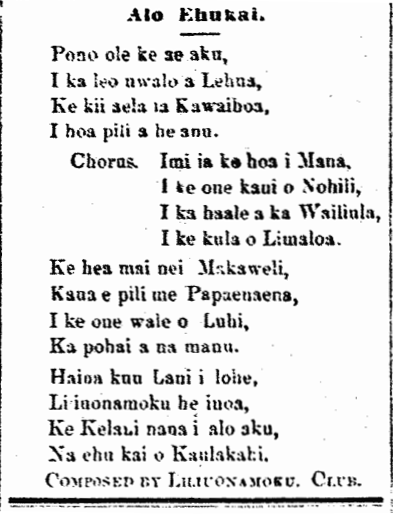
Pono ole ke ae aku,
I ka leo uwalo a Lehua,
Ke kii aela ia Kawaihoa,
I hoa pili a he anu.

Chorus. Imi ia ke hoa i Mana,
I ke one kani o Nohili,
I ka haale a ka Wailiula,
I ke kula o Limaloa.

Ke hea mai nei Makaweli,
Kaua e pili me Papaenaena,
I ke one wale o Luhi,
Ka pohai a na manu.

Haina kuu Lani i lohe,
Liliuonamoku he inoa,
Ke Kalani nana i alo aku,
Na ehu kai o Kaulakahi.

Composed by Liliuonamoku Club.

(Kuokoa, 11/24/1877, p. 4)

Alo Ehukai.

Ka Nupepa Kuokoa, Buke, XVI, Helu 47, Aoao 4. Novemaba 24, 1877.

Mele composed by Pauhagagi, 1877.

Wiliokai Song.

Nani wale kuu ike ana,
I ka wai kihene a ka menehune,
Inu iho wau a kena,
A hoolai me na manu.

Chorus. Ha, Ha, Far away
Take round lively iho oe.

O ka wai iho ia e kena ai,
E lai ai ka nanea ana,
Noho wau a huli ae,
Honi ana i ke ala o ka Mokihana.

Kaupaona ia iho a like,
A ili wai like ke aloha,
Hookahi oi a’u i ike,
Ka wa-wai ula Iliahi.

Nee mai kaua a pili,
Oiai ke aloha me a’u,
E aho paha wau e hoi,
Ke wehe ae nei kai ao.

Composed by Pauhagagi.

(Kuokoa, 11/24/1877, p. 4)

Wiliokai Song.

Ka Nupepa Kuokoa, Buke XVI, Helu 47, Aoao 4. Novemaba 24, 1877.

Mele by Liliuonamoku Club, 1877.

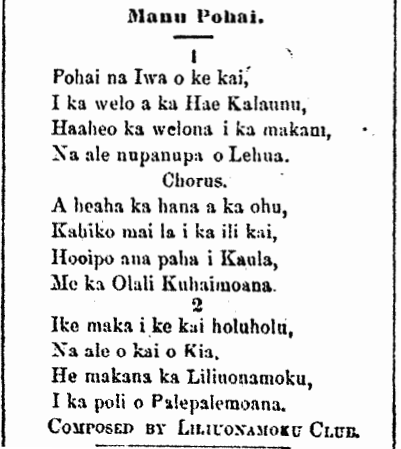
Manu Pohai.

1

Pohai na Iwa o ke kai,
I ka welo a ka Hae Kalaunu,
Haaheo ka welona i ka makani,
Na ale nupanupa o Lehua.

Chorus.

A heaha ka hana a ka ohu,
Kahiko mai la i ka ili kai,
Hooipo ana paha i Kaula,
Me ka Olali Kuhaimoana.

2

Ike maka i ke kai holuholu,
Na ale o kai o Kia,
He makana ka Liliuonamoku,
I ka poli o Palepalemoana.

Composed by Liliuonamoku Club.

(Kuokoa, 11/24/1877, p. 4)

Manu Pohai.

Ka Nupepa Kuokoa, Buke XVI, Helu 47, Aoao 4. Novemaba 24, 1877.

A name song for the new Princess Kaiulani, 1877.

A Name Song For the New Royal Scion.

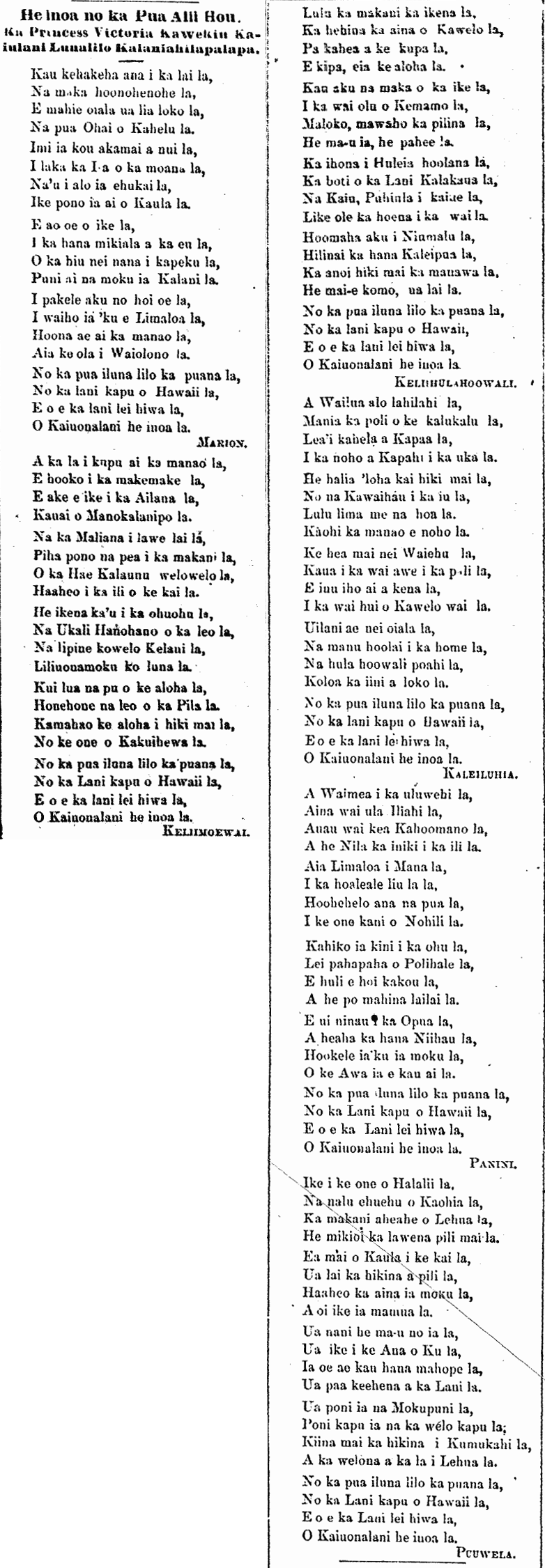
Princess Victoria Kawekiui Kaiulani Lunalilo Kalaniahilapalapa.

Kau kehakeha ana i ka lai la,
Na maka hoonohenohe la,
E mahie oiala ua lia loko la,
Na pua Ohai o Kahelu la.

Imi ia kou akamai a nui la,
I laka ka I-a o ka moana la,
Na’u i alo ia ehukai la,
Ike pono ia ai o Kaula la.

E ao oe o ike la,
I ka hana mikiala a ka eu la,
O ka hiu nei nana i kapeku la,
Puni ai na moku ia Kalani la.

I pakele aku no hoi oe la,
I waiho ia ‘ku e Limaloa la,
Hoona ae ai ka manao la,
Aia ke ola i Waiolono la.

No ka pua iluna lilo ka puana la,
No ka lani kapu o Hawaii la,
E o e ka lani lei hiwa la,
O Kaiulani he inoa la.

Marion.

A ka la i kupu ai ka manao la,
E hooko i ka makemake la,
E ake e ike i ka Ailana la,
Kauai o Manokalanipo la.

Na ka Maliana i lawe lai la,
Piha pono na pea i ka makani la,
O ka Hae Kalaunu welowelo la,
Haaheo i ka ili o ke kai la.

He ikena ka’u i ka ohuohu la,
Na Ukali Hanohano o ka leo la,
Na lipine kowelo Kelani la,
Liliuonamoku ko luna la.

Kui lua na pu o ke aloha la,
Honehone na leo o ka Pila la,
Kamahao ke aloha i hiki mai la,
No ke one o Kakuihewa la.

No ka pua iluna lilo ka puana la,
No ka Lani kapu o Hawaii la,
E o e ka lani lei hiwa la,
O Kaiuonalani he inoa la.

Keliimoewai.

Lulu ka makani ka ikena la,
Ka hehina ka aina o Kawelo la,
Pa kahea a ke kupa la,
E kipa, eia ke aloha la.

Kau aku na maka o ka ike la,
I ka wai olu o Kemamo la,
Maloko, mawaho ka pilina la,
He ma-u ia, he pahee la.

Ka ihona i Huleia hoolana la,
Ka boti o ka Lani Kalakaua la,
Na Kaiu, Puhiula i kaiue la,
Like ole ka hoena i ka wai la.

Hoomaka aku i Niumalu la,
Hilinai ka hana kaleipua la,
Ka anoi hiki mai ka manawa la,
He mai-e komo, ua lai la.

No ka pua iluna lilo ka puana la,
No ka lani kapu o Hawaii,
E o e ka lani lei hiwa la,
O Kaiuonalani he inoa la.

Keliihulahoowali.

A Wailua alo lahilahi la,
Mania ka poli o ke kalukalu la,
Lea’i kahela a Kapaa la,
I ka noho a Kapahi i ka uka la.

He halia ‘loha kai hiki mai la,
No na Kawaihau i ka iu la,
Lulu lima me na hoa la,
Kaohi ka manao e noho la.

Ke hea mai nei Waiehu la,
Kaua i ka wai awe i ka pali la,
E inu iho ai a kena la,
I ka wai hui o Kawelo wai la.

Uilani ae nei oiala la,
Na manu hoolai i ka home la,
Na hula hoowali poahi la,
Koloa ka iini a loko la.

No ka pua iluna lilo ka puana la,
No ka lani kapu o Hawaii la,
E o e ka lani leihiwa la,
O Kaiuonalani he inoa la.

Kaleiluhia.

A Waimea i ka uluwehi la,
Aina wai ula Iliahi la,
Auau wai kea Kahoomano la,
A he Nila ka iniki i ka ili la.

Aia Limaloa i Mana la,
I ka hoaleale liu la la,
Hoohehelo ana na pua la,
I ke one kani o Nohili la.

Kahiko ia kini i ka ohu la,
Lei pahapaha o Polihale la,
E huli e hoi kakou la,
A he po mahina lailai la.

E ui ninau i ka Opua la,
A heaha ka hana Niihau la,
Hookele ia’ku ia moku la,
O ke Awa ia e kau ai la.

No ka pua luna lilo ka puana la,
No ka Lani kapu o Hawaii la,
E o e ka Lani lei hiwa la,
O Kaiuonalani he inoa la.

Panini.

Ike i ke one o Halalii la,
Na nalu ehuehu o Kaohia la,
Ka makani aheahe o Lehua la,
He mikioi ka lawena pili mai la.

Ea mai o Kaula i ke kai la,
Ua lai ka hikina a pili la,
Haaheo ka aina ia moku la,
A oi ike ia mamua la.

Ua nani he ma-u no ia la,
Ua ike i ke Ana o Ku la,
Ia oe ae kau hana mahope la,
Ua paa keehena a ka Lani la.

Ua poni ia na Mokupuni la,
Poni kapu ia na ka welo kapu la,
Kiina mai ka hikina i Kumukahi la,
A ka welona a ka la i Lehua la.

No ka pua iluna lilo ka puana la,
No ka Lani kapu o Hawaii la,
E o e ka Lani lei hiwa la,
O Kaiuonalani he inoa la.

Puuwela.

[This mele inoa for Princess Kaiulani is also found under the title “He Inoa no Kaiulani” with the oki by the different composers found scattered in Ed. C. Holstein’s Ka Buke Mele o na Himeni Hawaii. There are variations between the two versions.]

(Kuokoa, 11/24/1877, p. 4)

He inoa no ka Pua Alii Hou.

Ka Nupepa Kuokoa, Buke XVI, Helu 47, Aoao 4. Novemaba 24, 1877.
Mrs. A. B. Palea reports on news from Kauai, 1939.

Various news from Kauai

Kekaha, Kauai

Dec. 18.

With Appreciation to the Editor of the Newspaper Ka Hoku o Hawaii.

Much aloha between us.

Please allow me some room on the deck of our beloved esteemed one. And it will be for you to carry the bits of news of the Flower garden famed for the Cherished Scent of Mokihana.

Kauaiomanookalanipo.

Kekaha, Kauai: The birthday of one of our granddaughters, Hildren Kawehionapuanani Palea, was celebrated at the home of our children, Mr. and Mrs. W. Palea, Jr.

The ohana who came were:

Mrs. A. B. Palea

Mr. & Mrs. Wailiula, Mrs. Dora Fellez, Miss Emily Niau, Mr. and Mrs. F. Furtado, W. Lalana Furtado, F. Kamakanaokalani Furtado, G. Keolamauloa Furtado, Oleiponimoi Furtado, D. Kealohaokalani Furtado, Mr. and Mrs. P. Palea, Miss Kananiokaohu Palea, and me, the one who is writing this reflection.

It was for our grandchild who is two years old, and we give our thanks to our Almighty Father for blessing his young servant, her parents, and entire family. With appreciation.

——— Continue reading

Judge Arthur A. Wilder takes own life, 1917.

TAKES HIS OWN LIFE

Former Judge Arthur A. Wilder of the supreme court took his own life with a bullet from a pistol. The bullet entered beneath his right eye and exited behind the side of his head and he died instantly. He carried this out at the home of his cousin, James A. Wilder, in the evening of this past Thursday at Kalia, Honolulu.

He was one of the knowledgeable attorneys of this town, and a fair judge while he was sitting on the bench.

This happened as a result of bad feelings as a result of Mr. Watson leaving his seat on the supreme court in place of Mr. Wilder [Mr. Wilda].

(Puuhonua, 1/5/1917, p. 4)

LAWE I KONA OLA PONOI

Ka Puuhonua o na Hawaii, Buke IV, Helu 1, Aoao 4. Ianuari 5, 1917.