Party thrown by Arthur A. Wilder, 1916.

JUDGE WILDER THROWS A PARTY

Amongst the news spoken of in Honolulu nei, is the party given by Judge Wilder at the Hotel New Willard; it was a party adorned with a great amount of food along with the beauty of the decorations.

In the very short time it was organized, there were many malihini who showed up at the party, and speeches were given by members of Congress who were invited.

In a majority of the speeches given, appreciation was mentioned for the kindness of Hawaii’s people for welcoming the group of Congressmen the previous summer. Continue reading

Alatau Wilder, Boy Scout, 1916.

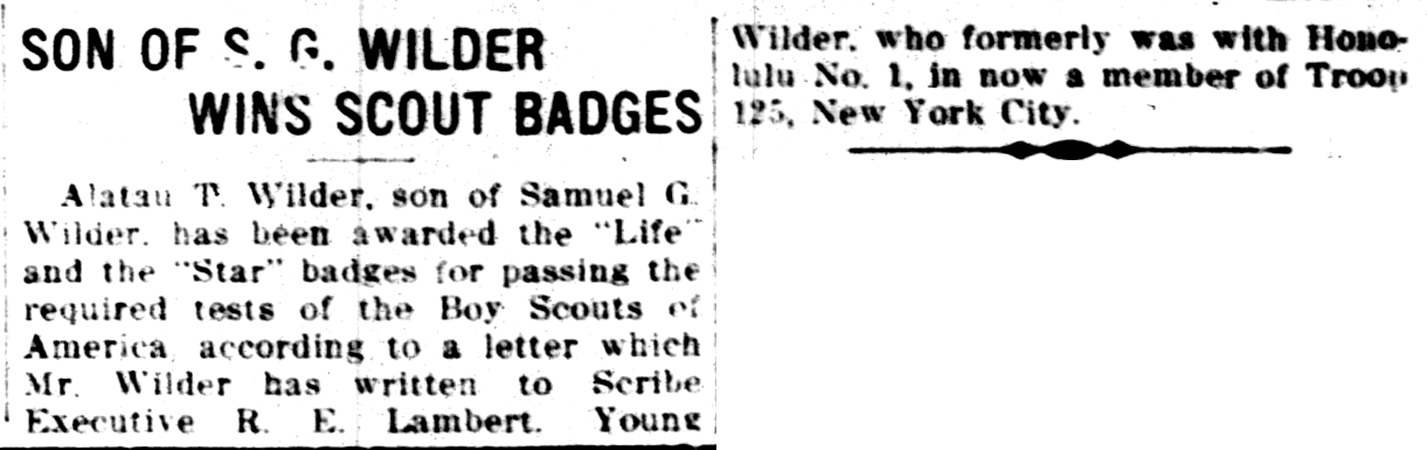
SON OF S. G. WILDER WINS SCOUT BADGES

Alatau T. Wilder, son of Samuel G. Wilder, has been awarded the “Life” and the “Star” badges for passing the required tests of the Boy Scouts of America according to a letter which Mr. Wilder has written to Scribe Executive R. E. Lambert Young. Wilder, who formerly  was with Honolulu No. 1, is now a member of Troop 125, New York City.

(Honolulu Star-Bulletin, 5/16/1916, p. 8)

SON OF S. G. WILDER WINS SCOUT BADGES

Honolulu Star-Bulletin, Volume XXIII, Number 7517, Page 8. May 16, 1916.

Kamehameha Glee Club on stage, 1912.

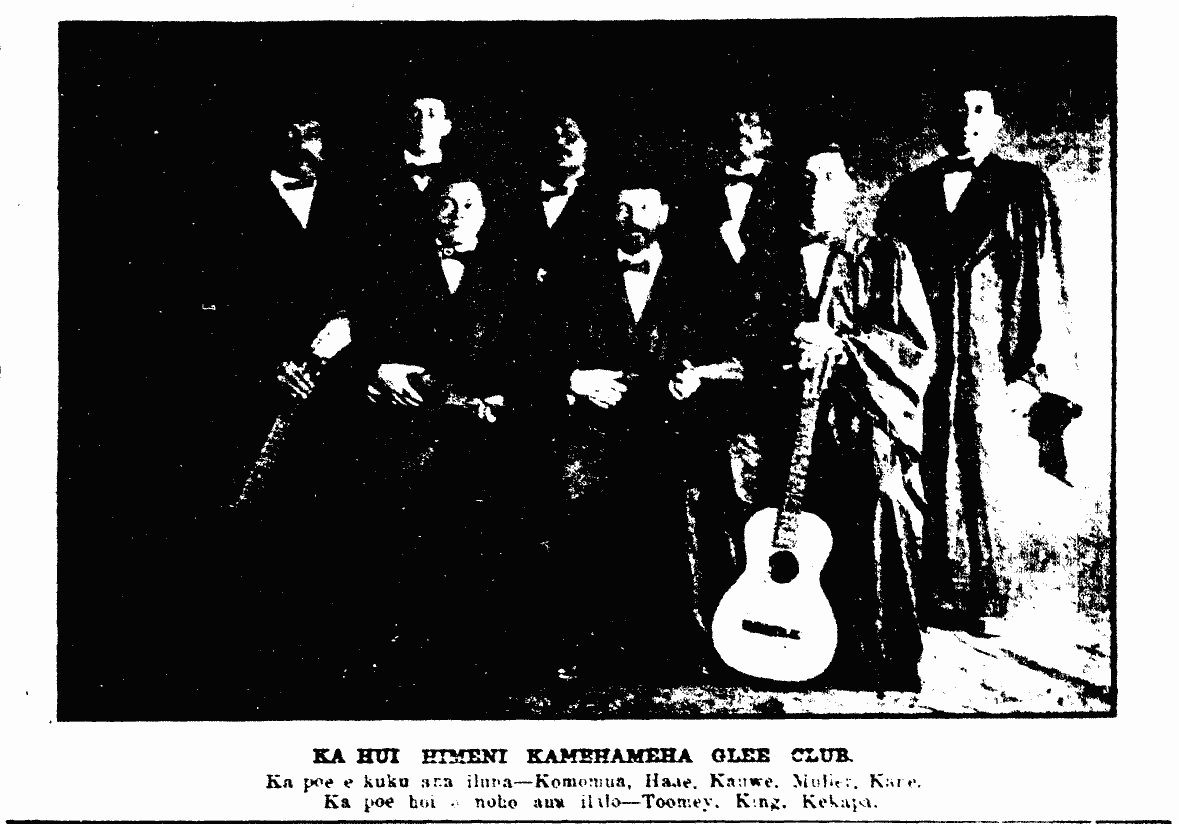
THE TWO OF US IN THE JOYFUL NIGHT OF HALALII

In K. P. Hall [Knights of Pythias Hall], tomorrow night, Saturday, the people of town will hear for themselves the singers of the Island of Keawe, known by the name “Kamehameha Glee Club,” because on that night, those singers will entertain with their deep voices, pleasing the girls of Honolulu nei so that they will not be able to sleep at night because of the beauty and sheer vigor.

Their fame of this glee club of the students of Kamehameha and Hawaiian teachers is only heard of, but during this concert of the Hawaiian Band Organization to be soon held; actually seen is the swaying of all those who listen to them; the ears tingle, making the singers of this town no match [lihi launa ole] for them.

This glee club has been travelling around Hawaii from one place to another, with much acclaim; songs that have become commonplace [paku-a] and not fun to listen to are like brand new songs when these boys sing them, and that is how they have gained fame. Continue reading

Ellen Pukila and child pass away, 1912.

MY DEAR, MY WIFE HAS GONE

Mr. Patient Editor of the Nupepa Kuokoa, Aloha oe:—May it please your open heart to place upon the deck of your precious, my baggage of tears so that those who live from where the sun appears at Ha’eha’e to the setting of the sun at Lehua, will know about my beloved, my wife, who has gone, undoing the supporting bond within.

For dust has returned to dust, and the soul to the One who created it; and this is what I endlessly grieve over, for my beloved, my wife, being that she has gone together on that road of no return with the first fruit of our loins of our youth, which is the reason for her being taken so early in her life.

For Lahaina, Maui, is the birthplace of my Ellen Pukila, and we were married here in Wailau, Molokai in the month of October, 1911, and we lived faithfully together in the holy covenant of matrimony, and she has grown weary of this life on July 24, 1912, at 10 a. m.; we were together all over Wailau; and I ask of the high heavens to lighten my grief for my dear wife who has gone afar.

Her beloved husband,

GEORGE PAUOLE KAMAI.

Wailau, Molokai, July 29, 1912.

(Kuokoa, 8/2/1912, p. 4)

KUU MEA ALOHA HE WAHINE UA HALA

Ka Nupepa Kuokoa, Buke XLVIII, Helu 31, Aoao 4. Augate 2, 1912.

Greatest Mariners, 1938 / 2015.

POLYNESIANS AS MARINERS SEEN

Dr. Buck Terms Early Polynesians Greatest Mariners World Has Ever Known

HONOLULU, Nov. 29—Dr. Peter Buck, director of the Bishop Museum, last night termed the early Polynesians the greatest mariners the world has ever known.

Dr. Buck, who will leaves soon for Yale University to lecture on primitive religions, spoke at a dinner in his honor attended by almost 200 persons. He was introduced by Frank Atherton.

He said it was probable that some of the early Polynesians reached the shores of America. He traced the possibility in similarity of certain words, such as that for sweet potato itself was brought into the South Seas from the American continent. Continue reading

Peter Buck to become an American citizen, 1943.

Resolution Approved

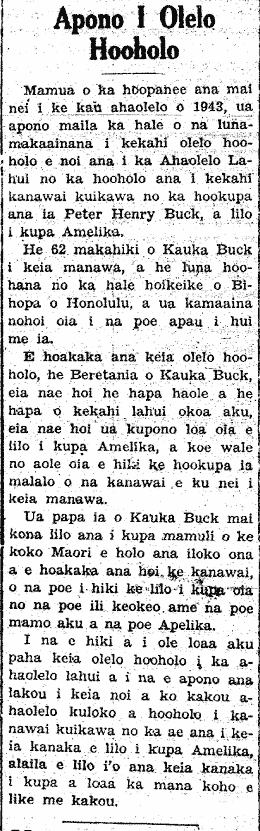
Before the session of the legislature of 1943 was postponed, the house of representatives approved a resolution asking Congress [Ahaolelo Lahui] to pass a special law to naturalize Peter Henry Buck, and make him an American citizen.

Dr. Buck is 62 years old now, and he is the director of the Bishop Museum of Honolulu, and he is a kamaaina to all the people he meets.

This resolution clarifies that Dr. Buck is English, however he is half haole and half another ethnicity, but it is appropriate that he be naturalized as an American citizen, but he cannot become a citizen under the current laws.

Dr. Buck is restricted from becoming a citizen because of the Maori blood flowing through him, and the law states that those who are able to become citizens a whites and descendants of African people.

If this resolution reaches or is received by the senate, and should they approve this request of our local legislature, and they pass a special law to allow this man to become an American citizen, then this man will indeed become a citizen and he will be able to vote like we do.

(Hoku o Hawaii, 5/5/1943, p. 1)

Apono I Olelo Hooholo

Ka Hoku o Hawaii, Volume XXXVIII, Number 2, Aoao 1. Mei 5, 1943.

The Maori and Hawaiians, 1911.

Hawaiians and Maori Talk to Each Other.

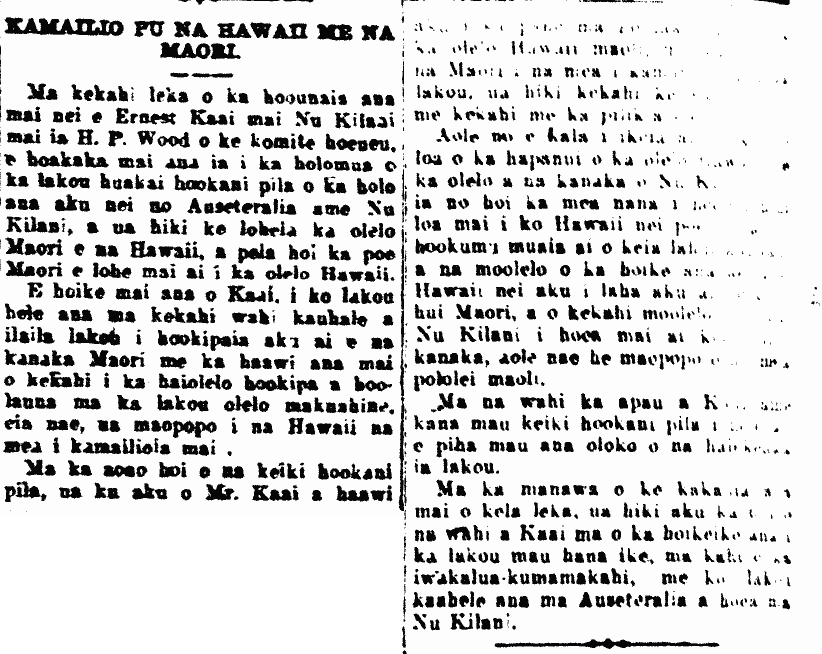
In a letter sent by Ernest Kaai from New Zealand to H. P. Wood of the Hawaiian Promotion Committee [which seems to be a precursor to the visitor’s bureau], he shows the progress of their musical touring of Australia and New Zealand. The Hawaiians could hear the Maori language and the Maori could hear the language of Hawaii.

Kaai said that when they went to some villages, they were hosted by Maori people, where one of them said words of welcome and friendship in their mother tongue. But the Hawaiians understood what was being said.

From the side of the musicians, Mr. Kaai stood and gave [rest of the paragraph unclear].

It was not long ago that [also unclear here, but they seem to be talking about the relationship between Aotearoa and Hawaii].

Everywhere that Kaai and his musical group went, the theaters would be filled with them.

When this letter was written, the number of places that Kaai them performed at was about 21, with them going around Australia and reaching New Zealand[?]

[A great deal of the Hawaiian Language Newspapers are bound into book form, and because they were purposely printed without much empty margins, often the printed portions that fall in the margin area of the books are not legible, especially when scanned. To get a clear image of the entire page, the books will have to be unbound first. That, it seems, takes a great amount of funding.]

(Kuokoa, 6/30/1911, p. 8)

KAMAILIO PU NA HAWAII ME NA MAORI.

Ka Nupepa Kuokoa, Buke XLVII, Helu 26, Aoao 8. Iune 30, 1911.

Laimakua Kaiwipunakea passes away, 1888.

Gone on the road of no return on the 30th of this past month, at Kawanui Uka, North Kona; death took away the last breath of Laimakua Kaiwipunakea. She left behind a husband, 3 children, and grandchildren who grieve for her. She was born in the year 1816, married her husband in 1836, and they had 13 children, and 10 have gone before with 3 still living. She was a mother who loved her children as well as her husband. Her remains were carried from the home of her daughter and buried on the grounds of Lanakila Church. “Blessed are the dead who die in the Lord.”

Kaiwipunakea Opio.

(Alakai o Hawaii, 1/7/1888, p. 4)

Ke Alakai o Hawaii, Buke 1, Helu 1, Aoao 4. Ianuari 7, 1888.

Ke Alakai o Hawaii, Buke 1, Helu 1, Aoao 4. Ianuari 7, 1888.