Makalei Cave, North Kona, Hawaii, 1924.

ENJOYMENT OF TIME

DESCRIPTION OF MAKALEI

This is a cave to the south of the hill of Akahipuu, and it was there that a man named Ko’amokumoku-o-hueia [Ko’amokumokuoheeia] lived, who came from Koolau and settled here, living as a newcomer.

And he lived here with his family: his wife, whose name was Kahaluu; and their two daughters; and one young son named Makalei.

And it was for this boy that this cave is called the cave of Makalei until this day.

While this man was living here, he began to farm taro, sweet potato, banana, sugar cane, and awa; and it all appeared to be well watered.

The natives of the area came to him and said, “The problem with this land is the water; it is a land without water, and you have to get water from the cave, but the places to store water here are kapu and cannot be fetched from in secret; if you are caught, you will be killed by the one who the water belongs.

Ko’amokumoku-o-heeia heard this talk of the locals, and this caused him to contemplate about where he and his family could get their water; and therefore, he made a reservoir [pa-o wai ?] for himself, and when the rains returned, water would fill receptacles [haona] then be held in the reservoir.

While living there with the family, one day, the boy went to relieve himself at a ravine behind their house, and while he was throwing the old waste into a plain old hole, right then wind blew out from that hole, and Makalei examined it and saw this deep, dark hole.

This boy was however not frightened at all; he stood up and went to where his father was farming and said:

“I went over there to defecate, but this is the astonishing thing, there was a lot of wind coming from that pit, maybe it is a hole of winds.”

“Where?” the father asked. “Down there,” and the father went to see.

When Ko’amokumoku-o-heeia reached the area and cleared away the stones covering the hole, he saw that it was a deep cave and wind rose from it as if it came from the mountains.

He turned and said to the child, “We have our place to hold water for our life here in this land without water, and I will make a hole for us to defecate in.”

The mouth to the cave was finished off nicely and there they defecated; while one side of the opening was made so that a person could enter.

No kamaaina knew of this cave, and he did not tell his wife, and nor did he talk of it again to his son; he totally refused to speak of the things pertaining to this cave.

One day, he entered the cave and saw the great vastness, and that he could walk upright without his head touching the wall above, and there was a lot of water dripping down; he decided to make containers [waa] of ohia, and containers of wiliwili.

In the night he fetched wiliwili and carried it on his back inside the cave, and it was inside of the cave that he dug until he made the opening of the wiliwili water container; the ohia chosen was dug out by the farmer and he carried it on his back into the cave. The inside of the cave grew criss-crossed with water troughs of wiliwili and ohia; there was just so many of the water containers that continued to be fitted inside.

When the dry season of this land returned as always, he did nothing other than farm, and he had ample water and had no problems with it.

It was at night that he fetched water and filled containers and gourds [olo], until the reservoir was full, and this was their drinking water for the month, and so forth.

The locals were suspicious about where these people go their water from, being that they did not see the source of their water, and they spoke often about the water of these malihini.

This cave still remains, and the entrance is very small but made like the entrance to a house, but within is very spacious and the walls are very tall.

When Maguire lived at Huehue, a great water catchment was built inside of the cave and a pipe was laid from the catchment until his house because he wanted cold water like ice water; also, pipes were laid above the catchment so that more water would go into it.

The story of this boy, Makalei is a beautiful one, along with his father, and it is a very long story; and should the writer have time to write this touching entertainment, then Makalei will be seen, the one whose name this cave is named after, Makalei Cave.

Here we will list the famous storied places [wahi pana kaulana] of these ahupuaa, from the sea until the summit of the mountain of Hualalai. With their names that they were called by the people of old.

1. Kileo hill.

2. Kaaialalaua.

3. Kapuukao.

4. Pahulu.

5. Moanuiahea.

6. Puumamaki.

7. Puuiki.

8. Puukoa.

9. Kaiwopele [Kaiwiopele].

10. Puuuhinuhinu.

11. Kahuaiki.

12. Kamawae.

13. Hikuhia, in the uplands of Napua.

14. Uau pooole [Uaupooole].

15. Na hale o Kaua [Nahaleokaua].

16. Kipuka o Oweowe.

17. Pualala.

18. Kawahapele.

19. Keoneeli.

20. Hinakapoula.

21. Kalulu.

22. Na puu Mahoe [Napuumahoe].

23. Kumu mamane [Kumumamane].

24. Kaluamakani.

25. Pohokinikini.

26. Hopuhopu.

27. Kipahee.

28. Hanakaumalu.

29. Kapuu o Honuaula [Honuaula Hill].

30. Ka puu o Hainoa [Hainoa Hill].

31. The summit of Hualalai and the pit of Milu.

32. Kipahee.

33. Makanikiu, Hill.

The pit of Milu [lua o Milu] spoken of is the pit which Hikuikanahele went to fetch Kawelu under the [Nuu ?] of Milu, the chief of the dark night; this is the round pit atop the summit of Hualalai which still remains to this day; it is a very deep hole and if you drop a rock down the pit, you will not hear the rattling of the rock.

The width of the mouth of this pit is perhaps about 6 to 7 feet in my estimation as I am familiar with those regions.

The water of Kipahee is a pit which goes down and reaches a spring.

It is not rippling water from which to scoop water out of, but it is moss [limu] which you collect until the container is full and then return to the top.

Climbing back up is troublesome; should you try to go straight up thinking you will exit immediately, you won’t be able to because you will keep sliding back until you are sitting after exhaustion from sliding down. In order to return to the top with ease, you have to climb zigzag, turning to the right and then to the left, and that is how you climb back to the top easily.

(Not complete.)

[This article continues into the next issue (6/5/1924, p. 4) and is signed: “Ka Ohu Haaheo I na Kuahiwi Ekolu. Kona Hawaii, April 30 1924.”]

(Hoku o Hawaii, 5/29/1924, p. 4)

NA HOONANEA O KA MANAWA

Ka Hoku o Hawaii, Buke XVIII, Helu 1, Aoao 4. Mei 29, 1924.

Liliuokalani’s personal adornments sold, 1924.

Liliu’s Gold Necklaces are Auctioned Off.

In accordance with the wishes of the deceased Queen Liliuokalani, the board of trustees of the estate of the the deceased announced the auctioning off of the gold adornments of the deceased queen. In one of the rooms on the bottom of the Young Hotel in Honolulu, on this Tuesday, March 25, the auction began of the adornments: the diamond rings, the diamond bracelets, the diamond necklaces, the earrings, the stickpins, and many other items. Colonel C. Piehu Iaukea made known the wishes of Liliuokalani to build a house to care for orphaned girls of all ethnicities, in Honolulu, and the Hawaiian girls were the first in her heart.

On the first day, this Tuesday, $11,360.50 was made. The auction was continued on another day. It is not known what the total is at this time.

The houses intended for these orphaned children probably cannot be built with just the funds from these jewels, because these valuables were sold in Honolulu at a place where it was believed that they would go for cheap, and the gold craftsmen of Honolulu said that the prices bid on these treasures of Hawaii nei were just like throwing them away. If it was held in a town of ten million people or more, like London, New York, or Paris, where millionaires reside, then proper prices might have been gotten, however, here in Hawaii, where there are no millionaires, high prices are not attained.

Perhaps if it is included with the rest of Liliuokalani’s estate, then it will be enough to build this type of facility, for it will need over a hundred thousand more dollars for that kind of place. On top of that is the expenses for the care taking and for the executives, which would be some hundreds of thousands of dollars more, and where would this all come from? The treasures from the tomb of King Tutankhamen, Pharaoh of Egypt, who died over 3,000 years ago, is estimated at over a billion dollars today.

(Kuokoa, 3/27/1924, p. 2)

Na lei gula o Liliu ua kudala ia

Ka Hoku o Hawaii, Buke XVII, Helu 44, Aoao 2. Maraki 27, 1924.

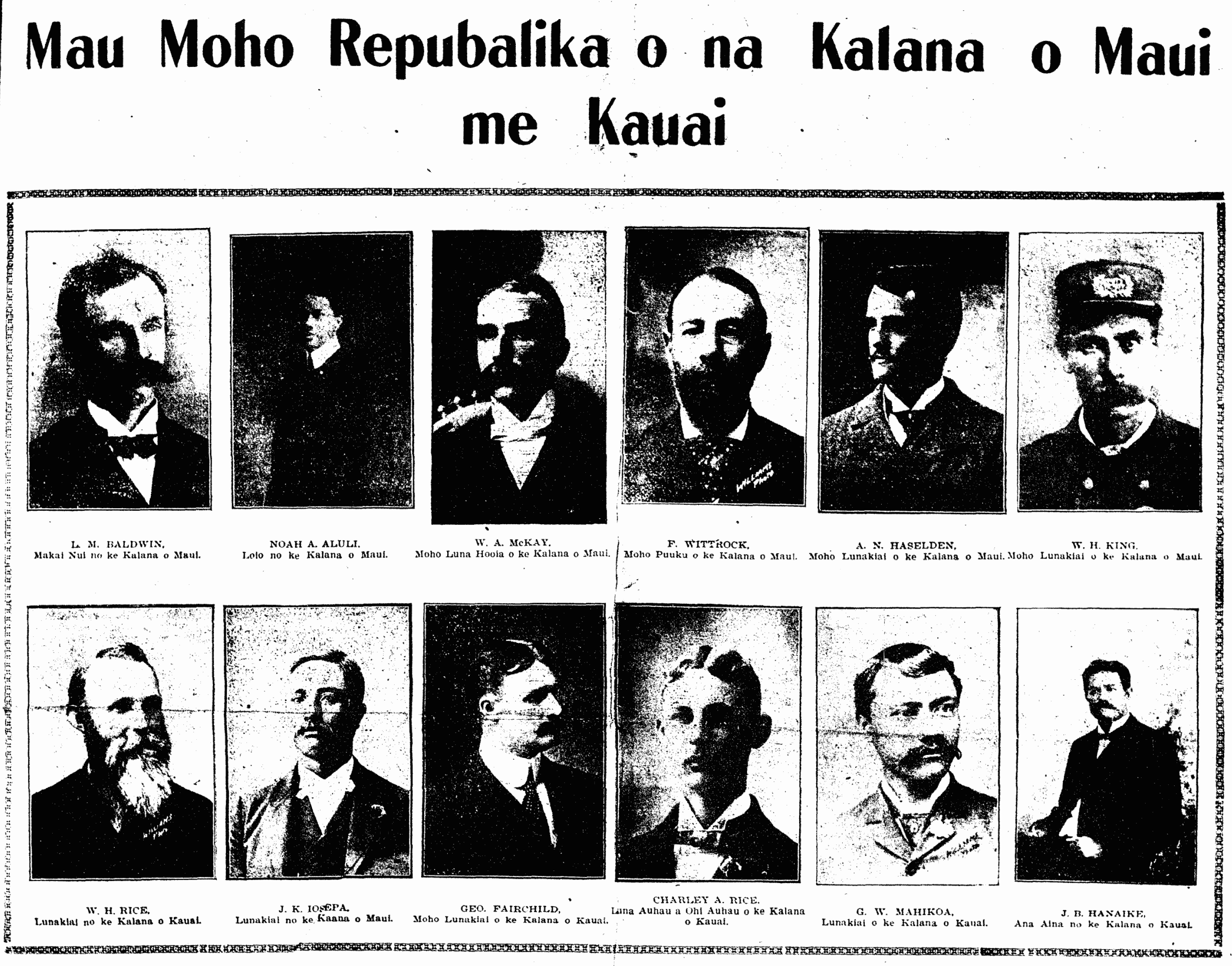
Candidates, 1903.

Republican Candidates of the Counties of Maui and Kauai

L. M. BALDWIN, Chief Sheriff of Maui County.

NOAH A. ALULI, Lawyer of Maui County.

W. A. McKAY, Candidate for Auditor of Maui County.

F. WITTROCK, Candidate for Treasurer of Maui County.

A. N. HASELDEN, Candidate for Supervisor of Maui County.

W. H. King, Candidate for Supervisor of Maui County.

W. H. RICE, Supervisor for Kauai County.

J. K. IOSEPA, Supervisor for Maui County.

GEORGE FAIRCHILD, Candidate for Supervisor of Kauai County.

CHARLEY A. RICE, Tax Assessor and Collector of Kauai County.

G. W. MAHIKOA, Supervisor of Kauai County.

J. B. HANAIKE, Surveyor of Kauai County.

(Kuokoa, 10/23/1903, p. 1)

He Mau Moho Repubalika o na Kalana o Maui me Kauai

Ka Nupepa Kuokoa, Buke XLI, Helu 43, Aoao 1. Okatoba 23, 1903.

Hidden cave, 1897.

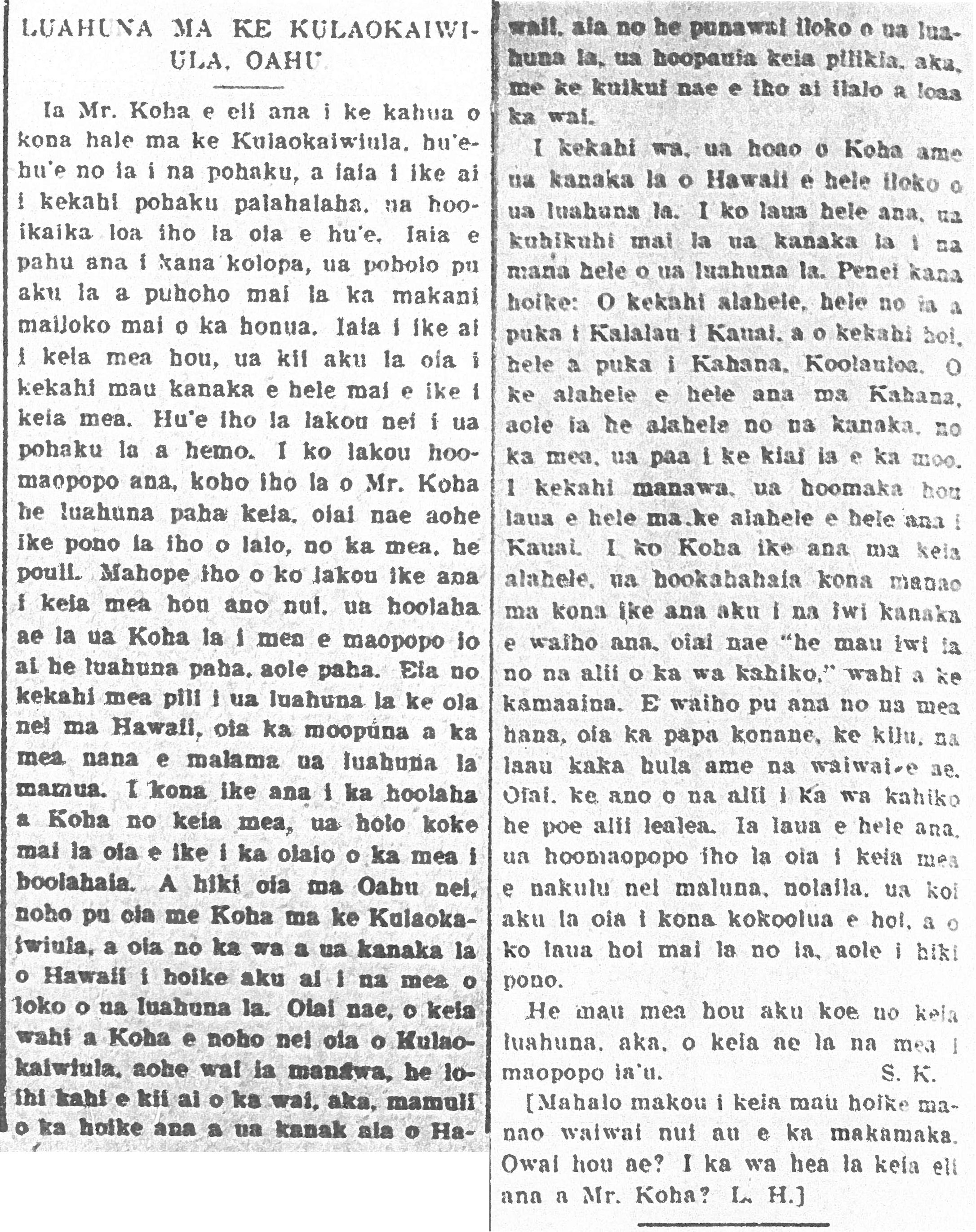
HIDDEN CAVE AT KULAOKAIWIULA, OAHU.

While Mr. Koha was digging the foundation of his house at Kulaokaiwiula [Kekulaokaiwiula], he excavated some rocks, and as he noticed a flat rock he put exerted himself in pulling it up; as he shoved down his crowbar, it slipped in and wind came blowing up from the earth. Discovering this new thing, he fetched some people to come and see it. They pried up the rock. After they saw this, Mr. Koha supposed that it possibly was a hidden cave [luahuna], although the bottom couldn’t be clearly seen because it was dark. After this great discovery, Mr. Koha put out an announcement, so that it would be clear whether it was a hidden cave or not. There was someone who was associated with this hidden cave on Hawaii, the grandchild of the caretaker of the luahuna previously. When he saw Koha’s ad about this thing, he came at once to check if what was advertised was true.  He arrived on Oahu and stayed with Koha at Kulaokaiwiula, and that was when that man from Hawaii told him about what was in that cave. Being that there was no water at this place, Kulaokaiwiula, when Koha was living there, you had to go far to fetch water; however, according to what the man from Hawaii said, there was a spring in the cave, and so that problem was solved, although you had to go down with a light [kuikui] to get the water.

Once, Koha and the man from Hawaii tried to go down in the cave. When the went, the man pointed out the different paths of the cave. This is what he described: On path went and exited at Kalalau, Kauai; and another path went and exited at Kahana, Koolauloa. The path heading to Kahana was not to be travelled by man, for it was guarded by a moo. Another time, they started taking the path which headed towards Kauai. When Koha saw this path, he was astounded to see human bones laid out, being “these were bones of ancient chiefs,” according to the kamaaina. Also here were implements, like a konane board, kilu, hula sticks [laau kaka hula], and other valuable items. The alii of old were fond of entertainment. As they continued on, he noticed there was something dripping down, so he urged his companion to turn back, and so they returned and did not go all the way.

There are more things dealing with the hidden cave, but this is what I know.  S. K.

{O Friend, we are appreciative for this very valuable description. Who else? When did this digging by Mr. Koha happen? Editor}

[The Mr. Koha being spoken of here is very likely G. M. Koha, who is a frequent writer into the newspapers. Hopefully the announcement mentioned in this article can be found sometime soon!]

(Kuokoa, 3/26/1897, p. 2)

LUAHUNA MA KE KULAOKAIWIULA, OAHU.

Ka Nupepa Kuokoa, Buke XXXVI, Helu 13, Aoao 2. Maraki 26, 1897.

POISONOUS SNAKE in Hawaii? 1912.

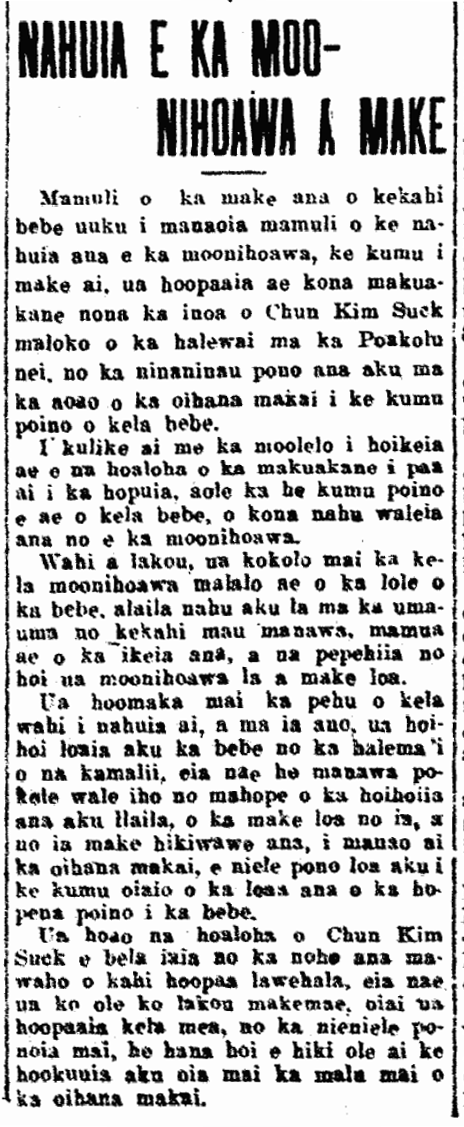
BITTEN BY A SNAKE AND DIED.

As a result of a small baby dying believed as a result of being bitten by a snake [moonihoawa], the parent, whose name is Chun Kim Suck was taken to jail on Wednesday to be questioned by the sheriff’s office as to the cause of the baby’s injuries.

According to statements of the friends of the father who was arrested, there was no other reason for the baby’s injuries other than that it was bitten by a snake.

According to them, the snake crawled beneath the clothing of the baby and then bit its chest several times before it was noticed, and then the snake was killed.

The bitten area began to swell at which point the baby was taken to the children’s hospital, however soon after being taken there, it died, and because of this quick death, the sheriff’s department decided to find the true cause of the tragic end of the baby.

Chun Kim Suck’s friends tried to bail him out of the hold for criminals, however, their wish was not granted because he is being held for interrogation, for which he cannot be released from the watch of the sheriff’s department.

(Kuokoa, 8/2/1912, p. 1)

NAHUIA E KA MOONIHOAWA A MAKE

Ka Nupepa Kuokoa, Buke XLVIII, Helu 31, Aoao 1. Augate 2, 1912.

Traditional and Wise Sayings, 1922.

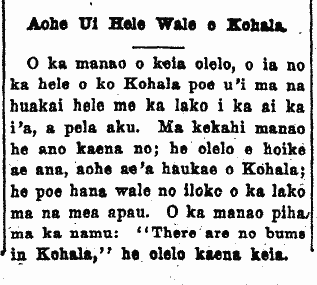
There Are No Youths of Kohala That Just Wander About.

The idea of this saying is that when Kohala youths go travelling, they take along provisions: vegetables, meat, and so forth. Looking at it in another way, it is like a boast; it is saying that Kohala has no vagrants; they are prepared in every way when doing things. In English, the whole thought goes: “There are no bums in Kohala,” and is a boast.

[During this period, there were many articles on traditional proverbs printed!]

(Kuokoa, 9/29/1922, p. 3)

Aohe Ui Hele Wale o Kohala.

Ka Nupepa Kuokoa, Buke LXI, Helu 39, Aoao 3. Sepatemaba 28, 1922.

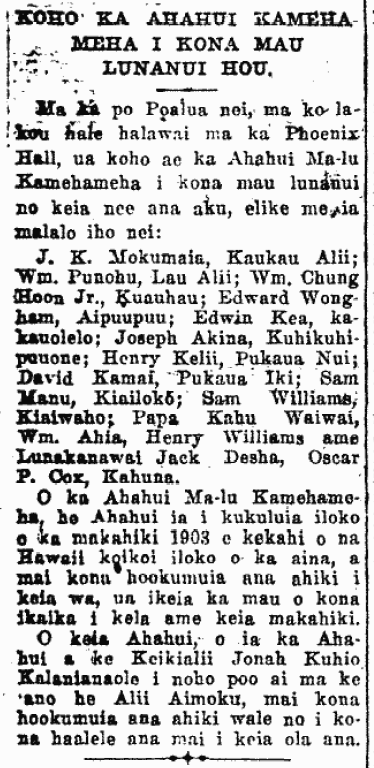
Ahahui Kamehameha, 1922.

THE AHAHUI KAMEHAMEHA ELECTS ITS NEW OFFICERS.

On the Tuesday night, at their meeting house at Phoenix Hall, the Kamehameha Secret Society [Ahahui Ma-lu Kamehameha] selected their officers for to move forward, as shown below:

J. K. Mokumaia, Kaukau Alii; William Punohu, Lau Alii; William Chung Hoon, Jr., Kuauhau; Edward Wongham, Aipuupuu; Edwin Kea, secretary; Joseph Akina, Kuhikuhipuuone; Henry Kelii, Pukaua Nui; David Kamai, Pukaua Iki; Sam Manu, Kiailoko; Sam Williams, Kiaiwaho; Board of Trustees, William Ahia, Henry Williams, and Judge Jack Desha, Oscar P. Cox, Kahuna.

The Kamehameha Secret Society is an Organization established in the year 1903 by some leading Hawaiians of the land, and from its beginnings until today, its continued strength is seen yearly.

This Association is the one Prince Jonah Kuhio Kalanianaole was the head of, as the Alii Aimoku, from its inception until he left this life.

(Kuokoa, 5/11/1922, p. 4)

KOHO KA AHAHUI KAMEHAMEHA I KONA MAU LUNANUI HOU.

Ka Nupepa Kuokoa, Buke LXI, Helu 19, Aoao 4. Mei 11, 1922.

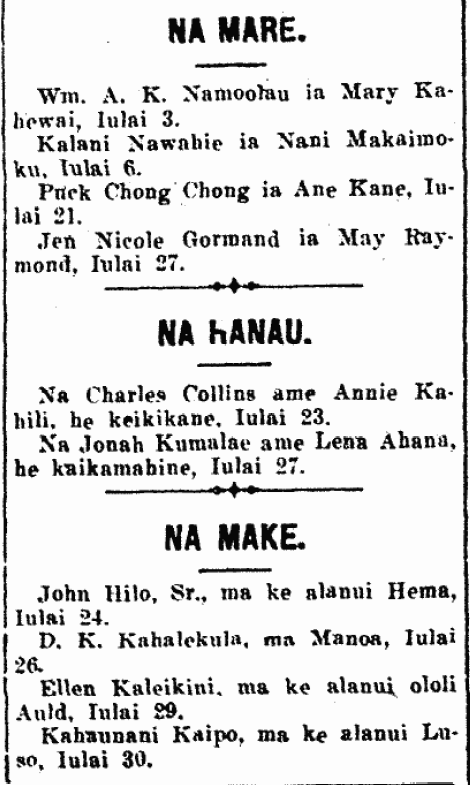
Vital Statistics, 1912.

MARRIAGES.

William A. K. Namoolau to Mary Kahewai, July 3.

Kalani Nawahie to Nani Makaimoku, July 6.

Puck Chong Chong to Ane Kane, July 21.

Jen Nicole Gormand to May Raymond, July 27.

BIRTHS.

To Charles Collins and Annie Kahili, a son, July 23.

To Jonah Kumalae and Lena Ahana, a daughter, July 27.

DEATHS.

John Hilo, Sr., on South Street, July 24.

D. K. Kahalekula, at Manoa, July 26.

Ellen Kaleikini, on Auld Lane, July 29.

Kahaunani Kaipo, on Luso Street, July 30.

(Kuokoa, 8/2/1912, p. 8)

NA MARE. / NA HANAU. / NA MAKE.

Ka Nupepa Kuokoa, Buke XLVIII, Helu 31, Aoao 8. Augate 2, 1912.

More on officers of Ahahui Kamehameha, 1923.

JOHN C. LANE THE HEAD OF THE AHAHUI KAMEHAMEHA

After waiting a whole year after the death of Prince Kalanianaole, the Aliiaimoku of the Ahahui Kamehameha [Royal Order of Kamehameha], John C. Lane was chosen the replacement to fill his hole, so that he is the present head of the Ahahui Kamehameha until his replacement is elected sometime in the future when the officers are chosen.

John C. Lake was chosen aliiaimoku on the 29th of January, and in other words, he is the head of all of the chapters who are members of the Ahahui Kamehameha.

In that meeting that was held, it was decided that the organization would hold regularly every year, a day of remembrance for Prince Kalanianaole, the one who organized and established the Ahahui Kamehameha from when he was very young until it became the hugest of all Hawaiian organizations.

On this year, the 25th of March will be the day that the Ahahui Kamehameha will remember Prince Kalanianaole, by holding a prayer gathering at Kawaiahao Church, and invitations were sent to the other Hawaiian organizations of this town to join along in this gathering of remembrance.

For that meeting of remembrance, it is hoped that all the Hawaiian organizations will wear their uniforms, and in the afternoon of that day, the Ahahui Kamehameha will hold a party with all of the officers in attendance, and they will all eat as one of the foods prepared.

Up until this time, the main islands of Hawaii nei have all established their own chapters; Maui was the last island to join as a chapter in this organization, this past December.

To increase the membership of the Ahahui Kamehameha, it will be the duty of the members of this organization to search out and find new members here forth, with no confusion as to the number of new members that are to join.

The Ahahui Kamehameha on Kauai is the Ahahui Kaumualii, with its membership reaching about 200, and A. G. Kaulukou is the Mamoalii.

The organization on Hawaii Island is called Ahahui Mamalahoa, and William H. Beers is the Mamoalii.

The Ahahui Hawaii is the name of the organization here on Oahu, and B. N. Kahalepuna is the Mamoalii, with its membership of 250.

The Ahahui and their Officers

Here below are the officers of the Ahahui Kamehameha (Oahu):

1. Aliiaimoku, Prince Jonah K. Kalanianaole (deceased).

2. Alii, Dr. George H. Huddy. 3.

Officers of the Ahahui Kamehameha.

B. N. Kahalepuna, Mamo Alii; James H. Boyd (deceased). 4. Alii, Abraham Fernandez (deceased).

5. Alii, Charles H. Rose; 6. Alii, Carlos A. Long; 7. Alii, George E. Smithies (deceased); 8. Alii, Nagaram Fernandez (deceased).

9. Alii, James L. Holt; 10. Alii, David Kanuha; 11. Alii, Charles L. Oio; 12. Alii, John K. Kamanoulu.

13. Aliiaimoku, John C. Lane (replacement for Prince Kalanianaole); 14. Alii, Moreno K. Hulu; 15. Alii, Joseph K. Kanepuu (deceased); 16. Alii, William Chung Hoon.

17. Hope Aliiaimoku, William Chung Hoon, Jr.; 18. Alii, Edward K. Wongham; 19. Alii, Andrew I. Bright; 20. Alii, David K. Hoapili, Sr.

21. Alii, Eli J. Crawford; 22. Alii, Reuben Kinney; 23. Alii, Henry H. Williams.

24. Alii, Stephen L. Desha, Sr.; 25. Alii, George L. Desha, Sr.; 26. Alii, Samuel K. Pua.

The Ahahui Kaumualii.

27. Alii, J. Mahiai Kaneakua; 28. Alii, Nicholas K. Hoopii.

J. K. Mokumaia, Kaukaualii; William Punohu, Laualii; Edward K. Kea, Kakaolelo; William Chung Hoon, Jr., Kuauhau; Edward K. Wongham, Aipuupuu.

Oscar P. Cox, Kahuna; Joseph H. Akina, Kuhikuhipuuone; Henry Kelii, Pukaua Nui.

Samuel K. Kakelaka, Pukaua Iki; Samuel Manu, Kiai Loko; Samuel M. Williams, Kiai Waho.

Board of Trustees—William Ahia, Henry H. Williams, J. R. Desha.

Ahahui Mamalahoa.

This chapter of the Ahahui Kamehameha was established on April 18, 1907, and these are the officers:

William H. Beers, Mamo Alii; Stephen L. Desha, Sr., George L. Desha, Sr., and Samuel K. Pua.

Ahahui Kaumualii.

This chapter of the Ahahui Kamehameha was established in December 1918, and these are the officers:

A. G. Kaulukou, Mamo Alii; John Hano, Kaukaualii; I. K. Kaauwai, Sr., Laualii.

S. K. Kaahu, Kakaolelo; Henry Blake, Kuauhau; W. O. Crowell, Aipuupuu; H. W. Waiau, Kahuna.

Samuel Keliinoi, Kuhikuhipuuone; John Naleimaile, Pukaua Nui; E. C. Lovell, Pukaua Iki; F. W. Akana [?], Kiai Loko; David Pele, Kiai Waho.

The Alii:—J. Mahiai Kaneakua, Nicholas K. Hoopi.

Ahahui Kahekili.

In the month of December, on the 2nd, of 1922, recently past, this chapter was established, and the officers are:

W. E. Bal, Sr., Kaukaualii; Clem Crowell, Laualii; Frang K. Kalua, Kakaolelo; C. F. N. Rose, Kuauhau; Charles Wilcox, Aipuupuu; Stephen Lake, Kahuna; William Hoopii, Kuhikuhipuuone; George Kauwenaole, Pukaua Nui.

J. Hiona, Pukaua Iki; M. Ross, Kiai Loko; W. Cockett, Kiai Waho.

Executive Committee—S. E. Kalama, Guy Goodness, W. F. Kaae.

[Does anyone know if the name of the member of the Ahahui Kaumualii is “F. W. Akana”? It is hard to read from the image online…]

(Kuokoa, 2/15/1923, p. 3)

O JOHN C. LAKE KE POO O KA AHAHUI KAMEHAMEHA

Ka Nupepa Kuokoa, Buke LXII, Helu 7, Aoao 3. Feberuari 15, 1923.