John Wise on Hawaiian Homes and more, 1921.

The Question about the Work Ethic of Hawaiians.

Your writer [John Wise], continues to defend the Hawaiian lahui from being attacked by that question above.

The Hawaiians have perhaps become much talked about amongst those who do not know them and who are not familiar with their accomplishments of today and of the past. And maybe mostly these days for the land being given to us. Your writer frequently clashes with all kinds of other people who protest the giving of land to Hawaiians, because of the ridiculous idea that they don’t know how to work or that they are lazy.

In these attacks, we can see, O Lahui, that they are carried with criticisms and that it is would be a waste to confirm their misbeliefs. But so that the Hawaiians may answer these questions, your writer wants to be made known for all times the sound justification for our side. The readers of past issues of the Kuokoa have seen the responses given by the Commissioner in Washington, and they have seen also the other justifications given, in the newspaper.

The ultimate representation of the skill of a people is their supplying themselves with food and the things necessary for their livelihood. There perhaps is no better response than that. This lahui was living by  themselves for centuries, supplying themselves with everything, and received no assistance from the outside.

But there are things made by this lahui, things that attest to their fine craftsmanship, that will serve as a measure of their skills. Those that see Hawaiian canoes and their manufacture and how they can get Hawaiians through great gales, remaining solid in the dangers of the pounding of waves; how they could make beautiful canoes by using stone adzes; the distance they were taken from mountain to the sea; the patience of the canoe makers. All of these things will show, without being contradicted, that just by seeing the quality of the canoes can one see that this is a lahui that knows how to work. We see the canoes of today being made by people from other lands, and the canoes made by Hawaiians are far more well made and beautiful.

The beauty of things crafted by a people are undeniable proof of the work ethic of that people. Where will you find things more beautiful, O Hawaiians, if you travel all over the world, than the ahuula that are preserved at the Museum of Kamehameha School. Where is the lahui that lives on today, or perhaps has disappeared, that can make these outstanding works, with a beauty second to none, with fine craftsmanship, and patience; with a true sense of work ethic. Snaring birds is a great task all in itself, the inserting [kuku ana] of the feathers is a big job. One mamo feather cloak was said to have been started during the time of Umi and completed during the time of Kamehameha. For this ahu, the entire ahu were done with mamo feathers. And by our counting back, we see that ten generations of ancient kings passed on before the completion of this ahu; showing that it took from about 250 to 300 years of work. Where is there a great work that was completed by a people taking hundreds of years to construct? We perhaps can think of huge things, but as for something of this nature which required the knowledge and patience of men, there is no equal. Continue reading
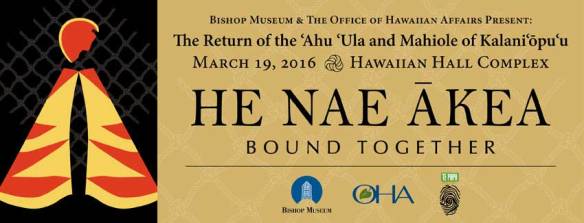
Kalaniopuu’s ahuula and mahiole that he placed on Cook, 1779 / 2016.

I just put up the short excerpt the other day describing Kalaniopuu giving James Cook his ahuula and kahili. And now there is this exciting announcement from the Bernice Pauahi Bishop Museum!

he-nae-akea

[It should be perhaps made clear however that the ahuula at least has made its way back to Hawaii nei two times since 1779, courtesy of the Dominion Museum, the predecessor of Te Papa Tongarewa]. The first time was in 1960:

DOMINION MUSEUM FEATHER CLOAK

Each year the Museum attempts to bring back for the Aloha Week exhibit a fine example of Hawaiian featherwork from abroad. This year the Dominion Museum of Wellington, New Zealand, has generously loaned a large Hawaiian feather cloak, which to the best of our knowledge, was presented to Captain Cook’s expedition in 1779. Aloha Week marks the first return of this cloak to Hawaii.

(Conch Shell: News of the Bishop Museum, October 1960)

The second time was for the “Artificial Curiosities” exhibit at the Bishop Museum which ran from January 18 to August 31, 1978.

Also, check out this previous post on an amazing story about other featherwork given to Cook by Kalaniopuu!

Duke, the true sportsman! 1916.

WIN OR LOSE KAHANAMOKU WEARS SMILE

Duke Kahanamoku, Greatest of Swimmers.

“The biggest thing in sport? It is the heart to accept defeat gracefully.”

The Duke Kahanamoku, greatest of swimmers, has just been beaten, together with his teammates, in the grueling 300-yard exposition relay swim at San Francisco by the Illinois Athletic club.

His smile and unstinted praise for the victors gave his words a personal application. “The duke” knows how to lose as well as to win. Continue reading

Crown Room of Iolani Palace, 1936.

THE CROWN ROOM OF IOLANI PALACE TO BE REDONE

ACTING GOVERNOR HITE REVEALED HIS THOUGHTS

This past Thursday, June 25, acting Governor [kokua Kiaaina] Charles M. Hite revealed his thoughts to redo the crown room of Iolani Palace in the upcoming days to bring back once again the commemoration of the alii of Hawaii who passed on; the pulo’ulo’u, the paintings hanging upon the walls, the throne, and also the other chairs which decorated the crown room. Continue reading

Keeaumoku’s ahuula, Eheukani, 1903.

FEATHER GARMENTS

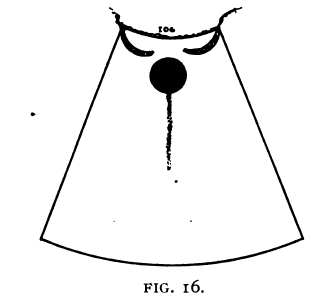
106. A cloak said to have been destroyed in the conflagration caused accidentally in the attempt of the Board of Health to stamp out the bubonic plague in the Chinese quarter of Honolulu. At the time when the claims for losses caused by this great fire were presented to the Commission appointed for the purpose, my assistant, Mr. Allen M. Walcott, obtained from the claimant, Peleioholani, a carpenter by trade, the following particulars: The cloak was called “Eheukani” and was made in the time of Keeaumoku (the father of Kaahumanu) and finished shortly before the battle of Mokuohai (July, 1782) between Kamehameha and Kiwalaó. Keeaumoku’s wife gave it to Peleioholani’s grandmother. Principally mamo* feathers with a small crescent of red iiwi in each upper corner; between the shoulders a round spot of black oo feathers, from which a line of red iiwi led down to a trifle below the middle of the cloak. The cords at the neck were of human hair, an unusual thing. It must be remembered that the design (Fig. 16) as well as the following measurements are from the description given to Mr. Walcott by Peleioholani and are of course only approximate. They are worth recording as differing from any robes described. Length, about 4 feet 9 inches; neck measurment about 2 feet; circumference at bottom about 5 feet 8 inches. It is a matter of tradition that 27,000 birds were captured to furnish the feathers for this cloak. In the left side were seven spear holes that were never patched, and about which were blood stains. Keeaumoku was severely wounded in this battle, and it was rather a fancy with the old chiefs to retain the honorable scars in the ahuula, as in the cloak given by Kamehameha to Vancouver to be taken to England for King George.

*Probably oo, for a genuine mamo ahuula was devoid of any adulteration by other colored feathers. It should be stated that Peleioholani’s claim to be the owner of this cloak was disputed and it was said to have been taken from the palace years ago; but from what I have seen of the observation of natives whose duty it was to care for the royal robes, I do not believe one of them could describe the pattern of the cloaks he or she had seen for years.

[And a note on the note by Brigham. I am not sure the oo instead of mamo feathers comment should be considered true when even the great mamo feather ahuula of Kamehameha Paiea has red iiwi feathers within it…]

(Brigham, William T. Additional Notes on Hawaiian Featherwork. Honolulu: Bishop Museum Press, 1903. pp. 15–16.)

"Eheukani"

Brigham, William T. Additional Notes on Hawaiian Featherwork. Honolulu: Bishop Museum Press, 1903. p. 17.

Duke saves lives, 1925.

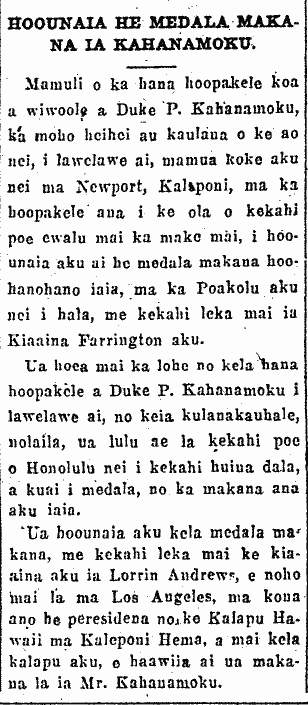
SENT WAS A MEDAL GIFTED TO KAHANAMOKU.

Because of the brave and fearless rescue carried out by Duke P. Kahanamoku, the famous swimming champion of the world, just recently at Newport, California, in saving the lives of eight people from death, he was sent a gift of a medal to honor him, last Wednesday with a letter from Governor Farrington.

The news of this rescue carried out by Duke P. Kahanamoku arrived in this town, therefore,  some people of Honolulu donated a sum of money to purchase a medal to present to him.

This presentation medal was sent along with a letter from the governor to Lorrin Andrews, living in Los Angeles, as the president of the Hawaiian Club of South California [Kalapu Hawaii ma Kalepooni Hema], and from that club the gift will be given to Mr. Kahanamoku.

[I noticed today’s post by Bishop Museum announcing their upcoming exhibit on this hero, Duke Paoa Kahanamoku!]

(Kuokoa, 8/27/1925, p. 4)

HOOUNAIA HE MEDALA MAKANA IA KAHANAMOKU.

Ka Nupepa Kuokoa, Buke LXIV, Helu 35, Aoao 4. Augate 27, 1925.

Pueo found in Kalihi, 1902.

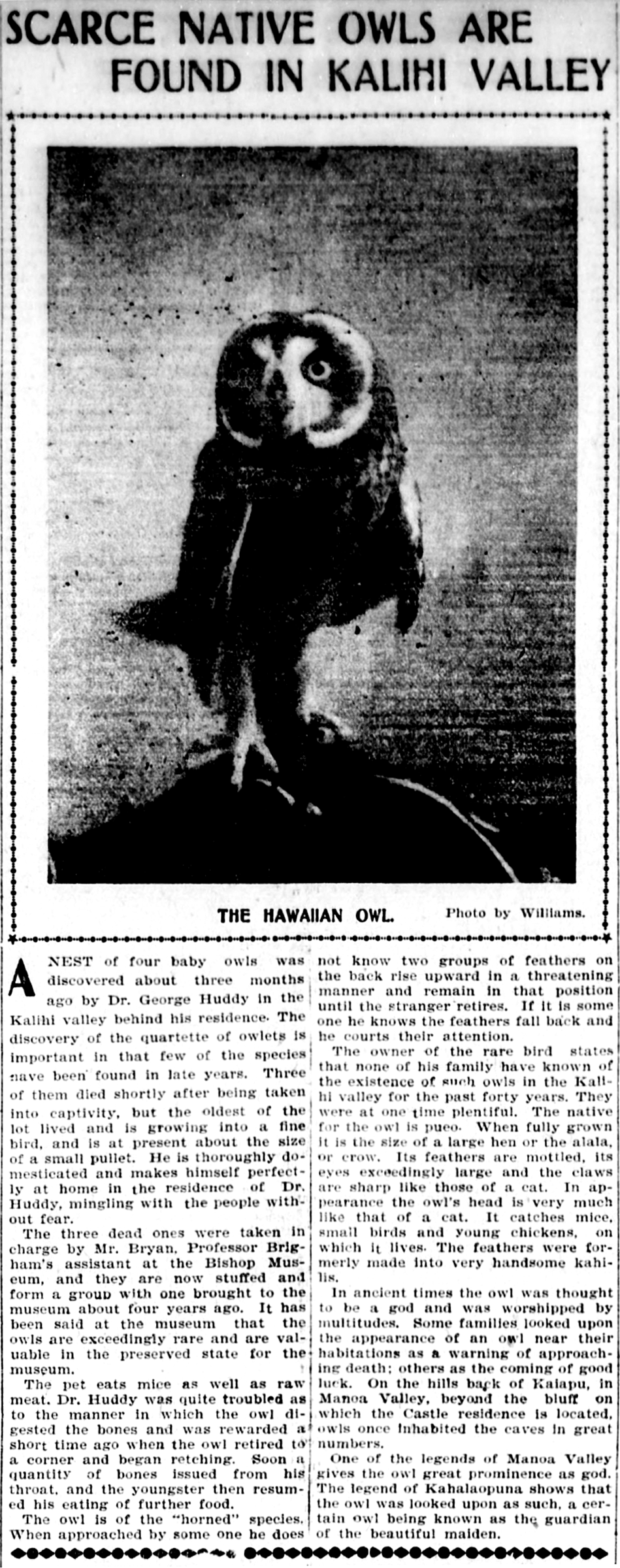
SCARCE NATIVE OWLS ARE FOUND IN KALIHI VALLEY

THE HAWAIIAN OWL.  Photo by Williams.

A NEST of four baby owls was discovered about three months ago by Dr. George Huddy in the Kalihi valley behind his residence. The discovery of the quartette of owlets is important in that few of the species have been found in late years. Three of them died shortly after being taken into captivity, but the oldest of the lot lived and is growing into a fine bird, and is at present about the size of a small pullet. He is thoroughly domesticated and makes himself perfectly at home in the residence of Dr. Huddy, mingling with the people without fear.

The three dead ones were taken in charge by Mr. Bryan, Professor Brigham’s assistant at the Bishop Museum, and they are now stuffed and form a group with one brought to the museum about four years ago. It has been said at the museum that the owls are exceedingly rare and are valuable in the preserved state for the museum.

The pet eats mice as well as raw meat. Dr. Huddy was quite troubled as to the manner in which the owl digested the bones and was rewarded a short time ago when the owl retired to a corner and began retching. Soon a quantity of bones issued from his throat, and the youngster then resumed his eating of further food.

The owl is of the “horned” species. When approached by some one he does not know two groups of feathers on the back rise upward in a threatening manner and remain in that position until the stranger retires. If it is some one he knows the feathers fall back and he courts their attention.

The owner of the rare bird states that none of his family have known of the existence of such owls in the Kalihi valley for the past forty years. They were at one time plentiful. The native for the owl is pueo. When fully grown it is the size of a large hen or the alala, or crow. Its feathers are mottled, its eyes exceedingly large and the claws are sharp like those of a cat. In appearance the owl’s head is very much like that of a cat. It catches mice, small birds and young chickens, on which it lives. The feathers were formerly made into very handsome kahilis.

In ancient times the owl was thought to be a god and was worshipped by multitudes. Some families looked upon the appearance of an owl near their habitation as a warning of approaching death; others as the coming of good luck. On the hills back of Kalapu, in Manoa Valley, beyond the bluff on which the Castle residence is located, owls once inhabited the caves in great numbers.

One of the legends of Manoa Valley gives the owl great prominence as god. The legend of Kahalaopuna shows that the owl was looked upon as such, a certain owl being known as the guardian of the beautiful maiden.

[Does anyone know of kahili made with pueo feathers?]

(Hawaiian Gazette, 2/11/1902, p. 5)

SCARCE NATIVE OWLS ARE FOUND IN KALIHI VALLEY

Hawaiian Gazette, Volume XXXVII, Number 12, Page 5. February 11, 1902.


Hala exhibit coming to the Bishop Museum, 2015.

It seems that the Museum is having an exhibit on weaving starting the end of this week. Maybe go check it out if you are on Oahu.

The beauty and significance of hala is woven throughout our history and throughout this exhibit. In ancient times, the sails of voyaging canoes were plaited of hala, and utilitarian hala baskets and mats were commonplace. The introduction of foreign items that replaced Hawaiʻi-made mats and baskets encouraged weavers to further their creativity, leading to a distinctive and truly exquisite Hawaiian style of lau hala hats that are coveted and treasured as fine art.

Nani i ka Hala

Amazing story about the capes given by Kalaniopuu to Cook, 1908.

The Ahuula Garments of Kalaniopuu!

Given by the Chief to Captain Cook!

It is understood in Hawaii’s ancient history, before Captain Cook [Kapena Kuke] left Hawaii, on the 3rd of February, 1779, King Kalaniopuu gave a gift to Captain Cook some Ahuula and Ahu Mamo and feather mahiole headgear of Hawaii. After the ships of Captain Cook left Hawaii Island shortly after the death of that British Captain, the ships went and landed at Kamchatka, on the eastern shores of Siberia.
Continue reading

Much more on the protest mat, 1990.

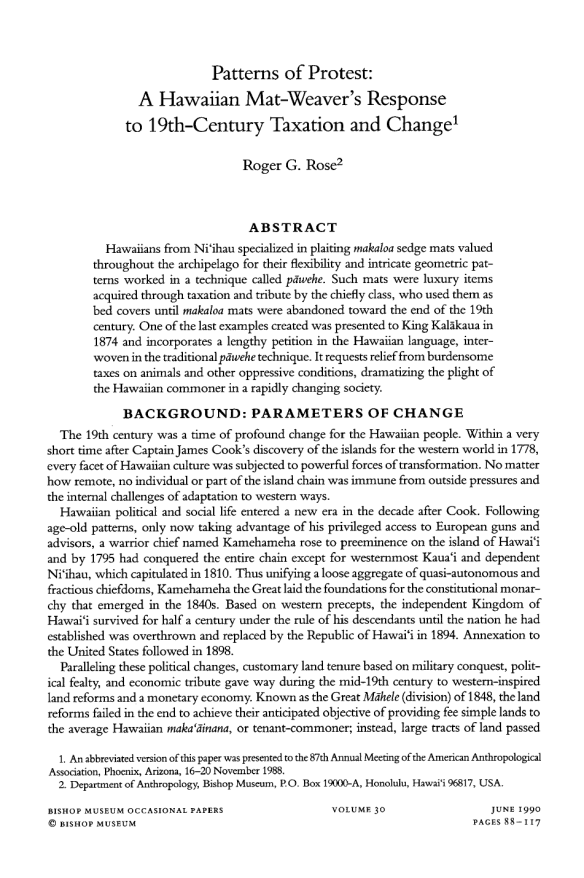
For much, much more on Kalai’s mat of protest, see Roger G. Rose’s “Patterns of protest : a Hawaiian mat-weaver’s response to 19th-century taxation and change,” found in Bishop Museum Occasional Papers, Vol. 30 (June 1990). It can be found online by clicking here below:

Patterns of protest : a Hawaiian mat-weaver’s response to 19th-century taxation and change

Patterns of protest : a Hawaiian mat-weaver’s response to 19th-century taxation and change, Roger G. Rose