Queen Emma affronted, 1866.

We Do Not Approve.

As we read the words which President Johnson spoke at his audience with Queen Emma, we nearly ridicule them. Were he instead the greatly beloved Abraham Lincoln, were it perhaps during his time, then the words would have been splendid. He was a very humble man, whereas this President is arrogant. It is unfortunate that it was him, and that he is the head of the Nation which we love. Here are his good for nothing words:—

“I offer you my esteem as you enter the Nation’s capital, for a people of 30,000,000” [He knows that Hawaii is a tiny Nation, and is boasting of America’s greatness.] “It is not because you are Royalty that I give you my regard, but because you are a woman who has looked out for the interest of your people.” [What is wrong with showing aloha in her Royal status?] “I can say that in our country, we are all royalty, we are all Kings and Queens. Therefore, when you speak to one of our people, you are speaking Monarch to Monarch.” [Queen Emma is aware of how America is; what purpose does it serve to speak those words in a welcoming address? You’d imagine that he would have words of aloha for Hawaii. America couldn’t be more against their President [? Oi ole kue ko Amerika i ko lakou Peresidena].

[Johnson’s speech as quoted in Memphis, Tennessee’s Public Ledger of August 24, 1866, is as follows:

“I am most happy to renew to your Majesty the assurances of profound regard and esteem made to you by the Acting Secretary of State, and it affords me pleasure to offer you a cordial welcome to the capital of these United States, the seat of government for over thirty millions of people. And in according you this earnest welcome, permit me to assure you that it is not because you bear the title of Queen; it is induced solely by the prestige that has preceded you, that has assured us of your virtues as a woman, and especially of your efforts in the cause of Christianity, civilization and education among the people of your country. It is more on that account than of the rank or appellation that you bear. If I were disposed to be facetious on this occasion, I might say that while none of the people of these United States wear crowns, while no man is acknowledged as a king and no woman as a queen, yet while you are here in these United States, you will have none but queens to associate with.”]

(Kuokoa, 10/27/1866, p. 3)

Makemake ole.

Ka Nupepa Kuokoa, Buke V, Helu 43, Aoao 3. Okatoba 27, 1866.

Queen Emma in Washington D. C., 1866.

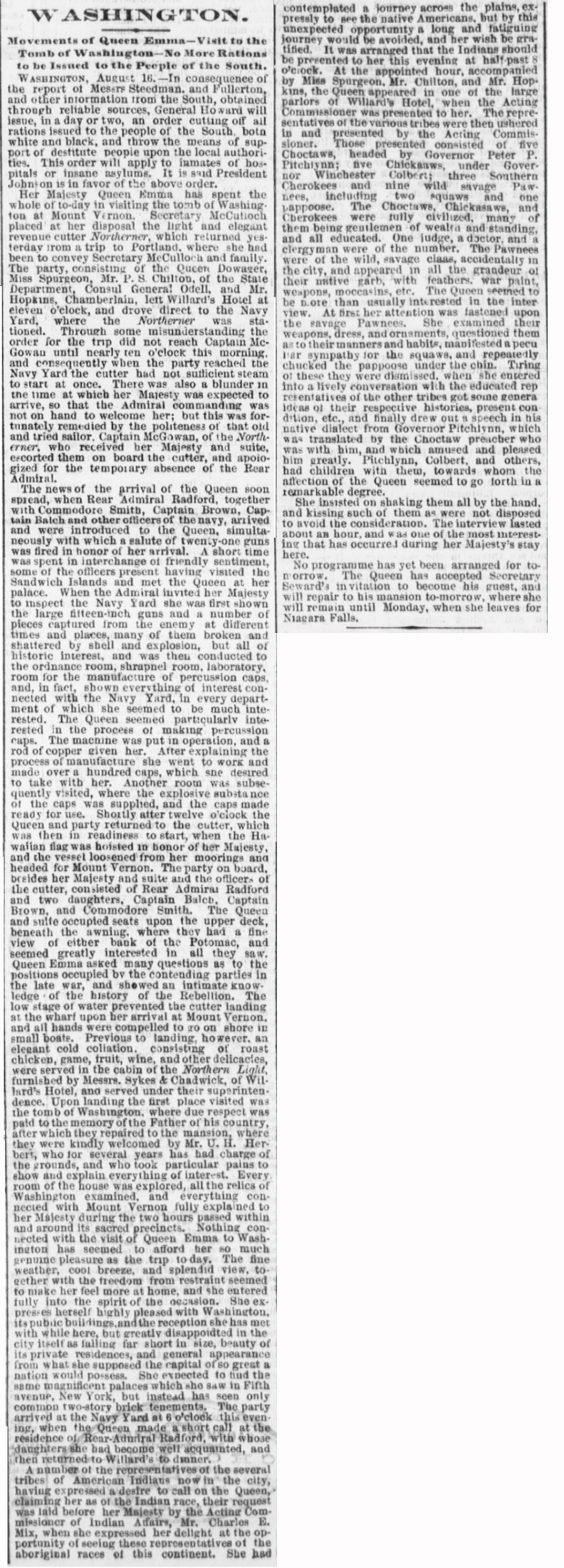
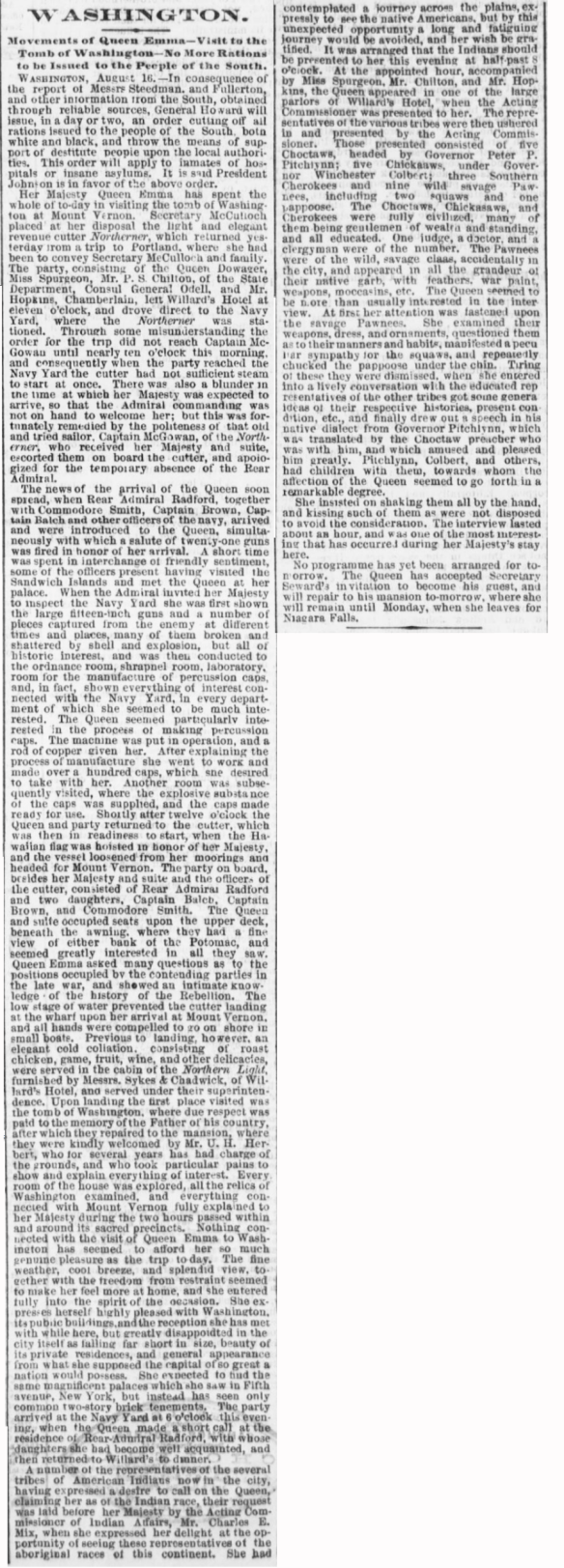
WASHINGTON.

Movements of Queen Emma—Visit to the Tomb of Washington—No More Rations to be Issued to the People of the South.

Washington, August 16.—In consequence of the report of Messrs Steedman, and Fullerton, and other information from the South, obtained through reliable sources, General Howard will issue, in a day or two, an order cutting off all rations issued to the people of the South, both white and black, and throw the means of support of destitute people upon the local authorities. This order will apply to inmates of hospitals or insane asylums. It is said President Johnson is in favor of the above order.

Her Majesty Queen Emma has spent the whole of to-day in visiting the tomb of Washington at Mount Vernon. Secretary McCullouch placed at her disposal the light and elegant revenue cutter Northerner, which returned yesterday from a trip to Portland, where she had been to convey Secretary McCulloch and family. The party, consisting of the Queen Dowager, Miss Spurgeon, Mr. P. S. Chilton, of the State Department, Consul General Odell, and Mr. Hopkins, Chamberlain, left Willard’s Hotel at eleven o’clock, and drove direct to the Navy Yard, where the Northerner was stationed. Through some misunderstanding the order for the trip did not reach Captain McGowan until nearly ten o’clock this morning, and consequently when the party reached the Navy Yard the cutter had not sufficient steam to start at once. There was also a blunder in the time at which her Majesty was expected to arrive, so that the Admiral commanding was not on hand to welcome her; but this was fortunately remedied by the politeness of that old and tried sailor, who received her Majesty and suite, escorted them on board the cutter, and apologized for the temporary absence of the Rear Admiral.

The news of the arrival of the Queen soon spread, when Read Admiral Radford, together with Commodore Smith, Captain Brown, Captain Balch and other officers of the navy, arrived and were introduced to the Queen, simultaneously with which a salute of twenty-one guns was fired in honor of her arrival. A short time was spent in interchange of friendly sentiment, some of the officers present having visited the Sandwich Islands and met the Queen at her palace. When the Admiral invited her Majesty to inspect the Navy Yard she was first shown the large fifteen-inch guns and a number of pieces captured from the enemy at different times and places, many of them broken and shattered by shell and explosion, but all of historic interest, and was then conducted to the ordinance room, shrapnel room, laboratory, room for the manufacture of percussion caps, and, in fact, shown everything of interest connected with the Navy Yard, in every department of which she seemed to be much interested. The Queen seemed particularly interested in the process of making percussion caps. The machine was put in operation, and a rod of copper given her. After explaining the process of manufacture she went to work and made over a hundred caps, which she desired to take with her. Another room was subsequently visited, where the explosive substance of the caps was supplied, and the caps made ready for use. Shortly after twelve o’clock the Queen and party returned to the cutter, which was then in readiness to start, when the Hawaiian flag was hoisted in honor of her Majesty, and the vessel loosened from her moorings and headed for Mount Vernon. The party on board, besides her Majesty and suite and the officers of the cutter, consisted of Rear Admiral Radford and two daughters, Captain Balch, Captain Brown, and Commodore Smith. The Queen and suite occupied seats upon the upper deck, beneath the awning, where they had a fine view of either bank of the Potomac, and seemed greatly interested in all they saw. Queen Emma asked many questions as to the positions occupied by the contending parties in the late war, and showed and intimate knowledge of the history of the Rebellion. The low stage of water prevented the cutter landing at the wharf upon her arrival at Mount Vernon, and all hands were compelled to go on shore in small boats. Previous to landing, however, an elegant cold collation, consisting of roast chicken, game, fruit, wine, and other delicacies, were served in the cabin of the Northern Light, furnished by Messrs. Sykes & Chadwick, of Willard’s Hotel, and served under their superintendence. Upon landing the first place visited was the tomb of Washington, where due respect was paid to the memory of the Father of this country, after which they repaired to the mansion, where they were kindly welcomed by Mr. U. H. Herbert, who for several years has had charge of the grounds, and who took particular pains to show and explain everything of interest. Every room of the house was explored, all the relics of Washington examined, and everything connected with Mount Vernon fully explained to her Majesty during the two hours passed within and around its sacred precincts. Nothing connected with the visit of Queen Emma to Washington has seemed to afford her so much genuine pleasure as the trip to-day. The fine weather, cool breeze, and splendid view, together with the freedom from restraint seemed to make her feel more at home, and she entered fully into the spirit of the occasion. She expresses herself highly pleased with Washington, its public buildings, and the reception she has met with while here, but greatly disappointed in the city itself as falling far short in size, beauty of its private residences, and general appearance from what she supposed the capital of so great a nation would possess. She expected to find the same magnificent palaces which she saw in Fifth avenue, New York, but instead has seen only common two-story brick tenements. The party arrived at the Navy Yard at 6 o’clock this evening, when the Queen made a short call at the residence of Rear-Admiral Radford, with whose daughters she had become well acquainted, and then returned to Willard’s to dinner.

A number of the representatives of the several tribes of American Indians now in the city, having expressed a desire to call on the Queen, claiming her as of the Indian race, their request was laid before her Majesty by the Acting Commissioner of Indian Affairs, Mr. Charles E. Mix, when she expressed her delight at the opportunity of seeing these representatives of the aboriginal races of this continent. She had contemplated a journey across the plains, expressly to see the native Americans, but by this unexpected opportunity a long and fatiguing journey would be avoided, and her wish be gratified. It was arranged that the Indians should be presented to her this evening at half-past 8 o’clock. At the appointed hour, accompanied by Miss Spurgeon, Mr. Chilton, and Mr. Hopkins, the Queen appeared in one of the large parlors of Willard’s Hotel, when the Acting Commissioner was presented to her. The representatives of the various tribes were then ushered in and presented by the Acting Commissioner. Those presented consisted of five Choctaws, headed by Governor Peter P. Pitchiynn; five Chickasaws, under Governor Winchester Colbert; three Southern Cherokees and nine wild savage Pawnees, including two squaws and one pappoose. The Choctaws, Chickasaws, and Cherokees were fully civilized, many of them being gentlemen of wealth and standing, and all educated. One judge, a doctor, and a clergyman were of the number. The Pawnees were of the wild, savage claas, accidentally in the city, and appeared in all the grandeur of their native garb, with feathers, war paint, weapons, moccasins, etc. The Queen seemed to be more than usually interested in their interview. At first her attention was fastened upon the savage Pawnees. She examined their weapons, dress, and ornaments, questioned them as to their manners and habits, manifested a peculiar sympathy for the squaws, and repeatedly chucked the pappoose under the chin. Tiring of these they were dismissed, when she entered into a lively conversation with the educated representatives of the other tribes got some general ideas of their respective histories, present condition, etc., and finally drew out a speech in his native dialect from Governor Pitchlynn, which was translated by the Choctaw preacher who was with him, and which amused and pleased him greatly. Pitchlynn, Colbert, and others, had children with them, towards whom the affection of the Queen seemed to go forth in a remarkable degree.

She insisted on shaking them all by the hand, and kissing such of them as were not disposed to avoid the consideration. The interview lasted about an hour, and was one of the most interesting that has occurred during her Majesty’s stay here. No programme has yet been arranged for tomorrow. The Queen has accepted Secretary Seward’s invitation to become his guest, and will repair to his mansion to-morrow, where she will remain until Monday, when she leaves for Niagara Falls.

(Evening Telegraph, 8/17/1866, p. 1)
WASHINGTON.

The Evening Telegraph, Volume VI, Number 40, Page 1. August 17, 1866.
Local coverage of Queen Emma’s visit to New York, 1866.

LOCAL NEWS.

NEW YORK AND THE VICINITY.

Movements of the Queen Dowager of Hawaii—She attends church twice yesterday—Interesting interview with deaf mutes—Queen Emma passed a comparatively quiet day on Saturday. She had her photographs taken in various positions at two photographic galleries in the morning, being accompanied by Miss Spurgin, Major Hopkins, her maid servant, and Mr. John Welsh. She also, in company with Miss Spurgin, did some shopping on Broadway during the day. The Rev. Dr. Gallaudet, Rector of St. Ann’s Church for Deaf Mutes, visited Her Majesty in the evening, and invited her to attend his church yesterday. The invitation was accepted. Gen. Darling and Col. Gerhard, of Gov. Fenton’s staff, also called and extended a formal invitation to the Queen to visit Albany, which she promised to do on her return from Boston, in the evening Her Majesty and suite dined with Hon Moses H. Grinneli and suite, and at 10 o’clock the royal party returned to the Brevcort House.

Early yesterday morning Old Trinity was crowded in every part by visitors, who, from appearances, had been attracted there by the announcement that the Queen would be present. At about half-past ten  her Majesty entered the Church accompanied by her suite, and proceeded up the main aisle, proceeded by the sexton and Rev. Dr. Vinton, who conducted her to the pew which the Prince of Wales occupied when he was here. The royal [unclear line] In the first pew were her Majesty Queen Emma, and Mr. Odel (Hawaiian Consul) and [unclear] Second—Major Hopkins, Miss Spurgin, and Mr. Chilton, Government Agent from Washington. Third—Mr. John Walsh, Mr. J. V. B. Marshall and the Swiss maid servant. As her Majesty entered the pew she knelt and remained some moments in silent prayer, and as she rose an elegant prayer book bearing a suitable inscription, and bound in royal purple with illuminated rubrics was presented to her. A suitable writing was also within the book, staiting that it was presented to her Majesty in memory of her visit and her fellowship with the Apostolic Church. Morning prayer was intoned throughout by the Rev. Dr. Vinton; the first lesson was read by Rev. Joseph J. Kinegood, of Eastern Pennsylvania. The second by Rev. Sidney Corbett, of Quincy, Ill. In the ante-communion service the epistic was read by Rev. Mr. Elesegood, and the gospel by Rev. Dr. Vinton. The music was splendid and consisted of Onseley’s service in G. the anthem, “O! Lord our Governor.” Ps. VIII, V. 1, 3, 4, by Marcello, also in G. This was the anthem sung at the Coronation of the Queen of England, and at the visit of the Prince of Wales to Trinity Church. The 41st hymn concluded the musical portion of the exercices. The solos were by Master Knowles and Mr. Yatman. In the anthem both organs were used, as they were in the [unclear] Voluntary (hallelujah chorus) Organists, Mr. W. A. M. Diller and Mr. Arthur G. Messeter. In the morning service the prayer for a safe return from sea was said, it having special reference to the Royal party. The Rev. Dr. Vinton preached the sermon from the words, “If I perish, I perish.” Esther IV: 16. He gave an account of the deposition of Queen Vashti and the elevation of Queen Esther, and remarked that this must have been no chance work, but was pre-ordained by the Almighty for the preservation of her people. He concluded by directing all to do their duty fearlessly in this world and Christ would hold out the golden sceptre of his love to those and bring them to this presence. A collection was then taken up for the benefit of the church in the Sandwich Islands, after which the congregation retired. As the Queen entered her carriage she was loudly cheered by the crowds who had collected outside the church. The party then retired to the hotel. The Queen and suite again attended St. Ann’s Church on Eighteenth street, near Fifth avenue, at 3 1/2 P. M. and witnessed the service for deaf mutes. The Rev. Dr. Gallandet explained many of the signs before the service commenced and stated some interesting circumstances connected with the church. The services were conducted by Rev. Dr. Vinton, and the sermon was preached by the Rev. Eastman Benjamin, the whole being interpreted by Rev. Dr. Gallaudet in the sign language. At the close an address was delivered by Rev. Dr. Vinton, who stated that the present was an occasion of thankfulness, inasmuch as a lady born in one of the isles of the sea and who had been lifted to a throne, had come among them to witness the miracle which had been performed, of causing the deaf to hear and the dumb to speak. It was delightful to show this miracle to her Majesty, whom God had made the instrument of making a nation Christian, which only a few years ago had been steeped in heathenism. She was now on a mission for the purpose of raising houses of mercy in her own land, and he hoped God would prosper it. By invitation, the Queen and suite remained after service, and a number of questions were asked the mutes and answered. Her Majesty, who by the way writes an elegant female hand, wrote the following, and handed it to one of the lady deaf mutes:—”My delight has been very great at being able to have prayed with you this day. I shall always remember brothers and sisters in you here when I am far away in my own land, far off, in my prayers. Do you believe we shall meet in Heaven and why?—Emma R.” The lady mute immediately wrote the following—”We, deaf mutes, are very happy to see her Majesty Queen Emma, of the Sandwich Islands to-day; and moreover we are greatly delighted in sitting with you in the house of the Lord. For myself I believe that there will be a mutual recognition in heaven.” Her Majesty then shook hands with several of the mutes, and also with the clergyman. She was accompanied to the carriage by the Rev. Dr. Gallaudet, who pressed her hand  and said, “God bless you.” She thanked him with a smile, and was driven to the hotel. This morning the Queen and suite will take the eight o’clock train to Philadelphia, en route to Washington. Mr. Cheiton, the special envoy from Mr. Seward, will accompany the royal party. The Queen will be received at Washington by Attorney General Stansbury, Acting Secretary of State.

(New York Sun, 8/13/1866, p. 1)

LOCAL NEWS.

The New York Sun, Year 33, Number 10,629, Page 1. August 13, 1866.

Beginning of the Daughters of Hawaii, 1903.

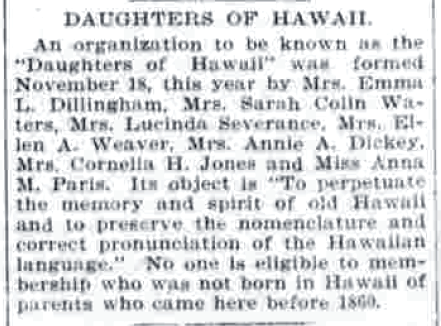
DAUGHTERS OF HAWAII.

An organization to be known as the “Daughters of Hawaii” was formed November 18, this year by Mrs. Emma L. Dillingham, Mrs. Sarah Collin Waters, Mrs. Lucinda Severance, Mrs. Ellen A. Weaver, Mrs. Annie A. Dickey, Mrs. Cornelia H. Jones and Miss Anna M. Paris. Its object is “To perpetuate the memory and spirit of old Hawaii and to preserve the nomenclature and correct pronunciation of the Hawaiian language.” No one is eligible to membership who was not born in Hawaii of parents who came here before 1869.

[I had a nice time at Queen Emma Summer Palace yesterday. They have a new exhibit called “Kiakahi,” dealing with the Queen’s travels abroad. Here is one of the first articles mentioning the Daughters of Hawaii found in the English newspapers. There are many more interesting accounts which can be found at http://chroniclingamerica.loc.gov/ and by choosing Hawaii as the state and using the search term “Daughters of Hawaii” (in quotations).]

(Hawaiian Star, 12/7/1903, p. 7)

DAUGHTERS OF HAWAII.

The Hawaiian Star, Volume XI, Number 3654, Page 7. December 7, 1903.

Those afflicted with leprosy forsaken by the church? 1873.

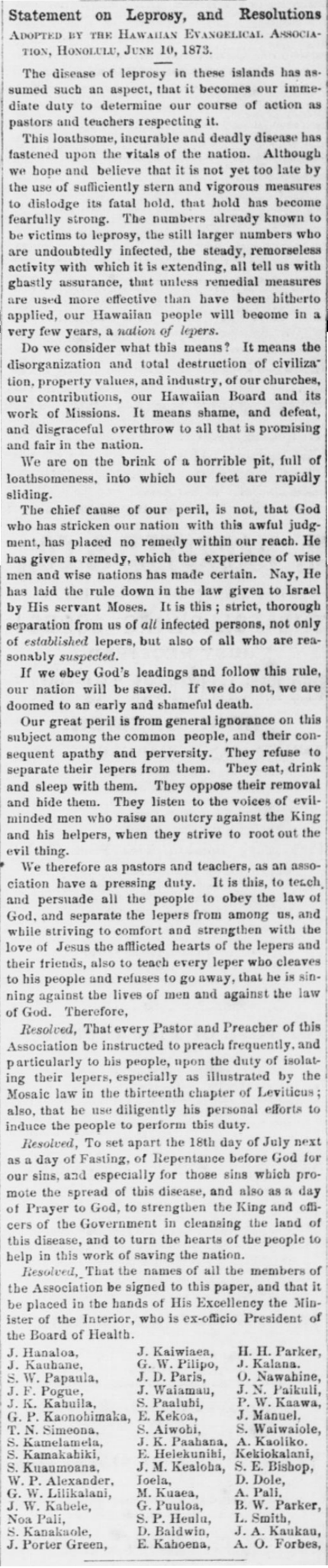
Statement on Leprosy, and Resolutions

Adopted by the Hawaiian Evangelical Association, Honolulu, June 10, 1873.

The disease of leprosy in these islands has assumed such an aspect, that it becomes our immediate duty to determine our course of action as pastors and teachers respecting it.

This loathsome, incurable and deadly disease has fastened upon the vitals of the nation. Although we hope and believe that it is not yet too late by the use of sufficiently stern and vigorous measures to dislodge its fatal hold, that hold has become fearfully strong. The numbers already known to be victims to leprosy, the still larger numbers who are undoubtedly infected, the steady, remorseless activity with which it is extending, all tell us with ghastly assurance, that unless remedial measures are used more effective than have been hitherto applied, our Hawaiian people will become in a very few years, a nation of lepers.

Do we consider what this means? It means the disorganization and total destruction of civilization, property values, and industry, of our churches, our contributions, our Hawaiian Board and its work of Missions. It means shame, and defeat, and disgraceful overthrow to all that is promising and fair in the nation.

We are on the brink of a horrible pit, full of loathsomeness, into which our feet are rapidly sliding.

The chief cause of our peril, is not, that God who has stricken our nation with this awful judgment, has placed no remedy within our reach. He has given a remedy, which the experience of wise men and wise nations has made certain. Nay, He has laid the rule down in the law given to Israel by His servant Moses. It is this; strict, thorough separation from us of all infected persons, not only of established lepers, but also of all who are reasonably suspected.

If we obey God’s leadings and follow this rule, our nation will be saved. If we do not, we are doomed to an early and shameful death.

Our great peril is from general ignorance on this subject among the common people, and their consequent apathy and perversity. They refuse to separate their lepers from them. They eat, drink and sleep with them. They oppose their removal and hide them. They listen to the voices of evil-minded men who raise an outcry against the King and his helpers, when they strive to root out the evil thing.

We therefore as pastors and teachers, as an association have a pressing duty. It is this, to teach and persuade all the people to obey the law of God, and separate the lepers from among us, and while striving to comfort and strengthen with the love of Jesus the afflicted hearts of the lepers and their friends, also to teach every leper who cleaves to his people and refuses to go away, that he is sinning against the lives of men and against the law of God. Therefore,

Resolved, That every Pastor and Preacher of this Association be instructed to preach frequently, and particularly to his people, upon the duty of isolating their lepers, especially as illustrated by the Mosaic law in the thirteenth chapter of Leviticus; also, that he use diligently his personal efforts to induce the people to perform this duty.

Resolved, To set apart the 18th day of July next as a day of Fasting, of Repentance before God for our sins, and especially for those sins which promote the spread of this disease, and also as a day of Prayer to God, to strengthen the King and officers of the Government in cleansing the land of this disease, and to turn the hearts of the people to help in this work of saving the nation.

Resolved, That the names of all the members of the Association be signed to this paper, and that it be placed in the hands of His Excellency the Minister of the Interior, who is ex-officio President of the Board of Health.

J. Hanaloa,  J. Kaiwiaea, H. H. Parker,
J. Kauhane,  G. W. Pilipo,  J. Kalana,
S. W. Papaula,  J. D. Paris,  O. Nawahine,
J. F. Pogue,  J. Waiamau,  J. N. Paikuli,
J. K. Kahuila,  S. Paaluhi,  P. W. Kaawa,
G. P. Kaonohimaka,  E. Kekoa,  J. Manuel,
T. N. Simeona,  S. Aiwohi,  S. Waiwaiole,
S. Kamelamela,  J. K. Paahana,  A. Kaoliko,
S. Kamakahiki,  E. Helekunihi,  Kekiokalani,
S. Kuaumoana,  J. M. Kealoha,  S. E. Bishop,
W. P. Alexander,  Ioela,  D. Dole,
G. W. Lilikalani,  M. Kuaea,  A. Pali,
J. W. Kahele,  G. Puuloa,  B. W. Parker,
Noa Pali,  S. P. Heulu,  L. Smith,
S. Kanakaole,  D. Baldwin,  J. A. Kaukau,
J. Porter Green,  E. Kahoena,  A. O. Forbes.

[How have things changed today? How have things remained the same? Find the Hawaiian-Language version printed in the Kuokoa, 6/18/1873, p. 3, here.]

(Pacific Commercial Advertiser, 6/14/1873, p. 3)

Statement on Leprosy, and Resolutions

The Pacific Commercial Advertiser, Volume XVII, Number 50, Page 3. June 14, 1873.

New blog from the folks who bring the Hawaii newspapers to Chronicling America, 2013.

HDNP

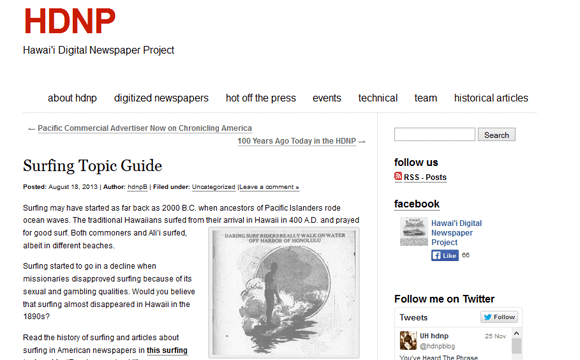
I just came across this new (as of summer 2013) blog from the Hawaii Digital Newspaper Project. They are the ones who take care of the Hawaii newspapers on Chronicling America. On the blog are posts about the progress of the project itself, as well as random articles from the English-language newspapers. I am looking forward to see what they find in the future about the past!

The Ninth Independence Day, 1852.

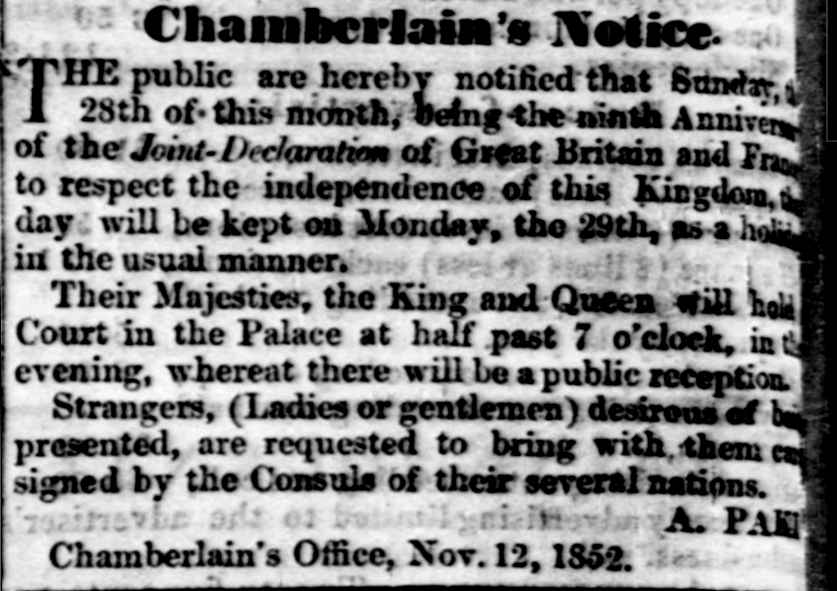
Chamberlain’s Notice.

The public are hereby notified that Sunday, the 28th of this month, being the ninth Anniversary of the Joint-Declaration of Great Britain and France to respect the independence of this Kingdom, the day will be kept on Monday, the 29th, as a holiday in the usual manner.

Their Majesties, the King and Queen will hold Court in the Palace at half past 7 o’clock, in the evening, whereat there will be a public reception.

Strangers, (Ladies or gentlemen) desirous of being presented, are requested to bring with them cards signed by the Consuls of their several nations.

A. PAKI

Chamberlain’s Office, Nov. 12, 1852.

[The 9th anniversary of La Kuokoa was celebrated under the reign of King Kamehameha III, Kauikeaouli and Queen Kapakuhaili.]

(Polynesian, 11/20/1852, p. 110)

Chamberlain's Notice.

The Polynesian, Volume 9, Number 28, Page 110. November 20, 1852.

San Francisco Call and the military trials, 1895.

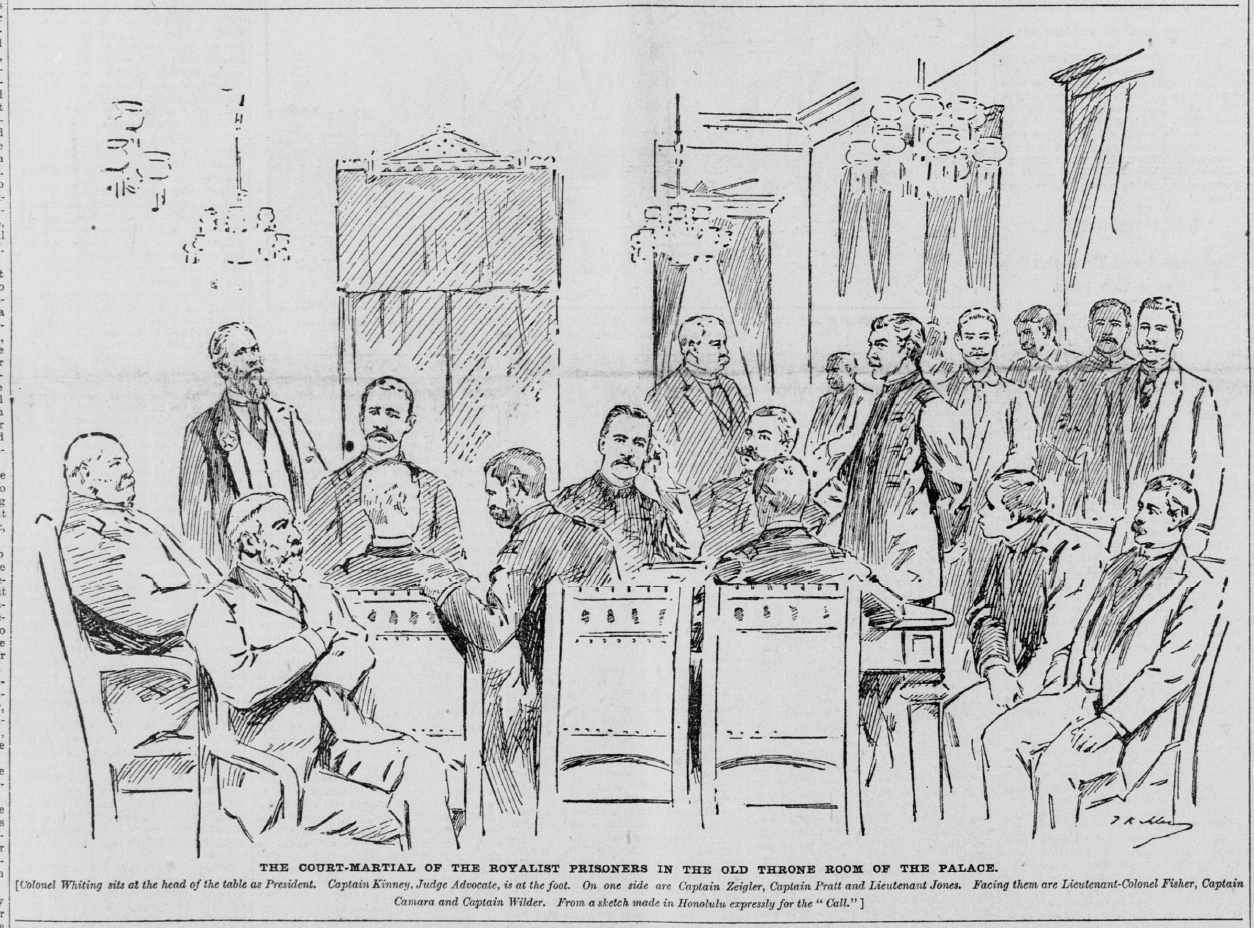
THE COURT-MARTIAL OF THE ROYALIST PRISONERS IN THE OLD THRONE ROOM OF THE PALACE.

{Colonel Whiting sits at the head of the table as President. Captain Kinney, Judge Advocate, is at the foot. On one side are Captain Zeigler, Captain Pratt and Lieutenant Jones. Facing them are Lieutenant-Colonel Fisher, Captain Camara and Captain Wilder. From a sketch made in Honolulu expressly for the “Call.”}

[The San Francisco Call had strong ties with Hawaii, and it is interesting to see the articles printed within its pages and how it saw the situation in Hawaii. See for instance the famous story printed a couple of years later: “Strangling Hands upon a Nation’s Throat,” by Miriam Michelson.

…So many unthinkable things took place in the Throne Room of Iolani Palace.]

(San Francisco Call, 2/7/1895, p. 1)

THE COURT-MARTIAL...

San Francisco Call, Volume LXXVI, Number 52, Page 1. February 7, 1895.

And yet more from the Saturday Press, including a ditty, 1884.

More True “Criticism.”

That the Government Organ, the Advertiser, is hand in glove with the perpetrators of the “Piracy” hoax, published in the S. F. Alta, is made apparent by the fact that a stereotype plate of the article was received at that office per Alameda, and from which the ‘extra’ was printed.—Gazette.

Notwithstanding the snarling jealousy of our antiquated neighbor, it is the intention of the proprietors of the Advertiser to repeat the enterprise shown by them on Tuesday last. No expense will be spared to furnish the most interesting news within an hour of each steamer’s arrival. By the Zealandia, we expect something special that will afford further criticism for our out-of-date, old-time-custom, weakly  contemporary,—Advertiser.

“Auwe! Auwe!”
Said the P. C. A.
“You horrid horrid Gazette,
Get!
Virtuous fellers is we
As ever the world did see,
And ‘enterprizen.’
As pizen.
Do you think, as you wink,
O! big blanket G.,
That we
Was a goin to give the thing away
And say
As how we got ‘lectrotypes from ‘Frisco
And printed em brisk so
The town would roll up its eyes and say
‘Auwe!’
‘How awfully clever!’ ‘Now did you ever!’?
We never thought any one here would spy
The little wee rent in the great big lie.
Wich is w’y we cry,
Wich is w’y we wail,
Wich is w’y the ‘Tizer dog droops his tail,
For the lie un-nailed made a very big bang;
But the lie found out was a boomerang.”

(Saturday Press, 12/27/1884, p. 3)

"More True Criticism."

Saturday Press, Volume V, Number 17, Page 3. December 27, 1884.

Reaction from the Saturday Press, 1884.

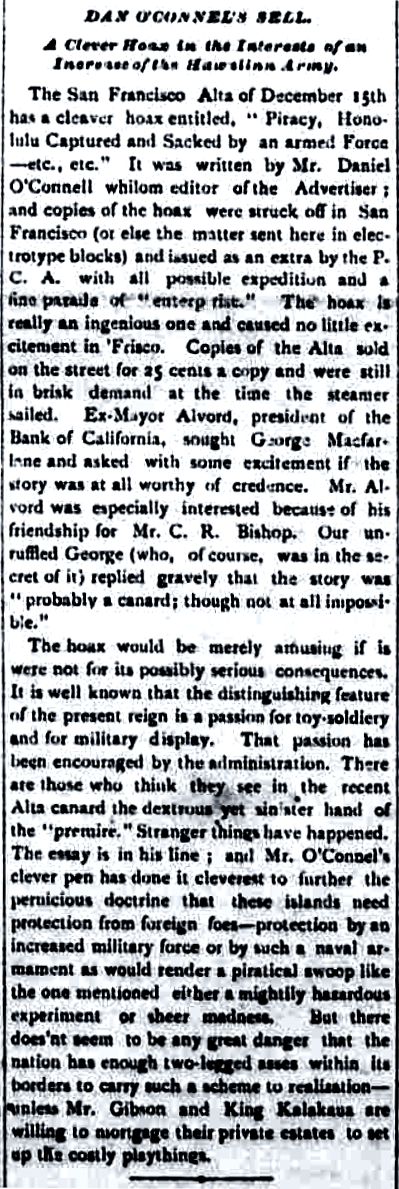
DAN O’CONNEL’S SELL.

A Clever Hoax in the Interests of an Increase of the Hawaiian Army.

The San Francisco Alta of December 15th has a cleaver hoax entitled, “Piracy, Honolulu Captured and Sacked by an armed Force—etc., etc.” It was written by Mr. Daniel O’Connell whilom editor of the Advertiser ; and copies of the hoax were struck off in San Francisco (or else the matter sent here in electrotype blocks) and issued as an extra by the P. C. A. with all possible expedition and a fine parade of “enterp rise.” The hoax is really an ingenious one and caused no little excitement in ‘Frisco. Copies of the Alta sold on the street for 25 cents a copy and were still in brisk demand at the time the steamer sailed. Ex-Mayor Alvord, president of the Bank of California, sought George Macfarlane and asked with some excitement if the story was at all worthy of credence. Mr. Alvord was especially interested because of his friendship for Mr. C. R. Bishop. Our unruffled George (who, of course, was in the secret of it) replied gravely that the story was probably a canard; though not at all impossible.”

The hoax would be merely amusing if is were not for its possibly serious consequences. It is well known that the distinguishing feature of the present reign is a passion for toy-soldiery and for military display. That passion has been encouraged by the administration. There are those who think they see in the recent Alta canard the dextrous yet sinister hand of the “premire.” Stranger things have happened. The essay is in his line ; and Mr. O’Connel’s clever pen has done it cleverest to further the pernicious doctrine that these islands need protection from foreign foes—protection by an increased military force or by such a naval armament as would render a piratical swoop like the one mentioned either a mightily hazardous experiment or sheer madness. But there does’nt seem to be any great danger that the nation has enough two-legged asses within its borders to carry such a scheme to realization —unless Mr. Gibson and King Kalakaua are willing lo mortgage their private estates to set up the costly playthings.

(Saturday Press, 12/27/1884, p. 3)

DAN O'CONNEL'S SELL.

Saturday Press, Volume V, Number 17, Page 3. December 27, 1884.