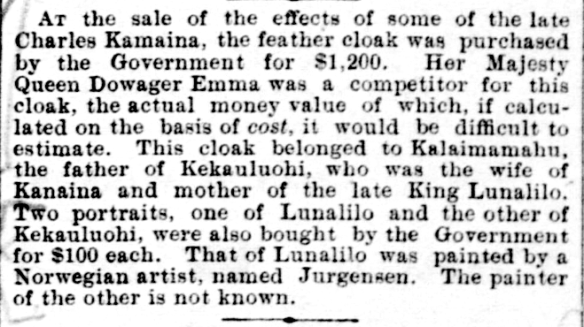
Estate sale of Charles Kanaina, 1882.

[Found under: “NEWS OF THE WEEK.”]

At the sale of the effects of some of the late Charles Kanaina, the feather cloak was purchased by the Government for $1,200. Her Majesty Queen Dowager Emma was a competitor for this cloak, the actual money value of which, if calculated on the basis of cost, it would be difficult to estimate. This cloak belonged to Kalaimamahu, the father of Kekauluohi, who was the wife of Kanaina and mother of the late King Lunalilo. Two portraits, one of Lunalilo and the other of Kekauluohi, were also bought by the Government for $100 each. That of Lunalilo was painted by Norwegian artist, named Jurgensen. The painter of the toher is not known.

(Pacific Commercial Advertiser, 7/29/1882, p. 3)

PCA_7_29_1882_3

The Pacific Commercial Advertiser, Volume XXVII, Number 5, Page 3. July 29, 1882.

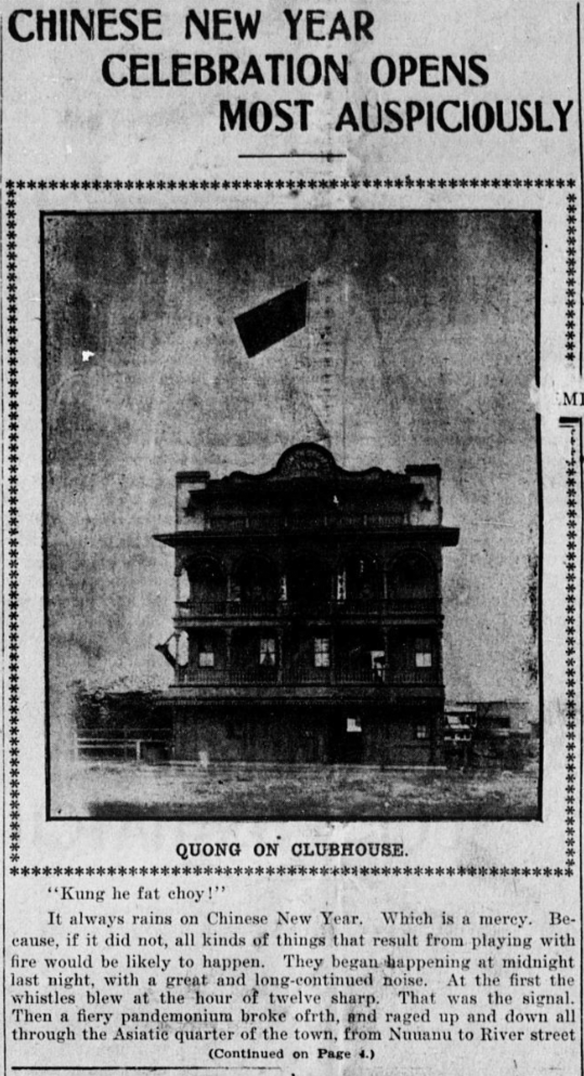
Chinese New Year, 1905.

CHINESE NEW YEAR CELEBRATION OPENS MOST AUSPICIOUSLY

QUONG ON CLUBHOUSE.

“Kung he fat choy!”

It always rains on Chinese New Year. Which is a mercy. Because, if it did not, all kinds of things that result from playing with fire would be likely to happen. They began happening at midnight last night, with a great and long-continued noise. At the first the whistles blew at the hour of twelve sharp. That was the signal. Then a fiery pandemonium broke forth, and raged up and down all through the Asiatic quarter of the town, from Nuuanu to  River street…

(Hawaiian Gazette, 2/3/1905, p. 1)

HawaiianGazette_2_3_1905_1.png

Hawaiian Gazette, Volume XL, Number 10, Page 1. February 3, 1905.

…and beyond, and on all the cross streets where the sons of the Central Flowery Kingdom, who make their homes in Honolulu, have their abiding place. Continue reading

Thomas De Witt Talmage on the overthrow, 1894.

A TWO SIDED CASE.

DR. TALMAGE INVESTIGATES THE TROUBLE IN HAWAII.

The American Traveler Also Enjoys the Hospitality of the Ex-Queen and the New President—The Wife of the Latter a Most Delightful and Talented Lady.

[Copyright, Louis Kiopesch, 1894.]

Honolulu, June 18.—The chamberlain, come to invite us to the residence of the ex-queen, had suggested 11 o’clock that morning as the best hour for our visit. We approached the wide open doors through a yard of palm trees and bananas and cocoanut, and amid flowers that dyed the yard with all the colors that a tropical sun can paint. We were ushered into the royal lady’s reception room, where, surrounded by a group of distinguished persons, she arose to greet us with a cordial grasp of the hand. The pictures of her hardly convey an accurate idea of her dignity of bearing. She has all the ease of one born to high position. Her political mis-…

EX-QUEEN LILIUOKALANI.

fortunes seem in nowise to have saddened her. She spoke freely of the brightness of life to any one disposed to meet all obligations, and at my suggestion that we found in life chiefly what we look for, and if we look for flowers we find flowers, and if we look for thorns we find thorns, she remarked: “I have found in the path of life chiefly flowers. I do not see how any one surrounded by as many blessings as many of us possess could be so ungrateful as to complain.” She said it was something to be remembered thankfully that for 50 years there was no revolution in the islands. She has full faith that the provisional government is only a temporary affair, and that she will again occupy the throne.

She asked her servant to show me, as something I had not seen before, a royal adornment made up from the small bird with a large name—the Melithreptes pacifica [mamo; Drepanis pacifica]. This bird, I had read, had under its wing a single feather of very exquisite color. The queen corrected my information by saying that it was not a single feather, but a tuft of feathers from under the wing of the bird from which the adornment was fashioned into a chain of beauty for the neck. She spoke of her visit to New York, but said that prolonged illness hindered her from seeing much of the city. She talked freely and intelligently on many subjects pertaining to the present and the future.

I was delighted with her appearance and manner and do not believe one word of the wretched stuff that has been written concerning her immoralities. Defamation is so easy, and there is so much cynicism aboard, which would rather believe evil than good, that it is not to be thought strange that this queen, like all the other rulers of the earth, has been beaten with storms of obloquy and misrepresentation. George Washington was called by Tom Paine a lying impostor. Thomas Jefferson was styled an infidel, and since those times we are said to have had in the United States presidency a bloodthirsty man, a drunkard and at least two libertines, and if anybody in prominent place and effective work has escaped “let him speak, for him have I offended.” After an exchange of autographs on that day in Honolulu we parted. Continue reading

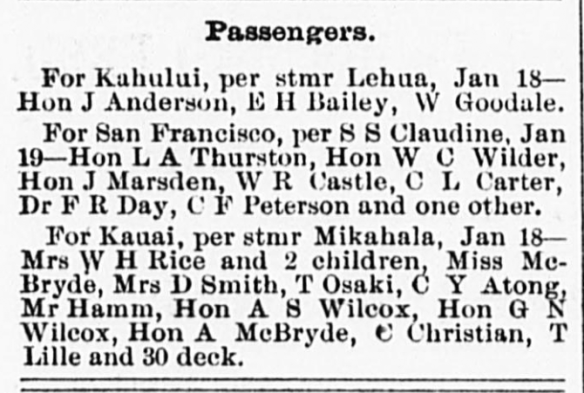
Ship passenger list, 1893.

Passengers.

For Kahului, per stmr Lehua, Jan 18—Hon J Anderson, E H Bailey,W Goodale.

For San Francisco, per S S Claudine, Jan 19—Hon L A Thurston, Hon W C Wilder, Hon J Marsden, W R Castle, C L Carter, Dr F R Day, C F Peterson and one other.

For Kauai, per stmr Mikahala, Jan 18—Mrs W H Rice and 2 children, Miss McBryde, Mrs D Smith, T Osaki, C Y Atong, Mr Hamm, Hon A S Wilcox, Hon G N Wilcox, Hon A McBryde, C Christian, T Lille and 30 deck.

(Daily Bulletin, 1/19/1893, p. 3)

DailyBulletin_1_19_1893_3

The Daily Bulletin, Volume  V, Number 628, Page 3. January 19, 1893.

More on the landing of the Boston, 1893.

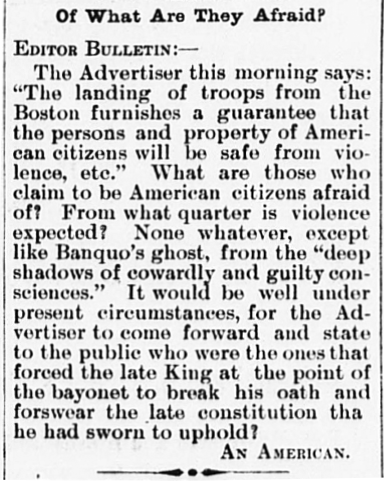
Of What Are They Afraid?

Editor Bulletin:—

The Advertiser this morning says: “The landing of the troops from the Boston furnishes a guarantee that the persons and property of American citizens will be safe from violence, etc.” What are those who claim to be American citizens afraid of? From what quarter is violence expected? None whatever, except like Banquo’s ghost,¹ from the “deep shadows of cowardly and guilty consciences.” It would be well under present circumstances, for the Advertiser to come forward and state to the public who were the ones that forced the late King at the point of the bayonet to break his oath and forswear the late constitution that he had sworn to uphold?

An American.

¹Reference to Shakespeare’s Macbeth.

(Daily Bulletin, 1/17/1893, p. 3)

DailyBulletin_1_17_1893_3

The Daily Bulletin, Volume V, Number 626, Page 3. January 17, 1893.


Duke, the true sportsman! 1916.

WIN OR LOSE KAHANAMOKU WEARS SMILE

Duke Kahanamoku, Greatest of Swimmers.

“The biggest thing in sport? It is the heart to accept defeat gracefully.”

The Duke Kahanamoku, greatest of swimmers, has just been beaten, together with his teammates, in the grueling 300-yard exposition relay swim at San Francisco by the Illinois Athletic club.

His smile and unstinted praise for the victors gave his words a personal application. “The duke” knows how to lose as well as to win. Continue reading

Ka Puuhonua o na Hawaii, 1916.

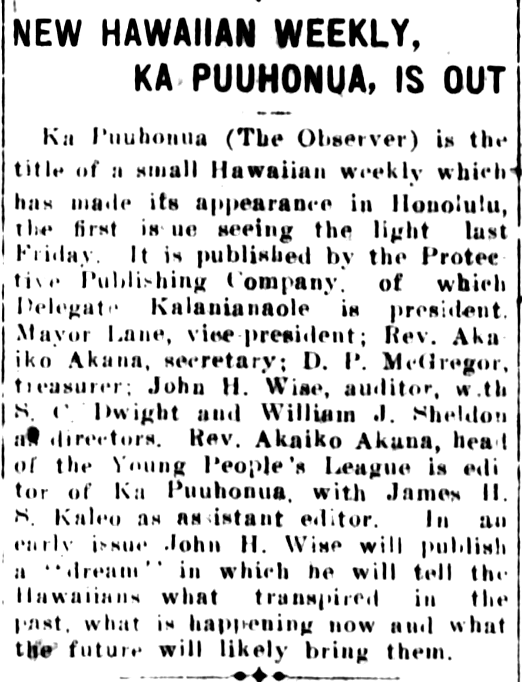
NEW HAWAIIAN WEEKLY, KA PUUHONUA, IS OUT

Ka Puuhonua (The Observer) is the title of a small Hawaiian weekly which has made its appearance in Honolulu, the first issue seeing the light last Friday. It is published by the Protective Publishing Company, of which Delegate Kalanianaole is president. Mayor Lane, vice president; Rev. Akaiko Akana, secretary; D. P. McGregor, treasurer; John H. Wise, auditor, with S. C. Dwight and William J. Sheldon as directors. Rev. Akaiko Akana, head of the Young People’s League is editor of Ka Puuhonua with James H. S. Kaleo as assistant editor. In an early issue John H. Wise will publish a “dream” in which he will tell the Hawaiians what transpired in the past, what is happening now and what the future will likely bring them.

(Hawaiian Gazette, 4/14/1916, p. 5)

NEW HAWAIIAN WEEKLY, KA PUUHONUA, IS OUT

The Hawaiian Gazette, Volume IX, Number 29, Page 5. April 14, 1916.

Sarai Hiwauli died, 1856.

DIED.

At Nawiliwili, Kauai, on the 29th of this past August, Sarai Hiwauli, the wife of Ioane Ii, of Honolulu nei. She was travelling with the Alii who were circuiting the land, and she got paralysis and died. She was returned by the ship the Maria in the morning of the 3rd of Sept. when the ship docked. And it will carry the King and the chiefs from Kauai to Hilo. Mr. Ii is at Hilo judging, and he was told to return.

Sarai Hiwauli was a loving, benevolent, and respectable woman. She was highly regarded by all for her righteousness and her piety. She will be mourned from Hawaii to Niihau by her fellow church members and mostly her people. “Blessed are the dead who die in the Lord.”

[The Hoku Loa was a page of the Pacific Commercial Advertiser from 7/2/1856 to 9/18/1856, and was a precursor to the Hawaiian-Language Newspaper, Kuokoa.]

(Hoku Loa o Hawaii, 9/11/1856 [Pacific Commercial Advertiser 9/11/1856, p. 4])

MAKE.

The Pacific Commercial Advertiser, Volume I, Number 11, Page 4. September 11, 1856.

Mongoose, “a general destroyer,” 1883.

[Found under: “EDITORIALS.”]

The Planters’ Monthly has lately been proposing the introduction of a little animals from India called the mongoose, as a destroyer of rats. He is a famous ratter, surpassing the cat or the ferret. He is described as a lively little urchin, about the size of a weasel, as having a snaky body, vicious looking claws, a sharp nose, a villanous eye and looks like “murder incarnate.” In speaking of his action in capturing rats, it is said that he crawls sinuously up to his victim until within easy distance for a rush, and then strikes with unerring aim, snapping the rat just at the base of the brain. The rat has not time even to squeak, so sudden and deadly is the onslaught. Wherever the rat can enter the mongoose can follow. Thus as a ratter this lively little Indian is incomparable, but the trouble is he will not confine his operations to what is deemed his legitimate business. Some writers have endeavored to save his credit as a poultry destroyer, but a naturalist, who has carefully observed his characteristics, says that he is a general destroyer, not only of everything under, but of many creatures over his size. When in a cage that sight of a small living creature made him frantic and whenever he escaped, as he sometimes did, he made a sensation in the poultry house. The mongoose is not content with maurauding forays in the yard, but he seems to pervade the house when domesticated. His manner for getting into objectionable nooks and holes is most perplexing, as for instance the leg of a pair of trousers or a skirt with the owner in them, quite come up to his views, as a desirable place for a roost or forage. The rat is unquestionably a great pest of the cane and rice planter and grain cultivator in all parts of the world. The rat pest was deemed so serious here some fifty years ago that an enlightened and enterprising Commisioner of the Hawaiian Government, sent in quest of Chinese coolies, deemed it a judicious venture in behalf of the agricultural interests of the Islands to procure a species of sanke famed as a destroyer of rats; but the Hawaiian people, whose sacred soil has been kept free from snakes and toads by some patron saint in influence to St. Patrick, conceived a holy terror of the snake, notwithstanding his possible utilities, and passed a decree that Hawaii would have no snake in her plantations. The destruction of rats in the cane-fields was hardly deemed a sufficient compensation to the Hawaiian mind for the probable presence every now and then of his snakeship in the thatch of the Hawaiian hale-pili. And we think that if the mongoose be as well understood as the snake, he will be as objectionable as the tempter of our first parents to the popular mind. This terrible Indian ferret is said to take a fancy to fasten on to lambs and suck away their very life-blood; and who knows if he may not ake a fancy once in a while to a baby in its cradle. Continue reading