Kamehameha IV returns to Honolulu from Kona, 1862.

Return of the King.

The King [Kamehameha IV] returned from Kona, Hawaii, in the morning of this past Sunday, the 29th of Dec., with the Queen [Emalani], and Ka Haku o Hawaii, and their travel companions, the Honorable W. C. Lunalilo, Peter Y. Kekuaokalani, and the family of the Alii. The Royal Ones are in good health. Long live the Alii in God.

(Hoku o Hawaii, 1/2/1862, p. 2)

Ka hoi mai o ka Moi.

Ka Hoku o ka Pakipika, Buke I, Helu 15, Aoao 2. Ianuari 2, 1862.

A name song for the fearless traveler, Emalani, 1871.

He Inoa no Kaleleonalani.

Ka uka i Kilohana ka anoi la,
Ka iini kau o ka manao la,
Ka halia i ke anu o ka uka la,
I ke ohu nee o ka mauna la,
He kapeke he pahee he pakika la,
Ke ala e hiki aku ai la,
Paa i ka lala kamahele la,
Na hinahina ku alanui la,
Ke hiki aku i Puukapele la,
I ka kauila pano ohiohi la,
Luana i Waineki ka Wahine la,
Kaleleonalani he inoa la,
Moe aku i ka hale kamala la,
Hale o ka pupu kanioe la,
He’hu wawae o Elekini la,
Kinikini na hoa Painiu la,
Ka nahele o Hauailiki la,
Ilaila o Kapukaohelo la,
He ihona Kauaikanana la,
Ikiiki ia alu kahawai la,
He ka-hana koke aku no ia la,
Heia ka mana o ka wai la,
Hailona i ke kino ohia la,
Ka piina’ku o Pakaua la,
He kaua lima ka ke aloha la,
Kualono o Kaluaokaa la,
Komo i ka nahele wehiwehi la,
I ka ulu ohia mokihana la,
Ku hao Kalehuamakanoe la,
Ponaha i ka wao laau la,
Noe wale mai no ka lehua la,
Neenee papa i ke Kohekohe la,
Ua poni ka maka o ia pua la,
Noho hiehie i ka lau laau la,
He nenelu ke ala e hiki ai la,
He ulike launa ole mai la,
Hoao i na lepo pilali la,
Kohu lepo ai o Kawainui la,
Kalalaakamanu aku ia la,
Ka ihona aku o Kawaikoi la,
Koi kua inea i ka loa la,
Aikena ua maopaopa la,
He hanahanai Halepaakai la,
He malana hinu hoi ka nahele la,
I ka naele o Alakai la,
Ka nahele o Aiponui la,
He au kika i ka Puukolea la,
Kunihi mai Aipoiki la,
Lawelawe na lima o ke anu la,
Kipu paa mai e ka noe la,
Halana wai a’e ko lalo la,
Moe ole ia po a ao la,
Na hoa i ka heu kalakala la,
Hoolale i ke ahi lala poli la,
Pulupulu i ka pua limu la,
Ua noho pohai a puni la,
Le’a ai kulou a “Emma” la,
Aia ka pono o ke ao la,
I loaa Kipapaaola la,
Ua ola i ka ohu kokua la,
Kau pono i Kaawakoo la,
Ka palena mai o Kilohana la,
Okipau ka hana a ka Wahine la,
Kau pono iho i ka wekiu la,
Ka pane poo o Maunahina la,
Ike i na pali Koolau la,
Ka waiho nani a Hanalei la,
One hanana o Mahamoku la,
Oni ana o Naue i ke kai la,
O ka wai o Lumahai la,
E huli e hoi ka Wahine la,
Ua uhi ka ohu i ka mauna la,
He aloha—la—ua lai—e.     “Mi;” *

Honolulu, Feb. 9, 1871.

[A name song written for Queen Emma and her famous travels about Kauai.]

(Au Okoa, 2/16/1871, p. 1)

He Inoa no Kaleleonalani.

Ke Au Okoa, Buke VI, Helu 44, Aoao 1. Feberuari 16, 1871.

Kaleleonalani, 44 years old, 1880.

The Birthday of Emma Lani.—This Friday (yesterday) the 2nd of January 1880, Queen Emma Kaleleonalani made a full 44 years old. Just as usual, the day her royal mother suffered the pangs of birth arrived. The walls of her estate were filled with people. We are very happy to announce to the public that the cherished lehua blossom is as always bright upon her attractive full cheeks and the body of that “Rare Blossom” of the lahui remains strong. And while the people joyfully celebrate the arrival of that fine day, we remember and join in the cheer, and give our prayer that she lives long with her family with ease and good fortune. The King was graceful in passing by to give his congratulations to the Queen of one of the famed Kings of Hawaii nei.

(Kuokoa, 1/3/1880, p. 2)

Ka La Hanau o Emma Lani.

Ka Nupepa Kuokoa, Buke XIX, Helu 1, Aoao 2. Ianuari 3, 1880.

Hanaiakamalama rules, 1916.

RULES REGARDING HOME OF QUEEN EMMA PASSED BY HAWAII DAUGHTERS

Rules and regulations bearing on Hanaiakamalama, the Nuuanu home of the late Queen Emma, were adopted at a meeting on Wednesday of the Daughters of Hawaii, which society now has charge of the home. The rules are as follows:

“1. The object of Hanaiakamalama is to preserve articles formerly owned by the late Queen Emma and such other articles of historic interest as may be give the Daughters of Hawaii for safe keeping.

“2. The building shall be open to visitors daily from 9 to 12 in the morning and from 2 to 4 in the afternoon, excepting Sunday and other days that may be designated.

“3. The house can only be used as a meeting place for the Daughters of Hawaii and cannot be engaged for any other purpose.

“4. A fee of 25 cents will be charged all visitors, members excepted.

“5. Visitors are requested not to handle or deface any article in the building.”

(Star-Bulletin, 10/19/1916, p. 3)

RULES REGARDING HOME OF QUEEN EMMA PASSED BY HAWAII DAUGHTERS

Honolulu Star-Bulletin, Volume XXIV, Number 7651, Page 3. October 19, 1916.

Traditional place names and the Daughters of Hawaii, 1918.

OLD HAWAIIAN NAMES TO BE PRESERVED.

This past Wednesday the Daughters of Hawaii [Ahahui o na Kaikamahine] held a meeting at the home of Queen Emma in the uplands of Nuuanu, known by all by the name Hanaiakamalama, the old home of Kamehameha IV and his queen; and at that meeting it was decided that the calling of many places in Honolulu nei by their Hawaiian names will be preserved forever.

To carry out this endeavor, the organization decided to continue calling the name “Leahi,” and not Diamond Head, as it is being called now, and so too with other names that have been changed; they will be returned to their old names that Hawaiians are familiar with.

At that meeting several things were read pertaining to the life of Queen Liliuokalani  by Mrs. Lahilahi Web, a speech by A. F. Knudsen, and Representative Kuhio, along with the singing of some old mele, just as if they were recreating memories of familiar deeds from the time of Queen Emma in that home.

For the treasury of the Red Cross, Mr. A. F. Knudsen will give a speech specifically pertaining to Hawaii nei of the olden days, at Memorial Hall of the Hawaiian Evangelical Association [Papa Hawaii], at eight o’clock on the evening of this Saturday, May 4, under the direction of the Daughters of Hawaii nei.

The entrance will be half price to go and listen to the speech and for all activities that will be put on, and being that it is a benefit for the Red Cross, and that it is beneficial to listen to this history pertaining to the Hawaiian lahui, all the people should go to hear his speech so that the new generations can get some education.

Mr. Knudsen was born on Kauai and went around amongst the Hawaiian children, and met the old people, and listened to the old stories of Hawaii nei; and because of this, the stories he tells that night will be something totally new for Hawaiians of today, the people who know hardly any of the stories of their lahui and their land.

(Kuokoa, 5/3/1918, p. 4)

E MALAMAIA NA INOA HAWAII KAHIKO.

Ka Nupepa Kuokoa, Buke LVI, Helu 18, Aoao 4. Mei 3, 1918.

The first Kamehameha Day, 1872.

On this past Tuesday, in accordance with the royal proclamation, the 11th of June was celebrated as a day of remembrance of Kamehameha I, the Royal Ancestor who conquered our aina. This is a new day included in the circle of holidays, and the minds of the populace are happy about this type of day set aside to remember our cherished one of days gone by. The day dawned beautifully; there were no droplets to interfere with those who skillfully took care of the day. From early morning the doors of the shops of the town, both large and small, were shut. And when the sun came all the way out, there were not many people seen on the streets of town, and the great work places were deserted. All things meant to entertain themselves were prepared—some people made parties while others rode horses; however, it seemed as if most of the people were all at the races organized at Kulaokahua, the usual place for all types of entertainment.

The atmosphere of the race tracks that day seemed better than all previous days. Lanai and tents were set up impeccably, and those that undertook that task received much appreciation. The lanai, fields, and hills were filled with thousands who amused themselves with the events of the day. If an observer stood and watched from afar, it was as if he were seeing a picture of a race day somewhere like in Europe. The events of the day started at 10 or so, and after watching all the day’s activities, it was truly wonderful. There were no great commotions to disturb the peace among the crowd–this is something unfamiliar on special days like these.

At 10 o’clock sharp, Queen Emma arrived with her guests, and King Kapuaiwa with his entourage. At the appearance of the King, the activities of the day commenced, and all of the crowd joined in the gaieties that were set up. Below, you will find the races and those that won.

[Various horse races, winners, and prizes are listed.]

The final race, the wheelbarrow race was the most humorous. This entertainment marked the close of the festivities of the day. And everyone left with hearts filled with much glee. We are greatly pleased with one thing, and that is the decrease in the number of outbreaks of various sorts. There were no big riots thought to be related to the events of the day.

(Au Okoa, 6/13/1872, p. 2)

Ma ka Poalua iho nei...

Ke Au Okoa, Buke VIII, Helu 9, Aoao 2. Iune 13, 1872.

St. Andrew’s, the early days, 1909.

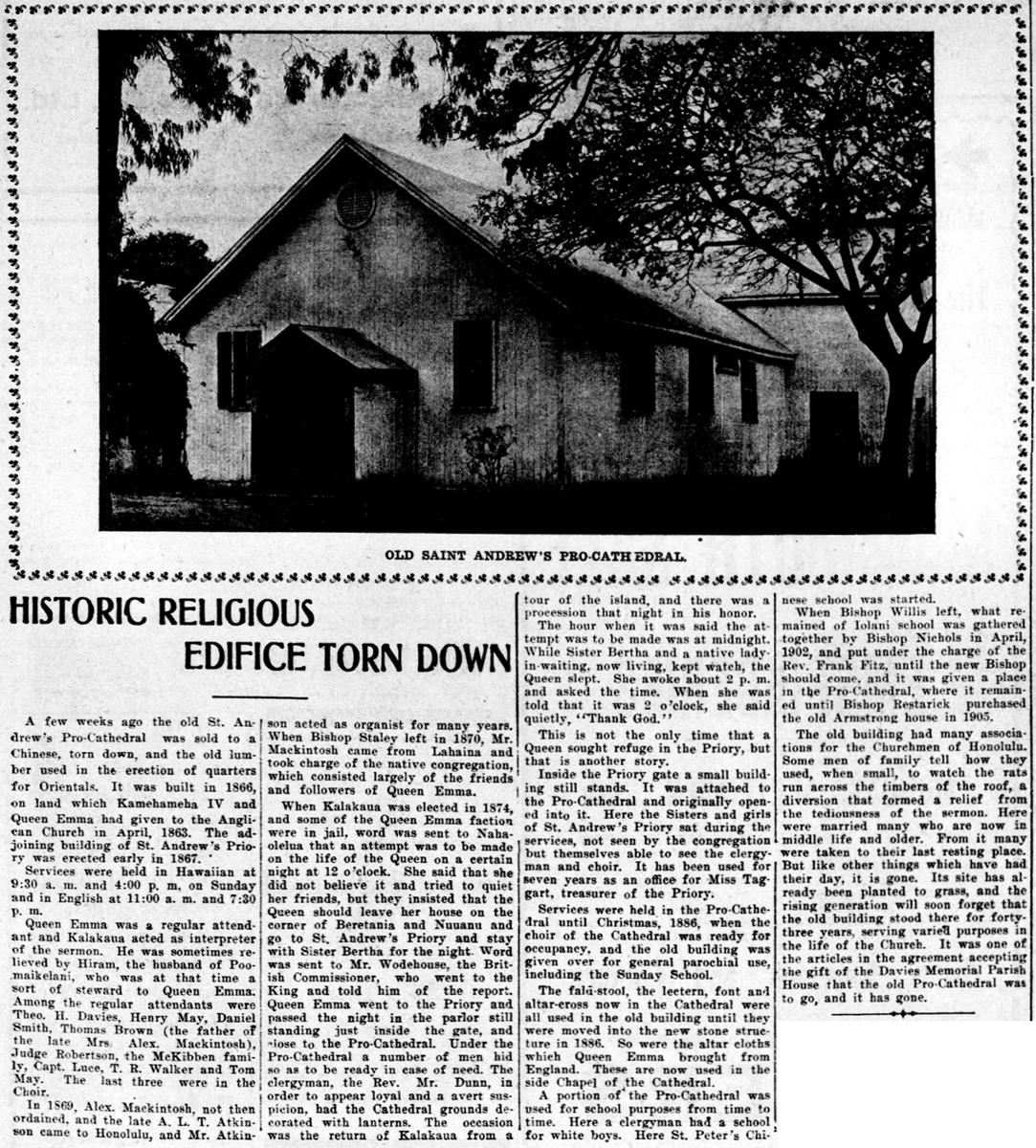
OLD SAINT ANDREW’S PRO-CATHEDRAL.

RELIGIOUS EDIFICE TORN DOWN

A few weeks ago the old St. Andrew’s Pro-Cathedral was sold to a Chinese, torn down, and the old lumber used in the erection of quarters for Orientals. It was built in 1866, on land which Kamehameha IV and Queen Emma had given to the Anglican Church in April 1863. The adjoining building of St. Andrew’s Priory was erected in 1867.

Services were held in Hawaiian at 9:30 a. m. and 4:00 p. m. on Sunday and in English at 11:00 a. m. and 7:30 p. m.

Queen Emma was a regular attendant and Kalakaua acted as interpreter of the sermon. He was sometimes relieved by Hiram, the husband of Poomaikelani, who was at that time a sort of steward to Queen Emma. Among the regular attendants were Theo. H. Davies, Henry May, Daniel Smith, Thomas Brown (the father of the late Mrs. Alex. McKintosh), Judge Robertson, the McKibben family, Capt. Luce, T. R. Walker and Tom May. The last three were in the Choir.

In 1869, Alex. Mackintosh, not then ordained, and the late A. L. T. Atkinson came to Honolulu, and Mr. Atkinson acted as organist for many years. When Bishop Staley left in 1870, Mr. Mackintosh came from Lahaina and took charge of the native congregation, which consisted largely of the friends and followers of Queen Emma.

When Kalakaua was elected in 1874, and some of the Queen Emma faction were in jail, word was sent to Nahaolelua that an attempt was to be made on the life of the Queen on a certain night at 12 o’clock. She said that she did not believe it and tried to quiet her friends, but they insisted that the Queen should leave her house on the corner of Beretania and Nuuanu and go to St. Andrew’s Priory and stay with Sister Bertha for the night. Word was sent to Mr. Wodehouse, the British Commissioner, who went to the King and told him of the report. Queen Emma went to the Priory and passed the night in the parlor still standing just inside the gate, and close to the Pro-Cathedral. Under the Pro-Cathedral a number of men hid so as to be ready in case of need. The clergyman, the Rev. Mr. Dunn, in order to appear loyal and a avert suspicion, had the Cathedral grounds decorated with lanterns. The occasion was the return of Kalakaua from a tour of the island, and there was a procession that night in his honor.

The hour when it was said the attempt was to be made was at midnight. While Sister Bertha and a native lady-in-waiting, now living, kept watch, the Queen slept. She awoke about 2 p. m. and asked the time. When she was told that it was 2 o’clock, she said quietly, “Thank God.”

This is not the only time that a Queen sought refuge in the Priory, but that is another story.

Inside the Priory gate a small building still stands. It was attached to the Pro-Cathedral and originally opened into it. Here the Sisters and girls of St. Andrew’s Priory sat during the services, not seen by the congregation but themselves able to see the clergyman and choir. It has been used for seven years as an office for Miss Taggart, treasurer of the Priory.

Services were held in the Pro-Cathedral until Christmas, 1886, when the choir of the Cathedral was ready for occupancy, and the old building was given over for general parochial use, including the Sunday School.

The fald-stool, the lectern, font and altar-cross now in the Cathedral were all used in the old building until they were moved into the new stone structure in 1886. So were the altar cloths which Queen Emma brought from England. These are now used in the side Chapel of the Cathedral.

A portion of the Pro-Cathedral was used for school purposes from time to time. Here a clergyman had a school for white boys. Here St. Peter’s Chinese school was started.

When Bishop Willis left, what remained of Iolani school was gathered together by Bishop Nichols in April, 1902, and put under the charge of the Rev. Frank Fitz, until the new Bishop should come, and it was given a place in the Pro-Cathedral, where it remained until Bishop Restarick purchased the old Armstrong house in 1905.

The old building had many associations for the Churchmen of Honolulu. Some men of family tell how they used, when small, to watch the rats run across the timbers of the roof, a diversion that formed a relief from the tediousness of the sermon. Here were married many who are now in middle life and older. From it many were taken to their last resting place. But like other things which have had their day, it is gone. Its site has already been planted to grass, and the rising generation will soon forget that the old building stood there for forty-three years, serving varied purposes in the life of the Church. It was one of the articles in the agreement accepting the gift of the Davies Memorial Parish House that the old Pro-Cathedral was to go, and it has gone.

(Pacific Commercial Advertiser, 9/18/1909, p. 3)
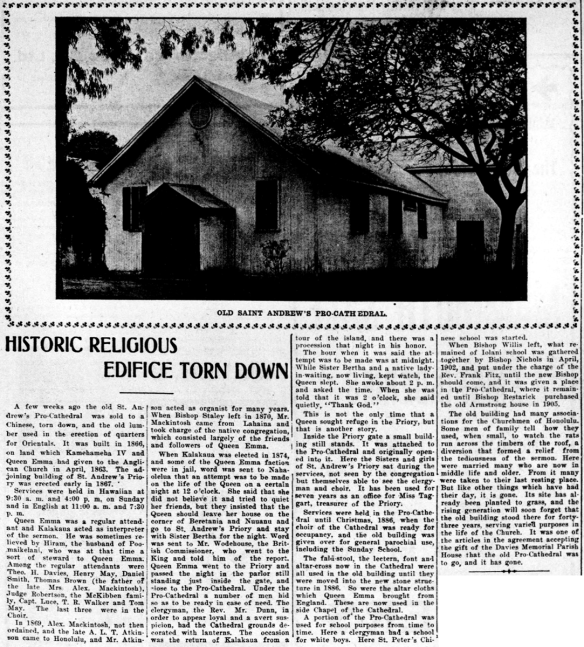
HISTORIC RELIGIOUS EDIFICE TORN DOWN

The Pacific Commercial Advertiser, Volume L, Number 8459, Page 3. September 18, 1909.
Death of Kekelaokalani, 1880.

FUNERAL.

A service will be held over the remains of Kekelaokalani, Kekuaipoiwa [Kekuiapoiwa], Kailikulani, Leleoili, Kulua, on the following Sunday, October 3, between the hours of 1 and 3 in the afternoon, at the pleasant home, Rooke House [Luka Hale], the place where they made warm with their daughter, the Royal One, Emma Kaleleonalani.

Aloha wa—le,
Ke haha hewa nei o’u mau lima,
I ke kino wailua o kuu mama,
Ua ha—la,
Ua hala ma kela aoao o ka pouli,
Aohe e loaa aku ia’u ke hahai,
Eia au la ua huihui i ke anu,
Anu maeele i kuu kino,
Owau wale no nei e u ae nei,
Aloha—Aloha ino.

[Much Aloha,
My hands search in vain,
Over the body of my dear mama,
She has gone,
She has gone to the other side of the darkness,
I shall not catch her should I follow after her,
Here I am chilled in the cold,
My body is numbed,
It is I alone who mourns,
Aloha—How woeful.]

(Elele Poakolu, 9/29/1880, p. 1)

HOOLEWA.

Ka Elele Poakolu, Buke I, Helu 4, Aoao 1. Sepatemaba 29, 1880.

Just because something appears in a newspaper doesn’t necessarily make it true, 1865.

[Found under: “NOTES OF THE WEEK.”]

News from a Far Country.—The following item is clipped from the Weekly London Times:

An Irish Queen in the Sandwich Islands.—The fact that Queen Emma of the Sandwich Islands is expected in Europe gives interest to the following details:—The Sandwich Islands were thus named in 1778, by Captain Cook, in honor of Lord Sandwich, then First Lord of the Admirality. The inhabitants are of the Polynesian race, and were long governed by a number of native chiefs perpetually at war with each other. In 1784 one of them, Kamehameha I., subjected all the islands to his authority, established a monarchy, took up his residence in the town of Honolulu, in the island of Oahu, and reigned until his death in 1819. His dynasty is still on the throne. The present King, Kamehameha V., aged thirty-five, succeeded his brother, who had left no children, in 1863. He has reformed the constitution of the State, favoured trade, manufactures, and the settlement of foreigners, and has acquired the love of his people. The Minister of Finance, M. Crosnier de Varigny, is a Frenchman; the Minister of Foreign Affairs, Mr. Wilkie, was born in Scotland; and the Minister of Interior, Mr. Hopkins, is a native of London; the Minister of Justice and the Chancellor, Mr. Harris and Mr. Allen, are both citizens of the United States. This Cabinet is much esteemed by the Chambers. Queen Emma is a native of Ireland, and is aged twenty-nine. She married in 1856 Kamehameha IV., the late King, but lost her only son in 1862, and her husband in the following year. Queen Victoria has placed a ship of war at her disposal for her voyages to Europe, where she intends to visit successively England, France and Germany.

(Pacific Commercial Advertiser, 9/30/1865, p. 2)

News from a Far Country...

The Pacific Commercial Advertiser, Volume X, Number 13, Page 2. September 30, 1865.

Prince Albert baptized, 1862.

[Found under: “NA MEA HOU O HAWAII NEI.”]

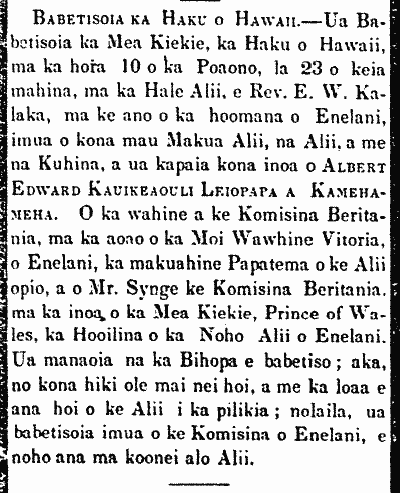
Ka Haku o Hawaii Baptized.—His Highness, ka Prince of Hawaii was baptized at 10 oʻclock on Saturday, the 23rd of this month at the Palace [Hale Alii], by Rev. E. W. Clark [E. W. Kalaka], in the Anglican faith, before his Royal Parents, the Alii, and the Ministers, and his was named Albert Edward Kauikeaouli Leiopapa a Kamehameha. The wife of the British Commissioner stood in for Queen Victoria of England, the godmother [makuahine Papatema] of the young chief, and Mr. Synge, the British Commissioner, stood in for the Prince of Wales, the Heir to the Throne of England. It was intended for the Bishope to do the baptismal, but because he has not arrived, and the Alii is in distress, therefore, he was baptized before the Commissioner of England who is among the Royal court here.

(Kuokoa, 8/30/1862, p. 2)

Babetisoia ka Haku o Hawaii.

Ka Nupepa Kuokoa, Buke 1, Helu 40, Aoao 2. Augate 30, 1862.