FIVE KAHILI WERE MADE FOR THE GOVERNOR

FIVE KAHILI FOR THE GOVERNOR

From the Workers Under Mokumaia

Yesterday afternoon, these kahili were shown in Waikiki.

These kahili will become property of the territory.

According to J. K. Mokumaia, the workers are showing their congratulations to the governor as did the makaainana to their alii in the days gone by.

The kahili were began on May 2 and were completed on May 17.

F. M. B. Kahea is who has knowledge of how to make a kahili.

J. K. Mokumaia is the great general of the alii.

Some Hawaiians have [made] five kahili to present to Governor Farrington on the 9th of June.

At the right of the picture is M. Keawe, J. Kapaiki, Mokumaia, Piko Kamahaa, Clara Kaaipua, Minnie Kakalia, Kahea and Makekehau. Each large kahili has 8000 feathers.

(Alakai o Hawaii, 5/24/1928, p. 1)

Ke Alakai o Hawaii, Buke I, Helu 4, Aoao 1. Mei 24, 1928.

New kahili made by Keahi Luahine, 1920.

CEREMONY MARKS TRANSFER OF FINE PAGEANT KAHILIS

Fourteen magnificent kahilis, completed after three months of painstaking toil by a Hawaiian, Keahi Luahine, of Kakaako, especially for the great Missionary Centennial Pageant of Tuesday next, were last evening, at 7 o’clock, ceremoniously conveyed from Kakaako to Bishop Hall, Punahou.

The ceremonies attending the transfer were such as would have been held in honor of such royal symbols in the past. They are replicas of kahilis now in the Bishop museum. Continue reading

Queen Liliuokalani attends historical play at Kapiolani Park, 1916.

THE PRESENTATION AT KAPIOLANI PARK ABOUT LONOIKAMAKAHIKI AND KAIKILANI WAS BEAUTIFUL

SOME SCENES THAT WERE SHOWN—(1) Kakuhihewa, King of Oahu. (2) The Alii and Kaukau Alii of King Lonoikamakahiki of Hawaii leaving the throne. (3) King Lonoikamakahiki. (4) The Chiefs and Attendants in the Procession. (5) Queen Liliuokalani, and Her Companions watching the Performance. (6) The Attendants of Queen Kaikilani. (7) The Retainers of Queen Kaikilani. Continue reading

Fred Malulani Beckley Kahea passing on traditional knowledge, 1922.

[Found under: “Nuhou Kuloko”]

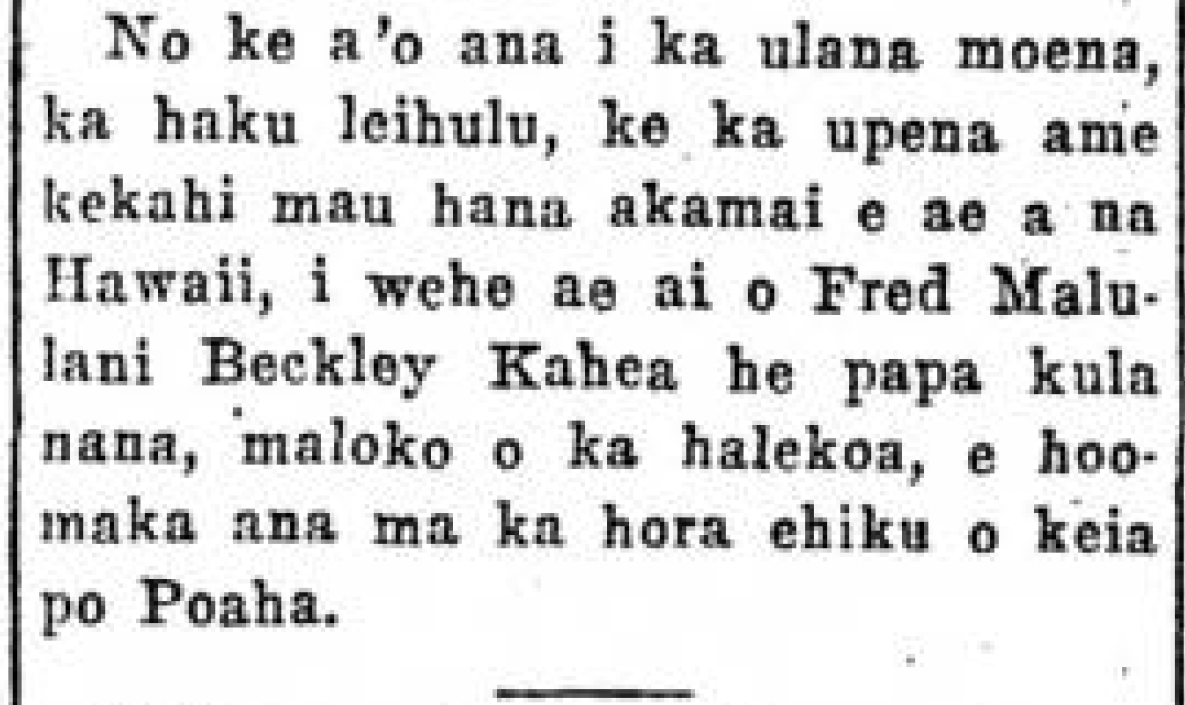
In order to teach mat weaving [ulana moena], feather lei making [haku lei hulu], net tying [ka upena], and other Hawaiian skills, Fred Malulani Beckley Kahea initiated himself a class in the armory, beginning at seven o’clock this Thursday night.

[I was reminded of this article by the recent post by Nanea Armstrong-Wassel about Fred Malulani Beckley Kahea and traditional featherworkers.

F. M. B. Kahea not only taught his class at the armory, but he also was the sharing his knowledge in the construction of kahili when they were made for Governor Farrington in 1928.]

(Kuokoa, 12/7/1922, p. 8)

No ke a'o ana...

Ka Nupepa Kuokoa, Buke LXI, Helu 49, Aoao 8. Dekemaba 7, 1922.

Pueo found in Kalihi, 1902.

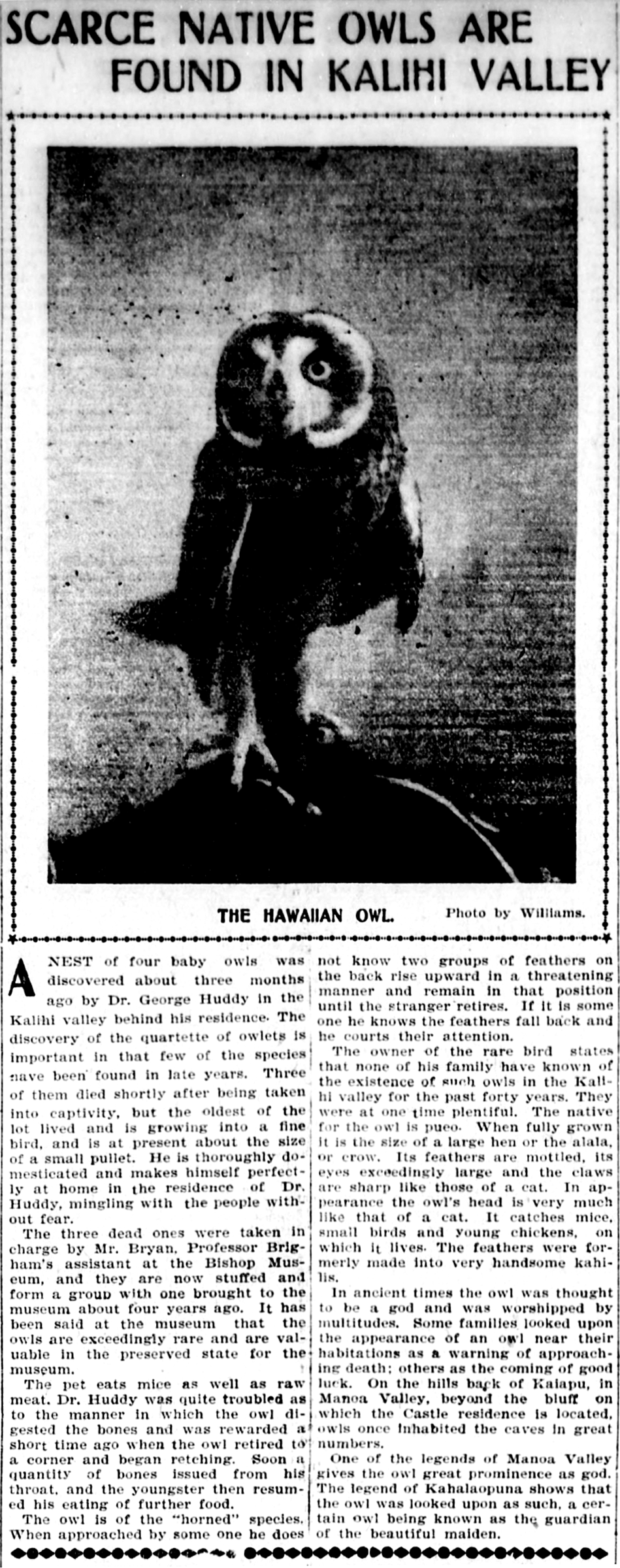
SCARCE NATIVE OWLS ARE FOUND IN KALIHI VALLEY

THE HAWAIIAN OWL.  Photo by Williams.

A NEST of four baby owls was discovered about three months ago by Dr. George Huddy in the Kalihi valley behind his residence. The discovery of the quartette of owlets is important in that few of the species have been found in late years. Three of them died shortly after being taken into captivity, but the oldest of the lot lived and is growing into a fine bird, and is at present about the size of a small pullet. He is thoroughly domesticated and makes himself perfectly at home in the residence of Dr. Huddy, mingling with the people without fear.

The three dead ones were taken in charge by Mr. Bryan, Professor Brigham’s assistant at the Bishop Museum, and they are now stuffed and form a group with one brought to the museum about four years ago. It has been said at the museum that the owls are exceedingly rare and are valuable in the preserved state for the museum.

The pet eats mice as well as raw meat. Dr. Huddy was quite troubled as to the manner in which the owl digested the bones and was rewarded a short time ago when the owl retired to a corner and began retching. Soon a quantity of bones issued from his throat, and the youngster then resumed his eating of further food.

The owl is of the “horned” species. When approached by some one he does not know two groups of feathers on the back rise upward in a threatening manner and remain in that position until the stranger retires. If it is some one he knows the feathers fall back and he courts their attention.

The owner of the rare bird states that none of his family have known of the existence of such owls in the Kalihi valley for the past forty years. They were at one time plentiful. The native for the owl is pueo. When fully grown it is the size of a large hen or the alala, or crow. Its feathers are mottled, its eyes exceedingly large and the claws are sharp like those of a cat. In appearance the owl’s head is very much like that of a cat. It catches mice, small birds and young chickens, on which it lives. The feathers were formerly made into very handsome kahilis.

In ancient times the owl was thought to be a god and was worshipped by multitudes. Some families looked upon the appearance of an owl near their habitation as a warning of approaching death; others as the coming of good luck. On the hills back of Kalapu, in Manoa Valley, beyond the bluff on which the Castle residence is located, owls once inhabited the caves in great numbers.

One of the legends of Manoa Valley gives the owl great prominence as god. The legend of Kahalaopuna shows that the owl was looked upon as such, a certain owl being known as the guardian of the beautiful maiden.

[Does anyone know of kahili made with pueo feathers?]

(Hawaiian Gazette, 2/11/1902, p. 5)

SCARCE NATIVE OWLS ARE FOUND IN KALIHI VALLEY

Hawaiian Gazette, Volume XXXVII, Number 12, Page 5. February 11, 1902.


Hawaii at the Great London Exposition, 1862.

The Sandwich Islands.—During the last few days a stall has been fitted up near the department of the Ionian Islands which represents the latest and most distant echo in response to the invitation given to all nations and peoples to exhibit their natural and artificial products under the domes of South Kensington. The Hawaiian, or, as they are better known, the Sandwich Islands, were unrepresented in 1851, owing to the collection made there not reaching England till the Exhibition had finally closed, the voyage by a sailing vessel occupying five or six months. This year a similar fate threatened this remote group in the Pacific, and it seemed likely that the name of Hawaii would only be known in connexion with the International Exhibition of 1862 by a pair of silk banners in the nave, and a foreign commissioner with nothing to do. Continue reading

Kahili crafted for Governor Farrington, 1928.

FIVE KAHILI MADE FOR THE GOVERNOR

FIVE KAHILI FOR THE GOVERNOR

From the Workers Under Mokumaia

Yesterday evening, these kahili were shown in Waikiki.

The kahili will become the property of the territory.

According to Mokumaia, the workers are showing their congratulations to the governor as did the makaainana do for the alii in times past.

On May 2nd, the work on the kahili began, and it was completed on the 17th of May.

F. B. M. Kahea [Frederick Beckley Malulani Kahea] was the one who knew how to construct kahili.

J. K. Mokumaia was the great general of the chiefs.

[The beginning of the caption seems to be dropped out.] some Hawaiians are making five kahili to gift to Governor Farrington this coming 9th of June.

On the right of the picture is M. Keawe, J. Kapaiki, Mokumaia, Piko Kamahaa, Clara Kaaipua, Minnie Kakalia, Kahea, and Makekehau. The large kahili took 8,000 feathers each.

(Alakai o Hawaii, 5/24/1928, p. 1)

HANAIA ELIMA KAHILI NO KE KIAAINA.

Ke Alakai o Hawaii, Buke I, Helu 4, Aoao 1. Mei 24, 1928.

Birthday of the Queen, 1902.

THE BIRTHDAY OF OUR QUEEN

There Will be a Great Royal Audience on That Day

Eia Kalani ka omole niho oi,
Ke apu oi nana e hookala ka moku,
Nana e keehi ke kihi o ka malama,
Poele ka moku kaumaha i ke’lii,
Ike’a ka mano ka eleele,
O Kalani kui hono i ka moku,

“Kekuhooheiheipahu.”

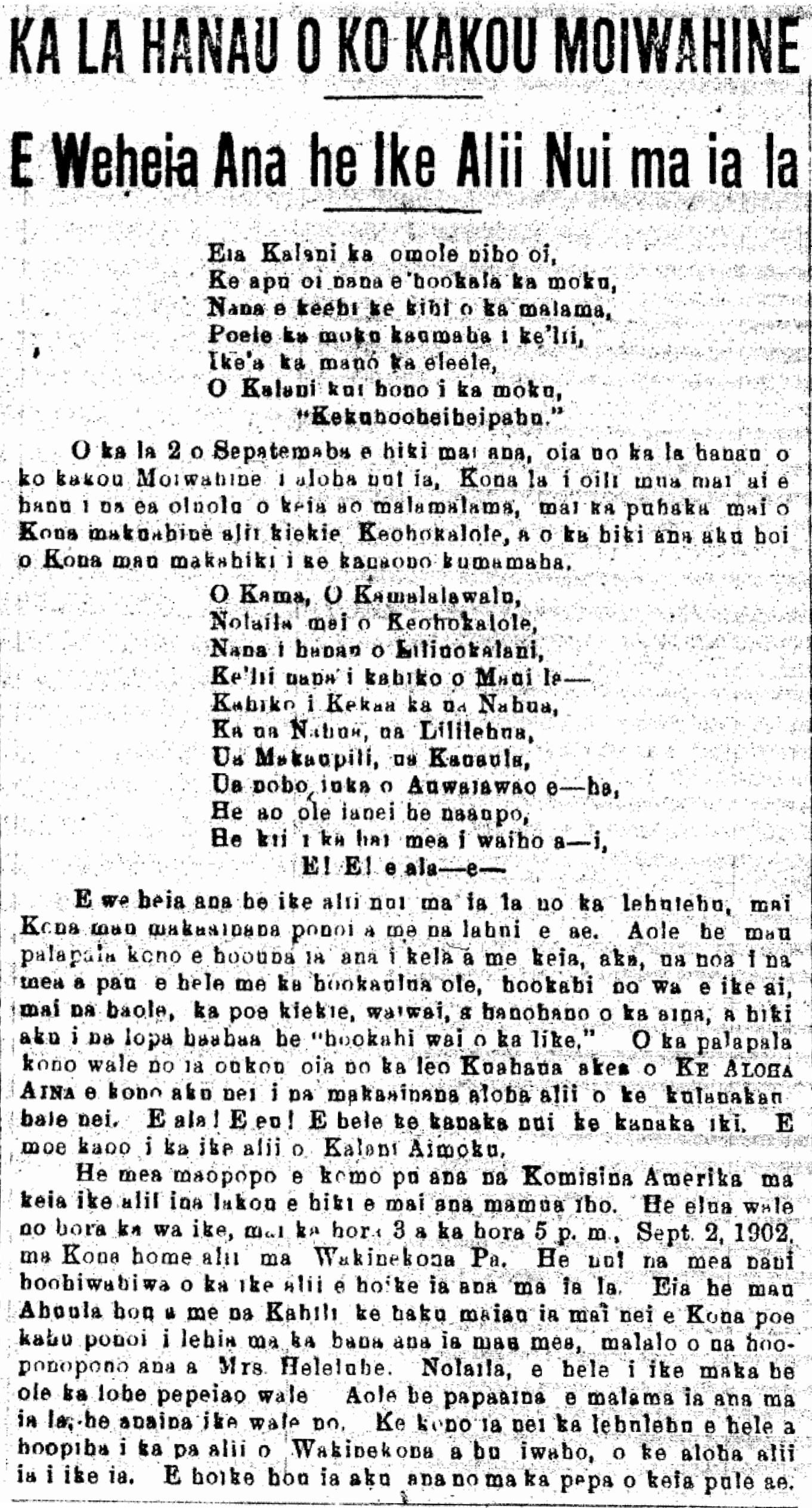
The coming 2nd of September is the birthday of our dearly beloved Queen, the day that She first arrived and breathed in the sweet air of this world of light, from the loins of Her mother, high chiefess Keohokalole, and She has now reached the age of sixty-four.

O Kama, O Kamalalawalu,
Nolaila mai o Keohokalole,
Nana i hanau o Liliuokalani,
Ke’lii nana i kahiko o Maui la—
Kahiko i Kekaa ka ua Nahua,
Ka ua Nahua, ua Lililehua,
Ua Makaupili, ua Kauaula,
Ua noho iuka o Auwaiawao e—ha,
He ao ole ianei he naaupo,
He kii i ka hai mea i waiho a—i,
E! E! e ala—e—

There will be a great royal audience for the people that day, from Her own makaainana to the people of other ethnicities. There will not be invitations sent out to each person, but it is open to all without hesitation, and there will be but one audience, from the haole, the rich and prestigious of the land all the way to the humble peasants; they are all the same. The only invitation to you all will be this public Announcement by the Aloha Aina inviting all those of this town who have aloha for the monarch. Rise! Get going! Go forth, big man and little man. File along to the royal audience with the Queen.

It is understood that the American Commissioners [the Subcommittee on Pacific Islands and Porto Rico] will be present at this royal audience if they arrive before then. The audience will only be for two hours, from 3 to 5 p. m., Sept. 2, 1902, and Her royal residence at the grounds of Washington Place [Wakinekona Pa]. There will be many beautiful adornments displayed that day at the royal audience. There are new Feather Capes [Ahuula] and Kahili being skillfully crafted by Her own attendants who are skilled at the making of such things, under the guidance of Mrs. Heleluhe. So go and see for yourself, and not just hear about it. There will  not be a meal presented that day, only an audience. The public is invited to go a fill the yard of Washington Palace until it overflows, showing the love for the alii.  This will be shown once more in the paper of this coming week.

(Aloha Aina, 8/23/1902, p. 1)

KA LA HANAU O KO KAKOU MOIWAHINE

Ke Aloha Aina, Buke VIII, Helu 34, Aoao 1. Augate 23, 1902.

Keelikolani’s house and valuables destroyed by fire, 1873.

Destruction by Fire of the Residence of the Governess of Hawaii.

The tedium of this dull town, was relieved a little on last Wednesday night by a rousing fire. About one quarter to eight o’clock, the dwellers on Emma street, and in the immediate neighborhood, were suddenly aroused by the shouts and cries of kanakas, the screams of wahines, and the barking of dogs; and were first led to suppose that a big fight was on hand,—that perhaps the police had mutinied and the rifles were called out; but as each anxious individual peered into the street, they soon discovered by the column of flame that was leaping up into the dark sky, that a conflagration was on hand, and farther observation showed that it was taking place at the town mansion of Her Excellency, R. Keelikolani, the Governess of Hawaii.

The fire evidently had a good start, and as soon as discovered, was beyond the control of blankets or buckets of water; but not beyond the control of a good head of water from a fire plug, if spouting on it there and then. But the hydrant for public safety was not ready till the roaring devourer was licking the roof tree of Ruth. And when it was ready, the quenching stream served only to raise an impotent fizzle of stream. And oh! had the wind been up, and this fire had been in the close built part of the town, then we would have had a dance of destruction, that would have been equal to the cost of forty reservoirs.

But we must not complain, as the Ministers were out to see the fire burn, and lend a hand if needed. Emma street was lively with the jostling of Ministers and milkmen, diplomats and deacons, judges and jews, and editors and elderly ladies. Everybody turned out,—even some of the churches turned out. These were in the midst of the regular Wednesday evening service, when the uproar began. One pastor affected by the outside outcry, and the evident anxiety of his people, “sung it short,” and he and his flock, joined the throng in the street, to see the sight; but another one, while addressing his faithful, although he saw them speak out one by one, until he was left with only two to listen, yet he stood firm like the Roman sentinel at Pompeii, while the sparks of the conflagration were falling in his vestibule, and gave the two faithful witnesses the full benefit without halt or abbreviation of good orthodox sermon.

The cause of the fire is unknown, but as there had been on hand lately, a fierce litigation about this and other property, the circumstances afford occasion for a good deal of suspicion. Much that was curious and valuable in relation to ancient Hawaiian habits and costumes were unfortunately destroyed. There was some of the famed featherwork, worn by the old chiefs, many of the old feather insignia of office, the great kahilis of Hawaiian pageants, shell and hair ornaments, tappas and fine mats, and some royal bones—all of which were a considerable loss, excepting the bones.

The residence as a property, will not be much of a loss to the wealthy Governess of Hawaii. If the trades had been blowing fresh, several houses makai of this building, would have gone with it but as it was dead calm, and a light shower had fallen a few minutes before the fire broke out, it was easy to defend the roofs of neighboring houses.

On account of the absence of mail, we give this long report of an ordinary fire.

(Hoku o Hawaii, 1o/17/1873, p. 3)

Destruction by Fire of the Residence of the Governess of Hawaii.

Nuhou, Volume II, Number 24, Page 3. October 17, 1873.
Kahili from Washington Place to go to Hanaiakamalama, 1918.

KAHILI TO BE RETURNED TO THE HOME OF EMMA.

Because Washington Place [Wakinekona Hale] will be placed under the care of Governor McCarthy, as a home for him to live in with his family, twenty-six feather standards were returned from Washington Place to the old home of Queen Emma, in the uplands of Nuuanu, under the care of the Association, the Daughters of Hawaii [Na Kaikamahine o Hawaii].

During the funeral of Queen Liliuokalani, and while her body lay in state at Kawaiahao Church and in the throne room of the palace, those kahili were something the public could visit, however, as the result of an agreement between the trustees of Queen Liliuokalani’s estate and the Association of the Daughters of Hawaii, the caring for the kahili has been transferred to the association. As has been the custom from ancient times, it was during the night that kahili of those types were moved from one place to another, and so it was that the kahili were returned in the dark of night on Sunday two weeks ago.

However, because there were not enough people to carry the kahili and march on the roads to its new home where it is hoped to be cared for, the kahili were put on cars and it was on these cars which the people who held the kahili stood.

When the cars and the kahili arrived at the entrance to the yard of the home of Queen Emma in the uplands of Nuuanu, the kahili were taken by the leaders of the Association of the Daughters of Hawaii, and its care was transferred to them.

(Kuokoa, 10/18/1918, p. 2)

HOIHOIIA NA KAHILI MA KA HOME O EMA.

Ka Nupepa Kuokoa, Buke LVI, Helu 42, Aoao 2. Okatoba 18, 1918.