The birth of the future Kamehameha IV, 1839.

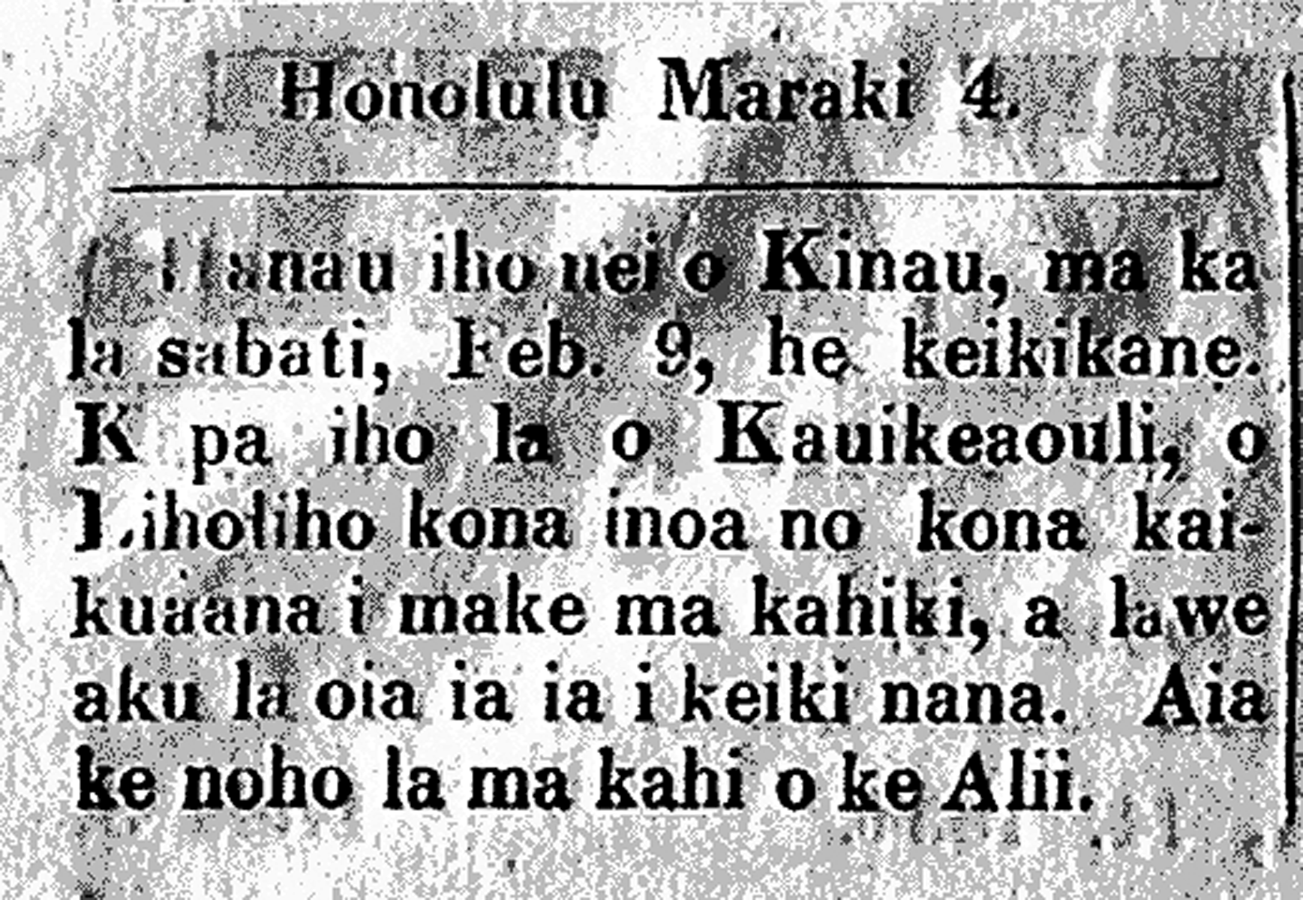
Honolulu March 4.

Kinau just gave birth, on the sabbath, Feb. 9, to a son. Kauikeaouli named him, Liholiho, for his older brother who died in foreign lands; and he took him as a child. He is living in the court of the King.

(Lama Hawaii, 3/14/1834, p. 2)

Honolulu Maraki 4.

Ka Lama Hawaii, Makahiki 1, Helu 5, Aoao 2. Maraki 14, 1834.

Death of Kamehameha III and the accession of Kamehameha IV, 1854.

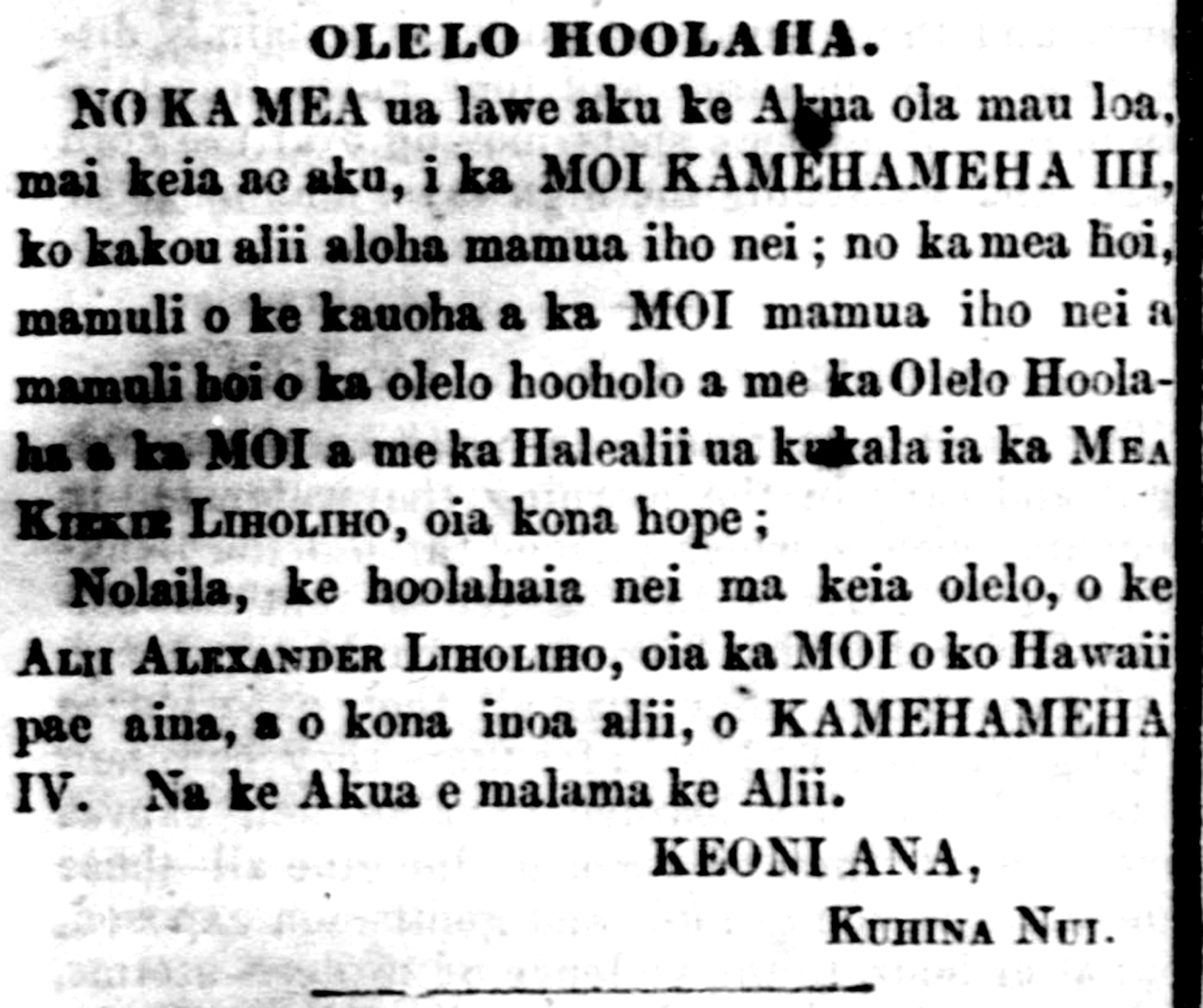
OLELO HOOLAHA.

NO KA MEA ua lawe ke Akua ola mau loa, mai keia ao aku, i ka MOI KAMEHAMEHA III, ko kakou alii aloha mamua iho nei; no ka mea hoi, mamuli o ke kauoha a ka MOI mamua iho nei a mamuli hoi o ka olelo hooholo a me ka Olelo Hoolaha a ka MOI a me ka Halealii ua kukala ia ka Mea Kiekie Liholiho, oia kona hope;

Nolaila, ke hoolaha nei ma keia olelo, o ke Alii Alexander Liholiho, oia ka MOI o ko Hawaii pae aina, a o kona inoa alii, o KAMEHAMEHA IV. Na ke Akua e malama ke Alii.

KEONI ANA,

Kuhina Nui.

(Polynesian, 12/16/1854, p. 2)

OLELO HOOLAHA.

The Polynesian, Volume XI, Number 32, Page 2. December 16, 1854.

Continue reading

Kamehameha IV and Ka Haku o Hawaii moved, 1865.

[Found under: “HUNAHUNA MEA HOU O HAWAII NEI.”]

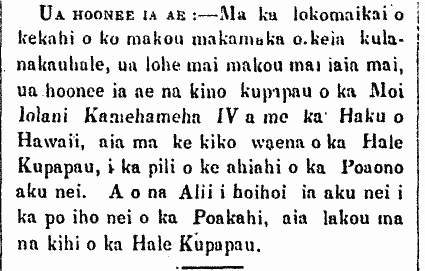
Transferred:—Through the kindness of one of our friends in this town, we heard from him/her that the bodies of the King Iolani Kamehameha IV and Ka Haku o Hawaii were moved when evening came last Saturday [11/28/1865]; they are in the center of the Crypt. And the alii who were moved this past Monday [11/30/1865], they are at the corners of the Crypt.

[See more at Nanea Armstrong-Wassel’s instagram page here. And also another article in appearing in the same column of the Kuokoa here.]

(Kuokoa, 11/4/1865, p. 2)

Ua Hoonee ia ae...

Ka Nupepa Kuokoa, Buke IV, Helu 44, Aoao 2. Novemaba 4, 1865.

St. Andrew’s, the early days, 1909.

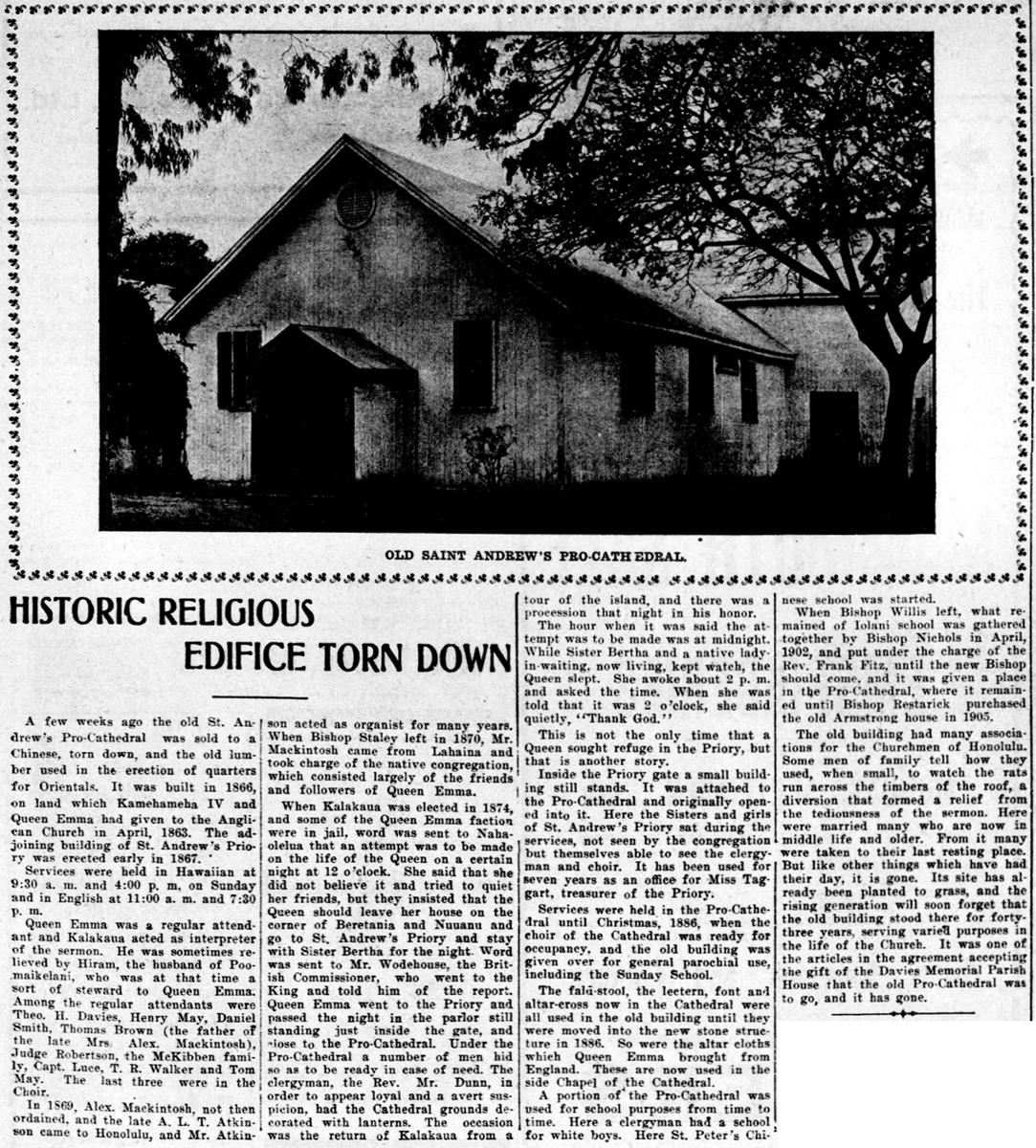
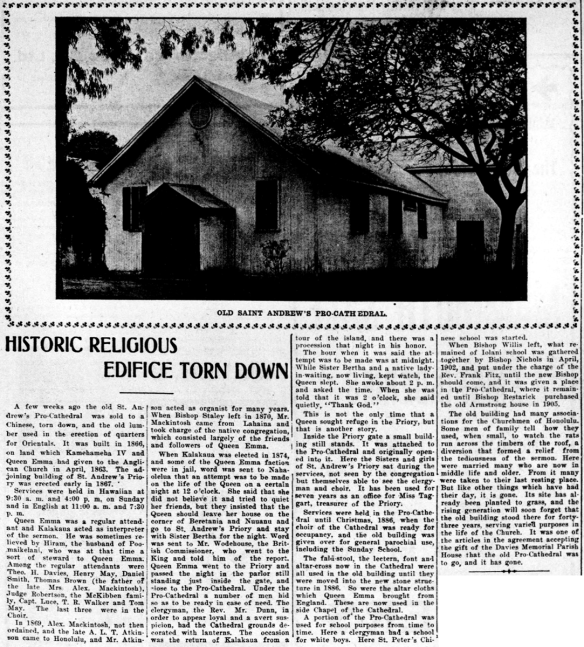
OLD SAINT ANDREW’S PRO-CATHEDRAL.

RELIGIOUS EDIFICE TORN DOWN

A few weeks ago the old St. Andrew’s Pro-Cathedral was sold to a Chinese, torn down, and the old lumber used in the erection of quarters for Orientals. It was built in 1866, on land which Kamehameha IV and Queen Emma had given to the Anglican Church in April 1863. The adjoining building of St. Andrew’s Priory was erected in 1867.

Services were held in Hawaiian at 9:30 a. m. and 4:00 p. m. on Sunday and in English at 11:00 a. m. and 7:30 p. m.

Queen Emma was a regular attendant and Kalakaua acted as interpreter of the sermon. He was sometimes relieved by Hiram, the husband of Poomaikelani, who was at that time a sort of steward to Queen Emma. Among the regular attendants were Theo. H. Davies, Henry May, Daniel Smith, Thomas Brown (the father of the late Mrs. Alex. McKintosh), Judge Robertson, the McKibben family, Capt. Luce, T. R. Walker and Tom May. The last three were in the Choir.

In 1869, Alex. Mackintosh, not then ordained, and the late A. L. T. Atkinson came to Honolulu, and Mr. Atkinson acted as organist for many years. When Bishop Staley left in 1870, Mr. Mackintosh came from Lahaina and took charge of the native congregation, which consisted largely of the friends and followers of Queen Emma.

When Kalakaua was elected in 1874, and some of the Queen Emma faction were in jail, word was sent to Nahaolelua that an attempt was to be made on the life of the Queen on a certain night at 12 o’clock. She said that she did not believe it and tried to quiet her friends, but they insisted that the Queen should leave her house on the corner of Beretania and Nuuanu and go to St. Andrew’s Priory and stay with Sister Bertha for the night. Word was sent to Mr. Wodehouse, the British Commissioner, who went to the King and told him of the report. Queen Emma went to the Priory and passed the night in the parlor still standing just inside the gate, and close to the Pro-Cathedral. Under the Pro-Cathedral a number of men hid so as to be ready in case of need. The clergyman, the Rev. Mr. Dunn, in order to appear loyal and a avert suspicion, had the Cathedral grounds decorated with lanterns. The occasion was the return of Kalakaua from a tour of the island, and there was a procession that night in his honor.

The hour when it was said the attempt was to be made was at midnight. While Sister Bertha and a native lady-in-waiting, now living, kept watch, the Queen slept. She awoke about 2 p. m. and asked the time. When she was told that it was 2 o’clock, she said quietly, “Thank God.”

This is not the only time that a Queen sought refuge in the Priory, but that is another story.

Inside the Priory gate a small building still stands. It was attached to the Pro-Cathedral and originally opened into it. Here the Sisters and girls of St. Andrew’s Priory sat during the services, not seen by the congregation but themselves able to see the clergyman and choir. It has been used for seven years as an office for Miss Taggart, treasurer of the Priory.

Services were held in the Pro-Cathedral until Christmas, 1886, when the choir of the Cathedral was ready for occupancy, and the old building was given over for general parochial use, including the Sunday School.

The fald-stool, the lectern, font and altar-cross now in the Cathedral were all used in the old building until they were moved into the new stone structure in 1886. So were the altar cloths which Queen Emma brought from England. These are now used in the side Chapel of the Cathedral.

A portion of the Pro-Cathedral was used for school purposes from time to time. Here a clergyman had a school for white boys. Here St. Peter’s Chinese school was started.

When Bishop Willis left, what remained of Iolani school was gathered together by Bishop Nichols in April, 1902, and put under the charge of the Rev. Frank Fitz, until the new Bishop should come, and it was given a place in the Pro-Cathedral, where it remained until Bishop Restarick purchased the old Armstrong house in 1905.

The old building had many associations for the Churchmen of Honolulu. Some men of family tell how they used, when small, to watch the rats run across the timbers of the roof, a diversion that formed a relief from the tediousness of the sermon. Here were married many who are now in middle life and older. From it many were taken to their last resting place. But like other things which have had their day, it is gone. Its site has already been planted to grass, and the rising generation will soon forget that the old building stood there for forty-three years, serving varied purposes in the life of the Church. It was one of the articles in the agreement accepting the gift of the Davies Memorial Parish House that the old Pro-Cathedral was to go, and it has gone.

(Pacific Commercial Advertiser, 9/18/1909, p. 3)
HISTORIC RELIGIOUS EDIFICE TORN DOWN

The Pacific Commercial Advertiser, Volume L, Number 8459, Page 3. September 18, 1909.

Just because something appears in a newspaper doesn’t necessarily make it true, 1865.

[Found under: “NOTES OF THE WEEK.”]

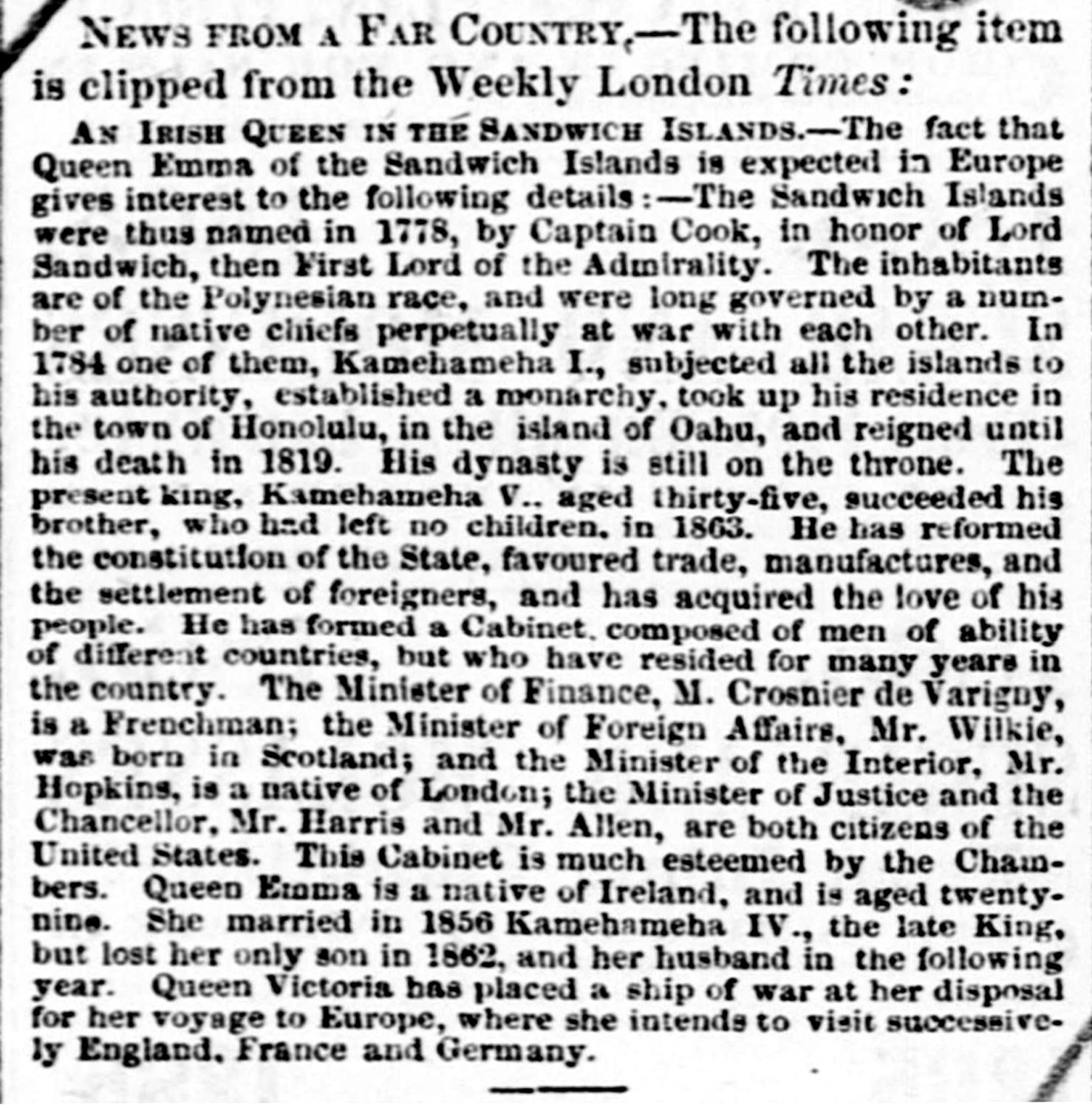
News from a Far Country.—The following item is clipped from the Weekly London Times:

An Irish Queen in the Sandwich Islands.—The fact that Queen Emma of the Sandwich Islands is expected in Europe gives interest to the following details:—The Sandwich Islands were thus named in 1778, by Captain Cook, in honor of Lord Sandwich, then First Lord of the Admirality. The inhabitants are of the Polynesian race, and were long governed by a number of native chiefs perpetually at war with each other. In 1784 one of them, Kamehameha I., subjected all the islands to his authority, established a monarchy, took up his residence in the town of Honolulu, in the island of Oahu, and reigned until his death in 1819. His dynasty is still on the throne. The present King, Kamehameha V., aged thirty-five, succeeded his brother, who had left no children, in 1863. He has reformed the constitution of the State, favoured trade, manufactures, and the settlement of foreigners, and has acquired the love of his people. The Minister of Finance, M. Crosnier de Varigny, is a Frenchman; the Minister of Foreign Affairs, Mr. Wilkie, was born in Scotland; and the Minister of Interior, Mr. Hopkins, is a native of London; the Minister of Justice and the Chancellor, Mr. Harris and Mr. Allen, are both citizens of the United States. This Cabinet is much esteemed by the Chambers. Queen Emma is a native of Ireland, and is aged twenty-nine. She married in 1856 Kamehameha IV., the late King, but lost her only son in 1862, and her husband in the following year. Queen Victoria has placed a ship of war at her disposal for her voyages to Europe, where she intends to visit successively England, France and Germany.

(Pacific Commercial Advertiser, 9/30/1865, p. 2)

News from a Far Country...

The Pacific Commercial Advertiser, Volume X, Number 13, Page 2. September 30, 1865.

David Hauola Makekau and “Leahi,” 1919.

[From: “KUU KAMAAINA I KA UA KUKALAHALE.”]

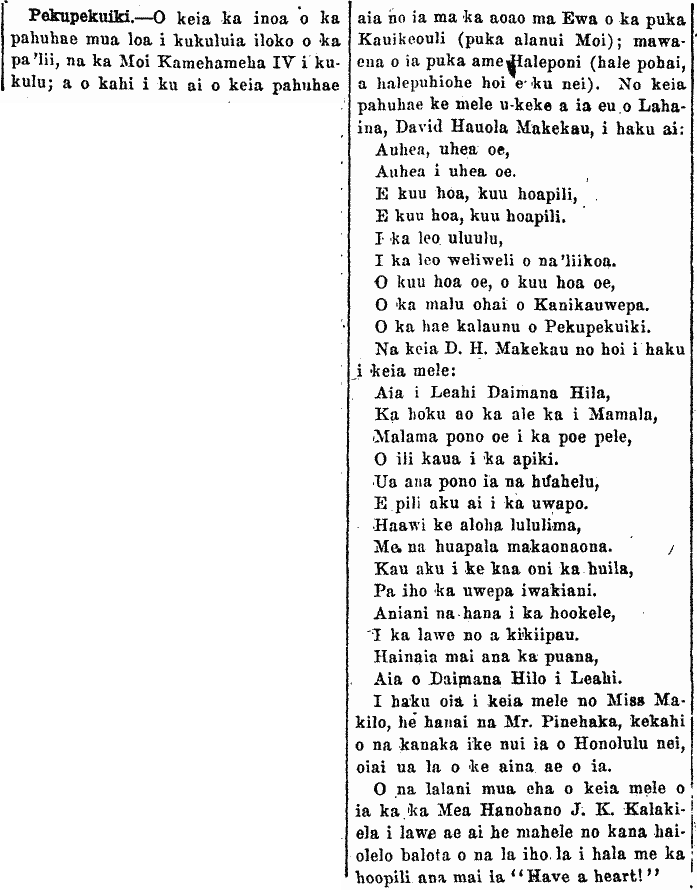
Pekupekuiki.—This is the name of the first flagpole put up in the palace grounds; it was erected by King Kamehameha IV; and this flagpole stood on the Ewa side of the Kauikeaouli gate (the King Street gate); between the gate and Haleponi, “the Coronation Building” (the gazebo and bandstand that stands now). For this flagpole is the u-keke song composed by that spry one of Lahaina, David Hauola Makekau:

Auhea, uhea oe,
Auhea i uhea oe.
E kuu hoa, kuu hoapili,
E kuu hoa, kuu hoapili.
I ka leo uluulu,
I ka leo weliweli o na ʻliikoa.
O kuu hoa oe, o kuu hoa oe,
O ka malu ohai o Kanikauwepa.
O ka hae kalaunu o Pekupekuiki.

It was this D. H. Makekau who indeed composed this mele:

Aia i Leahi Daimana Hila,
Ka hoku ao ka ale ka i Mamala,
Malama pono oe i ka poe pele,
O ili kaua i ka apiki.
Ua ana pono ia na huahelu,
E pili aku ai i ka uwapo.
Haawi ke aloha lululima,
Me na huapala makaonaona.
Kau aku i ke kaa oni ka huila,
Pa iho ka uwepa iwakiani.
Aniani na hana i ka hookele,
I ka lawe no a kikiipau.
Hainaia mai ana ka puana,
Aia o Daimana Hila i Leahi.

He composed this song for Miss Makilo, a hanai child of Mr. Pinehaka [? William Pinehasa Wood], one of the well-known men of Honolulu nei, in those days he lived there [? oiai ua la o ke aina ae o ia].

The first four lines of the mele are what the Honorable J. K. Kalakiela recently took to as part of his election speech adding, “Have a heart!”

[The awesome things you find while watching Merrie Monarch! This description is found in an awesome treatise on place names of Honolulu, “My Familiarity with the Land of the Kukalahale Rain,” which runs in the Kuokoa from 12/20/1918 to 1/24/1919 (although it indicates there is to be more to come), describing famous places of Honolulu in days gone by, written by the Anela o Mekiko, Gabriel K. Keawehaku.

Mahalo to the boys of Na Kamalei o Lililehua for their lively hula inspiring me to do a little searching.

For more on the gates of Iolani Palace, click here for Nanea Armstrong Wassel’s post!

For more on the Hale Poni, again click here for Nanea Armstrong Wassel’s post!!]

(Kuokoa, 1/24/1919, p. 3)

Pekupekuiki.

Ka Nupepa Kuokoa, Buke LVII, Helu 4, Aoao 3. Ianuari 24, 1919.

Prince Albert baptized, 1862.

[Found under: “NA MEA HOU O HAWAII NEI.”]

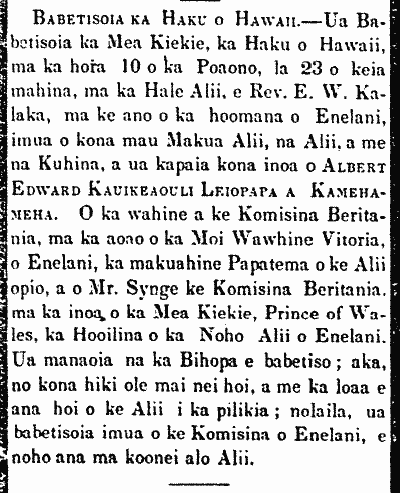
Ka Haku o Hawaii Baptized.—His Highness, ka Prince of Hawaii was baptized at 10 oʻclock on Saturday, the 23rd of this month at the Palace [Hale Alii], by Rev. E. W. Clark [E. W. Kalaka], in the Anglican faith, before his Royal Parents, the Alii, and the Ministers, and his was named Albert Edward Kauikeaouli Leiopapa a Kamehameha. The wife of the British Commissioner stood in for Queen Victoria of England, the godmother [makuahine Papatema] of the young chief, and Mr. Synge, the British Commissioner, stood in for the Prince of Wales, the Heir to the Throne of England. It was intended for the Bishope to do the baptismal, but because he has not arrived, and the Alii is in distress, therefore, he was baptized before the Commissioner of England who is among the Royal court here.

(Kuokoa, 8/30/1862, p. 2)

Babetisoia ka Haku o Hawaii.

Ka Nupepa Kuokoa, Buke 1, Helu 40, Aoao 2. Augate 30, 1862.

Lucy Kaheiheimalie Peabody Henriques has gone on, 1928.

MUCH ALOHA FOR THAT ALII WHO WAS FULL OF ALOHA

That chiefess born of the land, Mrs. Lucy Kaheiheimalie Peabody Henriques has gone. She was loved by all of us, and she was a precious one among the people. She was going silently away these past weeks. Aloha with unending tears. She went to see the sacred bosom of Kane. The rejected flowers were strewn at Wailua [?? Ua ahu iho la na pua wahawaha i Wailua]; she left grieving behind, her beloved lei, her daughter, Kalanikiekie Henriques. Continue reading

History of Kawaiahao Church, 1885.

KAWAIAHAO CHURCH

The readers of the Kuokoa will probably not be unable to recognize the features of the building pictured above; it is the church of Kawaiahao. It is an old building and one that is greatly beloved by a portion of our people, this mother church of ours. Its predecessor on these grounds was a church of pili grass; and the stone building was completed in 1842, constructed by the loving hands of the alii and makaainana of times gone by. It was Kekuanaoa and Bingham [Binamu] Sr. who selected the area where it was to be built and supervised its construction, however Bingham returned to America before the completion of this building.

There were many renowned events which were done in Kawaiahao such that it is as if the building was the place to carry out grand and fine deeds of the past, of the nation and the people. It was in this building that a number of the Legislative Sessions of the nation were opened, if this writer is not mistaken. It was in this building that Kamehameha V opened the Constitutional Convention [Ahaolelo Hooponopono Kumukanawai] on the 7th of July, 1864. Continue reading

Hawaii at the Great London Exposition, 1862.

The Sandwich Islands.—During the last few days a stall has been fitted up near the department of the Ionian Islands which represents the latest and most distant echo in response to the invitation given to all nations and peoples to exhibit their natural and artificial products under the domes of South Kensington. The Hawaiian, or, as they are better known, the Sandwich Islands, were unrepresented in 1851, owing to the collection made there not reaching England till the Exhibition had finally closed, the voyage by a sailing vessel occupying five or six months. This year a similar fate threatened this remote group in the Pacific, and it seemed likely that the name of Hawaii would only be known in connexion with the International Exhibition of 1862 by a pair of silk banners in the nave, and a foreign commissioner with nothing to do. Continue reading