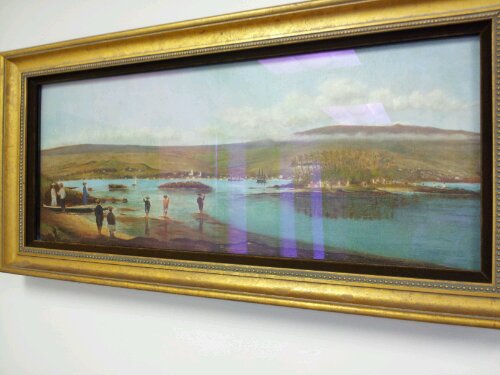
Christmas at Iolani Palace, 1920.

THE PALACE IS AGLOW WITH ELECTRIC LIGHTS.

The trees were bright with electric lights and the minds of the children were amazed, filled with wonder; the singing of Christmas joy and the skits were beautiful as the Christmas tree of the City of Honolulu was lit on the grounds of the capital this past Sunday; and there were thousands of people gathered while the event was held, while they sang along to Christmas carols being sung by choral groups.

The boys of the Kamehameha Schools led the singing along with the girls of the St. Andrews Priory School. Some of the songs sung that night were “Holy Light,” “O, The Little Town of Bethlehem,” a many other beautiful songs were sung. The crowd joined in the singing of the songs they knew, and when they did not know the words, they were silent.

The activities that night were wonderful because of the peace and because the queen of the night shone down her light, being this was a bright moonlit night, with a clear sky an no clouds.

There were skits performed as well, and in these performances to be seen, the crowd could watch the birth of the Lord, the angels blowing their trumpets, the following of the shepherds and the three magi to where the child lay, and their giving of gifts when they saw the child in the manger.

The audience was very appreciative of those who put on the joyous festivities that night, from the singing and so forth to the decorating of the trees with lights.

The words of the songs sung were projected onto a section of cloth so that everyone who could see could read it while the songs were being sung. The singing and the skits that were prepared for that night were wonderful.

(Kuokoa, 12/31/1920, p. 2)

KAULUWELA KA HALEALII I NA KUKUI UWILA.

Ka Nupepa Kuokoa, Buke LVIII, Helu 53, Aoao 2. Dekemaba 31, 1920.

E o, e ka Wahine Hele La o Kaiona, 1913.

Aloha Pauahi the Alii

This coming Friday, the 19th of December is the day to remember, for all those Hawaiian hearts with love for their Chiefs, the birthday of the Princess Mrs. Pauahi Bishop, the Mother who left behind the glory of her name with her lahui from one generation to the next, all the way until the very last Hawaiian child. Being that she is the Royal Mother who remembered the youth of the people of her own flesh, skin, and blood, by dedicating her wealth to the establishing of the Kamehameha Schools where our youths are to be educated.

We commemorate the sacredness and the grandeur of her name, “The Mother of Her People,” and upon our breasts is a bouquet of unforgettable flowers pinned with deep sadness of love. She now sleeps the eternal sleep, but her name is remembered with awe amongst the children whom she supported, along with their parents. We now voice from our lips with appreciation—”Aloha Pauahi, the Alii.”

E o e ka wahine hele la o Kaiona
Alualu wai li’ula o ke kaha puaohai
O ka ua lani polua, po anu o ke Koolau,
Kuu hoa o ka malu kiu, malu kukui o Kahoiwai.

[And more on the celebration one hundred years ago, at the Kamehameha Schools.]

(Holomua, 12/13/1913, p. 4)

Aloha Pauahi ke Alii

Ka Holomua, Buke I, Helu 11, Aoao 4. Dekemaba 13, 1913.

Kamehameha Schools column in Hoku o Hawaii, 1940.

NEWS FROM KAMEHAMEHA SCHOOL FOR BOYS

By John Desha

KAMEHAMEHA SCHOOL. May 22 (Special)—Four seniors from the Big Island were graduated on May 30. They were Frances Nohoikaiu, Odetta Needham, George Mills, and Nephi Needham.

All of these students have attained a standard of which they can be proud.

George Mills and Nephi Needham have taken up at Kamehameha the agriculture course.

Frances Nohoikaiu and Odetta Needham have taken the general course at Kamehameha school for Girls.

Calvin Christ, also of Hawaii, is graduating this year. Calvin is in his high-eleventh year but is graduating with six other high-eleventh students. He has taken up the electrical course at Kamehameha and is planning to return to Hawaii where he intends to work.

KAMEHAMEHA SCHOOLS, May 26 (Special) — Memorial services were held for Bernice Pauahi Bishop by the Kamehameha Schools at Mauna Ala cemetery at Nuuanu on Friday, May 24.

While the school band played “Hawaii”, the students marched in and formed in a semicircles before the grave of Mrs. Bishop. The program ran in the following order:

“He Inoa No Pauahi” — Led by Daniel Hano.

“Pauahi O Kalani” — Led by Bernice Campbell.

“Boys’s School Pledge” — Led by Richard Hart.

“Pauahi Ke Alii” — Led by Amy Miller.

“Girls’ School Pledge” — Led by Florence Spencer.

“Decorating the Grave” — By the various class presidents.

“Only Remembered” — Led by Bernhardt Alama.

“Girls’ School Call” — Led by Josephine Keanoano.

A number of townspeople were present, including graduates and parents.

By D. Akaka.

KAMEHAMEHA SCHOOLS. May 22 (Special). Keanohou Ludloff of Hilo was recently elected to the post of treasurer for the coming year of the Hi Y Warriors club.

The other officers who were also elected are Robert Gomard, president, John Saber [?], vice-president, and Arthur Doo, secretary.

The present officers of the Hi Y club are James G???, president, Reuben Anderson, vice-president, John Desha, secretary, and Robert Fountain, treasurer.

“Ka oki ana o ka piko o Hale Lama” was the first sentence of a Hawaiian chant that was chanted by Kahuna pule Kahului Anderson and was interpreted by Moki Burrows, wearing malos, as “The cutting of the piko o Hale Lama” which is the ceremonial dedication of Hale Lama. A brief history of Hale Lama was presented by Louis Agard. the paina was followed by a program of dances and songs. “Aloha oe,” which was sung by the boys conducted the ritual ceremony. This ceremony marked the completion of a grass hut, constructed by students at Kamehameha schools.

Invited guests were as follows: Mrs. Lahilahi Webb, Mrs. Mary Pukui, Mrs. Keith Jones, Mrs. Margaret Bardwell, Miss Maude K. Scheiffer, Mrs. Antoinette Faahong, Dr. and Mrs. Homer F. Barnes, Mr. and Mrs. Pat Rankin, Mr. and Mrs. L??? G. Hudson, Miss Juliana Jones, Miss Pat Namaka Wiggin, Mr. William Jones and Mr. Jack Q. Haydgen. Sponsoring the paina were the 24? members of the Hui Kumulipo and 41? members of the Hui Oiwi which were successfully advised by Miss Mabel Catlin and Mr. Donald Mitchell a total of about 100 persons attended the ceremony.

[If only papers like Hoku o Hawaii were rescanned as clearly as possible, maybe more information would be available from articles like these. Information can only be appreciated if it is legible! It is however awesome that you can actually make out that attending the opening ceremony for Hale Lama were people like Lahilahi Webb, Mary Kawena Pukui, and Pat Namaka (Wiggin) Bacon!

Oooh, and D. Akaka? Senator Daniel Akaka, class of ’42?

Once again, i am sorry if some of the names i typed are incorrect!]

(Hoku o Hawaii, 6/5/1940, p. 4)

NEWS FROM KAMEHAMEHA SCHOOL FOR BOYS

Ka Hoku o Hawaii, Volume XXXV, Number 6, Aoao 4. Iune 5, 1940.

More from Bishop Museum and Kamehameha Schools, 1894.

DECEMBER 19

Birthday of Pauahi.

Commemorated at the Kamehameha School with the opening of the

Kamehameha School for Girls.

THE ANNEX TO

Bishop Museum.

will be opened to the public on that day for the very first time.

Those are two fitting events held in BISHOP HALL [BiHOBA HOLO] at the hour of 2 p. m. Dec. 19.

Speeches by MRS. HAALELEA and some others.

GAMES for CHILDREN will be held at 3:30 p. m.

Period for touring the KAMEHAMEHA SCHOOL from 3 to 4 p. m.

[Mahalo to DeSoto Brown for commenting on this opening. This Annex to the Bishop Museum was unveiled to the public on the 19th of December, 1894, became Polynesian Hall, and today is reopening to the public after extensive renovations as Pacific Hall! If you are here on Oahu, go check it out!! Free admission all day today (Saturday, September 21, 2013, until 9:00 p. m.)!!!]

(Kuokoa, 12/15/1894, p. 2)

DEKEMABA 19 La Hanau o Pauahi

Ka Nupepa Kuokoa, Buke XXXIII, Helu 50, Aoao 2. Dekemaba 15, 1894.

The Kamehameha Museum and the Kamehameha Schools, 1894.

KA HALE HOIKEIKE O KAMEHAMEHA

THE ASSETS OF THE KAMEHAMEHA SCHOOLS.

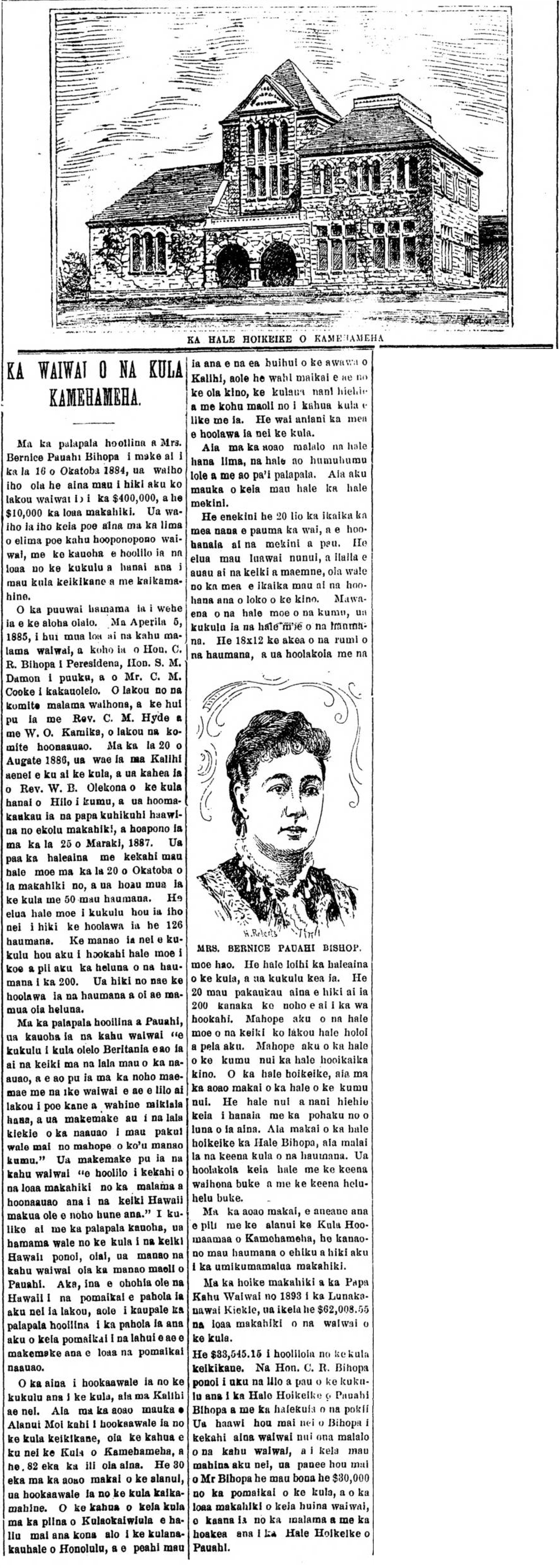
In the will of Mrs. Bernice Pauahi Bishop, who died on the 16th of October 1884, she set aside lands whose true value comes to $400,000, with $10,000 profit per year. These lands are in the hands of five trustees, with the stipulation that the profits go to the building and caring for a school for boys and girls.

This generosity was based on true aloha. On the 5th of April, 1885, the trustees met for the first time and selected the Hon. C. R. Bishop as President, Hon. S. M. Damon as treasurer, and Mr. C. M. Cooke as secretary. They are the finance committee, along with Rev. C. M. Hyde and W. O. Smith, made the education committee. On the 20th of August, 1886, up in Kalihi was chosen as the place where the school would stand, and Rev. W. B. Olsen of the Hilo boarding school to be a teacher, and the curriculum for three years was prepared and approved on the 25th of March, 1887. The cafeteria and some dormitories were completed on the 20th of October of that same year, and the school began with 50 students. There were two dormitories just built, which can house 126 students. One more dormitory is planned which will increase the number of students to 200. However more than that number of students can be accommodated.

In the will of Pauahi, the trustees were instructed to “build an English-language school where the children were to be educated in the regular branches of knowledge, and they were also to be educated to live morally and with important knowledge to make them industrious men and women, and I want high branches of knowledge to supplement those basics.” It is desired that the trustees “use a portion of the profits to go to the education and care of the indigent orphaned Hawaiian children.” As per the will, the school is opened to native Hawaiians, being that the trustees believe that was the true intent of Pauahi. However, the Hawaiians are not interested in the good put before them, the will does not preclude the the provision of those blessings to the other races who want to receive the benefits of an education.

The land set aside for the building of the school is up in Kalihi. The land mauka of King Street is set aside for the boys’ school; this is where the Kamehameha School now stands; the area of that land is 82 acres. There are 30 acres makai of the street, which is set aside for the girls’ school. The area for this school is in the heights of Kulaokaiwiula with it face overlooking the cit of Honolulu, and it is constantly fanned by the cool air of the valley of Kalihi; there is no other finer place for the health, the beauty, and the suitability as a school campus like this. Clear water is supplied to the school.

Below that are the workshops, the sewing shop and the printing shop. And mauka of these buildings is the mechanic shop.

The strength of the engine pumping the water is 20 horses, and the total power is utilized. There are two huge pools where the children will bathe until clean, and that is what will keep their bodies working strong. Between the sleeping quarters of the teachers were built the dormitories of the students. The student rooms are 18 x 12 wide, and are furnished with…

MRS. BERNICE PAUAHI BISHOP.

…iron beds. The schools cafeteria is a long building, and it was built in the form of a cross. There are 20 dining tables accommodating 200 people at a time. Behind the children dormitories, are their laundry building, and so forth. Behind the principal’s house is the gymnasium. The museum is on the makai side of the principal’s house. This is a grand a beautiful structure constructed with rock from atop the land. Makai of the museum is Bishop Hall, and this is where the school rooms of the students are. This building is furnished with a library and a reading room.

On the makai side, almost adjacent to the road is the Kamehameha Preparatory School; there are sixty students from seven until twelve years of age.

In the yearly report of the Trustees for 1893 to the Chief Justice, it was seen that the school’s annual income was $62,008.55.

$33,545.15 was spent on the boys’ school. It was the Hon. C. R. Bishop who paid for the entire cost of the building of the Pauahi Bishop Museum and the preparatory school. Bishop also recently gave some of his valuable land holdings under the trustees, and several months ago, Mr. Bishop forwarded bonds of $30,000 for the benefit of the school, and the yearly income of these assets will be apportioned for the care and the expansion of the Pauahi Museum.

[It was just serendipity that caused me to notice this article the other day, and I thought with the re-opening of the new Pacific Hall at the Bernice Pauahi Bishop Museum, there was no better time to post this article about the actual beginnings of the Museum and of the Kamehameha Schools.

Check the early years of this familiar building (minus the dome) on campus as well, from an earlier post!

The public opening of Pacific Hall is tomorrow. Admission is free! Go check out all of the special events, and the newly redone Pacific Hall!!]

(Kuokoa 5/26/1894, p. 1)

KA WAIWAI O NA KULA KAMEHAMEHA.

Ka Nupepa Kuokoa, Buke XXXIII, Helu 21, Aoao 1. Mei 26, 1894.

The Bernice Pauahi Bishop Museum, and the stone awa bowl, 1919.

SEEING ONCE AGAIN THE MUSEUM AT KAMEHAMEHA SCHOOL.

Twenty years or more has past since I first saw exhibits of the antiquities of Hawaii nei and the tiny islands of Polynesia that are stored in that building, and it is of great value to those who wish to see, and it is true, there are more things stored there from when I first saw it; and there were things which shocked me while other things made me sad.

When I arrived at the museum, it was already filled with foreigners and locals going upstairs and downstairs, and soldiers were the majority, from the military ships docked those days; officers as well as enlisted men returning and going back to the battlefield, they were awestruck; and being that there was only three hours allowed for going around, and while I looked, peeped, and peered here and there, I looked at my watch and more than an hour had past, and here I was on the first floor with so much more of the building to see; therefore, I tried to quicken my pace so that I see things; but if you intended to see everything, you would not be able to do that walking around the whole day because there are so many things that catch your attention and you’d spend some minutes looking at them; and because I wanted to read the explanations and all of the stories, minutes were spent there.

There were all types of fish, birds, and fruits, war implements of all sorts of that time, and they were amazing to see; plus the animals of the land and the sea, it was as if they were living.

On the second floor were the thrones of the beloved monarchs of Hawaii nei who passed, and it was painful in my gut to see this touching sight; and their portraits hung all about, looked as if they were watching you; yes, aloha, aloha for the chiefs of the land.

The time was going quickly, and I was intent on seeing everything, and yet the time was short.

With every step on the third floor, everything was fascinating to see, and looking blow, the winding stairs were just so beautiful and everything was kept so nicely. But amongst everything I saw, there were but two most important things: the first being the thrones and all of their belongings, and the second was a huge stone which weighed more or less a ton; when I entered and met the greeter, I was given a piece of tin stamped with a number, and was asked to leave my hat and coat, and then I stood at the base of the stairs thinking where should I go first; that is when I entered the room on the mauka side of the building, greatly delighted by everything until I reached the place where the great stone stood, and I was astonished at the look and appearance of this stone;  as if it was something I saw before, but when; that is what I thought to myself; and because I was very unclear about it, I looked here and there and I saw a haole sitting at a desk reading a book; I gave my aloha and he looked at me and asked if there was something he could do for me; I said yes, if he could explain to me the story of the stone.

“Yes,” he said, “that stone is the grinding stone of the Hawaiians in the old days; it was upon that stone that adzes were sharpened, and that is the reason for that smooth indentation on the top.”

While I was listening to the explanation of that fine friend, my eyes were set directly upon that stone, and that is when I saw the description printed below it; I immediately left him and I went to read, and I was shocked and for several minutes I stood there, astounded that I met up again with this rock after a span of 55 years gone by.

That label explained that this rock was sent from Kilauea, Kauai, when George R. Ewart was boss of the Kilauea sugar plantation, in 1897, and then I went and joined my friend, and told him the truth about that stone, and its name, and its function; it wasn’t a grindstone like what he believed; and as he heard my story he began to write.

Therefore my news loving friends, so that your confusion over this stone is put to an end, and for when you go to visit this building, you won’t fail to meet up with this rock, and you will have an understanding through this story I am revealing:

The name of this stone is Kanoa, and this was a awa bowl [Kanoa awa] for the alii of that time, and this is the reason why that depression was made right on the top, and there is a place between Kilauea and Pilaa called Kanoa until this day,  named for this stone; and from this spot, the sto0ne was taken away by the boss George R. Ewart when he was the head of that sugar plantation, and this place became the graveyard for the Portuguese, and a Catholic Church [Saint Sylvester Church] stands there until today near the government road.

It was 55 years ago that I first set my eyes on this stone, during those days when the land was forested, and beneath a pandanus tree was where this stone was placed; its height from the ground was perhaps a foot or so, and this Kanoa awa was crafted with great skill and at its side was the cup [apu], which was a smaller stone fashioned like an awa cup.

From what my kupuna told me, this Kanoa belonged to some chiefs and where the Kanoa was left was where a great house one stood, which was a place where the alii of the old times would enjoy themselves. And I was also informed of the alii to whom belonged the Kanoa; Kamoku was the man, and this is a hill that stands to this day in the middle of a field, and should a malihini go and see that Catholic church mentioned earlier, that place is Kanoa, and if you turn to look inland, about two miles away a hill stands like a heap of lava, and below all around it grow all sorts of plants, and from the middle until the top is pilipiliula grass, and today on its peak is a grove of tall pine trees planted after the owner of this land, Mr. C. Bertelman, died and his body was brought and buried some years ago; as for the chiefly woman, she was Kahili, and this is a land immediately seaward of this place, with a huge estuary where fishes of all types swim today.

Should the alii want to have fun, the chiefess went up with poi and fish, and Kamoku went down with the intoxicating awa of the uplands of Kahua-a, bundles of oopu fish, mokihana lei of Kahihikolo, dark shrimps [opae kuauli] of Kaluaokalani, and it was in this house that they would enjoy themselves with their people; that is the whole story dealing with this stone, a awa bowl for the chiefs.

If Mr. George R. Ewart had known of yet another stone that is in Kilauea in Kalihiwai, which rings like a bell, and it is rounded flat, and its sound can be heard for a mile or more if it is struck with a hammer or a rock in other times, and it was something played with by school children; then it would have probably been taken by Mr. Ewart to the museum to be viewed.

I give my appreciation to him being that in that year that this stone was sent, I was working at that sugar plantation, but I had no prior knowledge of this until I saw it once again in this museum.

With the Editor and the metal type setting boys go my valediction.

Me ka mahalo,

Charles K. Nawaiula.

Honolulu, Dec. 2, 1919.

(Kuokoa, 12/12/1919, p. 3)
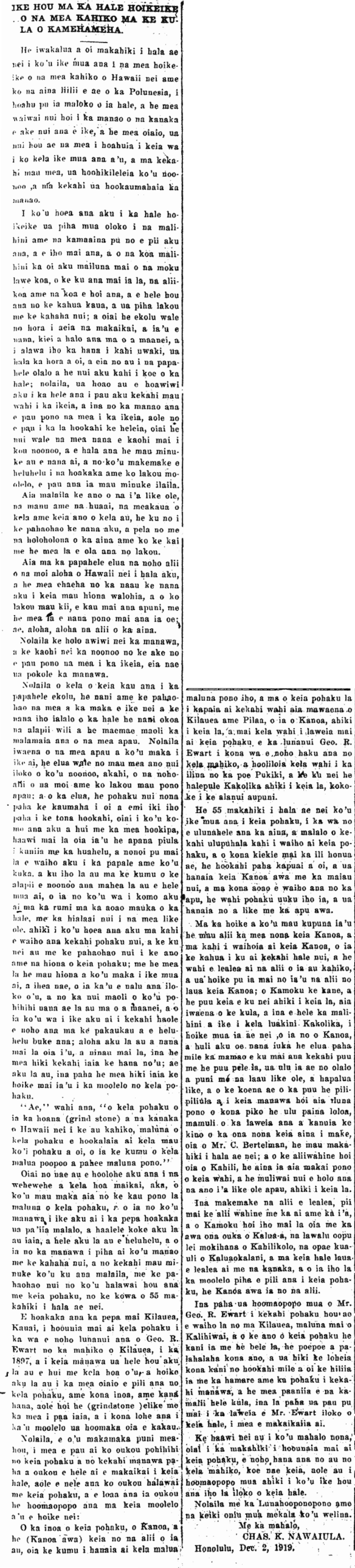
IKE HOU MA KA HALE HOIKEIKE O NA MEA KAHIKO MA KE KULA O KAMEHAMEHA.

Ka Nupepa Kuokoa, Buke LVII, Helu 50, Aoao 3. Dekemaba 12, 1919.The

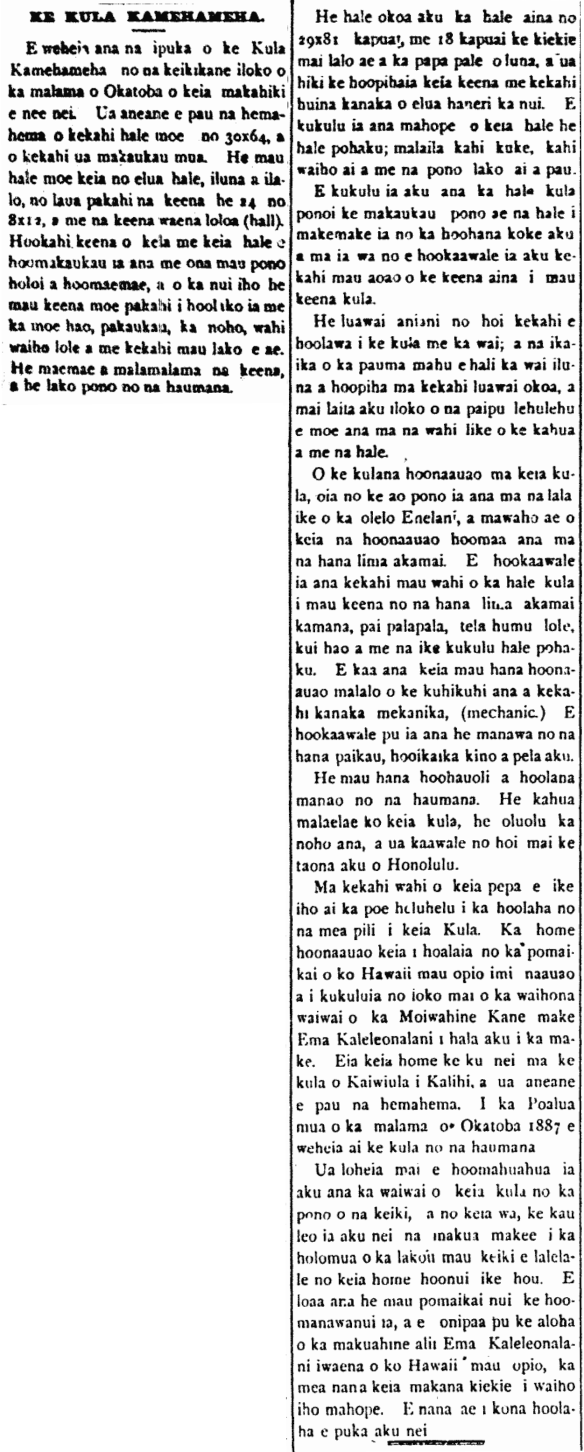
E o, e Kaleleonalani! Queen Emma and Kamehameha Schools, 1887.

KAMEHAMEHA SCHOOL.

The gates of the Kamehameha School for boys will open in October of this current year. The imperfections of one of the dormitories of 30 x 64 [feet] are almost smoothed out, and another was complete before. These dormitories are two storied, bottom floor and top floor, and each of them have 24 rooms of 8 x 12, and a hallway [keena waena loloa]. One room of each house is furnished with facilities to wash up and clean, and the rest of the rooms are bedrooms, each being supplied with a iron bed, desk, chair, closet, and some other furnishings. The rooms are clean and lighted, and well-furnished for the student.

The dining hall of 29 x 81 feet is a separate building, and it is 18 feet from the bottom to the ceiling, and it will fit two-hundred people. A stone building will be built behind this, which will be the kitchen and and a place to store the food and all cookware and dinnerware.

A proper schoolhouse will be built after the buildings that are desired to be completed quickly are done, and in the meantime, parts of the dining hall will be set aside as school rooms.

A clear spring will supply the school with water and it is by steam pumps that the water will be brought up and filled into a separate water tank, and from there into many pipes laid all over the grounds and buildings.

The curriculum at this school teaches thoroughly the branches of the English language; and outside of that are the teaching of industrial arts. Some rooms of the school house will be set aside as rooms for carpentry, printing, tailoring, blacksmithing, and masonry. The instruction will take place under the direction of a mechanic [mekanika]. Some time will also be set aside for military drilling, physical development, and so forth.

There are fun and cheerful activities for the students. This school sits on a serene site, living there is pleasant, and it is separated from the town of Honolulu.

In a section of this paper, the reader will see the advertisement dealing with this School. This is the educating home established for the benefit of Hawaii’s children who seek education, and built by way of the estate of the late Dowager Queen Ema Kaleleonalani. This home stands in the plain of Kaiwiula in Kalihi, and it is near completion. On the first Tuesday of October 1887, this school will open to students.

It has been heard that the assets of the school will be increased for the good of the children, and for now, parents who want their children to progress forward are being urged to rush to this new home where knowledge is increased. Much benefits will be gained if patient and if the aloha of the royal parent Ema Kaleleonalani is held resolute as well by Hawaii’s children, the one who left this great gift behind. Look at its published notice.

[On this, the day after Queen Emma’s 177th birthday, i thought it would be a good thing  to look back at her role in the establishment of the Kamehameha Schools, a role which she is not recognized often for today.

Notice the difference between the article appearing in the May 24th edition of the Hawaiian Gazette, “The Kamehameha Schools.” (probably what the article is based upon) and this Hawaiian-Language article.]

(Kuokoa, 5/28/1887, p. 2)

KE KULA KAMEHAMEHA.

Ka Nupepa Kuokoa, Buke XXVI, Helu 22, Aoao 2. Mei 28, 1887.

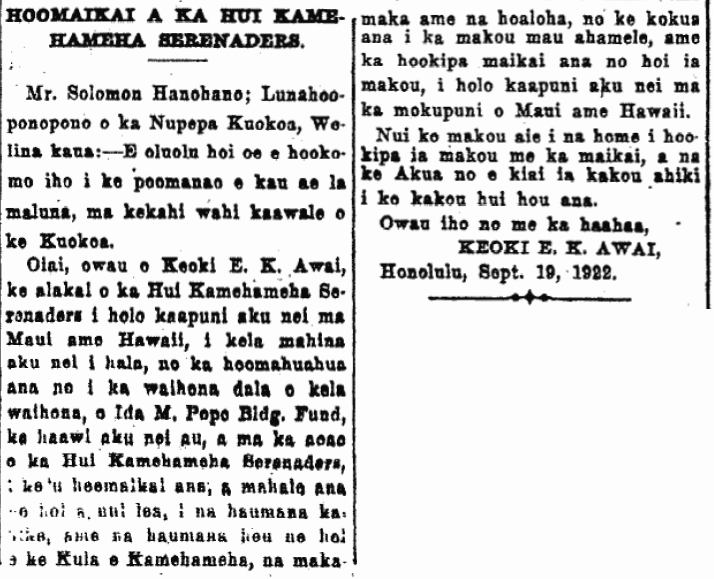
Kamehameha Serenaders, 1922.

GRATITUDE FROM THE KAMEHAMEHA SERENADERS.

Mr. Solomon Hanohano; Editor of the Kuokoa Newspaper, Greetings:—Please insert this topic above in an open space in the Kuokoa.

Being that I am Keoki E. K. Awai, the leader of the Kamehameha Serenaders which travelled around Maui and Hawaii last month to increase the funds for the Ida M. Pope Bldg. Fund; I give my great appreciation and thanks to the past students and the new students as well of Kamehameha School, and intimates and friends, for their assisting our concerts and for the good care given us while we went around Maui and Hawaii.

We are greatly indebted to the homes which offered us their fine hospitality, and may God watch over us until we meet once again.

Sincerely,

GEORGE E. K. AWAI,

Honolulu, Sept. 19, 1922.

(Kuokoa, 9/21/1922, p. 8)

HOOMAIKAI A KA HUI KAMEHAMEHA SERENADERS.

Ka Nupepa Kuokoa, Buke LXI, Helu 38, Aoao 8. Sepatemaba 21, 1922.