Cold weather on Maui, 1866.

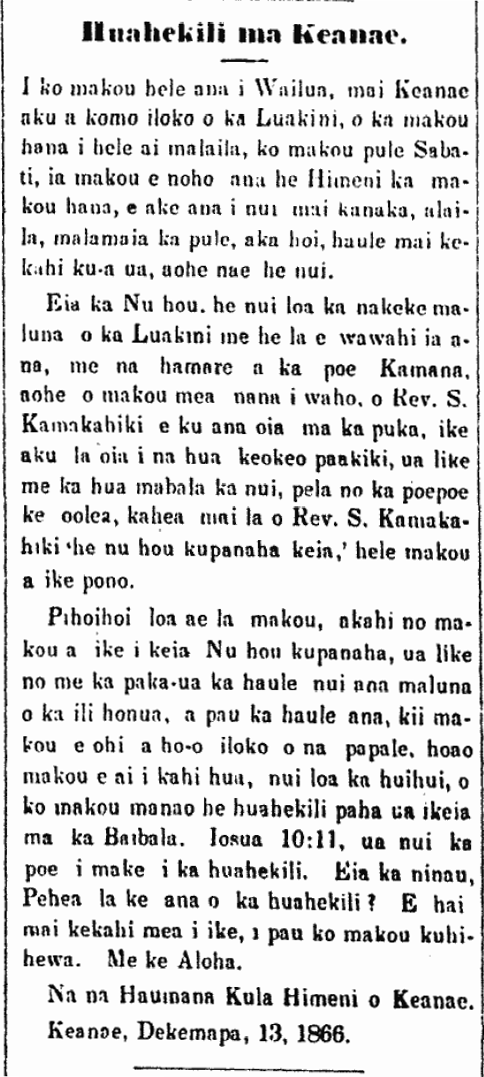
Hail in Keanae.

When we went to Wailua, from Keanae, and entered the church, the reason we went there was for Sunday services; while we were there, we were singing hymns hoping that a big crowd would come, at which point the prayers would be held, however, there was a shower, but not so big.

Here is the News: there was a big rumbling atop the Church as if it was being demolished with Carpenter’s hammers; none of us looked outside but Rev. S. Kamakahiki was standing by the window and saw hard white balls like the size of marbles, similar also in its spherical shape and hardness. Rev. S. Kamakahiki called out, “This is something new,” and we went to see for ourselves.

We were all agitated as this was our first time witnessing this new amazing thing; it was like rain, the way so much of them fell to the ground. After they fell, we went to pick some up and place them in our hats, and we tried to eat some of the balls. It was really cold, and we thought these were perhaps hailstones as seen in the Bible. Joshua 10:11, many people perished from the hailstones. Here is the question: How do you know a hailstone? Someone tell us, so are confusion is cleared. With Aloha.

The students of the Hymn School of Keanae.
Keanae, December 13, 1866.

(Kuokoa, 2/2/1867, p. 4)
Huahekili ma Keanae

Ka Nupepa Kuokoa, Buke VI, Helu 5, Aoao 4. Feberuari 2, 1867.
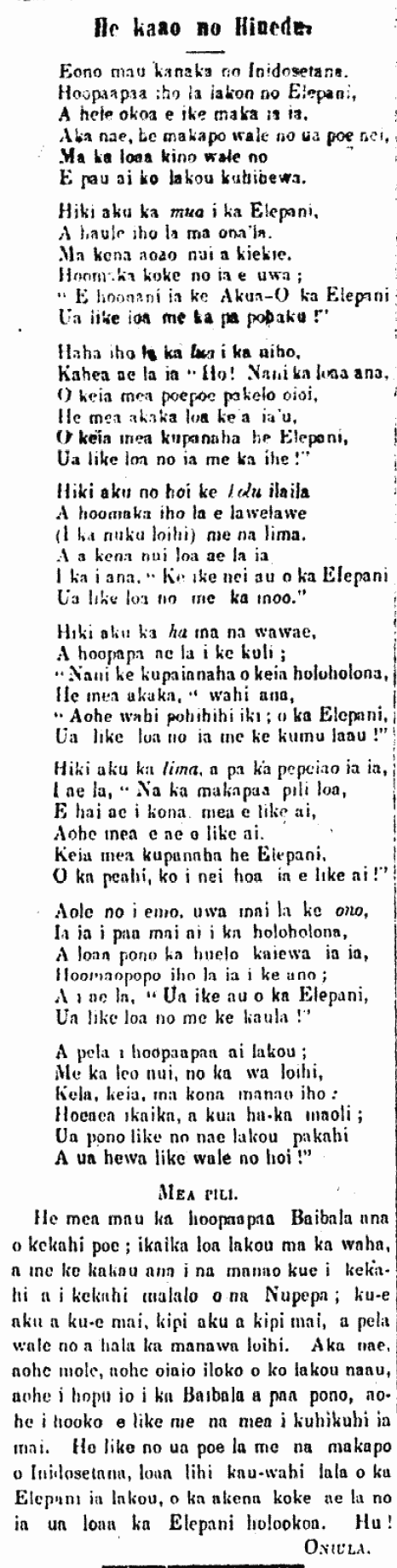
Six blind men and an elephant, 1867.

A TALE FROM HINDU.

[The story of the blind men who feel different parts of an elephant and give their varied impressions of what an elephant is, comes from India. But it was adapted into the poem “The Blind Men and the Elephant” by American, John Godfrey Saxe. This poem is then interpreted into Hawaiian in 1867 by Oniula, who submits many translations of foreign tales. The Saxe version can be found readily online…]

. . .

How it is related.

Some people constantly argue over the Bible; they are very outspoken, and write forcefully in the Newspapers, contradicting this person or that; arguing back and forth, conspiring back and forth, over long periods of time. However, there is no basis, no truth in their hearts; they don’t grasp the Bible firmly; they don’t do as they say. Those people are like the blind men of Indostan; they know just a small appendage of the Elephant, and then they boast that they know the whole Elephant. Hu!

Oniula.

(Kuokoa, 2/2/1867, p. 4)

He kaao no Hinedu.

Ka Nupepa Kuokoa, Buke VI, Helu 5, Aoao 4. Feberuari 2, 1867.

Poi and Kalo and a self sufficient Hawaii, 1915.

THE TIME WILL COME WHEN POI WILL BE SCARCE.

It would appear that the days are numbered, and 5 pounds of poi will go for a quarter, that is five cents per pound. This rise in price of poi is due to the lack of kalo, and perhaps because Hawaiians just don’t care to plant kalo in their fields.

These days in Honolulu, there are but few places that plant kalo. Places that loi kalo were seen are now dried out because the lands were accrued by other groups of people, and they dried the fields out; whereas it would be more beneficial if those back turners continued the planting of kalo. It has been almost two years since this spokesperson [the newspaper Ke Aloha Aina] first advised those with lands to farm them, for the time will come when there will be food shortages, at that time, America will declare war against Germany, which will intensify the problem, and that time we spoke of has come indeed. As proof of what we say, look to the issues of A. D. 1915–16, and you will find our words of advice, strongly encouraging Hawaiians to plant kalo and other crops, because the time will come when there will be hardships, and it will come, without fail.

Something terribly astonishing to us is that it as if kalo is being made into poi outside of Hawaii, for the cost is rising like goods imported here.

Why is this so? Because there is so little kalo being farmed, and there are a lot of people eating poi. These days, there are other ethnicities eating poi because their staples are expensive, and therefore, many people are eating poi and not much kalo is being planted.

We give our appreciation to the poi association of the stevedores which took some kalo lands and leased them out long term to plant kalo to supply their outlets at the markets and feed the poi-eating public.

Probably the public doesn’t realize that these days there is a poi shortage; maybe they continue to assume that poi is as usual. No! There is less poi now; six and a half pounds for a quarter, and some weeks it is just six pounds and sometimes five pounds for a quarter, which is five cents per pound.

So all you people with some kalo land, you should plant a lot of kalo and pull up well-developed corms when the time is right. Neglect during the day will leave you without. Work while the sun is up.

(Aloha Aina, 9/7/1917, p. 4)

E HIKI AKU ANA I KA MANAWA E LIILII LOA AKU AI O KA POI

Ke Aloha Aina, Buke XXII, Helu 36, Aoao 4. Sepatemaba 7, 1917.

McInerny Shoe Store ad, 1896.

McINERNY.

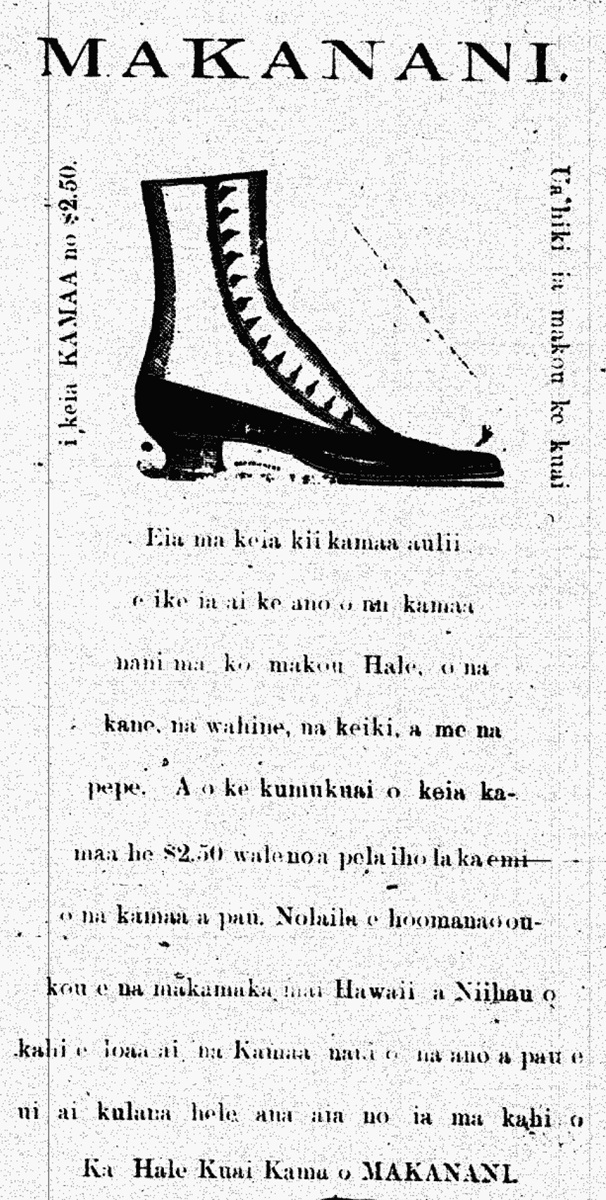
We can sell these SHOES for $2.50.

Here in this picture of an exquisite shoe, you will see the kind of beautiful shoes at our Store; for men, women, children, and babies. And the price of these shoes is but $2.50, and so too is the low cost of all of the shoes. So remember friends, from Hawaii to Niihau, the place to get your beautiful shoes of all sorts, to make your walking look sharp, is at the MAKANANI Shoe Store.

[This issue is labeled “Helu 8”, but it should be “Helu 9”, and it gets corrected on 1/17/1896.]

(Oiaio, 1/14/1896, p. 2)

MAKANANI

Ka Oiaio, Buke I, Helu 8, Aoao 2. Ianuari 14, 1896.

Eat local advertisement? 1932.

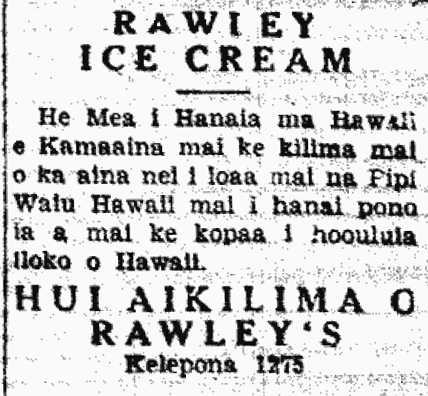
RAWLEY

ICE CREAM

Made in Hawaii by Kamaaina, from cream which is produced locally from Hawaii dairy cows which are well fed, and from sugar grown in Hawaii.

RAWLEY’S ICE CREAM COMPANY

Telephone 1275

(Alakai o Hawaii, 1/14/1932, p. 3)

RAWLEY ICE CREAM

Ke Alakai o Hawaii, Buke 3, Helu 37, Aoao, 3. Ianuali 14, 1932.

J. J. Williams Photographer advertisement, 1902.

J. J. WILLIAMS

PHOTOGRAPHER

CRAYONS
WATER COLORS
LANTERN SHOWS

ONLY COMPLETE
COLLECTION OF
ANCIENT
& MODERN
HAWAIIAN VIEWS.

Fort Street

Photography shoots are very reasonable at Wiliama’s place; you will receive beautiful prints from 4.00 for a dozen.

[Speaking of photography, the microfilming of these newspapers were done many years ago, and the resulting images taken from those microfilms are many times not legible. I barely could make out the tiny print. There needs to be funding to reshoot the Hawaiian-Language Papers, so that the words from the past can be seen clearly today!!]

(Aloha Aina, 1/11/1902, p. 3)

J. J. WILLIAMS PHOTOGRAPHER

Ke Aloha Aina, Buke VIII, Helu 2, Aoao 3. Ianuari 11, 1902.

“He has gone forever, but memories of him shall not be forgotten.” 1932.

A CHILD AND A NATIVE OF HAWAII

Last week, the last rites were carried out on the body of Joseph Kahahawai, the one who was shot by some soldiers after they kidnapped Kahahawai from the courthouse.

Kahahawai went to show himself before the officials, or those of the court, and when he exited from that office, he was pointed out by a women sitting upon her car to some other haole people.

When one of the two of them saw that Kahahawai was coming out, one of the haole went and said to Kahahawai to go with him, and showed Kahahawai a written document, and that was when Kahahawai agreed to go with him to the side of the car, but not the car belonging to the woman who pointed Kahahawai out; he went and death was sentenced upon him without him knowing the consequences of him agreeing to accompany these haole.

On Sunday was the funeral rites, and his body was laid to rest at Puea Cemetery on School Street.

As was reported in the papers, the funeral was large as the buddies and friends of the boy went along with his body to the graveyard.

The first services over his body was held at the Catholic church, and thereafter he was taken to the graveyard, and there, Rev. Robert Ahuna of the Christian Science Church held the last rites over the cold body of the child of whom the parents said their child was not at fault.

The Rev. Ahuna spoke before the congregation gathered together [?], “This kind of thing has not been seen here in Hawaii, but now this cruel deed is taking place because the law was taken into the hands of some people.”

There were thousands of people who came to Puea Cemetery.

Because there were so many people, they tried to move apart the people standing, as the hearse could not enter.

After the services by Rev. Ahuna, that famous hymn was sung, the hymn sung always at graveyards when someone is buried. That hymn is “Ka Lani Kuu Home [Heaven is My Home],” and after it was over, that beloved song of Hawaii nei, and a Nationalistic song for Hawaii’s locals [Hawaii Ponoi] was sung, and then dirt was covered over the child of Hawaiian parents who are loved.

He has gone forever, but memories of him shall not be forgotten.

(Hoku o Hawaii, 1/19/1932, p. 3)

HE PUA A HE EWE NO HAWAII

Ka Hoku o Hawaii, Buke, XXV, Helu 33, Aoao 3. Ianuari 19, 1932.

More from Kalaupapa, 1912.

GOOD CARE IS GIVEN.

To you, the distinguished one, O Nupepa Kuokoa, warm Aloha between us:—Please print these lines below:

Here I am spreading amongst the public, appreciation for the way we are being cared for at Baldwin Home here at the leprosy colony; the Brothers take good care of all of us and their care is better than true parents, all of the boys of the home have become true brothers to the Brothers of Baldwin Home; and this [letter] is to let the parents know of how their beloved children are being cared for at Baldwin Home.

If the children go down to the ocean of Kalaupapa, two Brothers will go down with them and come back with them; they take care of the children very morally; also, if the children go to Waikolu, some of the Brothers will accompany them all the time.

Let us look, O Friends and Parents, at the manner in which the sick children of Molokai are taken care of; in my opinion, Baldwin Home is the best. These are the names of the Brothers: Bro. Jokewe [Joseph Dutton] is the head of this Home, Bro. Lui [?] is the head of the Brothers, Bro. Lipolina [?] is their cook, Bro. Sawelino [?] is the one who sews the clothes of all of the children of Baldwin Home.

The Home is surrounded by eucalyptus trees and plum trees; those things above are what I have to inform you of.

O Distinguished One, I am one of the children who came to this foreign land, her to the leprosy colony of Molokai in the month of September 26, 1911.

That is the news from the land of suffering; please spread it to the entire archipelago.

Sincerely yours,
James Palakiko.
Baldwin Home, Molokai.

(Kuokoa, 1/12/1912, p. 6)

MAIKAI KA MALAMAIA ANA.

Ka Nupepa Kuokoa, Buke XLVIII, Helu 2, Aoao 6. Ianuari 12, 1912.

Fireworks accident #4, 1912.

[Here is the coverage of one of the English papers taken from Chronicling America. Notice how the name given is “Kaleihiena”. This is not to say that the Hawaiian-Language Newspapers did not have typos. Some papers were more prone to typos than others…]

(Hawaiian Gazette, 1/5/1912, p. 7)

HIS HAND BLOWN OFF BY GIANT POWDER STICK

The Hawaiian Gazette, Vol. LV, No. 2, P. 7. January 5, 1912.