[Found under: “Local News”]
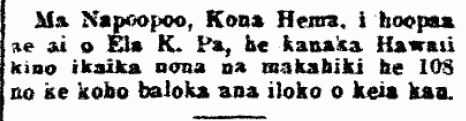
Here is the newspaper, Garden Island from Kauai, which is now being printed with some columns written in the Hawaiian Language for the benefit of those who can read Hawaiian.
(Kuokoa, 2/9/1912, p. 8)
I came across an ambitious work—alphabetical lists of names from newspaper obituaries, and thought i should post it here. There is a note saying, “The following information was acquired from index cards prepared and microfilmed by the Hawaii State Archives. The following information is subject to human error. Indexing was of full obituaries only, not death notices.”
And they further state that, “All are incomplete, till I find more time to work on them.” I totally understand how that goes…
I think that these sorts of listings are important, as it allows you to browse when you aren’t exactly sure of who you are looking for, and maybe that would draw connections you never would have imagined.
One of my dream lists would be one master list, of births, deaths, and marriages, along with which newspaper and issue (and page) that information came from!
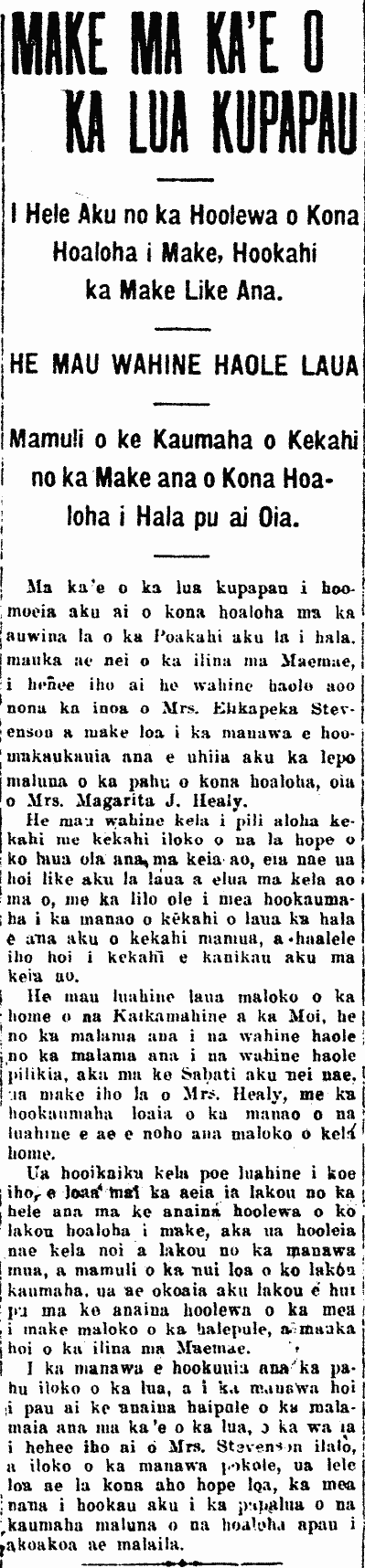
At the side of the grave where her friend was laid, on the afternoon of this past Monday, mauka at the cemetery of Maemae, is where an older haole woman collapsed and died when they were preparing to cover the coffin of her friend, Mrs. Margaret J. Healy with soil; her name was Mrs. Elizabeth Stevenson.
They were two woman who shared the bonds of aloha in their last days of their lives on this earth, and they left together to the other side, without one feeling sadness for the other in one dying before the other, and one being left behind in this world grieving.
They were both old ladies at the King’s Daughters’ Home which takes care of haole women in difficulty; but on this past Sunday, Mrs. Healy died, leaving the rest of the old ladies living in the home feeling very sad.
The remaining women were persistent in trying to get permission to attend the funeral of their friend who died, but their request was denied at first, however, because of their great sadness, they were all freely allowed to gather at the funeral in the church and mauka at the cemetery of Maemae.
When the coffin was lowered into the grave, and when the graveside service was over, that was when Mrs. Stevenson fainted, and in a short time, her last breath left her, and this made the grief of the friends gathered there increase twofold.
(Kuokoa, 2/9/1912, p. 1)
[There are times when an article will be taken from an English-Language paper, or even another Hawaiian-Language Newspaper (past or current, acknowledged or not). Here is an example of an article which seems to be generally translated from an English-Language item appearing three days earlier.
See the post by University of Hawaii at Manoa Library:
(Kuokoa Home Rula, 2/9/1912, p. 1)
The S. S. Mikahala arrived yesterday, and turned around full of cargo for this port, and at Kaunakakai it put ashore the pai ai [pa‘i ‘ai], and most of the items will perhaps arrive the following week. The kokua went upside to Kaunakakai with the donkeys to fetch the pai ai yesterday evening, and last night the provision donkeys arrived, and this morning they left again for the remaining pai ai. The reason that that S. S. Mikahala could not land her cargo was because of the rough seas surrounding us; there was no harbor, only ocean, and the waves spreading across shore were towering, but an amazing thing was the request by the Vice Superintendent and Doctor W. J. Goodhue for the children and their skiff of the H. H. K. L. [?] and this request was granted.
Dr. W. J. Goodhue got on, along with the stout boys of the H. H. K. L. and they rowed out to try and get the Mikahala to throw over the pai ai to them; the amazing thing I spoke of was when the skiff came into view and before them was a huge wave, and that was when everyone held their breath, because it was as if the boat and the brave ones aboard would be pulled down, however with the blink of an eye, the skiff arrived triumphantly outside without harm, and Dr. W. J. Goodhue was seen waving his handkerchief to the people on land. And to Mr. Paahao, the helmsman went the people’s appreciation, because it was his steering that they faced the powerful waves and came out like a man-eating shark speeding atop the sparkling [hulala?] billows of the sea; and admiration also went to the boys who rowed, being that it was their strength which helped the helmsman greatly. This is just some news.
I understand that you sent the Calendars and they came, but there they go back again, and maybe we will get them next week.
There is a much Rain and strong Kona winds blowing, from last week until today, and it is this wind that caused the rough seas, and the rough seas are bringing up great rocks [aa?] and depositing them upland.
William Notley
Kalaupapa, Molokai, Feb. 2, 1912.
(Kuokoa Home Rula, 2/9/1912, p. 1)
ANNEXATION REVISITED IN LIVING HISTORY PRESENTATION
Mai Poina: The Annexation Debate to be staged Feb. 23-26
HONOLULU – Historical figures Joseph Kaulia and Emma Nāwahī lead a compelling visit to pre-annexation Hawai‘i in Mai Poina:The Annexation Debate, a living history presentation to be staged February 23-26 at the Judiciary History Center in Ali‘iōlani Hale.
…
[For more information, click here.]
[This is one of the articles from the page shown in the previous post, and you can see that the left column is mostly illegible. I can make out phrases like “the river Seine,” “gathered,” “American troops,” “General Petain,” “William K. Wells,” “Bwen,” “for their bravery,” “Noble of Honolulu”…]
…the cheeks of these boys, like what is customary of the French military; and that is when you immediately heard the song “Aloha Oe.”
And the crowd was awestruck as their fellow platoon members were watching attentively at what was being performed upon these Hawaiian boys.
And these Hawaiians became something great amongst their platoon, and then the band played French nationalistic songs.
These boys received much happiness, and so too did their families living here in Hawaii. Two youths, both native Hawaiians, they being Francis Brown and William Noble.
Hawaii is truly famous these days, and their great sea journey was worthwhile, they are still alive, received great honors, and made their parents and families happy.
And you, tiny Hawaii, amongst the great nations of the Earth, are elevated and made famous through the celebrated and fearless deeds of these Hawaiian boys.
(Aloha Aina, 3/28/1919, p. 1)
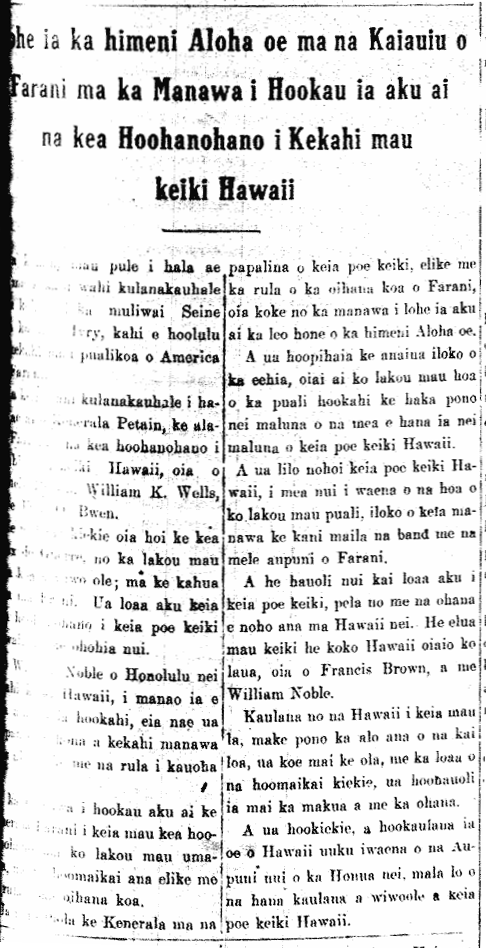
[This is what many of the images of the papers look like. Why? Because they were bound like a book. Binding is both a blessing and a curse. Because they were bound, they are for the most part intact and complete, but on the other hand because they are bound, the side that is sewn will usually get cut off when taking a picture of the page. The binding in the image below is on the left-hand side. (Click on the image for a closer view.)
There can be no searching done when you can’t even make out the words. And as a result, a lot of knowledge is not accessible!]
Mahalo a nui to Francis from the Museum IT Dept. for getting me back online and helping me save electricity to boot!