Oneha family history, 1876.

[Found under: “News”]

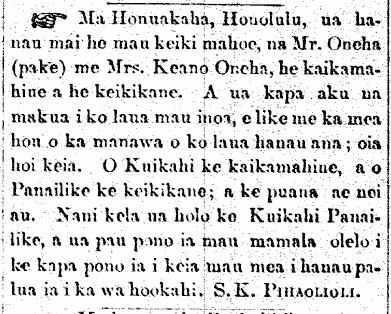
At Honuakaha, Honolulu, twins were born to Mr. Oneha (Chinese) and Mrs. Keano Oneha, one girl and one boy. The parents named them after the current news at the time of their birth; that being this: Kuikahi [Treaty] is the girl, and Panailike [Reciprocity] is the boy, and I announce it. How great that the Reciprocity Treaty has passed, and that this phrase is complete when speaking the names of these children born together at the same time. S. K. Pihaolioli.

[Children were often named after current events to commemorate the occasion.

There was a great debate over the merits of the Reciprocity Treaty with America, with many articulate compositions for and against it in the Hawaiian-Language Newspapers. More on that at a later date.]

(Lahui Hawaii, 10/19/1876, p. 3)

Ma Honuakaha, Honolulu...

Ka Lahui Hawaii, Buke II, Helu 43, Aoao 3. Okatoba 19, 1876.

Wow, this sounds like a pretty awesome opportunity for the young people! There is a lot of priceless information available in the English Newspapers as well, much of it dealing with Hawaii nei!

uodigcol's avatarOregon Digital Newspaper Program

As part of the National Digital Newspaper Program (NDNP) and provider of historic Oregon newspaper content for the Chronicling America historic American newspapers website (hosted by the Library of Congress and the National Endowment for the Humanities), the Oregon Digital Newspaper Program (ODNP) is pleased to spread the word about a new opportunity for recognition of middle and high school students with a passion for history.

The following press release was published today on the National Endowment for the Humanities website at http://www.neh.gov/news/press-release/2012-06-14:

WASHINGTON (June 14, 2012) —  The National Endowment for the Humanities (NEH) today announced a new contest to encourage middle and high school students to use Chronicling America, the NEH and Library of Congress-supported digital archive of historic newspapers, in their projects for National History Day.

At the closing ceremonies of National History Day, held on the University of Maryland campus in College Park, Maryland…

View original post 502 more words

25th Annual Kamehameha Schools Luau, 1912.

KAMEHAMEHA STUDENTS AT LUAU

For the twenty-fifth time, the Kamehameha Schools held a luau on the night of last Saturday, and a great number of Kamehameha Schools graduates: boys with their wives, and so too girls with their husbands; and it was a time for the old people to get acquainted with the new, and a time to rejoice, and to listen to the speeches prepared, and the main thing was the feasting on tables weighted down with foods prepared by the students of the school.

In attendance were the teachers of the schools, some of the trustees, and a few invited malihini; they ate heartily, and there was leftover for those who prepared it [?], and everyone went home at the proper time with pleasant thoughts on what was seen that night.

After stomachs [ka lua o ka inaina] were filled, everyone enjoyed some songs from the boys of Kamehameha, and also from the girls, and the Honolulu band, then the speeches of the night were heard.

From the school, President Horne gave the first speech, that is, he gave his thanks for the gathering of the students on that night, which was something that the school was happy about, that the students of Kamehameha always come back to see the school which educated them.

According to him, in learning from the students how they are living, that being not going into debt; each of them are have still gone in debt; they are indebted to the Kamehameha School, and the benevolence of Bernice Bishop, the one who founded this school.

Following him, Faxon Bishop was called, and he explained the falsity of what he heard about the lack of advancement of those who graduated from the school.

There have been many things which he has heard about the children of Kamehameha after they leave the school, and to put an end to his misconceptions, he instructed the principal, Mr. Horne, to supply him with the roster of all students who graduated from the school, along with their occupations; and when he saw the list, he exclaimed about the falsehood of all that he had heard.

From amongst the 261 students who graduated from the school, he separated them into their current occupations, along with those deceased and those whose occupations are not known. These are the students of Kamehameha by their different occupations which benefits their lives as well as that of their families.

From within the great number of children who graduated, 63 of them are working in skilled labor; 50 are in secretarial, bookkeeping, or office work; 20 have deceased; 18 are in the teaching profession; 17 farmers; 10 in singing; 9 in the postal service; 7 with the street cars; 7 in the police force; 6 of them are ranked deputy sheriff; 6 are architects [kahakii]; 6 at the custom house [kukeawa]; 4 in roadwork; 3 in the army or navy; 3 drivers; 2 in law school; 2 newspaper editors; 2 stevedores; 2 in the board of health; 2 are day laborers [limahana hana la]; 2 are ticket agents; 1 is the head of the jail; 1 undertaker; 1 bank employee; 1 pastor; 1 lighthouse keeper; 1 head of a store; 1 at Kalihi Camp; and as for those whose occupations are unknown, there are 4.

By this list of occupations of the children, he said that there is absolutely no school known which have graduates that have progressed in this manner, which contradicts the truth of what he heard.

At the close of his speech, one of the old graduates of the school was called up, Deputy Sheriff Oscar Cox of Waialua, and it was he that instructed the trustees that they also should look after the welfare of all of the students of Kamehameha who graduate.

There are two major points he spoke of on that night pertaining to the progress of the school, that being the trustees acceptance of the importance of paying heed to the longevity of the tenure of the teachers within the school, and to not have them just stay for a short period and return to America, followed by the arrival of new teachers; that just leads to the the children not having a unified education. The other point was the importance of paying attention to the children when they leave the school.

He encouraged the youths living in this town now to return to and to live in the country, for according to him, there are many jobs in the sugar plantations, and should there be boys going back to Waialua, he believes he will be able to assist them in finding proper work by talking with the people in the sugar plantations.

He pointed out to the board of trustees that there is much land all over, and should the trustees care for the well being of the youths of Kamehameha, then it is of great importance that they give out those many acres of land to those youths going into farming, raising livestock, or other endeavors that will benefit them, along with granting them a sum of money for their use; and in that way, according to him, if there was this assistance, he would leave his government position and start working where he would gain an independent livelihood, and he would be able to care for and educate his children.

There was much appreciation for the Mr. Cox’s speech amongst his fellow schoolmates, as they continued to clap, however the thoughts of the trustees have yet to be seen.

From what was said about the luau that was held, it was a party leaving everyone gratified.

[A hundred years later, as Kamehameha Schools is celebrating its 125th year anniversary, this is something perhaps to look back to and to think about today and tomorrow…]

(Kuokoa 6/14/1912, p. 4)

NA HAUMANA KAMEHAMEHA MA KA PAINA LUAU

Ka Nupepa Kuokoa, Buke XLVIII, Helu 24, Aoao 4. Iune 14, 1912.

More Decorating the Kamehameha Statue, 1912.

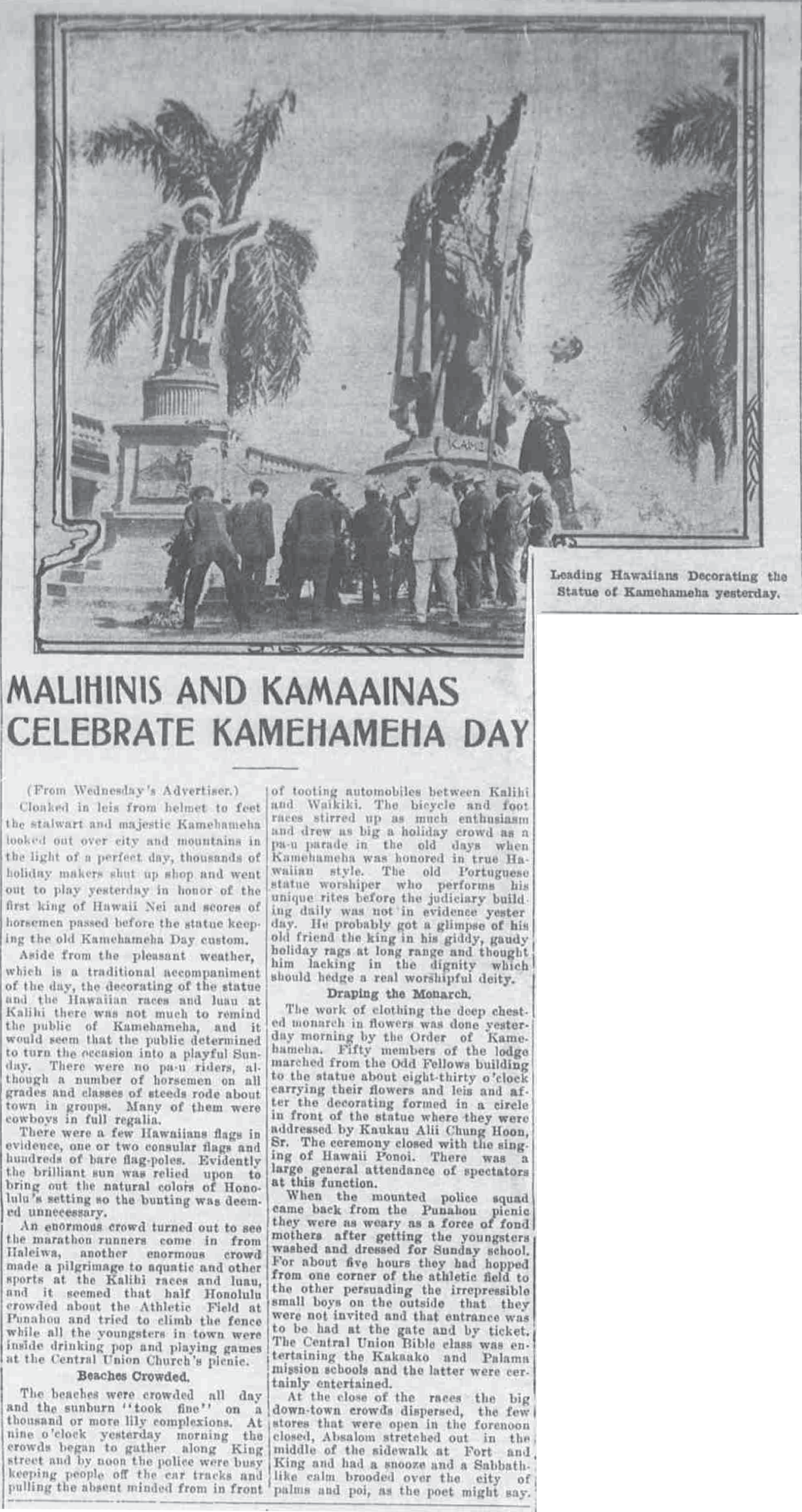
MALIHINIS AND KAMAAINAS CELEBRATE KAMEHAMEHA DAY

Leading Hawaiians Decorating the Statue of Kamehameha yesterday.

(From Wednesday’s Advertiser.)

Cloaked in leis from helmet to feet the stalwart and majestic Kamehameha looked out over city and mountains in the light of a perfect day, thousands of holiday makers shut up shop and went out to play yesterday in honor of the first king of Hawaii Nei and scores of horsemen passed before the statue keeping the old Kamehameha Day custom.

Aside from the pleasant weather, which is a traditional accompaniment of the day, the decorating of the statue and the Hawaiian races and luau at Kalihi there was not much to remind the public of Kamehameha, and it would seem that the public determined to turn the occasion into a playful Sunday. There were no pa-u riders, although a number of horsemen on all grades and classes of steeds rode about town in groups. Many of them were cowboys in full regalia.

There were a few Hawaiian flags in evidence, one or two consular flags and hundreds of bare flag-poles. Evidently the brilliant sun was relied upon to bring out the natural colors of Honolulu’s setting so the bunting was deemed unnecessary.

An enormous crowd turned out to see the marathon runners come in from Haleiwa, another enormous crowd made a pilgrimage to aquatic and other sports at the Kalihi races and luau, and it seemed that half of Honolulu crowded about the Athletic Field at Punahou and tried to climb the fence while all the youngsters in town were inside drinking pop and playing games at the Central Union Church’s picnic.

Beaches Crowded.

The beaches were crowded all day and the sunburn “took fine” on a thousand or more lily complexions. At nine o’clock yesterday morning the crowds began to gather along King street and by noon the police were busy keeping people off the car tracks and pulling the absent minded from in front of tooting automobiles between Kalihi and Waikiki. The bicycle and foot races stirred up as much enthusiasm and drew as big a holiday crowd as a pa-u parade in the old days when Kamehameha was honored in true Hawaiian style. The old Portuguese statue worshiper who performs his unique rites before the judiciary building daily was not in evidence yesterday. He probably got a glimpse of his old friend the king in his giddy, gaudy holiday rags at long range and thought him lacking in the dignity which should hedge a real worshipful deity.

Draping the Monarch.

The work of clothing the deep chested monarch in flowers was done yesterday morning by the Order of Kamehameha. Fifty members of the lodge marched from the Odd Fellows building to the statue about eight-thirty o’clock carrying their flowers and leis and after the decorating formed in a circle in front of the statue where they were addressed by Kaukau Alii Chung Hoon, Sr. The ceremony closed with the singing of Hawaii Ponoi. There was a large general attendance of spectators at this function.

When the mounted police squad came back from the Punahou picnic they were as weary as a force of fond mothers after getting the youngsters washed and dressed for Sunday school. For about five hours they had hopped from one corner of the athletic field to the other persuading the irrepressible small boys on the outside that they were not invited and that entrance was to be had at the gate and by ticket. The Central Union Bible class was entertaining the Kakaako and Palama mission schools and the latter were certainly entertained.

At the close of the races the big down-town crowds dispersed, the few stores that were open in the forenoon closed, Absalom stretched out in the middle of the sidewalk at Fort and King and had a snooze and a Sabbath-like calm brooded over the city of palms and poi, as the poet might say.

[Found on Chronicling America!]

(Hawaiian Gazette, 6/14/1912, p. 2)

MALIHINIS AND KAMAAINAS CELEBRATE KAMEHAMEHA DAY

The Hawaiian Gazette, Volume LV, Number 39, Page 2. June 14, 1912.

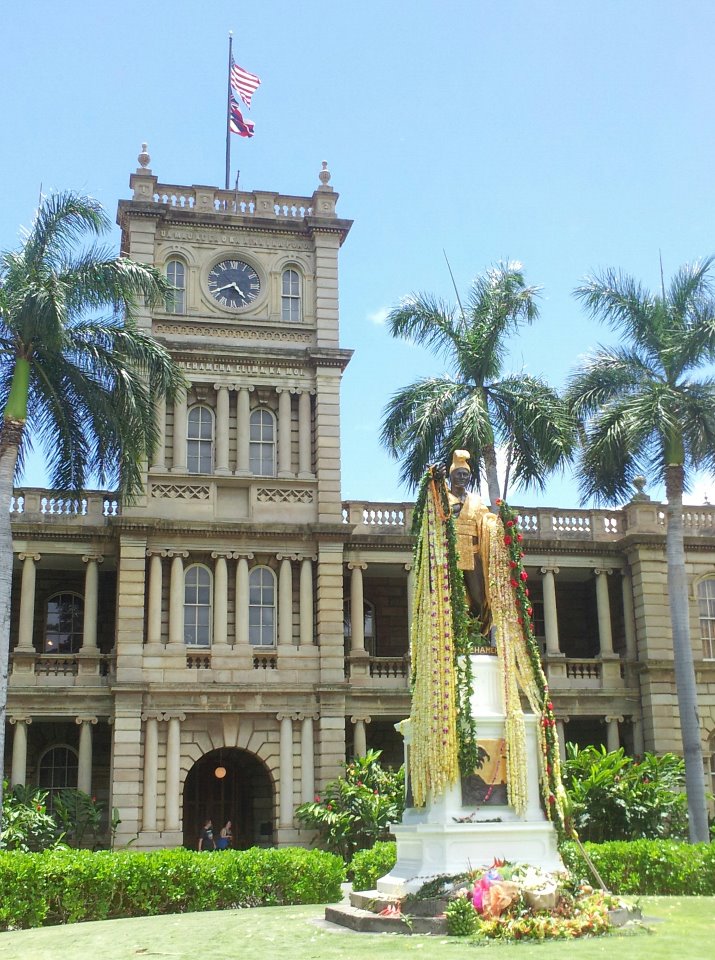
Decorating the Kamehameha Statue, 1912.

[Found under: “Local News”]

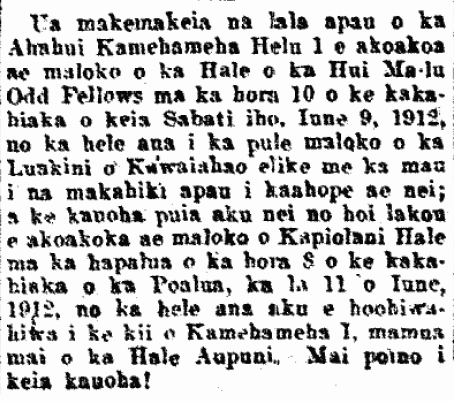
All members of the Ahahui Kamehameha Division 1 are requested to assemble in the Building of the Secret Society, Odd Fellows, at 10 in the morning of this coming Sunday, June 9, 1912, to go on to pray in Kawaiahao Church, as is done in all past years; and they are also ordered to assemble within Kapiolani Hale at half past 8 on the morning of Tuesday, the 11th of June, 1912, to go and decorate the statue of Kamehameha I in front of the Government Building. Do not forget this order!

(Kuokoa, 6/7/1912, p. 8)

Ua makemakeia na lala apau...

Ka Nupepa Kuokoa, Buke XLVIII, Helu 23, Aoao 8. Iune 7, 1912.

Vital Statistics, 1912.

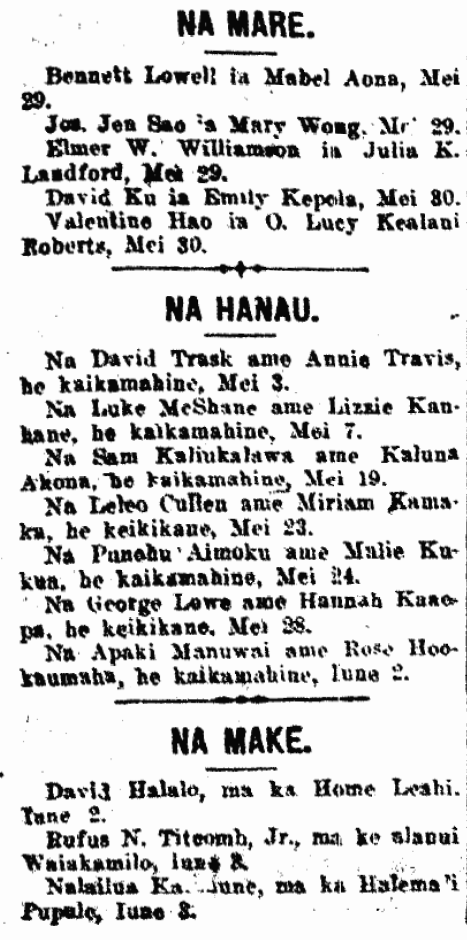
MARRIAGES.

Bennett Lowell to Mabel Aona, May 29.
Joseph Jen Sao to Mary Wong, May 29.
Elmer W. Williamson to Julia K. Landford, May 29.
David Ku to Emily Kepola, May 30.
Valentine Hao to O. Lucy Kealani Roberts, May 30.

BIRTHS.

To David Trask and Annie Travis, a daughter, May 3.
To Luke McShane and Lizzie Kauhane, a daughter, May 7.
To Sam Kaliukalawa and Kaluna Akona, a daughter, May 19.
To Leleo Cullen and Miriam Kamaka, a son, May 23.
To Punohu Aimoku and Malie Kukua, a daughter, May 24.
To George Lowe and Hannah Kaaepa, a son, May 28.
To Apaki Manuwai and Rose Hookaumaha, a daughter, June 2.

DEATHS.

David Halalo at Leahi Home, June 2.
Rufus N. Titcomb, Jr., on Waiakamilo Road, June 3.
Nalailua Ka[???]une, in the Insane Asylum, June 3.

[The last name is illegible but most likely if this page (and all of the rest of the newspapers) were re-photographed clearly, priceless information that we cannot see now will become clear! No one wants a bunch of @s in the middle of a kupuna’s name. There would be no way to find that name in a word search.]

(Kuokoa, 6/7/1912, p. 8)

NA MARE. / NA HANAU. / NA MAKE.

Ka Nupepa Kuokoa, Buke XLVIII, Helu 23, Aoao 8. Iune 7, 1912.

Keaunui family history, 1874.

[Found under: “Local News”]

On the 22nd of April, the King spoke at Lanakila Church in Hauula, and at the end of his royal speech, Keaunui brought his youngest daughter before the King; the King kissed the small girl, and the King asked, “Is this your daughter?” Keaunui said, “Yes, she is mine, her mother is over there, she is pregnant again.” The King responded, “When she gives birth, name the baby Kahooululahui,”¹ and the word of the King was agreed to. On the night of the 24th, when the King was in Ewa, at 2 o’clock at night, Mrs. Hellen K. Keaunui gave birth to a son, with J. L. Keaunui, and he was immediately named David Kahooululahui. He was the 13th of their children, they are just a small bit of the growing of the lahui; how blessed would be the nation if all the women from Hawaii to Kauai were like her.

¹”Hooulu Lahui” was Kalakaua’s famed motto, encouraging the increasing of the nation/race.

(Kuokoa, 5/9/1874, p. 2)

Ma ka la 22 o Apr...

Ka Nupepa Kuokoa, Buke XIII, Helu 19, Aoao 2. Mei 9, 1874.