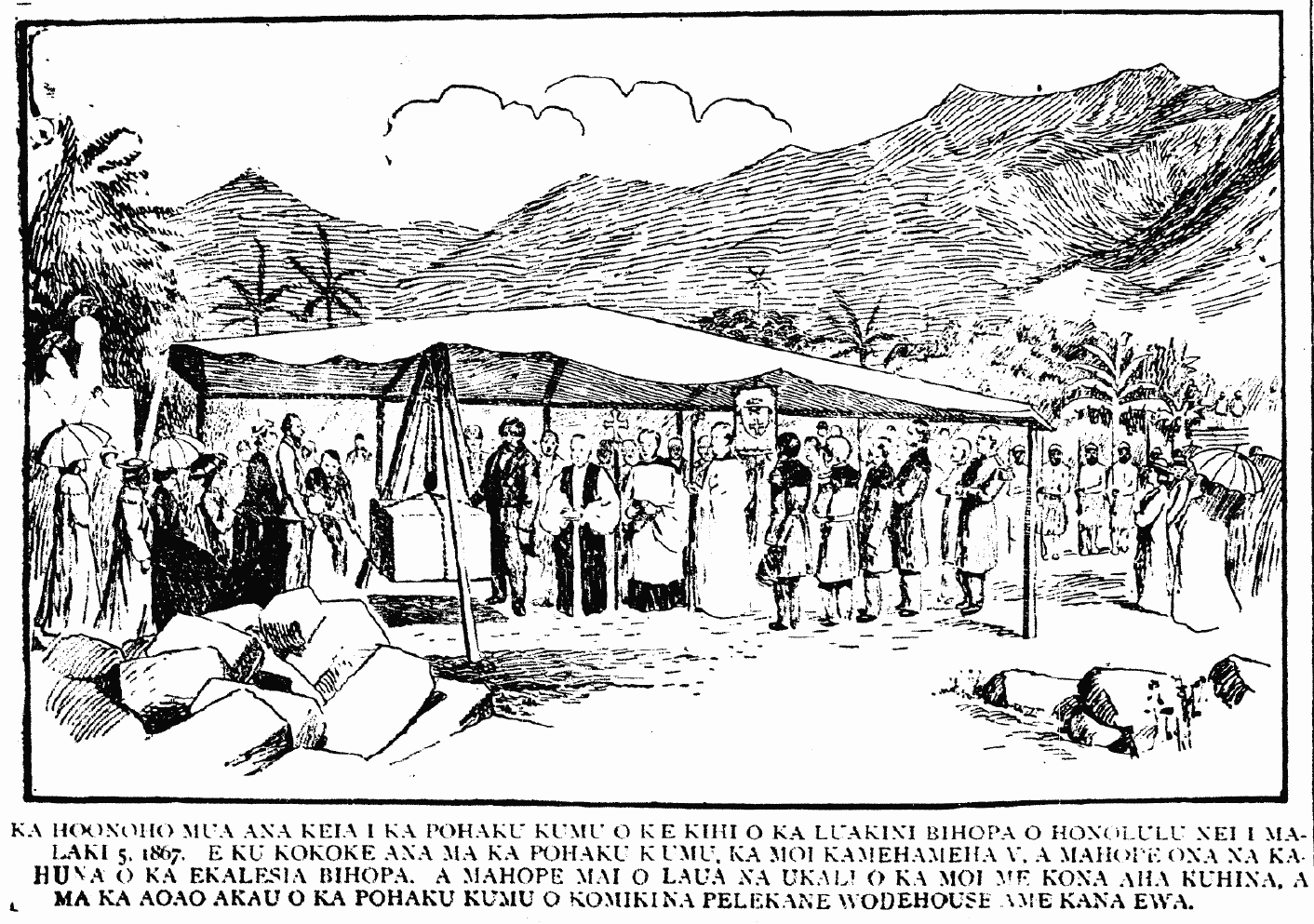
Look back at the 1867 laying of the cornerstone of St. Andrew’s Cathedral, 1906.

This is the first laying of the cornerstone of the Anglican Church of Honolulu, on March 5, 1867. Standing near the cornerstone is King Kamehameha V, and behind him are the priests of the Anglican Church. And behind those two are the attendants of the King and his Cabinet of Ministers, and to the right side of the cornerstone is the British Consul Wodehouse and his wife.

(Kuokoa, 11/30/1906, p. 2)

KA HOONOHO MUA ANA KEIA I KA POHAKU KUMU...

Ka Nupepa Kuokoa, Buke XLV, Helu 48, Aoao 2. Novemaba 30, 1906.

More on the weekly Lahainaluna newspaper, “Ko Lahainaluna Ponoi.” 1874.

[Found under the title: “O ka mikiala hana” (Prompt work)]

This Monday we saw a handwritten newspaper published amongst the students of the Lahainaluna College, called Ko Lahainaluna Ponoi; that paper is done promptly but with much effort, for each page is handwritten and it is published every Wednesday.

(Kuokoa, 9/12/1874, p. 3)

Ma ka Poakahi nei,...
Ka Nupepa Kuokoa, Buke XIII, Helu 37, Aoao 3. Sepatemaba 12, 1874.

More on the arrival of the British Astronomers, 1874.

Arrived at

Honolulu, is the Astronomical Expedition sent by the British Empire to observe the transit of Venus in front of the Sun, from Valparaiso, aboard the warship “Scout,” in thirty-six days. The head of the Expedition is Captain G. L. Tupman, just as we explained in an earlier issue.

The first location was chosen at Honuakaha, Honolulu, and the head of this expedition will watch and it is he who will actually be at this location while being assisted by Lieutenant Ramsden and Prof. Nichols. The second location to observe from will be chosen from somewhere on Hawaii Island, perhaps in Kohala, or Waiohinu maybe. This place will be overseen by Prof. G. Porepe [Forbes] assisted by Prof. H. G. Barnacle. The third location under consideration is perhaps on Kauai (between Waimea and Mana), or on Niihau. This will be under the direction of Prof. R. Johnson assisted by Lieut. E. W. J. Noble, but this observation place will have two astronomers there. The observations of the astronomers will decide the right location suitable for their work. An area with great clarity will be built: somewhere that their instruments can easily be transported without being damaged, a place that is dry and without rain, and not somewhere that is seen to be windy during the day, a place that the sun goes down clearly, and the sky cannot be obstructed with drifting clouds.

With them are not less than twenty-five meteorologists [ana ino?] who will be put to work at each of the three observation areas. The Expedition brought along with them a great many workers, and our government has forgave those duties to help this scientific endeavor of man. A British vessel will be sent to travel between the three locations, named Boxer, and it is hoped that it will arrive everyday. It is not for us to say that we should all help, both Hawaiians and haole, to advance this great endeavor, but it is for each of you to think and decide to extend a helping hand to move forward this knowledge, at each of the locations where they set up their equipment.

It is not often that before us appears [opportunities] to assist scientists of this class in our shores, and therefore, we hope as this is the beginning, and that their time here will be adorned with the lei of progress.

(Kuokoa, 9/19/1874, p. 2)

Ua hiki mai ma

Ka Nupepa Kuokoa, Buke XIII, Helu 38, Aoao 2. Sepatemaba 19e, 1874.

The British Astronomers arrive, 1874.

[Found under: “Local News”]

The British Man-of-war “Scout.”—On the evening of this Wednesday, this warship of the queen arrived with the expedition of the Group Observing the transit of Venus before the sun, after 36 days from Valparaiso. The reason for them not arriviving early as was planned was because the Observation Expedition did not arrive in Valparaiso before the date it was planned for them to leave there.

(Kuokoa, 9/14/1874, p. 3)

Ka Manuwa Beritania "Scout."

Ka Nupepa Kuokoa, Buke XIII, Helu 37, Aoao 3. Sepatemaba 12, 1874.

More on Transit of Venus, 1874.

The Day to Watch the Stars.

(Written for the Kuokoa)

The afternoon of this past Tuesday of this week, December 8th, was the day when Astronomers from times past and of these times believed that Venus [Hokuloa] would pass in front of the Sun, and it indeed did happen.

The Sun came out that morning shinning nicely, and its rays continued to shine forth with clarity until the second when Hokuloa’s was seen beginning to peep over at the edge of the sun. The heavens were clear and the floating clouds were banished away, with just one seen, the thick, black cloud surrounding the heavens.

Here are the places in Honolulu set aside by the people wanting to view the appearance of Hokuloa as it passed by: Honuakaha in Honolulu, the actual base of the Astronomers; the Government Surveying Office in the Government Building Aliiolani, for the Government Surveyor Laiana [C. J. Lyons]; the Labor Office, for David N. Flitner; Kapunahou [Punahou School], for the head of the Government Surveyors, W. D. Alekanedero [W. D. Alexander]; at Pawaa, for the Deputy Harbor Master of Honolulu, Captain Daniela [Daniel] Smith. And for the multitudes who just wanted a glimpse, they grabbed real telescopes and looked straight at the sun; and for those without telescopes, they grabbed shards of glass and placed them over candles until black, and then looked and could see.

From the base of the British Astronomers at Honuakaha, it was very calm, there were no one allowed entrance, there was no talking, no whispering, and nothing that would cause excitement was desired; a battalion of soldiers was sent to the observation area to guard their peace. The Astronomer Boys put their all into their work for which they were sent by the government at great expense. Not one of them has any complaints about Hawaii for they were provided and blessed with a totally clear sky, and perhaps we would not be mistaken to say that these astronomers were very lucky for getting this good day for which they will not forget Hawaii.

And by the kindness of the British Astronomers in Honolulu, we have these times below from various telescopes the Astronomers and others away from different places.

When Hokuloa was seen barely at the edge of the Sun, here are the different times of the British Astronomers:

Tupman, (Head Astronomer.) 3 [hr.], 7 [min.], 1 [sec.]

Noble, (Assistant Astronomer.) 3 [hr.], 7 [min.], 3 [sec.]

When Hokuloa began to clearly move into the face of the Sun, here are the various times from the Astronomers of Britain and those people from here:

Tupman, (Head Astronomer.) 3 [hr.], 35 [min.], 56 [sec.]

Noble, (Assistant.) 3 [hr.], 35 [min.], 54½ [sec.]

D. Smith (Of Hawaii.) 3 [hr.], 35 [min.], 54 [sec.]

C. J. Lyons (Of Hawaii.) 3 [hr.], 35 [min.], 54 [sec.]

D. N. Flitner (Of Hawaii.) 3 [hr.], 35 [min.], 58 [sec.]

The times seen by the last three were not taken into account by the Astronomers. However, there was not much difference between the times seen by the British Astronomers and our people keeping time. But it was surely a nice day for observing.

The slides taken were not as great as was hoped for, but they are indeed of much value.

(Kuokoa, 12/12/1874, p. 2)

Ka la Kilo Hoku.

Ka Nupepa Kuokoa, Buke XIII, Helu 50, Aoao 2. Dekemaba 12, 1874.

Transit of Venus, 1874.

[Found under: “Local News”]

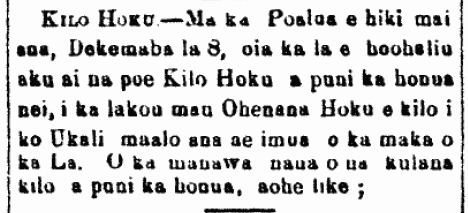
Astronomy.—This coming Tuesday, December 8th, that is the day that astronomers around the world will be looking through their Telescopes to watch Venus [Ukali]¹ pass before the face of the Sun. The time to watch around the world is not the same.

¹Ukali i usually associated with Mercury and not Venus.

[Don’t forget! If you are going to be checking out the transit tomorrow, wear those protective glasses made specifically for watching the sun!!]

(Kuokoa, 12/5/1874, p. 2)

Kilo Hoku.

Ka Nupepa Kuokoa, Buke XIII, Helu 49, Aoao 2. Dekemaba 5, 1874.

And yet more on Aberahama Kaikioewa Palekaluhi, 1912.

THE ALII HAS GONE, A. K. PELEKALUHI KAIKIOEWA KAMEHAMEHANUI

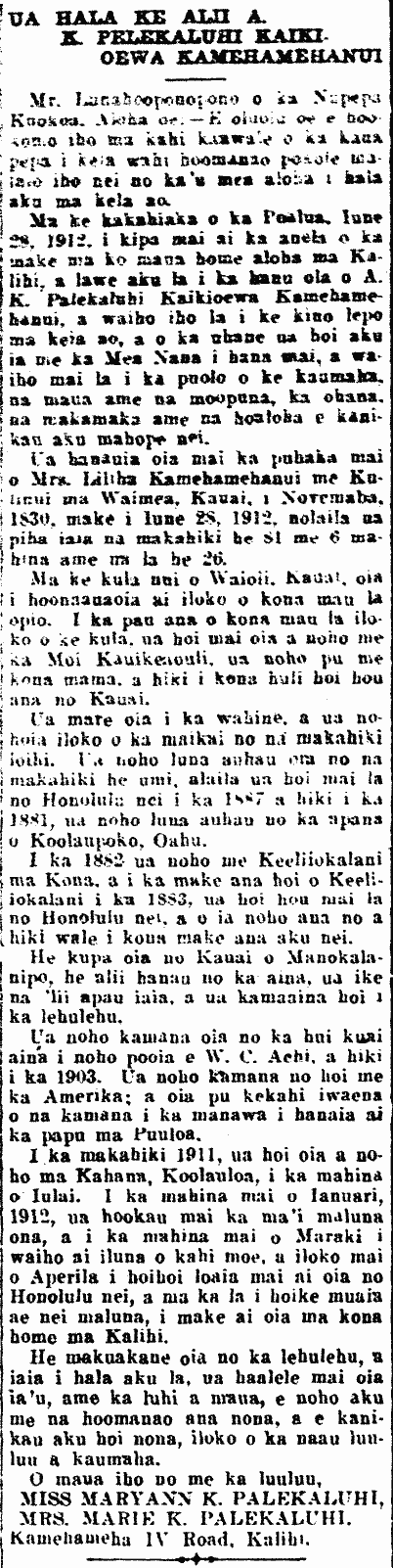
Mr. Editor of the Newspaper Kuokoa. Aloha to you:—Please be so kind as to insert in some open space in our paper, this short remembrance below for my beloved who passed over to that world.

On the morning of Tuesday, June 28 [?], 1912, the angel of death visited our beloved home in Kalihi, and took the living breath of A. K. Palekaluhi Kaikioewa Kamehamehanui, and left his earthly body here in this world, and his soul returned to the One who created it, leaving the bundle of sadness behind for us and the grandchildren, the family, the intimates, and friends to grieve over.

He was born from the loins of Mrs. Liliha Kamehamehanui and Kulinui at Waimea, Kauai, on the 1st of November, 1830, and died on June 28, 1912; therefore, he was 81 years and 6 months, and 26 days old.

He was educated at the college of Waioli, Kauai, in his youth. After his days at that school were over, he returned to live with the King Kauikeaouli; he lived with his mother until he went back to Kauai.

He married his wife, and they lived well for a great many years. He was employed as a tax assessor for ten years and then returned to Honolulu in 1887 [?] until 1881, and was the tax assessor for the district of Koolaupoko, Oahu.

In 1882, he resided with Keelikolani in Kona, and at her death in 1883, he came back to Honolulu and remained there until his recent death.

He was a native of Kauai of Manokalanipo, and a hereditary chief which all the alii knew of and also the general public was familiar with him.

He worked as a carpenter for the real estate company headed by W. C. Achi until 1903. He worked as a carpenter for America, and he was one of the carpenters when the fort at Puuloa was being built.

In 1911, he went back to live at Kahana, Koolauloa, in the month of July. From January 1912, he became ill and in March he was bedridden, and then in April he was brought back to Honolulu, and on the day shown above he died at his home in Kalihi.

He was a father for the multitudes, and with his passing, he leaves me and our child with memories of him, and grieving for him, with a sad and heavy heart.

We with grief,

MISS MARYANN K. PALEKALUHI,

MRS. MARIE K. PALEKALUHI.

Kamehameha IV Road, Kalihi.

(Kuokoa, 7/12/1912, p. 6)

UA HALA KE ALII A. K. PELEKALUHI KAIKIOEWA KAMEHAMEHANUI

Ka Nupepa Kuokoa, Buke XLVIII, Helu 28, Aoao 6. Iulai 12, 1912.

Aberahama Kaikioewa Palekaluhi and the malo of Kaumualii,

See this story about A. K. Palekaluhi’s description of a malo of Kaumualii’s, the king of Kauai, found in Additional Notes on Hawaiian Feather Work: a second supplement by William T. Brigham, in Memoirs of the Bernice Pauahi Bishop Museum of Polynesian Ethnology and Natural History, Vol VII.—No. 1, 1918. pp. 30–39.

I am not sure if this is what is described here at the Bishop Museum.

Even more on Aberahama Kaikioewa Palekaluhi (if it could be read), 1912.

THAT HIGH CHIEF OF THE LAND HAS GONE.

On Tuesday morning the merciless hand of death stretched out and took the life of that high chief, A. K. Palekaluhi at eighty-one years of life, at his residence in Kalihi. He is a true high chiefly descendant of Hawaii, of Liliha, who is of the lineage and a descendant of Kamehameha Nui, the king of Maui. His died because of the infirmities of old age.

To understand @@@@@, here is his genealogy.

In the lineage of the alii of Hawaii—Keawe, the king of Hawaii wed with Kalanikauleleiaiwi and born was Kekuiapoiwanui (f) who married [male] Kekaulike (m), the king of Maui, and born was Kamehameha Nui, the king of Maui, who married Manuhaaipo (f) and born was Kalaniuluamoku (m), who married Kualiiwahine and born was Loeauwahine (f), who married Koakanu (m) and born was Liliha (w) who married Kulinui (m) and born was A. K. Palekaluhi.

See page four.

[If you look below, most of this first column is hard to decipher, and much of the volunteer input would have likely been @@@@@ @@@@@. Hopefully people will think seriously about how much priceless information will be lost if the original newspapers are not clearly photographed before typescripts are done.]

(Kuokoa Home Rula, 5/31/1912, p. 1)

HALA IA ALII KIEKIE O KA AINA.

Kuokoa Home Rula, Buke X, Helu 22, Aoao 1. Mei 31, 1912.

THAT HIGH CHIEF OF THE LAND HAS GONE

From Page One.

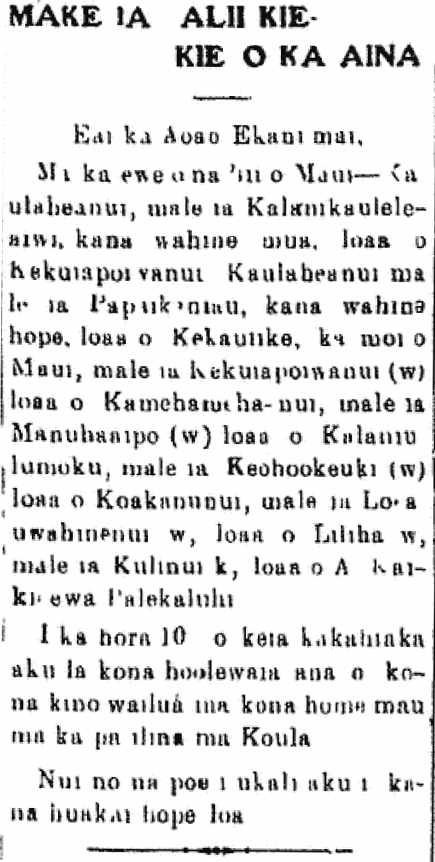
In the lineage of the alii of Maui—Kaulaheanui married Kalanikauleleaiwi, his first wife, and born was Kekuiapoiwanui. Kaulaheanui married Papaikaniau, his following wife, and born was Kekaulike, the king of Maui, who married Kekuiapoiwanui (f), and born was Kamehameha Nui, who married Manuhaaipo (f) and born was Kalaniulumoku who married Keohookeuki (f), born was Koakanunui who married Loeauwahinenui (f), and born was Liliha (f), who married Kulinui (m), and born was A. Kaikioewa Palekaluhi.

At 10 o’clock this morning, was the funeral over his remains at his eternal home at the cemetery at Koula.

There were many people who joined his last procession.

[It is interesting to see how different newspapers have different information in their coverage of the same event!]

(Kuokoa Home Rula, 5/31/1912, p. 4)

MAKE IA ALII KIEKIE O KA AINA

Kuokoa Home Rula, Buke X, Helu 22, Aoao 4. Mei 31, 1912.


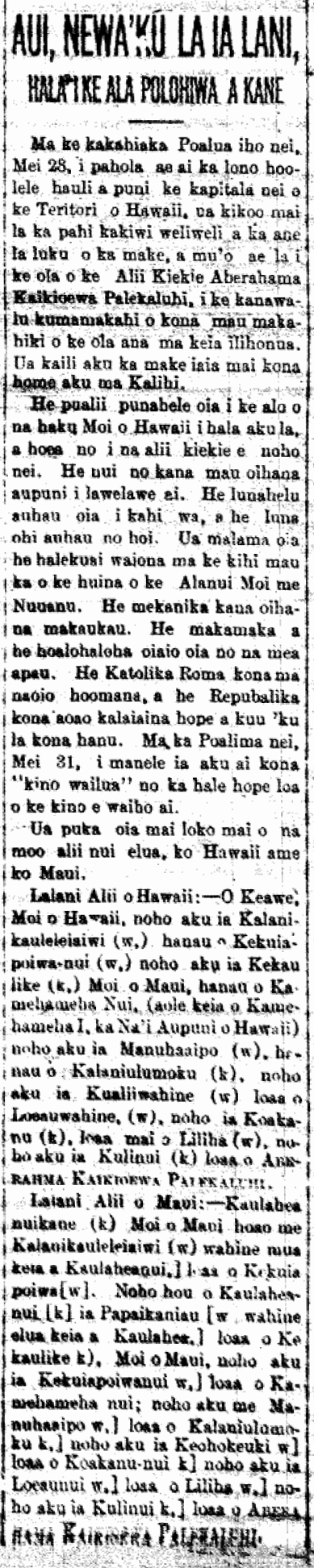
More on Aberahama Kaikioewa Palekaluhi, 1912.

THAT HEAVENLY ONE PASSED BY, STAGGERED AWAY,

GONE ON THAT DARK PATH OF KANE

On the morning of this past Tuesday, May 28th, the shocking news spread all over the capital of the Territory of Hawaii, that the terrifying sickle of the angel of death was stretched out and cut short the life of the High Chief Abraham Kaikioewa Palekaluhi, at eighty-one years of living on this earth. Death took him from his home in Kalihi.

He was a favorite chiefly descendant in the court of the past Kings of Hawaii, all the way until the high chiefs living now. He had many positions in the government. He was a tax assessor at one point, and a tax collector as well. He managed a bar at the corner mauka of the corner of King Street and Nuuanu Avenue. He was a skilled mechanic. He was a friend and a ally of all. He was a true believer in the Roman Catholic faith, and he was in the Republican party until his last breath. This Friday, May 31st, his remains [kino wailua] was carried to the last abode where his body would be laid.

He descended from two royal lineages, from Hawaii and from Maui.

Hawaii Island Lineage:—Keawe, the King of Hawaii, “wed” [noho] with Kalanikauleleiaiwi (f) and Kekuiapoiwanui (f) was born, who wed Kekaulike (m), the King of Maui, and Kamehameha Nui was born (which was not Kamehameha I, Ka Na’i Aupuni of Hawaii), who wed with Manuhaaipo (f) and Kalaniulumoku (m) was born, who wed Kualiiwahine (f) and born was Loeauwahine (f), who wed Koakanu (m), and Liliha (f) was born, who wed Kulinui (m) and Aberahama Kaikioewa Palekaluhi was born.

Maui Island Lineage:—Kaulaheanuikane (m), King of Maui wed [hoao] with Kalanikauleleiaiwi (f), which was his first wife, and Kekuiapoiwa (f) was born. Kaulaheanui (m) married again to Papaikaniau (f), his second wife, and born was Kekaulike (m), the King of Maui, who wed Kekuiapoiwanui (f), and born was Kamehameha Nui, who wed Manuhaaipo (f), and born was Kalaniulumoku (m), who wed Keohokeuki (f) and born was Koakanu Nui (m), who wed Loeaunui (f), and born was Liliha (f), who wed Kulinui (m), and born was Aberahama Kaikioewa Palekaluhi.

(Aloha Aina, 6/1/1912, p. 1)

AUI, NEWA'KU LA IA LANI, HALA I KE ALA POLOHIWA A KANE

Ke Aloha Aina, Buke XVI, Helu 22, Aoao 1. Iune 1, 1912.