Near tragedy caused by Kamehameha V’s deer, 1868.

[Found under: “LOCAL NEWS: Maui”]

Life saved from deer.—P. Kawelakawai of Kawela, Molokai wrote to us like this: On the 29th of April, I saw Kaukino, the one who barely survived. Here is the reason; one of the animals of our King, a deer set loose on his ranch, entered the sweet potato patch of at Kalamaula to eat the uala, and this man saw this and went to shoo it off; the animal rushed forward but he saw it coming, and it was but a few feet away and it caught him and thrust its antlers, whereupon he fell down, face thrown back. He was jabbed in the armpit, and the antler pierced through. His wife saw this happen and she brought him back to the houses and the man was very weak. We are relieved at the news following that letter that he has recovered.

[See earlier articles on the deer gifted to Kamehameha V. Deer imported from Japan in 1867. and Deer of Kamehameha V., 1867.]

(Kuokoa, 5/23/1868, p. 3)

Pakele ke ola i ke dia.

Ka Nupepa Kuokoa, Buke VII, Helu 21, Aoao 3. Mei 23, 1868.

Fish market affected by weather, 1929.

DECREASE IN THE CATCH OF OCEAN FISH

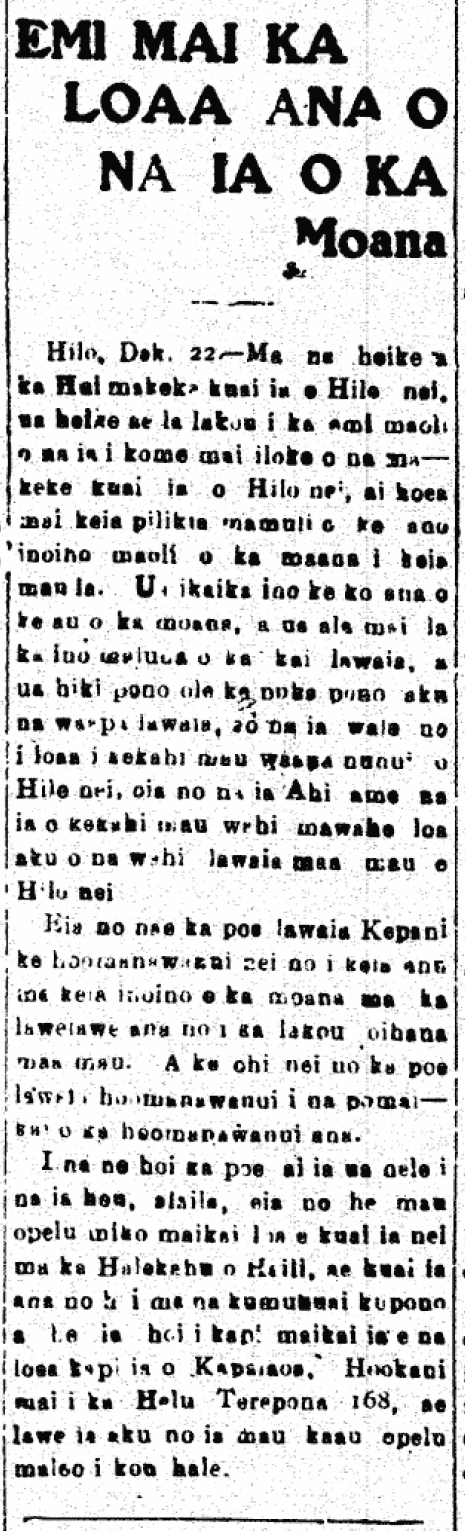
Hilo, Dec. 22—According to a report by the fish market association of Hilo, they said that there is a marked decrease in the amount of fish brought in to the fish markets of Hilo nei, and this is a result of the difficulty brought on by the very stormy seas these days. The pull of the currents is very strong, and this occurs in the fishing waters, so the fishing boats cannot head straight for them; the only fish caught by the large fishing vessels of Hilo are Ahi and other fish from far outside of the normal fishing areas of Hilo.

Here however are the Japanese, still persevering these stormy conditions of the sea by carrying out their regular work. And the determined fishermen are reaping the benefits of their persistence.

If those who eat fish are without fresh fish, here are nicely-salted opelu being sold at the pastor’s residence of Haili and it is being sold for a good price; it is fish salted well by the expert fish salters of Kapalaoa. Ring the Telephone Number 168, and the dried opelu in forties [kaau] will be delivered to your house.

(Hoku o Hawaii, 12/24/1929, p. 2)

EMI MAI KA LOAA ANA O NA IA O KA Moana

Ka Hoku o Hawaii, Buke XXIII, Helu 28, Aoao 2. Dekemaba 24, 1929.

Anyone know if this is Johnny Noble, the famous singer? 1912.

Here is the Cure for Hawaiians!

This is the medicine made with skill by John A. Noble, called NEWTON OINTMENT, which cures all type of skin ailments like rashes, eczema, skin odor, hemorrhoids, cuts, burns, and so forth.

This Medicine is available at Drug Stores and other stores around the Island for 25c. for a box.

THERE HAVE BEEN MANY WHO daubed this Medicine, and they all were cured. Therefore, to all those who have skin ailments, try the ointment of the Hawaiian Boy, called

—NEWTON OINTMENT—

If it is not available at the stores, send to JOHN A. NOBLE through the post office, Number 2450 Puunui. 6 boxes for $1.50; 25c. for one box.

(Hawaii Holomua, 4/10/1912, p. 16)

Eia ke Ola o na Hawaii!

Hawaii Holomua, Buke I, Helu 6, Aoao 16. Aperila 10, 1912.

In response to gas illumination at the opening of Iolani Palace, 1913.

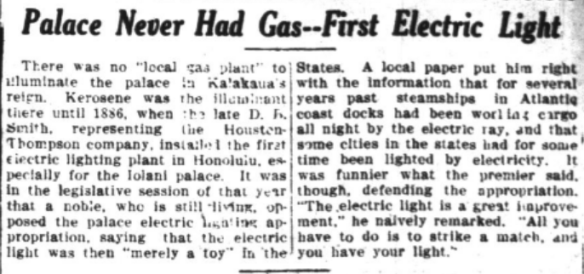
Palace Never Had Gas–First Electric Light

There was no “local gas plant” to illuminate the palace in Kalakaua’s reign. Kerosene was the illuminant there until 1886, when the late D. P. Smith, representing the Houston-Thompson company, installed the first electric lighting plant in Honolulu, especially for the Iolani palace. It was in the legislative session of that year that a noble, who is still living, opposed the palace electric lighting appropriation, saying that the electric light was then “merely a toy” in the States. A local paper put him right with the information that for several years past steamships in Atlantic coast docks had been working cargo all night by the electric ray, and that some cities in the states had for some time been lighted by electricity. It was funnier what the premier said, though, defending the appropriation. “The electric light is a great improvement,” he naively remarked. “All you have to do is to strike a match, and you have your light.”

(Honolulu Star-Bulletin, 1/11/1913, p. 8)

Palace Never Had Gas--First Electric Light

Honolulu Star-Bulletin, Volume XX, Number 6482, Page 8. January 11, 1913.

More on the Palace mirrors, 1913.

THOSE KALAKAUA MIRRORS.

Editor Honolulu Star-Bulletin,

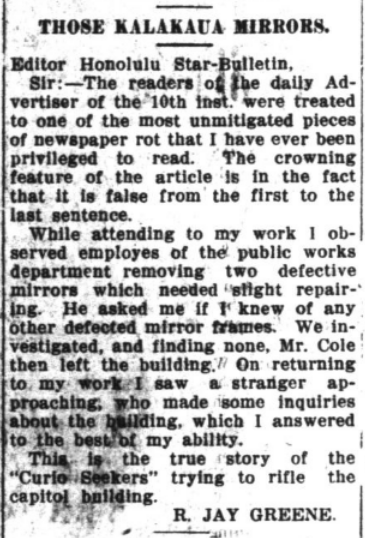
Sir:—The readers of the daily Advertiser of the 10th inst. were treated to one of the most unmitigated pieces of newspaper rot that I have ever been privileged to read. The crowning feature of the article is in the fact that it is false from the first to the last sentence.

While attending to my work I observed employees of the public works department removing two defective mirrors which needed slight repairing. He asked me if I knew of any other defected mirror frames. We investigated, and finding none, Mr. Cole then left the building. On returning to my work I saw a stranger approaching, who made some inquiries about the building, which I answered to the best of my ability.

This is the true story of the “Curio Seekers” trying to rifle the capitol building.

R. JAY GREENE.

[Here is an interesting response from the “Roland Green” of the previous articles.]

(Honolulu Star-Bulletin, 1/11/1913, p. 4)

THOSE KALAKAUA MIRRORS.

Honolulu Star-Bulletin, Volume XX, Number 6482, Page 4. January 11, 1913.

Mahalo to Zita Cup Choy for pointing out this related article in the Pacific Commercial Advertiser, 1913.

CURIO SEEKERS TRY TO RIFLE CAPITOL

King Kalakaua’s Mirrors the Pet Object of Souvenir Hunters—Kamehameha Knocked.

Daring souvenir collectors, willing to run the risk of a term in prison to gratify their desires, made a bold attempt to carry off a number of mirrors and bronze frames from the Capitol Building some time Wednesday night. It is believed that the collectors were frightened while at work and for that reason did not accomplish their purpose.

Roland Green, keeper of the Capitol, yesterday morning discovered the work of the would-be souvenir owners on the first terrace of the Ewa side of the building. They had succeeded in partially breaking two of the mirrors from their fastenings on the wall. A board holding one of the glasses in place was broken in two in tearing it from its lodgment. Green had the glasses and bronze frames removed to the basement of the Capitol where they will be repaired, resilvered and returned to their positions on the Capitol wall.

During the past few years several of these mirrors have been torn from their fastenings and carried away. Though malihinis, sightseeing and treasure hunting on the island, have been accused of the depredations it is said that kamaainas have had knowledge of at least one or two of them.

Kamehameha’s statue has not escaped the destructive onslaughts of the vandals. Several heads of the little bronze images at the base of the statue have been knocked off and carried away by the curio-seekers.

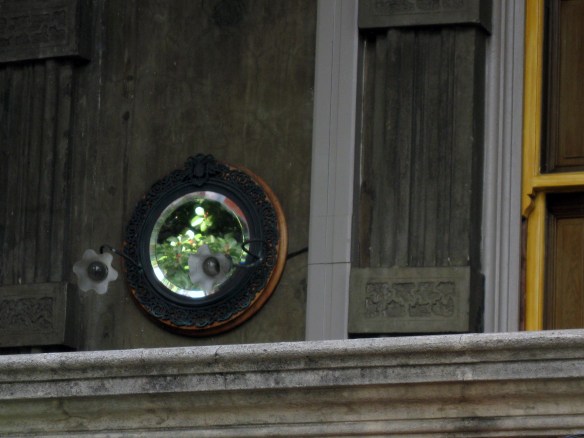
The mirrors, however, seem to have the most attraction. These mirrors are set in elaborate circular bronze frames surmounted by the coat of arms of King Kalakaua, bearing the initials of that monarch supported by two perfectly carved cherubs. It is stated that these frames originally cost $250 each and many were installed around the terraces of each floor of the palace. The idea of putting them in place is said to have originated with the King and were designed for the purpose of aiding in illuminating the palace grounds.

This was in 1883. Gas was then the modern method of illumination in Honolulu as well as on the mainland. Gas fixtures were arranged in front of each of the glasses. When these were lighted the mirrors were intended to cast the reflection to the surrounding grounds. It is said that this innovation cost the monarchy about $20,000.

For a year after the completion of the new palace it is said that King Kalakaua had one of the best illuminated palaces in the world, though practically the full capacity of the local gas plant was required to accomplish this purpose. By that time the good King learned that, after all, his bright mirrors were not the success they should be. Soon afterward the electric lights came and the gas fixtures were removed. Since then the mirrors have not only been sought after by curio hunters but have been the object of much speculation on the part of tourists.

Many of these strangers have figured that the mirrors were installed on the palace walls by the King with a view of aweing visiting native subjects, many of whom, according to fiction, had never gazed into a looking-glass.

It remained for Keeper Green to give the true version of their cause of their installation.

“It is strange how some people look upon this Capitol Building as a curio pile,” said a territorial official yesterday. “The fact that the former palace of the King is being used as the seat of a democratic government seems to appeal to them strongly and but for the vigilance used by the watchman and others the entire building would be carried off by souvenir hunters within a few years.”

[This is most likely the basis of the Hawaiian-Language article in the Kuokoa, 1/17/1913, p. 6.]

(Pacific Commercial Advertiser, 1/10/1913, p. 6)

CURIO SEEKERS TRY TO RIFLE CAPITOL

Pacific Commercial Advertiser, Volume LVII, Number 9494, Page 6. January 10, 1913.

Attempted theft from Iolani Palace, 1913.

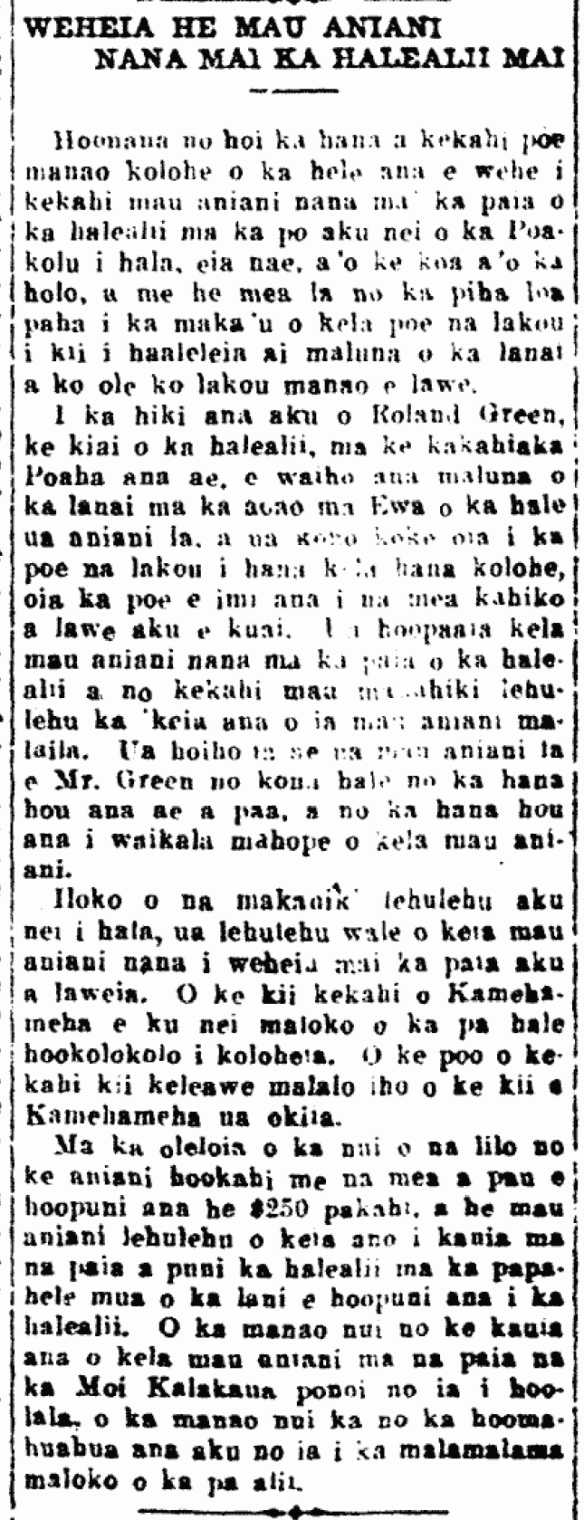
SOME MIRRORS REMOVED FROM THE PALACE.

Flagrant was the actions of some vandals who went and removed some mirrors from the wall of the palace the other night of this past Wednesday; however, [as the saying goes,] “Learn to be a warrior; learn also to run away.” And perhaps it was as if due to their being full of fear, that the ones who went to take the mirrors, left them on the lanai without them succeeding in taking them.

When Roland Green, the palace guard, arrived the next Thursday morning, the mirrors were left on the Ewa-side lanai, and he immediately surmised that the people who carried out the vandalism were people who sought out antiquities to sell them.  These mirrors were hung on the wall of the palace and they were there for many years. They were taken by Mr. Green to his place to fix, and to reapply the mercury behind the mirrors.

In many years past, there were numerous mirrors removed from the walls and taken. The statue of Kamehameha standing on the grounds of the court house was also vandalized. One of the heads of a brass image below Kamehameha was severed.

According to what is said, the cost of one of the mirrors and related expenses is $250 each; and there are many of those mirrors that are hung around the first floor walls of the lanai surrounding the palace. The idea for the hanging of these mirrors on the walls was devised by King Kalakaua himself; the intent it is said was to brighten the grounds of the palace.

(Kuokoa, 1/17/1913, p. 6)

WEHEIA HE MAU ANIANI NANA MAI KA HALEALII MAI

Ka Nupepa Kuokoa, Buke XLIX, Helu 3, Aoao 6. Ianuari 17, 1913.

Early movie making in Honolulu, 1913.

FAKE MOVIE.

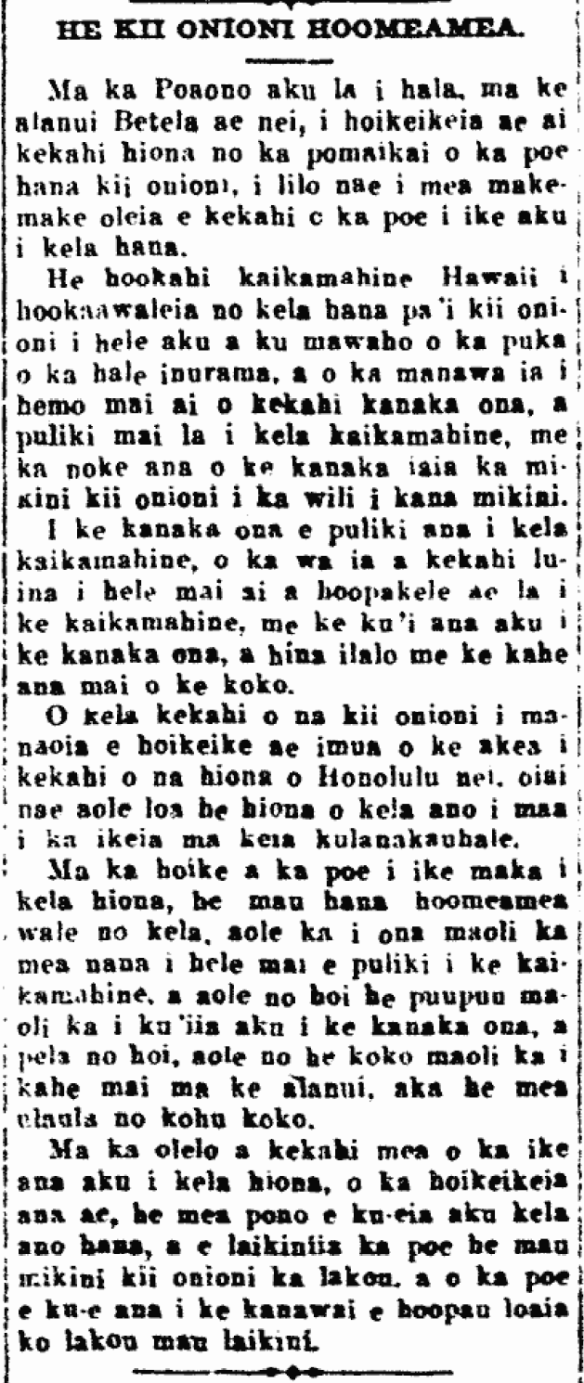
Last Saturday, on Bethel Street, a scene was put on for movie makers, which became something unappealing to some who witnessed it.

There was a Hawaiian girl set aside for the shooting that went and stood outside the entrance of a bar, and at this was when a drunk man exited and clutched the girl, while the one with the camera continued to film.

As the drunkard continued to grasp the girl, a sailor came and rescued the girl, and he punched the drunk man, who fell down as blood flowed.

This was a movie meant to show a Honolulu scene before the public, even if that type of scene is not something seen regularly in this town.

According to those who witnessed this, it was nothing but acting; the one who went and grabbed the girl was not really drunk, and he was not hit with a real punch, also, it was not real blood that flowed on the street, but it was something red that resembled blood.

One of those who saw this being staged said that this kind of thing should be prohibited, and those who own movie cameras should be licensed, and those who break the law should have their licenses revoked for good.

(Kuokoa, 1/10/1913, p. 4)

HE KII ONIONI HOOMEAMEA.

Ka Nupepa Kuokoa, Buke XLIX, Helu 2, Aoao 4. Ianuari 10, 1913.

Free admission at the Museum in honor of Pauahi’s birthday! 2012.

BISHOP MUSEUM CELEBRATES PRINCESS BERNICE PAUAHI BISHOP’S BIRTHDAY
WITH FREE ADMISSION FOR KAMA ‘ĀINA AND MILITARY

HONOLULU — Bishop Museum is celebrating Bernice Pauahi Bishop’s birthday a few days early — on Sunday, Dec. 16, 2012—with free admission to the museum all day for kama‘āina and military with valid identification. Regular admission rates will apply to the general public. A special program will take place from noon to 1 p.m. and will feature oli (chant), hula, and mele (song) by Bishop Museum staff and the Kamehameha Alumni Glee Club.

For the whole story, go here.