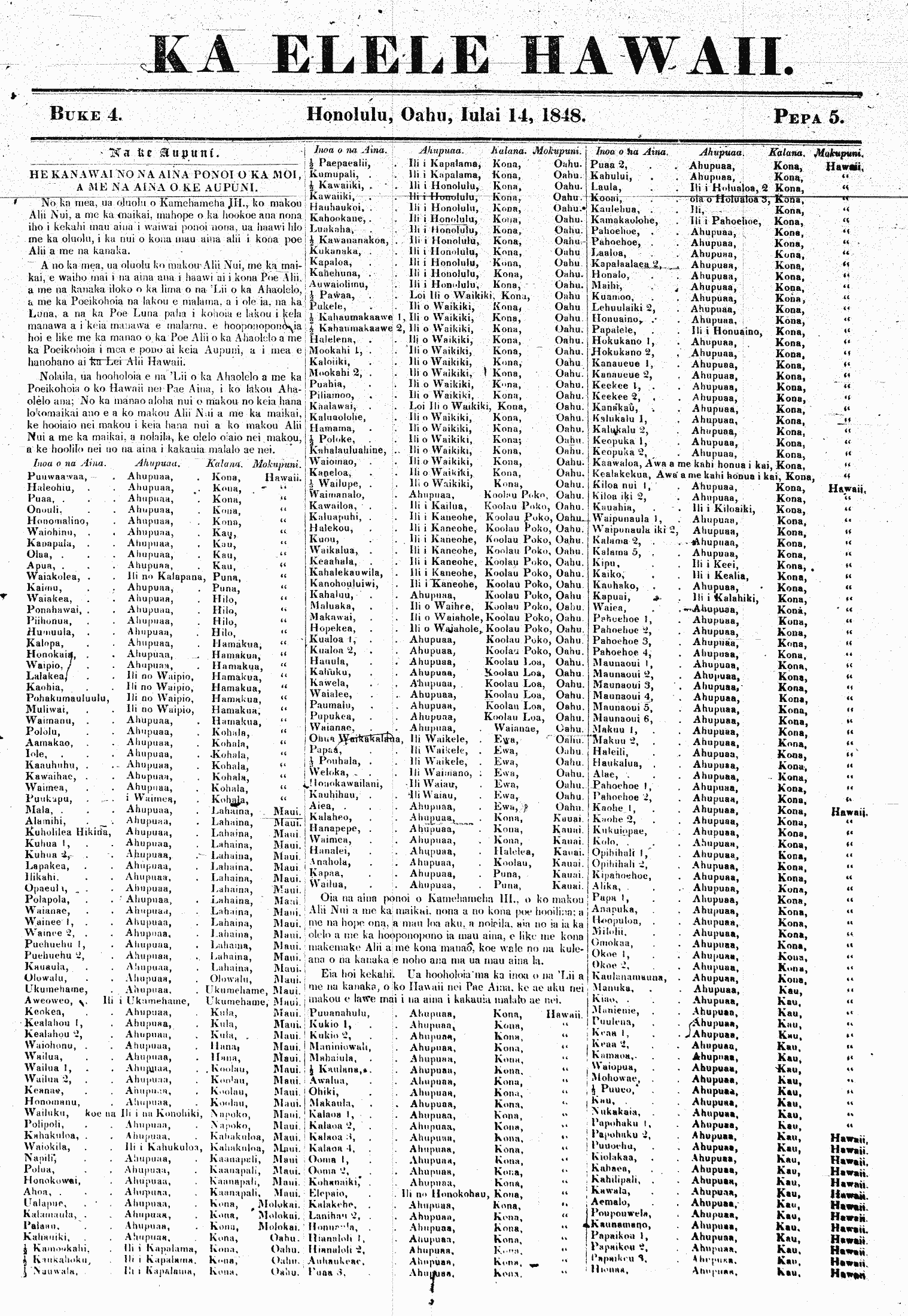
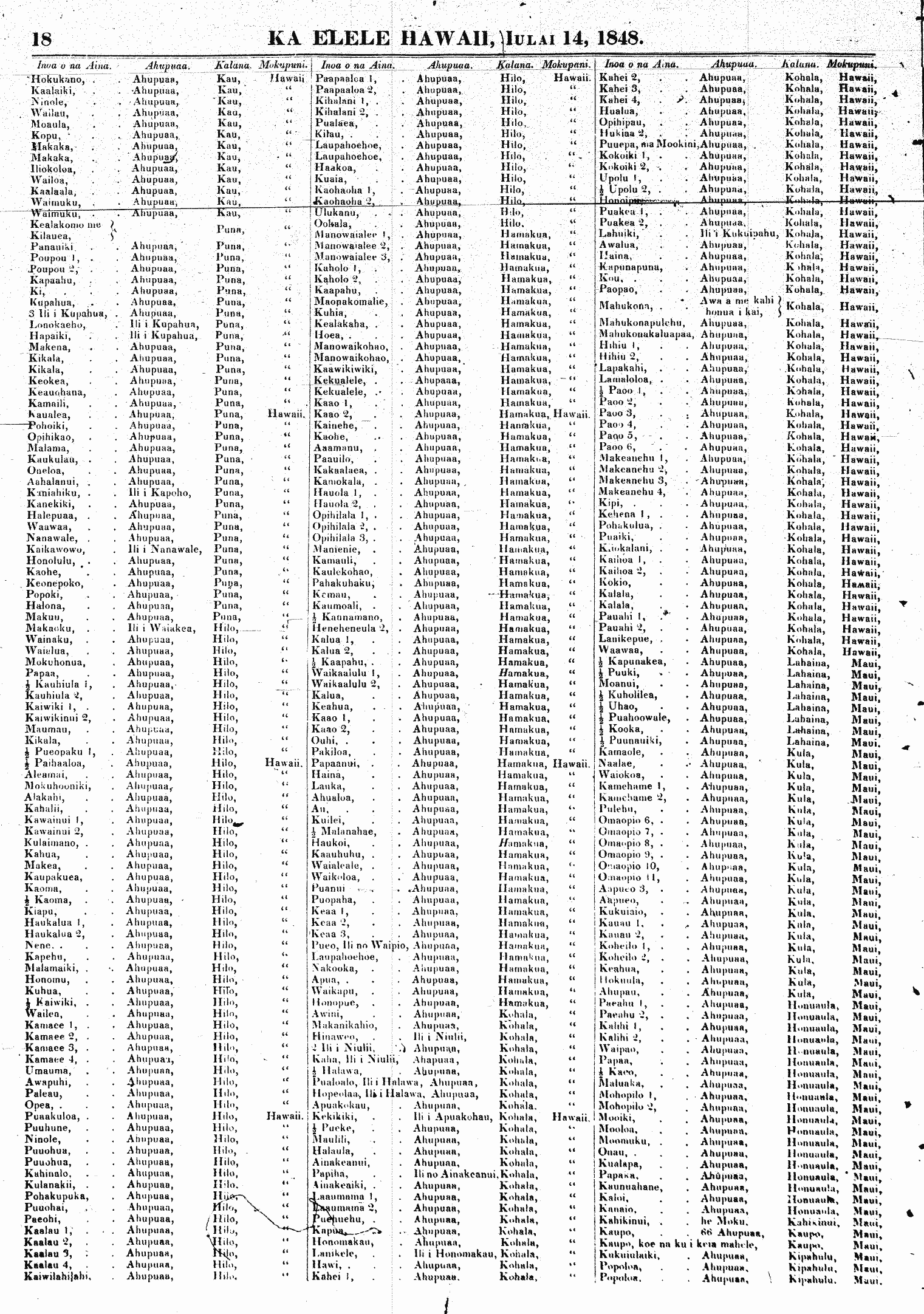
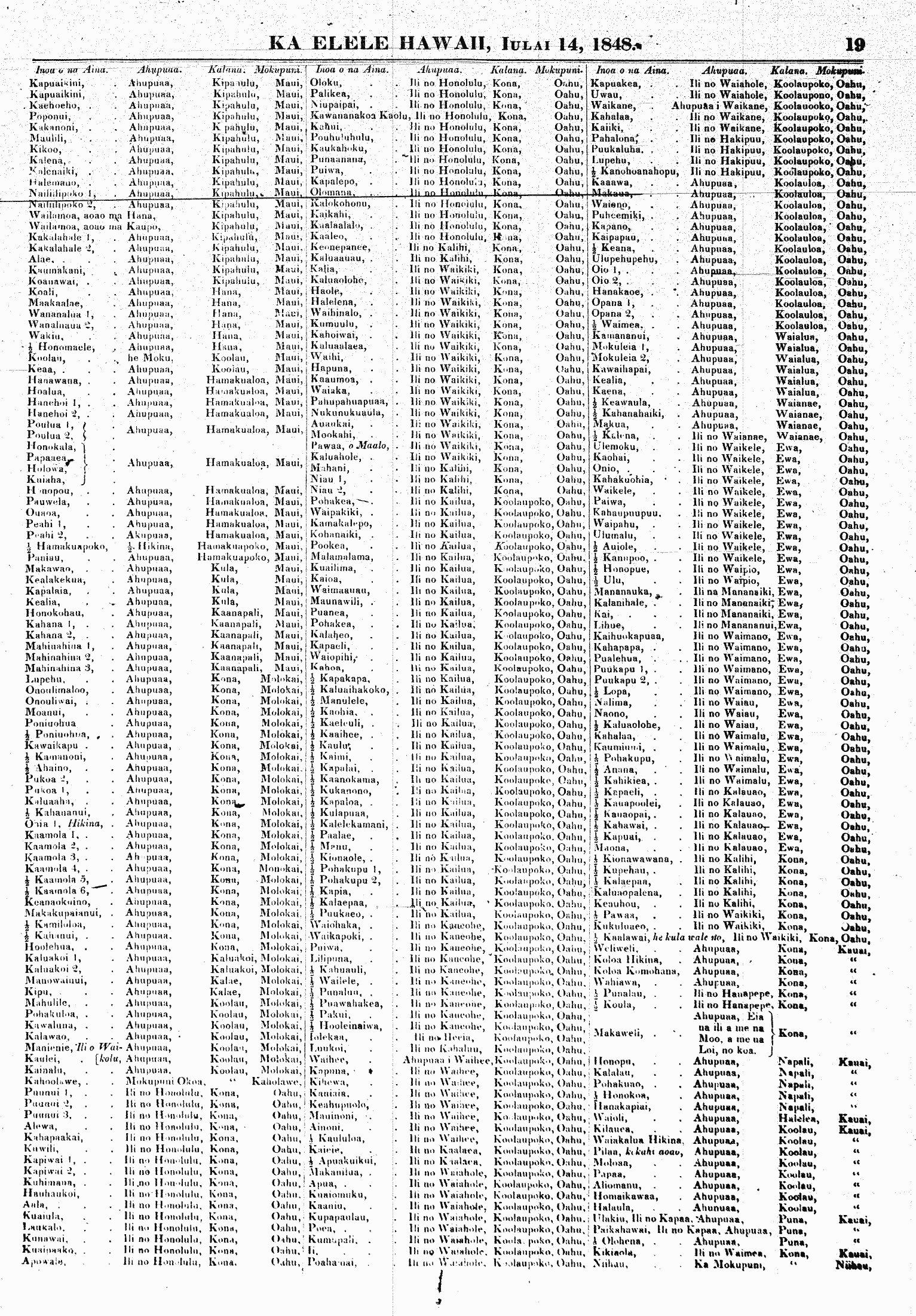
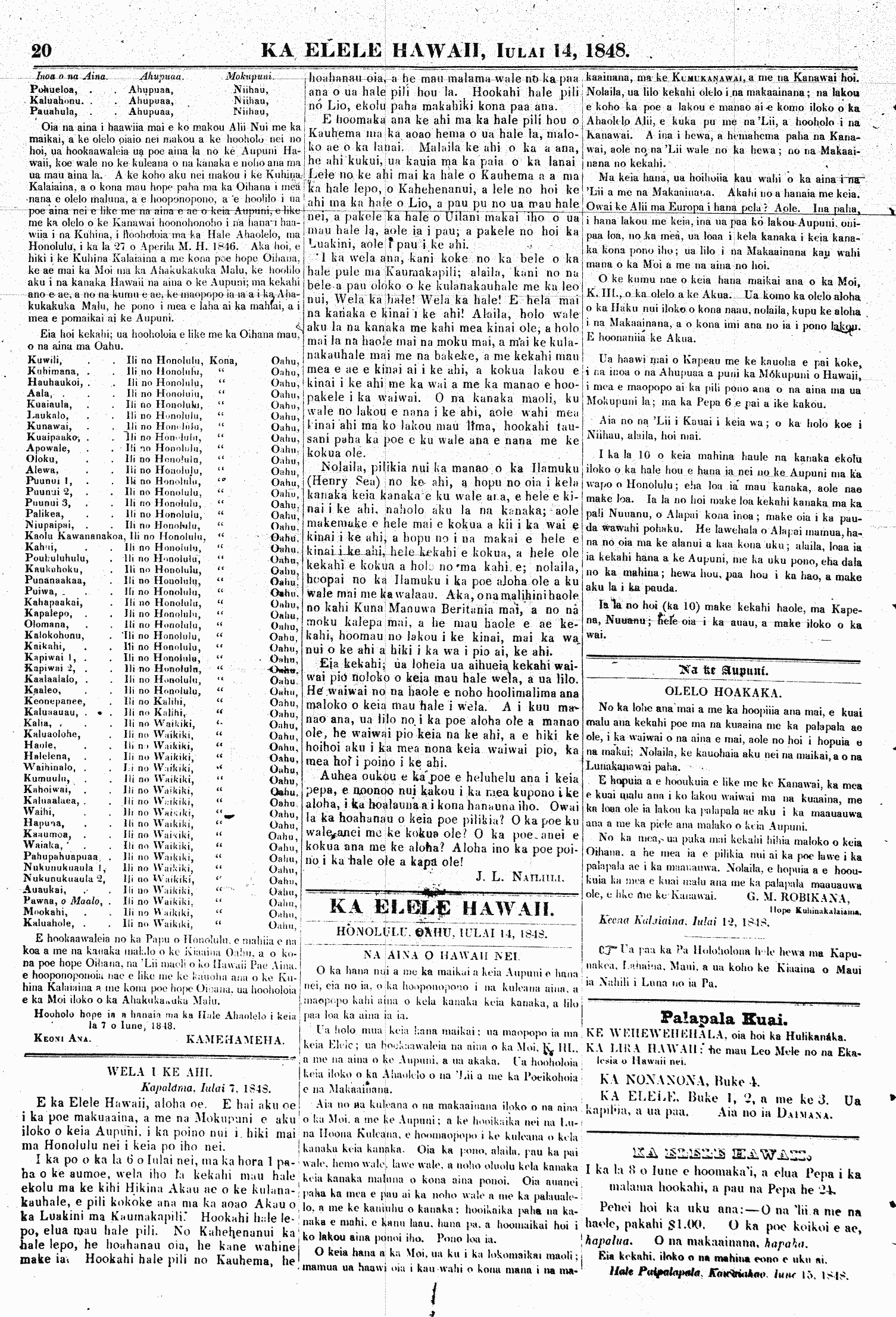
Personal Lands of Kamehameha III, and Government Lands, 1848.

By the Government.

A LAW FOR THE PERSONAL LANDS OF THE KING,
AND THE LANDS OF THE NATION.

[Here is a newly passed law of the land appearing in the newspaper Elele Hawaii. One of the functions of the newspapers was to inform the nation’s citizens of new laws and proclamations from the government. This particular law establishes the Crown Lands (and Government Lands) which still holds much importance to this day.

For a translation see “A Supplement to the Statute Laws of His Majesty, Kamehameha III., King of the Hawaiian Islands, … 1848.” pp. 22–43.

What is also valuable about this listing is that it describes in 1848 what ahupuaa a certain land belonged to, and so forth.]

(Elele Hawaii, 7/14/1848, pp. 17–20.)

HE KANAWAI NO NA AINA PONOI O KA MOI, A ME NA AINA O KE AUPUNI.

Ka Elele Hawaii, Buke 4, Pepa 5, Aoao 17. Iulai 14, 1848.


HE KANAWAI NO NA AINA PONOI O KA MOI, A ME NA AINA O KE AUPUNI.

Ka Elele Hawaii, Buke 4, Pepa 5, Aoao 18. Iulai 14, 1848.

HE KANAWAI NO NA AINA PONOI O KA MOI, A ME NA AINA O KE AUPUNI.

Ka Elele Hawaii, Buke 4, Pepa 5, Aoao 19. Iulai 14, 1848.

HE KANAWAI NO NA AINA PONOI O KA MOI, A ME NA AINA O KE AUPUNI.

Ka Elele Hawaii, Buke 4, Pepa 5, Aoao 20. Iulai 14, 1848.

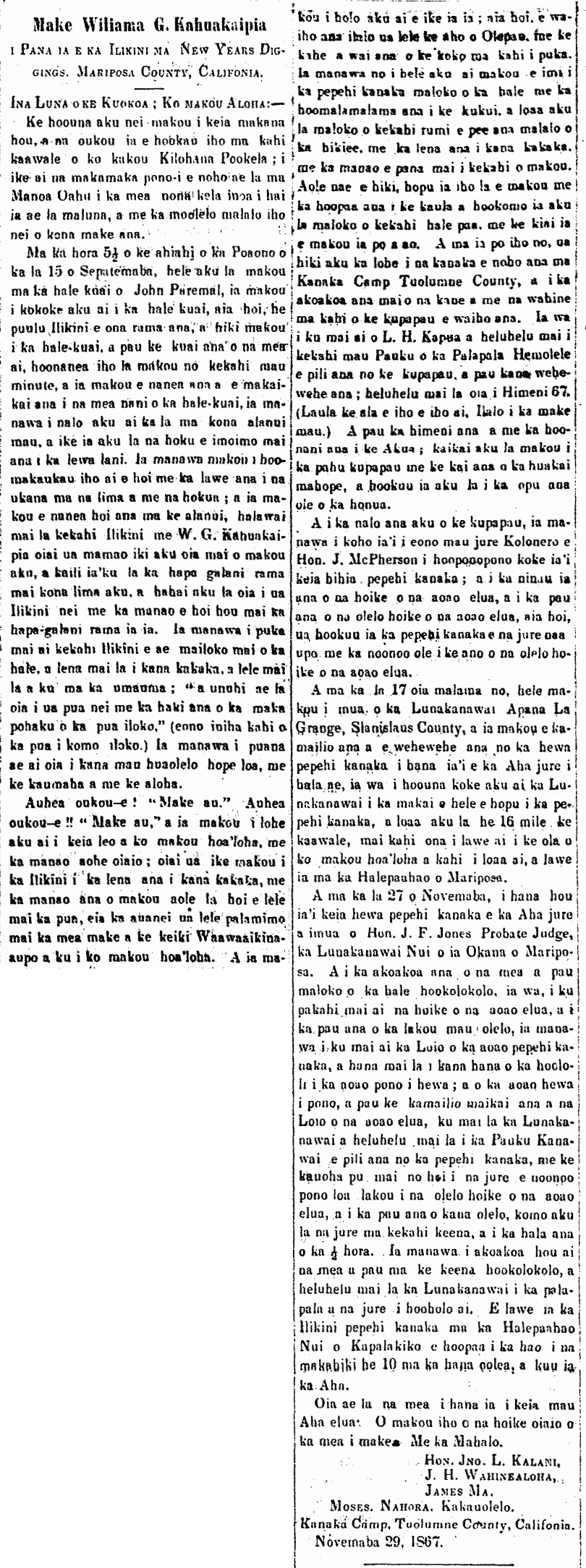
William G. Kahuakaipia is killed in California, 1868.

Wiliama G. Kahuakaipia is Dead

Shot by an Indian with a Bow and Arrow at New Year’s Diggings, Mariposa County, California.

To the Heads of the Kuokoa; Our Aloha:—

We are sending you this new gift, and it is for you to place it in some open space of our Greatest Prize (the newspaper Kuokoa) so that the personal friends living in Manoa, Oahu, of the person mentioned above, may see, along with the story below of his death.

At 5:30 in the evening of Saturday, the 15th of September, we went to the shop of John Paremal, and as we got closer to the store, there was a group of Indians getting drunk; and we got to the store, and finished our food shopping, then we hung around for a few minutes; and as we looked around at the nice items in the shop, the sun left on its usual path and the stars were seen twinkling in the heavens. That was when we got ready to leave, carrying our good by hand and on our shoulders; and while we were enjoying our way back, an Indian met up with W. G. Kahuakaipia while he was a bit away from us, and a half gallon jug of alcohol was taken from his hand, and he went after that Indian, thinking to retrieve the half gallon jug. Right then, another Indian came out from the shop and drew back his bow and the [arrow] flew and struck the chest; “and Kahuakaipia pulled out the arrow breaking the stone head off within,” (the arrow entered six inches). That was when he spoke his last words, with sadness and aloha.

O You guys! I am dead. Hey you guys!! and when we heard this call by our friend, we didn’t believe it was true, for when we saw the Indian pull back his bow, we thought that he wouldn’t let the arrow fly, but no, the weapon of the Ignorant [Waawaaikinaaupo] youth flew swiftly and struck our friend. And when we approached to see him, he already lay there, his last breath gone with blood flowing profusely from the wound. Right then we went to look for the murderer in the store aided by the light of a lamp and we found him in a room hiding under a couch; he was pulling back his bow, thinking to shoot one of us. But he was not able to because he was grabbed by us and tied up with rope and thrown into a secured building which we guarded all night until day. And on the next night, the news reached those living at Kanaka Camp, Tuolumne County, and when the men and women had gathered by where the body lay, then L. H. Kapua stood and read some passages from the Holy Book about the dead one, and after his talk, he read Hymn 67 (Wide is the path to go down, Down to eternal death). And after the hymn was over and the glorification of God, we carried the coffin with the procession following behind, and let it down into the depths of the bowels of the earth.

After the body was gone, a coroner’s jury of six was chosen by Hon. J. McPherson so that this murder case would be resolved quickly. With the questioning of the witnesses of both sides, and after the presentations by both sides were finished, come to find out, the murderer was set free by the stupid jury without them considering the testimony of both sides.

And on the 17th of that same month, we went before the district judge of La Grange, Stanislaus County, and when we were speaking of and explaining what was done by the past jury in the crime of murder, the judge immediately sent an officer to arrest the murderer, and he was found 16 miles away from where he took the life of our friend, and was taken to the jail of Mariposa.

Then on the 27th of November, this murderer was retried by a jury before Hon. J. F. Jones Probate judge, the head judge of Mariposa County. When everyone was gathered in the courthouse, each witness for both sides stood one by one, and after they were done with their statements, then the lawyer for the murderer stood and did his job of twisting right into wrong and wrong into right; and when the eloquent speeches by the lawyers of both sides were completed, the judge stood up and read the law dealing with murder and instructed the jury to carefully consider the testimony by both sides, and when he was done the jury went into a room. After half an hour, everyone gathered again in the courthouse and the judge read the decision of the jury. The murdering Indian will be taken to the great prison of San Francisco where he will be incarcerated for 10 years with hard labor; and the court was adjourned.

The is what was done in the two trials. We are true witnesses of the deceased. With appreciation.

Hon. John L. Kalani,

J. H. Wahinealoha,

James Ma,

Moses Nahora, Secretary.

Kanaka Camp, Tuolumne County, California.

November 29, 1867.

[I am not sure if this Moses Nahora and the Moses Naehola of the earlier post are the same person or not…

And how awesome is this, Mariposa County History page has a sponsor!]

(Kuokoa, 2/1/1868, p. 4)

Make Wiliama G. Kahuakaipia

Ka Nupepa Kuokoa, Buke VII, Helu 6, Aoao 4. Feberuari 1, 1868.

Less than a week before the new system at Bishop Museum Library and Archives kicks in!

“In alignment with Bishop Museum’s new strategic plan, the Library and Archives collections have been identified as an area of priority in the effort to develop increased access to Museum resources for our community. Effective March 1, 2012, the Library and Archives will temporarily suspend public reference hours and provide limited, by-appointment access to its collections. This temporary closure will allow staff the necessary time to support a museum and community effort to plan and implement a new model of operation for this area. “

Here is the link to the new form you must fill out and submit to make an appointment to request use of the Library and Archives.

Hawaiianized missionary name list, 1848.

NAMES OF THE MISSIONARIES.

Hawaiians are bad at pronouncing haole words, so they call the haole by names that they can pronounce. However, these names are not familiar to the newcomers; therefore, letters often fall to the side and do not arrive because the person to whom it is addressed is not known. In this manner, sometime earlier, a letter was addressed to Rev. R. Tinker, and this is what was written on the outside. Ia Tineka Amerikahuipuia [To Tineka, United States of America]. What Postmaster in America understands these words? So too of many who deliver letters here in Hawaii; those malihini form foreign lands who don’t know the missionaries’ Hawaiian names. Therefore, this document makes clear the real names of the missionaries living in this Archipelago.

Laimana, Rev. D. B. Lyman.

Koana, Rev. Titus Coan.

Parika, Rev. J. D. Paris.

Kine, Rev. H. Kinney.

Aiwa, Rev. Mar. Ives.

Pokue, Rev. J. F. Pogue.

Tatina, Rev. Asa Thurston.

Kauka Aneru, S. L. Andrews, M. D.

Laiana, Rev. Lorenzo Lyons.

Bona, Rev. E. Bond.

Kaahele, Rev. E. Whittlesey.

Gerina, Rev. J. S. Green.

Bele, Mr. E. Bailey.

Konede, Rev. D. T. Conde.

Okana, Miss M. Ogden.

Alekanedero, Rev. W. P. Alexander.

Aneru, Rev. C. B. Andrews.

Baluwina, Rev. D. Baldwin, M. D.

Hikikoke, Rev. H. R. Hitchcock.

Duaita, Rev. S. G. Dwight.

Berauna, Miss L. Brown.

Kalaka, Rev. E. W. Clark.

Kemita, Rev. Lowell Smith.

Limaikaika, Rev. R. Armstrong.

Kamalani, Mr. Levi Chamberlain.

Kasela, Mr. S. N. Castle.

Holo, Mr. E. O. Hall.

Laukeke, Mr. E. H. Rogers.

Kaimana, Mr. H. Dimond.

Kuke, Mr. A. S. Cooke.

Rikeke Wahine, Mrs. C. L. Richards.

Dole, Rev. D. Dole.

Rike, Mr. W. H. Rice.

Kemika, Miss M. M. Smith.

Aneru, Lunakanawai Rev. L. Andrews.

Hana, Rev. T. D. Hunt.

Demana, Rev. S. Damon.

Bihopa, Rev. A. Bishop.

Emekona, Rev. J. S. Emerson.

Kulika, Rev. P. J. Gulick.

Pareka, Rev. B. W. Parker.

Kauka Kemika, J. W. Smith, M. D.

Ioane, Rev. E. Johnson.

Wilikoke, Mr. A. Wilcox.

Rowela, Rev. G. B. Rowell.

Wini Wahine, Mrs. M. P. Whitney.

[This is definitely not a complete listing. One famous person not included for example is Gerrit P. Judd, who was called Dauta Iada and Kauka Iada, but mostly just Kauka. Also once again, there are often a variety of given names for a single person. Baldwin was not only called Baluwina, but Balawina, Ogden is not only Okana, but Ogana, etc.

This hopefully will help you when searching for missionaries, especially because they are often referred to only by their Hawaiian names in the newspapers (like Laiana in the earlier post about snow on Hualalai in 1862)!

There needs to be a more comprehensive listing (not only of missionary names but of all name variants) done and put somewhere online so that it is easily accessed!!

Also found: Ioane, Edward Johnson]

(Elele Hawaii, 10/9/1848, p. 36)

NA INOA O NA MISIONARI.

Ka Elele Hawaii, Buke 4, Pepa 9, Aoao 36. Okatoba 9, 1848.

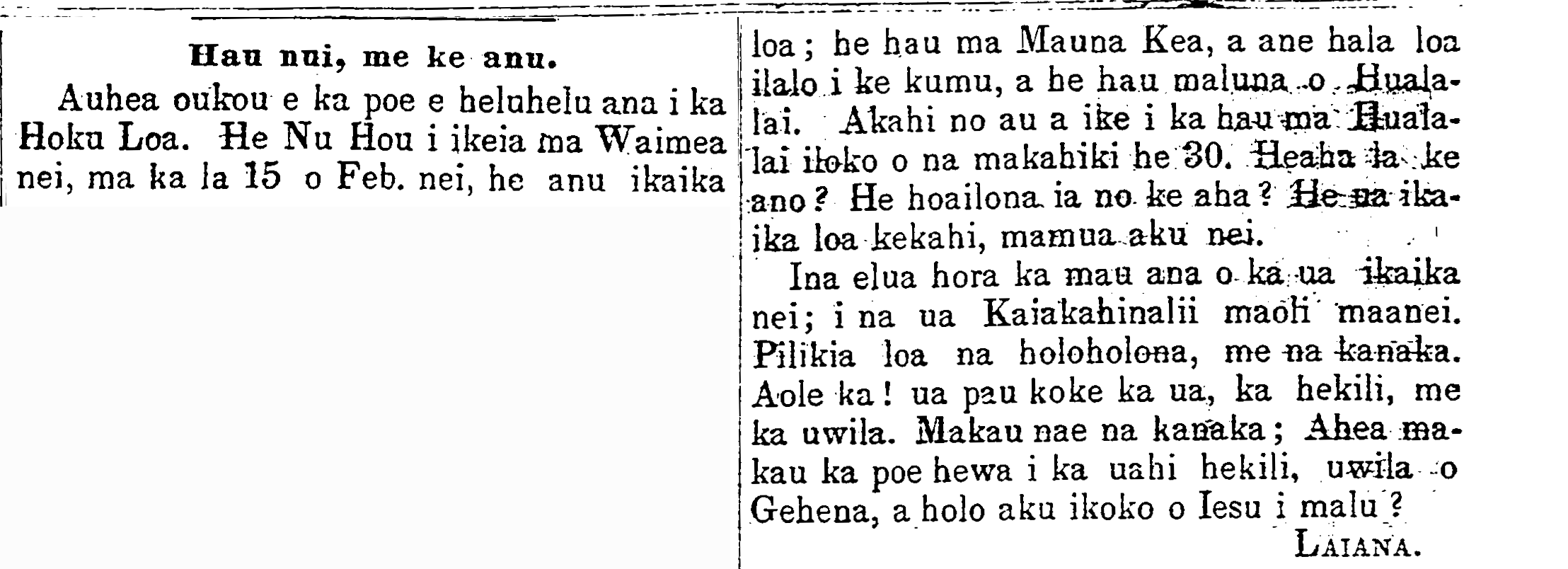
Snow on Hualalai 150 years ago. 1862.

Much Snow, and cold.

O People reading the Hoku Loa. There is News seen here in Waimea; on the 15th of February, there was extreme cold; there was snow on Mauna Kea, and it almost reached its base, and there was snow atop Hualalai. It was the first time I saw snow on Hualalai in 30 years. What is this? What is it a sign of? There was also heavy rains earlier.

If the heavy rains lasted for a couple of hours, it would have had a massive flood [Kaiakahinalii] here. The livestock and people would have been in trouble. But no! the rain, thunder, and lightning soon stopped. The people were still afraid; When will the people be afraid of the smoke, thunder, and lightning of Gehenna, and go to the protection of Jesus?

LYONS.

(Hoku Loa, 3/1862, p. 34.)

Hau nui, me ke anu.

Ka Hoku Loa, Buke III, Helu 9, Aoao 34. Maraki, 1862.

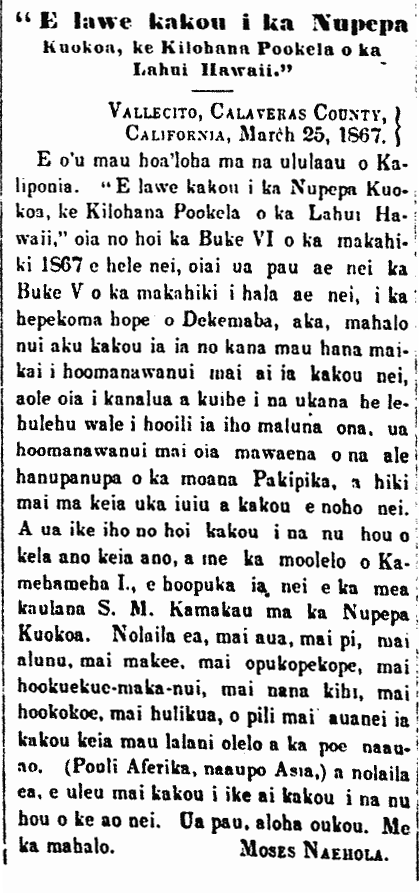
Hawaiians abroad and the Hawaiian-Language Newspapers, 1867.

“Let’s subscribe to the Newspaper

Kuokoa, the Greatest Prize of the
Hawaiian Nation.”

VALLECITO, CALAVERAS COUNTY,

CALIFORNIA, March 25, 1867.

O My friends of the forests of California, “Let’s subscribe to the Newspaper Kuokoa, the Greatest Prize of the Hawaiian Nation,” that is the ongoing Volume VI of the year 1867, being that Volume V of this past year, is over, with the last week of December; we are grateful for its patient work done for us; it was not uncertain or hesitant of all the parcels sent upon it, but it persevered upon the surging billows of the Pacific Ocean until reaching this towering lands upon which we live. And thus we see the news of this sort and that, and the history of Kamehameha I., that is being published by the famed S. M. Kamakau in the Kuokoa. Therefore, don’t hold back, don’t scrimp, don’t be greedy, don’t be covetous, don’t surly, don’t scowl, don’t look to the side, don’t look away, don’t turn you back; lest these lines by the enlightened by applied to us. (Dark Africa, ignorant Asia), and so, let’s act quickly so that we can see the news of the world. I am done, aloha to you all. With thanks.

MOSES NAEHOLA.

[For more on the serial by S. M. Kamakau, see: Ruling Chiefs of Hawaii, Tales and Traditions of the People of Old, Ka Po’e Kahiko: The People of Old, The Works of the People of Old, Ke Kumu Aupuni, and Ke Aupuni Mō‘ī.

As for Moses Naehola, does anyone know if this is the same person as Moses Nahora, who is also living in California during the same period?

One more thing… This article has an awesome listing of negative attributes (which by no means are adequately translated here). ]

(Kuokoa, 6/1/1867, p. 4)

"E lawe kakou i ka Nupepa...

Ka Nupepa Kuokoa, Buke VI, Helu 22, Aoao 4. Iune 1, 1867.

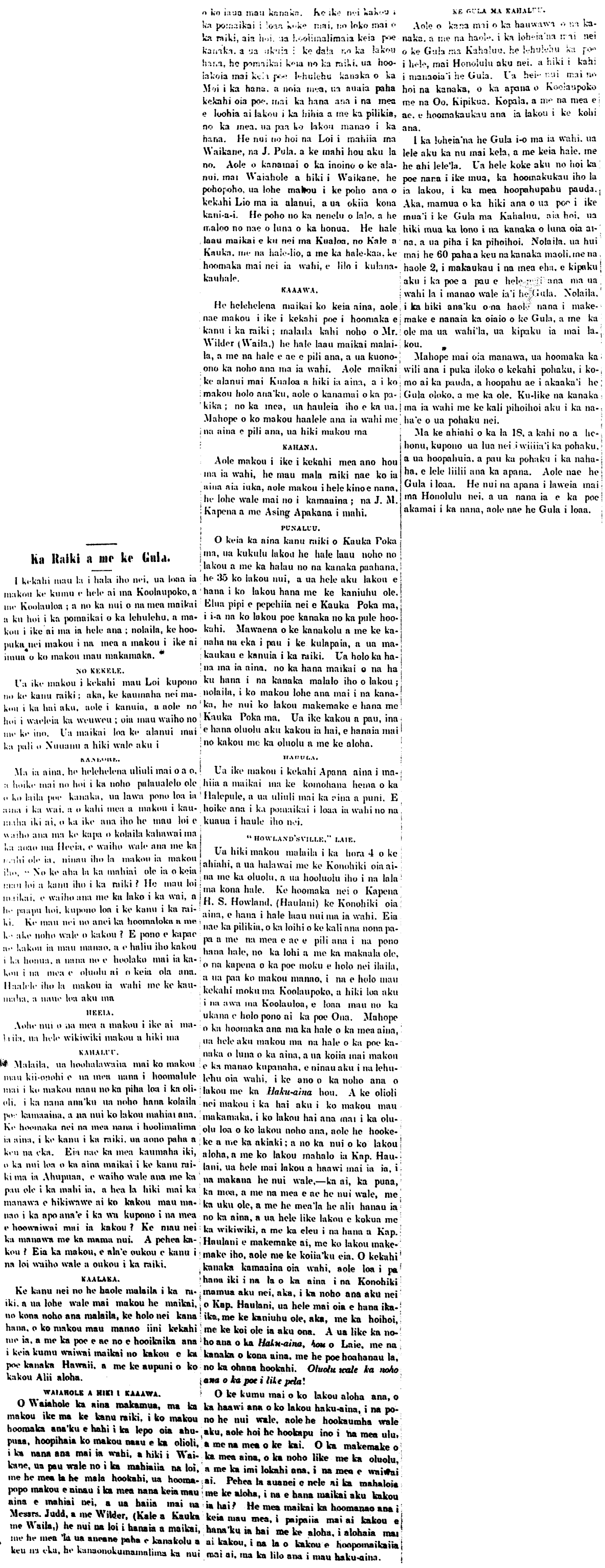
A small window into Koolauloa and Koolaupoko—150 years ago, 1862.

Rice and Gold.

Some days ago, we had reason to travel about Koolaupoko and Koolauloa, and because of the many wonderful and beneficial things for the people we witnessed in our travels, we are publishing what we saw before us.

PERTAINING TO KEKELE.

We saw some Loi perfect for growing rice; however, we are sad to state that they were fallow and it was not weeded, they were just left wild. Fine is the road from the pali of Nuuanu until

KANEOHE

In this land, it is green from one side to the other, which attests to the non-lazy lifestyle of the people there; the land has ample water, but one thing which saddened us a bit was the seeing of some loi that were left fallow next to the river there on the Heeia side, which caused us to ponder, “Why are these loi not farmed, and planted with rice? They are fine loi supplied and full of water, very good for rice growing. Does our lack of faith and our desire to while away our time still persist? We must discard those feelings, and heed the land, and it will supply us with items that will make this life pleasant. We left that place feeling sad, and travelled on to

HEEIA.

There is not much we saw there, and we went on quickly to

KAHALUU.

There, our eyes were shown things that eased our hearts because of our great joy, when we saw that the kamaaina there did work, and that they did much farming. The one who is leasing the land has started to plant rice; there are perhaps six or more acres. But the somewhat sad thing is the majority of the land suitable for rice cultivation in that Ahupuaa, are just left there without being all farmed; when will it be that if the time is right, we will quickly make up our minds to grasp opportunities to make ourselves rich? Time keeps going quickly. And what of us? Here is what we say, to wake up and to plant your unused loi with rice.

KAALAEA

A haole there is planting rice, and we hear that it is going well; because he resides there, the work is progressing, and our hopes go with him and those others that are working at this valuable endeavor for us Hawaiians and the nation of our beloved Alii.

WAIAHOLE TO KAAAWA.

Waiahole is the first place, in our knowledge, that planted rice; when we began to walk upon the soil of that ahupuaa, our hearts were filled with joy at the sights of that place, and reaching Waikane, all the loi were being farmed, as if it was just one huge farm; we thought to ask who was it that was farming the area, and we were told Messrs. Judd and Wilder (Kale of Kauka and Waila) [Kale of Kauka must be Charles Hastings Judd, the son of Kauka (Gerrit Parmele Judd); so many loi were finely built, and it seemed like almost thirty or more acres; they had thirty-five workers. We see the immediate benefits of growing rice, being that these men were hired, and got paid for their labor, and all this is because of rice; many subjects of the King were provided with jobs, and as a result, perhaps some of those people were prevented from acts which would have caused them to suffer difficulties and problems, because their minds are taken up by work. There are many Loi farmed in Waikane, by J. Fuller (J. Pula), and they are being reworked. The road from Waiahole to Waikane is horrible; it is swampy, and we hear that a horse sunk on this street and its throat was cut. The lower part is boggy, but it is dry on the surface of the earth. There is a fine wooden house standing in Kualoa belonging to Charles Hastings Judd, along with a horse shed, and a carriage house; that place is beginning to become a town.

KAAWA.

This land has a fine appearance, but we did not see a single person who started to grow rice; that is where Mr. Wilder (Waila) resides with a nice wooden house there, with other connected buildings, and life there is luxurious. The road from Kualoa until this land is not good, and in our travels, it was terribly slippery because rain had fallen upon it. After leaving that land and the adjoining lands, we arrived at

KAHANA.

We saw nothing new there, but they did have some rice fields which were located in the uplands; we did not go to see it for ourselves, we just heard of them from the kamaaina; J. M. Kapena and Asing Apakana are the ones doing the farming.

PUNALUU.

This is the rice growing lands of Dr. [Seth] Ford (Kauka Poka) them; they built a wooden house for themselves and a halau for the workers who number 35, and they work without any complaints. Dr. Ford them slaughter two cows as meat for their men for a week. The area that was plowed up is between thirty and forty acres and it is ready to be planted with rice. The work there progresses due to the good treatment by the bosses to their workers; they are anxious to work for Dr. Ford. We all know that if we treat others well, we will be treated well and with aloha.

HAUULA.

We saw some well-farmed land to the southwest of the Church, and the land all about is green. This shows the benefits of the recent showers.

“HOWLAND’SVILLE,” LAIE.

We arrived there at 4 in the evening, and met pleasantly with the Konohiki of that land, and rested our limbs at his house. Captain H. S. Howland (Haulani), the Konohiki of that land is starting to build a wooden house there. Here however is the problem, that being the long wait for the lumber and the other house building materials, because of the delay and the inattentiveness of the captains of the ships that travel there; we believe that if there was a ship that went regularly to Koolaupoko and landed at the harbor of Koolauloa, the materials needed for the Owners [of land] would always be there. After making a start at the home of the landowner, we went to the houses of those living on the land, and we were urged on by an astonishing idea, to question the people of that area about their life under their new landlord. And we are happy to report to our friends, their answer was that their life was very pleasant, without any admonishments or reproach; and because of their great aloha and appreciation for Capt. Howland, they went and gave him many gifts—taro, pig, chicken, and many other things, without pay; it was as if he was a native-born alii; also, they all went quickly to assist him, with things that Capt. Howland needed, on their own accord, without being coerced by him. One kamaaina of that area did not touch work in the least when the land was under the previous Konohiki, but with Capt. Howland, he came to work industriously without complaint, but enthusiastically, without being forced to. The new Land owner of Laie lives together with the people of his land, like brothers of the same family. How pleasant is the life of people like that!

The reason for their love is because their landlord gives them many things, and does not just burden them, or put a restriction on plants or things from the sea. The one who owns the land just wants to live together in peace, and to search for together things that will benefit them all. How could there be no appreciation and love if we treat others well? It is good to remember this, to remind us to treat others with aloha, so that we are loved, when the day comes where we will be blessed to become land owners.

GOLD IN KAHALUU.

There was so much commotion amongst the Hawaiians and haole at the news that there was Gold in Kahaluu; there were many people who came from Honolulu to the place where Gold was thought to be. Many Hawaiians from Koolaupoko came with Oo, Pickaxes, Shovels and other things, preparing them to dig.

When it was heard that there was real Gold on that land, the news flew from house to house like firebrand. Those who first spotted it went immediately, making ready with dynamite powder. However, before those people who first witnessed the Gold reached Kahaluu, the news reached the people of that land, and they were roused. Therefore, about 60 kanaka maoli and 2 haole got together with weapons to expel all those who came to that area thought to have Gold. So when the haole came that wanted to ascertain the truth or falsehood of the Gold of that place, they were sent away.

Following that time, a hole was bored into a rock to place dynamite and explode to see if there was Gold within it or not. People stood together there waiting in anticipation for the rock to break.

In the evening of the 18th, the hole dug in the rock was finally deep enough, and it was blasted, and the rock was shattered, the tiny pieces flew. There was however no Gold found. Many pieces were taken to Honolulu, and were looked at by experts, but there was no Gold found.

[Under all the disparaging comments and the obvious push for rice cultivation, you can glean some historical information of what the windward side of Oahu looked like a 150 years ago. There are followup articles in the papers speaking of how the true gold of Hawaii is found through farming the land…

For more information on the history of rice in Hawaii, see: RICE IN HAWAII: A GUIDE TO HISTORICAL RESOURCES, compiled and annotated by Karol Haraguchi.]

(Kuokoa, 2/22/1862, p. 2)
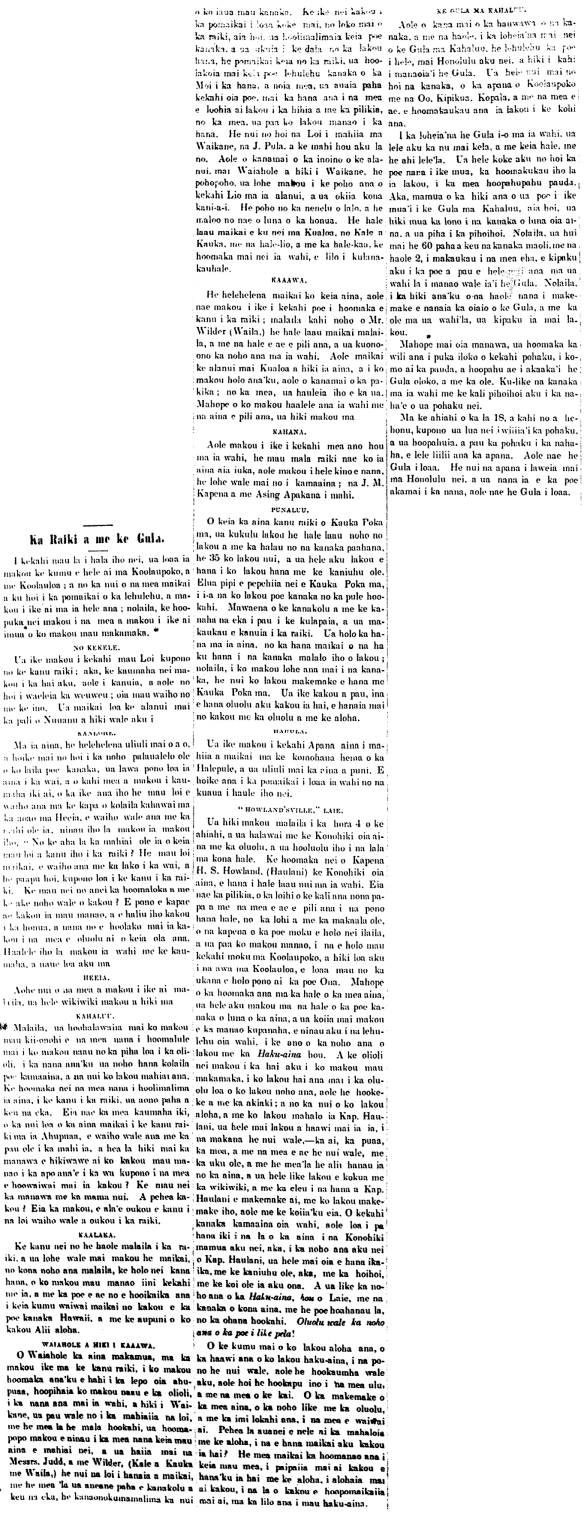
Ka Raiki a me ke Gula.

Ka Nupepa Kuokoa, Buke I, Helu 13, Aoao 2. Feberuari 22, 1862.

J. K. Mokumaia and Keoni Paakaula, 1927.

One of the reasons i posted the return of the ahuula article is because it reminded me of another post just put up—Moanalua, then and now. 1922.

In the image of the Palace Guards from the day of the return of the feather cape, you can see J. K. Mokumaia in the middle of the front row, and John Paakaula, far right on the back row.

I am wondering if this is the same Keoni Paakaula, the kumu hula of Moanalua. He would in theory be 107 years old in this picture.

[It is always important to look up name variants when you are searching for people (and even places). Biblical names in Hawaiian also appear in English, like “Keoni” and “John”. Also, Biblical names are sometimes abbreviated, like “Jas.” for “James”… It would be very helpful if there was a list of names and their variants up online.]

Another image of the return of Kamehameha III’s ahuula, 1927.

The guards of the Palace, when the Ahuula was returned to the Palace on this past Monday. Starting from the left, on the bottom row: E. K. Kaihe, John Hicky [John Hickey], J. K. Mokumaia, D. Hoke, and M. K. Reuter. The row in the back, from the left: S. K. Levi, Joseph Kawai, and John Paakaula.

(Kuokoa, 12/1/1927, p. 4)

Na kiai keia o ka Halealii...

Ka Nupepa Kuokoa, Buke LXVI, Helu 53, Aoao 4. Dekemaba 1, 1927.

Images of the return of Kamehameha III’s ahuula, 1927.

This is a picture showing scenes of the Feather cape of Kamehameha. The picture on the top is the return of the ahuula from the archives to within the Palace. The picture below is the ahuula draped upon the throne.

(Kuokoa, 12/1/1927, p. 1)

He kii keia e hoikeike ana...

Ka Nupepa Kuokoa, Buke LXVI, Helu 53, Aoao 1. Dekemaba 1, 1927.