Kalaupapa a hundred years ago, 1912.

NEWS FROM KALAUPAPA, MOLOKAI.

The S. S. Mikahala arrived yesterday, and turned around full of cargo for this port, and at Kaunakakai it put ashore the pai ai [pa‘i ‘ai], and most of the items will perhaps arrive the following week. The kokua went upside to Kaunakakai with the donkeys to fetch the pai ai yesterday evening, and last night the provision donkeys arrived, and this morning they left again for the remaining pai ai. The reason that that S. S. Mikahala could not land her cargo was because of the rough seas surrounding us; there was no harbor, only ocean, and the waves spreading across shore were towering, but an amazing thing was the request by the Vice Superintendent and Doctor W. J. Goodhue for the children and their skiff of the H. H. K. L. [?] and this request was granted.

Dr. W. J. Goodhue got on, along with the stout boys of the H. H. K. L. and they rowed out to try and get the Mikahala to throw over the pai ai to them; the amazing thing I spoke of was when the skiff came into view and before them was a huge wave, and that was when everyone held their breath, because it was as if the boat and the brave ones aboard would be pulled down, however with the blink of an eye, the skiff arrived triumphantly outside without harm, and Dr. W. J. Goodhue was seen waving his handkerchief to the people on land. And to Mr. Paahao, the helmsman went the people’s appreciation, because it was his steering that they faced the powerful waves and came out like a man-eating shark speeding atop the sparkling [hulala?] billows of the sea; and admiration also went to the boys who rowed, being that it was their strength which helped the helmsman greatly. This is just some news.

I understand that you sent the Calendars and they came, but there they go back again, and maybe we will get them next week.

There is a much Rain and strong Kona winds blowing, from last week until today, and it is this wind that caused the rough seas, and the rough seas are bringing up great rocks [aa?] and depositing them upland.

William Notley
Kalaupapa, Molokai, Feb. 2, 1912.

(Kuokoa Home Rula, 2/9/1912, p. 1)

NA MEA HOU O KALAUPAPA MOLOKAI.

Kuokoa Home Rula, Buke X, Helu 6, Aoao 1. Feberuari 9, 1912.
I hear this will be a good thing, but spaces are limited! 2012.

Mai Poina: The Annexation Debate

Description

ANNEXATION REVISITED IN LIVING HISTORY PRESENTATION
Mai Poina: The Annexation Debate to be staged Feb. 23-26

HONOLULU – Historical figures Joseph Kaulia and Emma Nāwahī lead a compelling visit to pre-annexation Hawai‘i in Mai Poina:The Annexation Debate, a living history presentation to be staged February 23-26 at the Judiciary History Center in Ali‘iōlani Hale.

[For more information, click here.]

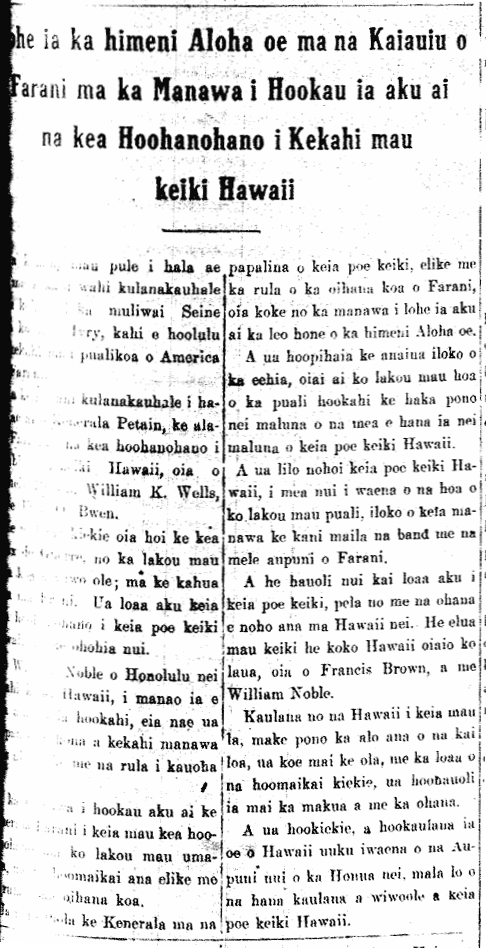
Francis Brown and William Noble honored in France, 1919.

The Song “Aloha Oe” is Heard in the Lands of France When Hawaiian Sons are Decorated with Honorary Medals.

[This is one of the articles from the page shown in the previous post, and you can see that the left column is mostly illegible. I can make out phrases like “the river Seine,” “gathered,” “American troops,” “General Petain,” “William K. Wells,” “Bwen,” “for their bravery,” “Noble of Honolulu”…]

…the cheeks of these boys, like what is customary of the French military; and that is when you immediately heard the song “Aloha Oe.”

And the crowd was awestruck as their fellow platoon members were watching attentively at what was being performed upon these Hawaiian boys.

And these Hawaiians became something great amongst their platoon, and then the band played French nationalistic songs.

These boys received much happiness, and so too did their families living here in Hawaii. Two youths, both native Hawaiians, they being Francis Brown and William Noble.

Hawaii is truly famous these days, and their great sea journey was worthwhile, they are still alive, received great honors, and made their parents and families happy.

And you, tiny Hawaii, amongst the great nations of the Earth, are elevated and made famous through the celebrated and fearless deeds of these Hawaiian boys.

(Aloha Aina, 3/28/1919, p. 1)

Lohe ia ka himeni Aloha oe ma na Kaiaulu o Farani ma ka Manawa i Hookau ia aku ai na kea Hoohanohano i Kekahi mau keiki Hawaii

Ke Aloha Aina, Buke XXXIV, Helu 12, Aoao 1. Maraki 28, 1919.

Why a lot of the pages need to be reshot (and probably unbound first). 2012.

[This is what many of the images of the papers look like. Why? Because they were bound like a book. Binding is both a blessing and a curse. Because they were bound, they are for the most part intact and complete, but on the other hand because they are bound, the side that is sewn will usually get cut off when taking a picture of the page. The binding in the image below is on the left-hand side. (Click on the image for a closer view.)

There can be no searching done when you can’t even make out the words. And as a result, a lot of knowledge is not accessible!]

Ke Aloha Aina, 3/28/1919, p. 1

Ke Aloha Aina, Buke XXXIV, Helu 12, Aoao 1. Maraki 28, 1919.

Wise Sayings of the people of old. 1922.

PROVERBS.

In order for us to hold on to all of the olelo noeau and all of the ingenious deeds of the Hawaiian people, we very much want everyone to assist the Bishop Museum in their collecting and explaining of wise and witty sayings known amongst this race.

So that this endeavor will move forward, whenever an ancient olelo noeau comes to mind, or perhaps a riddle, do write it down and send it to the museum; and if not to there, send it directly to the Kuokoa with clarification of its hidden meaning or deep wit.

Here are some olelo noeau sent from the museum to this newspaper:

Uhiuhi lau mamane, kahe ka wai o Kapapala.

Hookahi no hawa’e, lauhue Kona.

Kau ke poo i ka uluna, o Welehu ka malama.

Aohe hana a Kauhikoa, ua kau ka waa i ke aki.

Haehae ka manu, ke aleale nei ka wai.

E aho hoi ka make i ke kaua, he nui na moepuu.

Nakeke na iwi o Hua i ka la.

Uliuli kai pali o Kahikinui, kolo mai ka ohu la he ino.

Ua komo ka i’a i ka makaha, ua puni i ka nae.

Kulia i ka nuu, i ka paepae kapu o Liloa.

Aohe loea i ka wae opae.

Hoi hou ka paakai i Waimea.

Aohe u’i hele wale o Kohala.

Wehea iho maluna o Hihimanu.

E ike ia kaua hoa kanaka, o kipa hewa ke aloha i ka ilio; he ilio hoi ia, e, he kanaka hoi au, a!

Ka poe unaunahi hee o Kula.

Hilinai Puna, kalele ia Kau.

Hihi Kaunoa, hihi Mana; aloha wale ia laau makua ole.

Kiilili pua hau o Kalena.

Maemae i ke kai ka pua o ka hala.

Maewa wale i ka pali o Kahiwa. Niniu Puna i ke ala.

Nui pumaia, ohaka oloko.

Eleelepi ka waha o kanaka.

He wa ulu keia o ka hoi.

Ua le’a kaina a ka la’i, ua malie.

Make ke kalo, ola i ka naio.

Aia i kula i ka alaalapuloa.

E hoomanao i ka lua o ka ohiki.

Ako Nuuanu i ka hale halauloa a ka makani; ako Manoa i ka hale a ka ehu.

Na manu kolea kau ahua.

[And presumably from the responses came the publication we all know today as “‘Ōlelo No‘eau: Hawaiian Proverbs and Poetical Sayings”. If you don’t have a copy, this is a must have…]

(Kuokoa, 9/21/1922, p. 2)

NA OLELO NOEAU.

Ka Nupepa Kuokoa, Buke LXI, Helu 38, Aoao 2. Sepatemaba 21, 1922.

Lahainaluna School news, 1867.

Items from Lahainaluna College.

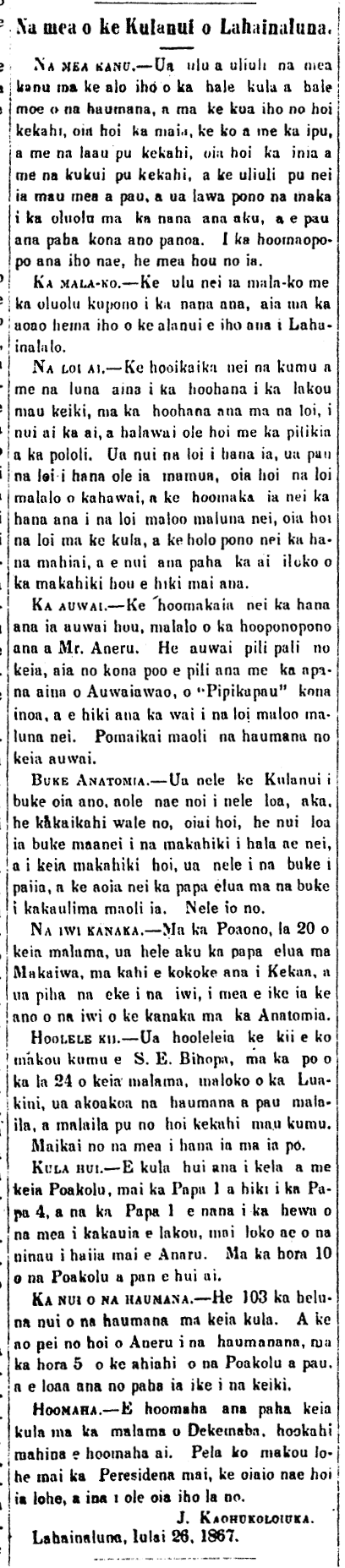
Crops.—The plants are thriving in front of the school house and the student’s dormitory, as well as in the back; those being: bananas, gourds, and trees as well, such as the pride of India, and kukui, which are all also thriving; it is very pleasant to look at, and the barrenness will perhaps be no more. But this is a considerably new thing.

The sugar cane patch.—The cane patch seems to be growing well, it is on the left side of the road going down to Lahainalalo.

The taro patches.—The teachers and land supervisors are putting effort into working the students in the patches to increase food so that they will not face problems with hunger. The patches being worked are large, and the loi that were not used before are being worked, those being the ones below the river, and the ones above it are starting to be worked (the ones at the school), and the farming is going well, and the taro production will perhaps increase in this upcoming year.

The canal.—The new auwai is being started under the direction of Mr. Andrews. This auwai runs next to the pali, and it’s source is in the district of Auwaiawao; it is called “Pipikapau” and the water will reach the dry patches here above. The students will be truly blessed by this auwai.

The anatomy book (“Anatomia”).—The College is lacking a volume of this type, but it is not totally without, there are a few; although there were a great many in the past years, this year, they are without the printed book, and the second class is being taught from a handwritten book. They are terribly lacking.

Human bones.—On Saturday, the 20th of this month, the second class went to Makaiwa, close to Kekaa, and bags were filled with bones so that they could see the kinds of bones as in Anatomia.

Lantern slides.—Pictures were projected by our instructor, S. E. Bishop, on the night of the 24th of this month in the Church; all the students gathered together, and also there were some of the teachers.
The activities that night were fine.

Joint school.—Every Wednesday, all the grades join together, from the 1st class to the 4th, and the 1st class checks the mistakes in what is written by the other classes in response to the questions given by Andrews. They join together at 10 o’clock on every Wednesday.

The enrollment.—There are 103 students at this school. And Andrews teaches the students at 5 o’clock in the evening every Wednesday, and perhaps the children are acquiring this knowledge.

Break.—The school might go on vacation during the month of December, for a month. This is what we hear from the President, whether it be true or not.

J. Kaohukoloiuka.
Lahainaluna, July 26, 1867.

(Kuokoa, 8/3/1867, p. 3)

Na mea o ke Kulanui o Lahainaluna.

Ka Nupepa Kuokoa, Buke VI, Helu 31, Aoao 3. Augate 3, 1867.

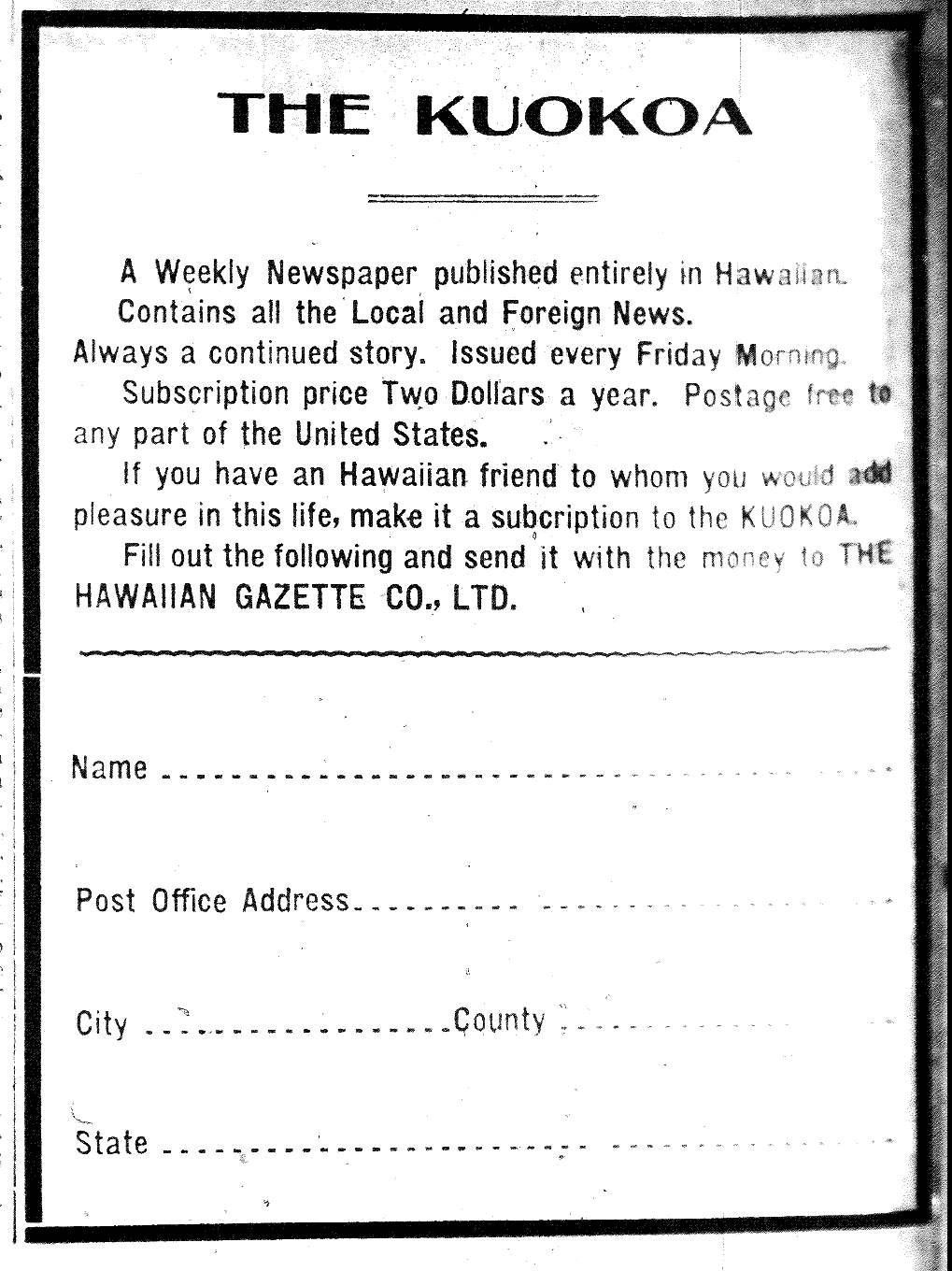
Subscription for a Hawaiian-Language Newspaper in an English paper, 1912.

[Here is an interesting advertisement appearing a hundred years ago in what was until just recently the Honolulu Advertiser. It is a cut out and mail in subscription form for Ka Nupepa Kuokoa!]

THE KUOKOA

Pacific Commercial Advertiser, Vol. LIV, No. 9175, p. 2. January 3, 1912.

Hawaii’s Historical English-Language Newspapers Exhibit, 2012.

Hawaii Digital Newspaper Project

Check out the new exhibit at Hamilton Library on the 5th floor in the Hawaiian/Pacific Collections, of articles from Hawaii’s historical English-Language Newspapers. It sounds fun and informative. I will be headed over to check it out soon!

[Maybe there should be one done of the Hawaiian-Language Newspapers as well!]

Click here for more information!