Meteor spotted, 1934.

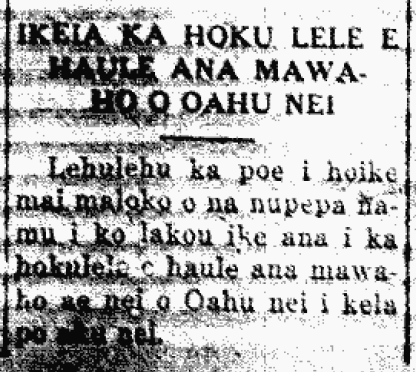
METEOR SEEN FALLING OUTSIDE OF OAHU NEI.

There were many people who reported in the English-language newspapers that they witnessed a meteor [hoku lele] falling outside of Oahu last night [Wednesday, 7/25/1934].

[If it is clear out early tomorrow morning, maybe we’ll be able to see meteors as well!]

(Alakai o Hawaii, 7/26/1934, p. 4)

IKEIA KA HOKU LELE E HAULE ANA MAWAHO O OAHU NEI

Ke Alakai o Hawaii, Buke 7, Helu 13, Aoao 4. Iulai 26, 1934.

Grass-Thatched Houses, disappearing, 1873.

[Found under: “LOCAL NEWS: Oahu.”]

Forty years or so ago, there perhaps was not a single wooden structure here in Honolulu [Kou], however today, you’d be hard pressed to find a single complete Hawaiian hale pili. It is true, the world is marching on.

(Kuokoa, 4/26/1873, p. 2)

He kanaha a oi ae na makahiki...

Ka Nupepa Kuokoa, Buke XII, Helu 17, Aoao 2. Aperila 26, 1873.


Runaways from Kalawao, 1875.

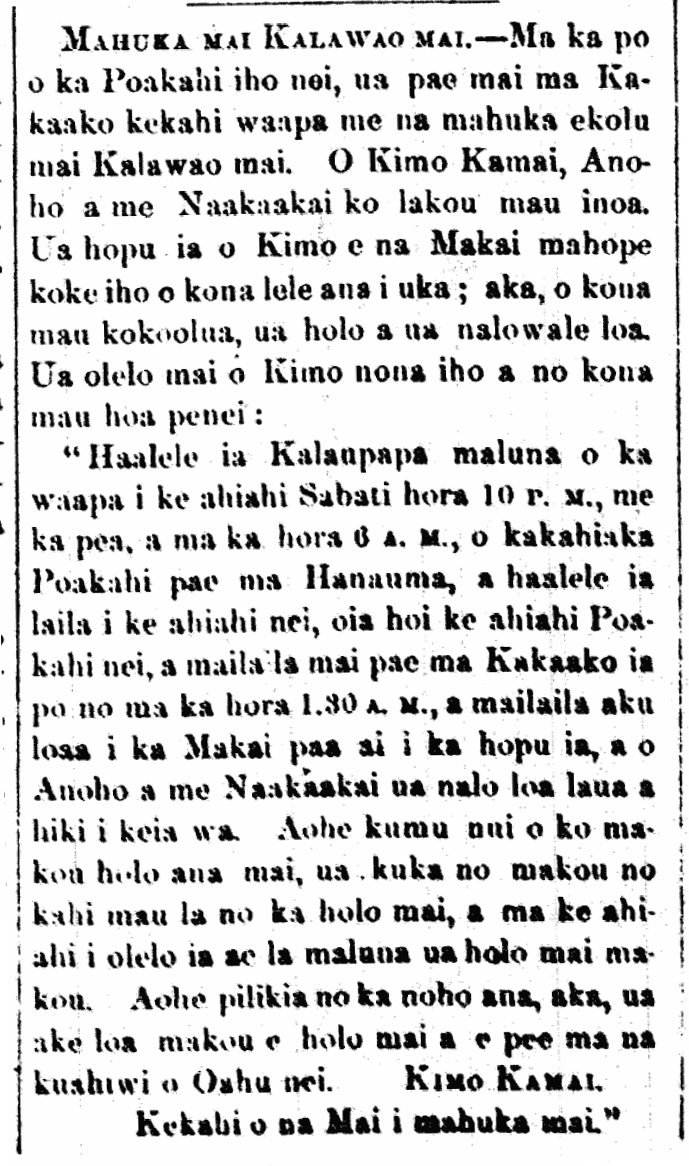
Escaped from Kalawao.—During the night of this past Monday, a skiff landed at Kakaako with three escapees from Kalawao. Their names are Kimo Kamai, Anoho, and Naakaakai. Kimo was captured by the Officers soon after he came ashore; however, his two companions ran and disappeared. Kimo said of himself and his companions:¹

“We left Kalaupapa aboard the skiff in the evening of Sunday, at the hour of 10 p. m., with a sail, and at 6 a. m., in the morning of Monday, we landed at Hanauma, and left there this past evening, that being the evening of this Monday, and from there landed at Kakaako that night at 1:30 a. m., and from there I was caught and detained by the Officer, while Anoho and Naakaakai escaped until the present. There was no big reason for us coming; we spoke for a number of days about coming, and on the evening mentioned above, we set sail. There is no difficulties in the way of life, but we really wanted to come here and hide in the mountains of Oahu nei. KIMO KAMAI.

One of the Patients who escaped.”

¹It is interesting the word here used for companion was “kokoolua” instead of “kokookolu”.

(Lahui Hawaii, 7/29/1875, p. 3)

Mahuka mai Kalawao mai.

Ka Lahui Hawaii, Buke I, Helu 31, Aoao 3. Iulai 29, 1875.

Vital Statistics, 1913.

MARRIAGES.

Abraham Kapoowai to Laura Kaapa, March 12.
Joseph Kaleohano to Elizabeth Kaakau, March 25.
Joseph Kuahine to Edna Moa, Apr. 11.
Charles Sing Loy to Mary Kahai, Apr. 12.

BIRTHS.

To D. M. Lonohiwa and Violet Holoholokulani, a daughter, Apr. 1.
To Abe Werner and Mary Kapua, a daughter, Apr. 5.
To Charles Kalua and Hana Kealoha, a son, Apr. 1.
To Sam Kauka and Hattie, a daughter, Apr. 8.
To Wong Hung and Elizabeth Gabriela, a daughter, Apr. 9.
To W. Osaki and Lydia West, a daughter, Apr. 10.
To Sam Kalama and Emily Hatton, a son, Apr. 11.
To Stephen Gumpher and Ellen K. Tripp, a daughter, Apr. 12.
To George Mossman and Rebecca Kainapau, a son, Apr. 13.
To Ed. Chang Akai and Beke Kaonohi, a son, Apr. 13.
To Joe Kaaea and Mary Hipuu, a son, Apr. 14.
To James Kaopua and Emilia K. Anina, a daughter, Apr. 14.
To R. N. Mossman and Wilhelmina Nieper, a son, Apr. 14.
To F. Scharsch and Kina Akana, a son, Apr. 14.
To Likelio and Kakalina Makakoa, a son, Apr. 15.
To W. Kekoa and Apia Nohua, a son, Apr. 16.
To Moike and Lilia U-a, a daughter, Apr. 18.
To Arthur Hussey and Lydia Lambere, a son, Apr. 19.
To Joseph Mahoe and Elizabeth Mahoe, a daughter, Apr. 18.
To George Ah Nee Kekoa and Lily Adams, a daughter, Apr. 20.
To Joseph K. Keliikoa and Hannah Komomua, a daughter, Apr. 19.
To Gershom Waiau and Adeline Baker, a son, Apr. 23.

DEATHS.

Kaiewe, on Waikahalulu Lane, Apr. 15.
Annie Moses He-u, at Leahi Home, Apr. 17.
Kelikolio, on Gulick Street, Apr. 17.
Mary Ellen K. Nakea, on Insane Asylum Road, Apr. 18.
Mrs. Luika Mahuka, at Ewa, Apr. 18.
William Cullen, on Rose Street, Apr. 18.
A baby of Joseph Mahoe, on Jack Lane, Apr. 19.
John Boki, at the Insane Asylum, Apr. 19.
Mrs. Mahawela Karratti, on Pensacola Street, Apr. 21.
Kalani Manaku, on Sheridan Street, Apr. 21.
S. W. Kawaa, on Palolo Street, Apr. 22.
Peke Kekaula, on Kukui Lane, Apr. 23.

[The image below on the left is taken from the digital images online. As you have heard me say many a time, the current digital images are often not legible. While this column is not bad overall, there were a number of names that I could not make out for sure. The image on the right is from the microfilms. The microfilm images are always clearer than the digital images. And luckily,  I was able to figure out the remaining information here.

The microfilms for now are the next clearest thing to the originals, and should not be dismissed or overlooked when doing research just because we have easily accessed digital images. If you cannot make out words from the online digital images, go to the microfilms always. Only if the microfilms are also illegible and you really need the information, only then would I suggest checking the originals.

My ultimate hope is that the originals will be rescanned clearly someday soon so that we will no longer need to handle them and they can be preserved for the future. The more they are flipped through and handled, the more damaged they get…]

(Kuokoa, 4/25/1913, p. 4)

NA MARE. / NA HANAU. / NA MAKE.

Ka Nupepa Kuokoa, Buke LI, Helu 16, Aoao 4. Aperila 25, 1913.

Population of Hawaii, 1838.

POPULATION OF HAWAII NEI.

This is something translated from a haole document.

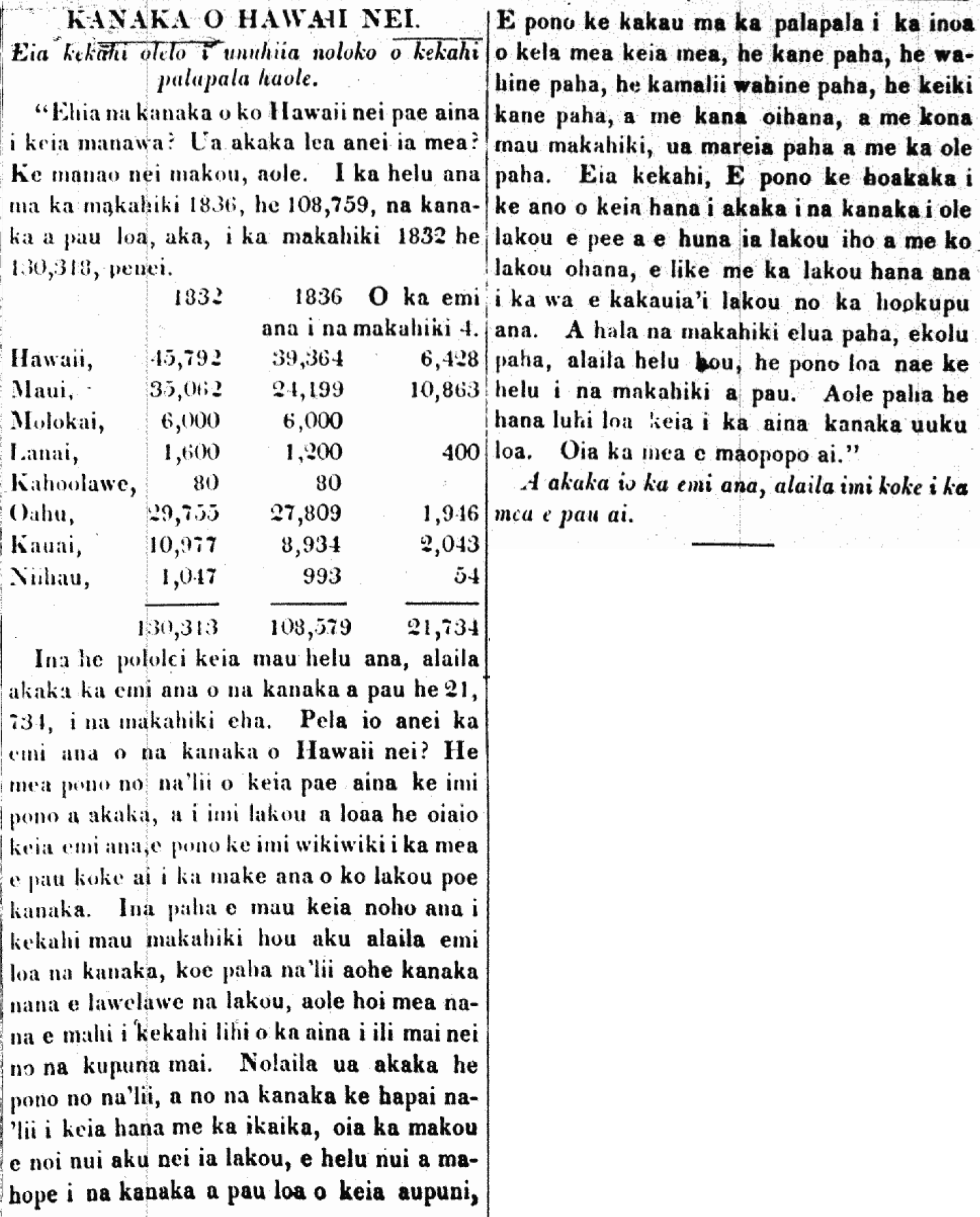
“How many people are there currently in the Hawaiian Archipelago? Is that something that is clear? We believe, it is not. In the census in 1836, there were 108,759 people total, however in 1832, there were 130,318, like this:

1832 1836 Decrease over 4 years
Hawaii 45,792 38,364 6,428
Maui 35,062 24,199 10,863
Molokai 6,000 6,000
Lanai 1,600 1,200 400
Kahoolawe 80 80
Oahu 29,755 27,809 1,946
Kauai 10,977 8,934 2,043
Niihau 1,047 993 54
130,313 108,579 21,734

If these figures are true, then it is clear that there has been a decrease of 21,734 people in the total population over four years. Is that truly the decrease in the population of Hawaii nei? It is imperative that the alii of this archipelago investigate and make it clear, and should they check and if this is indeed the decrease, they must quickly find a way to stop the deaths of their people. If this way of life goes on for another few years, then the population will be miniscule and perhaps only the alii will survive and they will not have people to care for them; there will be no one to farm a bit of land passed down from the ancestors. Therefore it is imperative for the sake of the alii and the people that the alii put great effort into this, and this is what we strongly ask of them to do a great count of all of the people of this nation. It is important to document the names of everyone, whether they are men, or women, or girls or boys, and their occupation, their age, and whether they are married or not. Also, it is important that this effort be explained so that people understand to prevent them from hiding themselves and their family, like they do when they are being tallied for taxation [hookupu ana]. And after two years or three pass, there should be another count, although it really is important to do it every year. This shouldn’t be very hard to do in a land of very few people. This is what should be understood.”

If there is an clear decrease, there should immediately be something done to curtail it.

(Kumu Hawaii, 12/5/1838, p. 55)

KANAKA O HAWAII NEI.

Ke Kumu Hawaii, Buke 4, Pepa 14, Aoao 55. Dekemaba 5, 1838.

Important words from today about yesterday, today, and tomorrow, 2013.

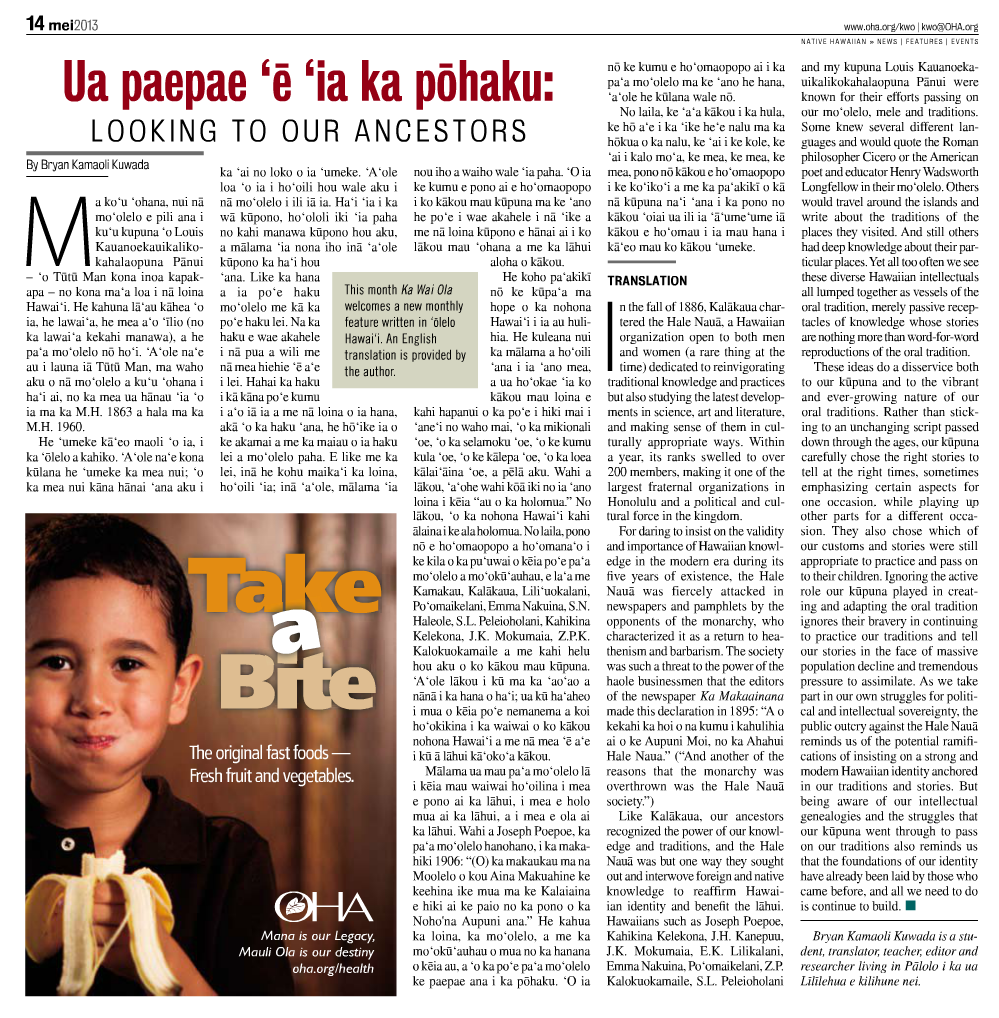
[Appropriate for this Lei Day, i found a lei woven with great thought and care within the pages of the current Ka Wai Ola, out today. This is a two-stranded lei—two insightful articles (both on a like topic, but one not a translation of the other) by Bryan Kamaoli Kuwada, student, translator, teacher, editor, and researcher living in Palolo i ka ua Lililehua e kilihune nei. Do read it and do pass it on.

For the entire issue, click here: Ka Wai Ola, Mei 2013.]

“Ua paepae ʻē ʻia ka pōhaku: Looking to Our Ancestors.”

Ua paepae e ia ka pohaku: Looking to our Ancestors

Ka Wai Ola, Volume 30, Number 5, Page 14. Mei 2013.

May Day in Hilo town, 1942.

Our Lei Day

According to what we understand and hear pertaining to the celebration of Lei Day, that being this Friday, the show put on will be great.

There will be two hula groups that will hula on that day, that being the hula troupe [Hui Lokelani] of Mrs. Rose Kuamoo and the Hui Huapala led by Albert Nahale-a. Other than these groups will be the Police Glee Club led by William K. Kahimoku (Kualii), and also the children of Mr. and Mrs. Joseph Kalima, and also perhaps some duets and some solos.

Last year, this show was held in the evening, beginning at 6:00, but this year, it can’t be put on in the late evening, but instead will be held at 3:00  p. m. This is times of blackout in this land, and we are not to turn on lights outside.

This show and hula will be held at Kalakaua Square, and we are lucky to have the military band join in and commemorate this day. There is nothing to be said about our County Band, for they have not dropped out of the activities of the day.

The activities of the day will begin with a concert put on by the military band at port here in Hilo, at 2:30 p. m. until 3:00 p. m., and the County band until 3:30 p. m. and followed by the other parts.

Here below is the program of events of that afternoon

MAY DAY IS LEI DAY
IN HAWAII
Directed by the Hawaiian Civic Club of Hilo
Friday, May 1, 1942,
at the Hour of 3:30 P. M.
KALAKAUA PARK

Part I, Old Hawaiian Hula

1. “Ka La o Mei He La Lei Ia Ma Hawaii” [May Day is Lei Day in Hawaii] Police Glee Club, Lokelani, and Huapala.

2. “Oli” by Mary Ahiena

3. Old Hawaiian Hula, by the Hui Lokelani.

a. Olapa — Niihau, Pua Hau o Maleka

b. Puili — Malualua

c. Iliili — Kona Hema

d. Uliuli — Moku Kia Kahi, Alekoki

4. Combined Old Hawaiian Hula, by the Hui Huapala

a. Puili & Uliuli — Nani Wale Na Hala

5. “Pua Mohala” by the Hilo Police Glee Club

Part II, Hawaiian Hula of Modern Times

1. “Kuikahi” by Huapala

2. A Hula for President Roosevelt, Lokelani

3. “Ua Hoomaka lakou i Kekahi Mea,” Frank Kahili

4. Holoholo Kaa, Huapala

5. “Loke Honesakala,” Ernest Hanaike and his Guitar

6. Nani Hilo, Lokelani

7. “Mele Maka Lalau” by Baby Kaieie

9. “Wiliwili Wai,” William Kualii

8. Aloha Ia No O Maui, Lokelani

10. Kona Hema, Huapala

11. My Sweet Sweetie, Three Children of Kalaima

12. Oahu, Lokelani

13. Ke Kali Nei Au, duet by Miss Kuaana Nathaniel and Joseph Kalima

14. Maikai Wale No Kauai, Lokelani

15. “TAHUAHUAI,” Abraham Laeha

16. Sasa & Somemore o Samoa, Huapala

17. THE CONCLUSION

a. Hilo March — Lokelani

b. “I Lei Nou” — Police Glee Club

c. Leahi, Hanohano Hanalei — Huapala

18. ALOHA OE

19. STARS SPANGLED BANNER

(Hoku o Hawaii, 4/29/1942, p. 2)

Ka La Lei O Kakou

Ka Hoku o Hawaii, Volume 37, Number 1, Page 2. Apelila 29, 1942.