More on Consul-General Shimizu, 1895.

[Found under: “KELA A ME KEIA.”]

Some well to do Japanese of Honolulu nei gave a large party outside of Sans Souci [Sana Susi], Waikiki, on the afternoon of this past Friday for the former Japanese Consul, and his secretary, Goro Narita. Also present was the new Consul-General (H. Shimamura) from Japan and his secretary.

[It seems Shimizu replaces Saburō Fujii as the Consul-General in November 1894 (although Gorō Narita was temporary Consul-General during the short period from November 1894 to January 1895), and Shimizu’s own term came to an end sometime in early November of 1895. In the 12/2/1895 issue of the same paper, there is a short three-line mention of the former Consul, Shimizu, returning to Japan on the Coptic of the past Thursday (11/28/1895).]

(Makaainana, 11/18/1895, p. 8)

Ua haawi ae kekahi mau Kepani...

Ka Makaainana, Buke IV—Ano Hou, Helu 21, Aoao 8. Novemaba 18, 1895.

On the search for the Japanese consul, F. Schmibu, 1895 / 2014.

We see in “Hawaii’s Story,” some of those present at the Queen’s trial were:

“The diplomatic corps, Mr. Albert F. Willis, minister of the United States, A. G. S. Hawes, British commissioner, Monsieur De Verlet, French commissioner, Senior Canavarro, Portuguese commissioner, and Mr. F. Schmibu, the Japanese consul…”

[According to Thrum’s Hawaiian Annual of 1895, Japan’s diplomatic representative was “F. Schimiczu, Eleve-Consul.”

In the Hawaii newspapers of the day, both English and Hawaiian-Language, there are also references to Consul-General Shimizu (Kanikela Kenerala Shimizu). But i still have yet to find any specific information on this man.

The four others are: Albert S. Willis, Albert G. S. Hawes, Henri L. Verleye, and Antonio de Souza Canavarro.]

Thrum

Thrum’s Hawaiian Annual for 1895, p. 156.

On this day, perhaps it is appropriate to remember further indignity faced by the Queen, 1901.

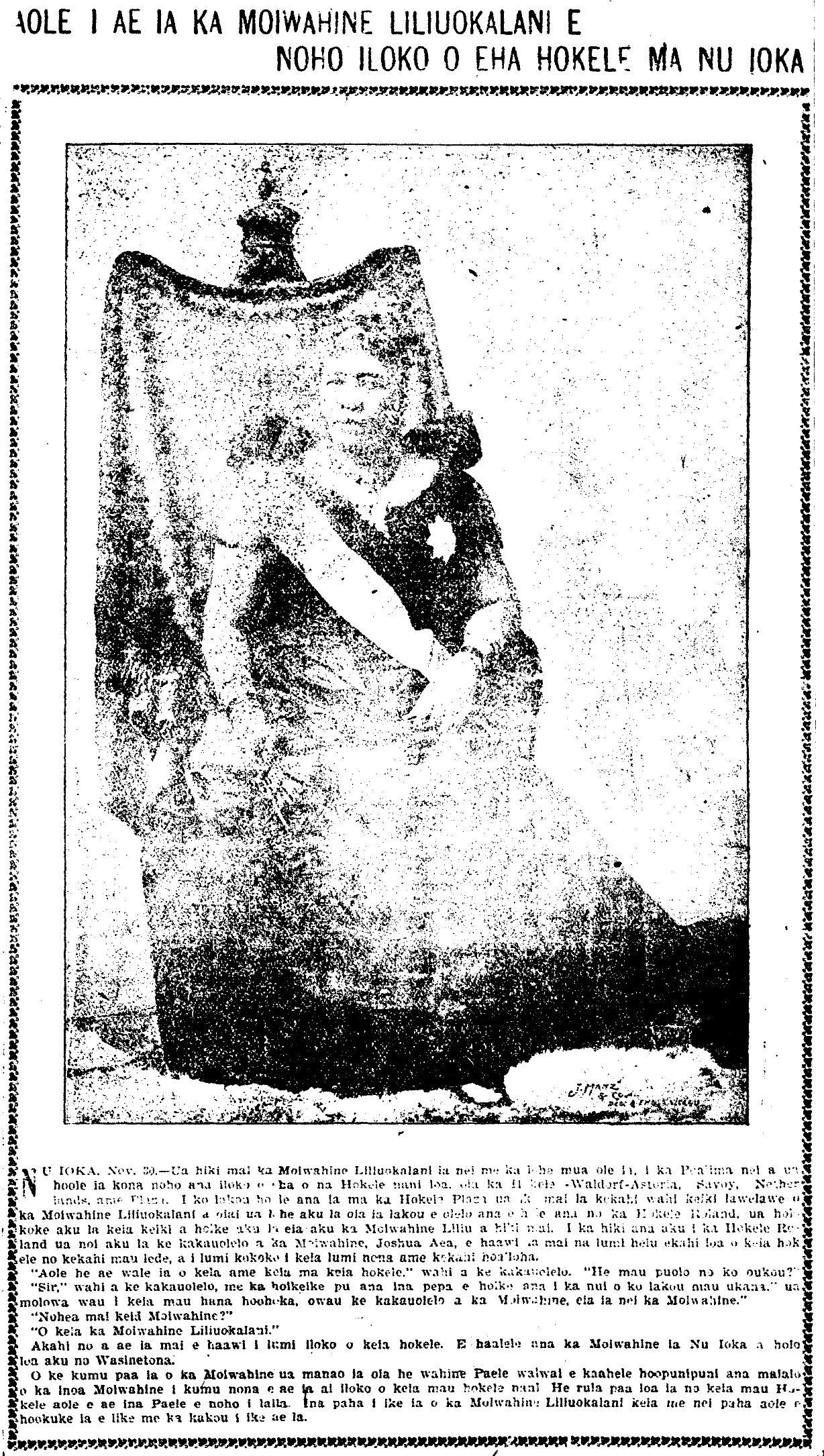
Queen Liliuokalani was Refused Stay at Four Hotels in New York.

New York. Nov. 30.—Queen Liliuokalani arrived here last Friday unannounced, and she was refused stay at four posh hotels: The Waldorf-Astoria, Savoy, Netherlands, and Plaza. After being refused by the Plaza, one of the Queen’s servants saw this and and being that he heard them saying they were headed to the Hotel Roland, he went at once and announced that the Queen would be arriving. When Joshua Aea, her secretary, asked for their best room for some ladies, and for a room nearby for him and his friends.

“Not just anyone is allowed admittance here to this hotel,” said the hotel staff [“kakauolelo” seems to be a misprint]. “Do you have baggage?”

“Sir,” the secretary said while showing a list of their baggage, “I have had enough of all of these frustrations; I am the secretary of the Queen; the Queen is here.”

“Where is this Queen from?”

“This is the Queen Liliuokalani.

Only then was a room in the hotel given. The Queen will be leaving New York for Washington.

The reason  the Queen was barred was that she was thought to be a rich Black [Paele] woman going around trying to pass as a Queen, so that she would be allowed to stay at these beautiful hotels. All of those hotels have a policy not to allow Blacks to stay there. Perhaps if they knew she was the Queen, perhaps she would not have been driven off as we have seen above.

(Kuokoa, 12/13/1901, p. 1)

AOLE I AE IA KA MOIWAHNE LILIUOKALANI E NOHO ILOKO O EHA HOKELE MA NU IOKA

Ka Nupepa Kuokoa, Buke XXXIX, Helu 24, Aoao 1. Dekemaba 13, 1901.

Queen’s Hospital news from George Pooloa, 1930.

AT THE QUEEN’S HOSPITAL

(Written by George Pooloa)

John Young is a grandchild of Queen Emma. Here at Queen Emma Hall [Kuini Ema Holo], the precious gifts from Britain are being cared for. In this Hall you can see antiquities of times gone by along with portraits of Queen Emma; Kamehameha IV, Liholiho; and the Prince, Kahakuohawaii. The favorite of Kamehameha IV was dogs, and when he was done eating, he would say, “That tiny pig was so delicious.”

[This is one of many articles written by George Pooloa in the Hawaiian-Language Newspapers. Many of his contributions are historical accounts. See here for an excerpt of one of them speaking of the naming of Hanauma: naneaarmstrongwassel on instagram  (as well as all the other articles!)

Does anyone know what became of these portraits and the other antiquities mentioned in this article?]

(Alakai o Hawaii, 2/20/1930, p. 3)

MA KA HALEMAʻI MOIWAHINE

Ke Alakai o Hawaii, Buke 2, Helu 43, Aoao 3. Feberuari 20, 1930.

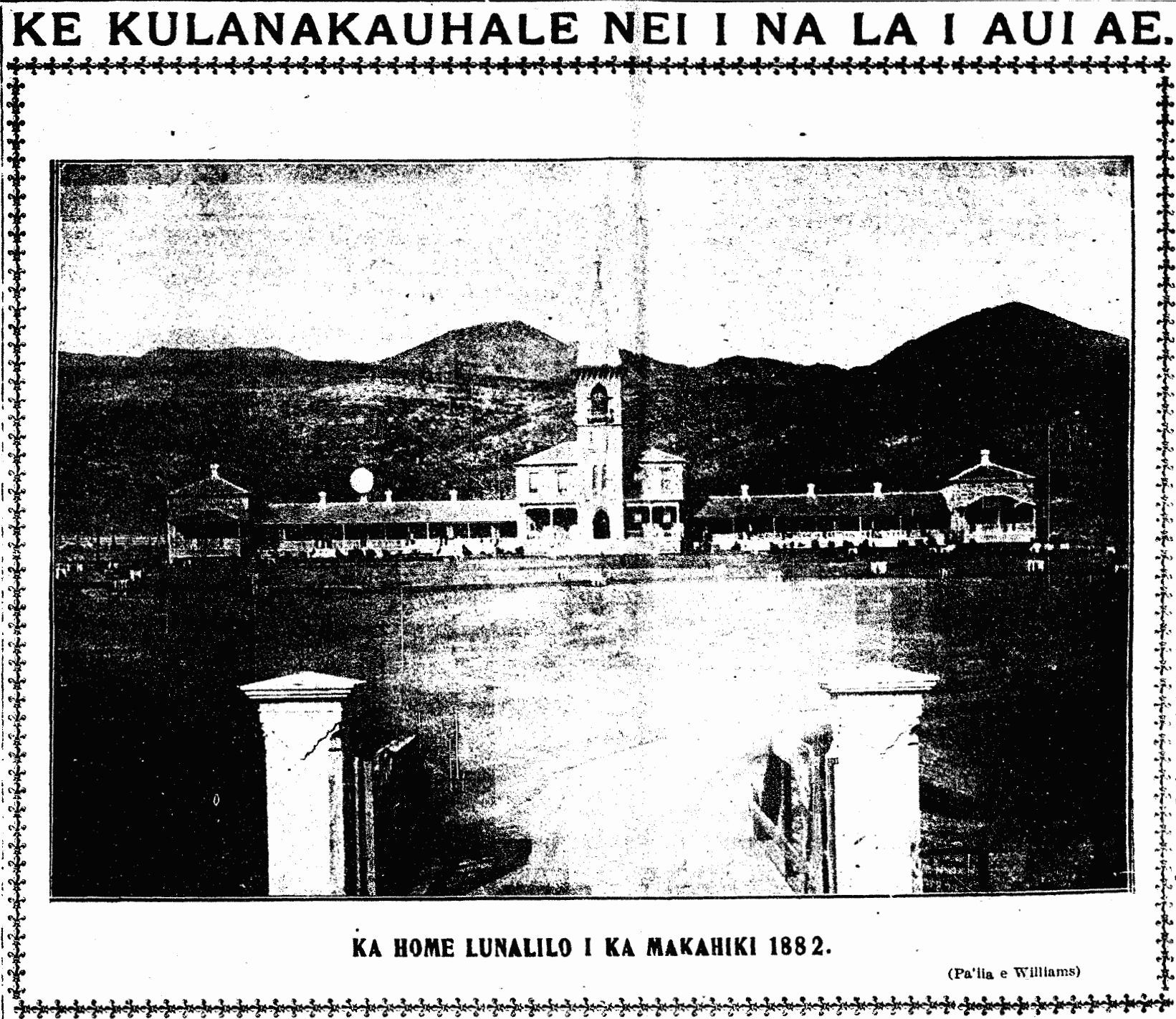
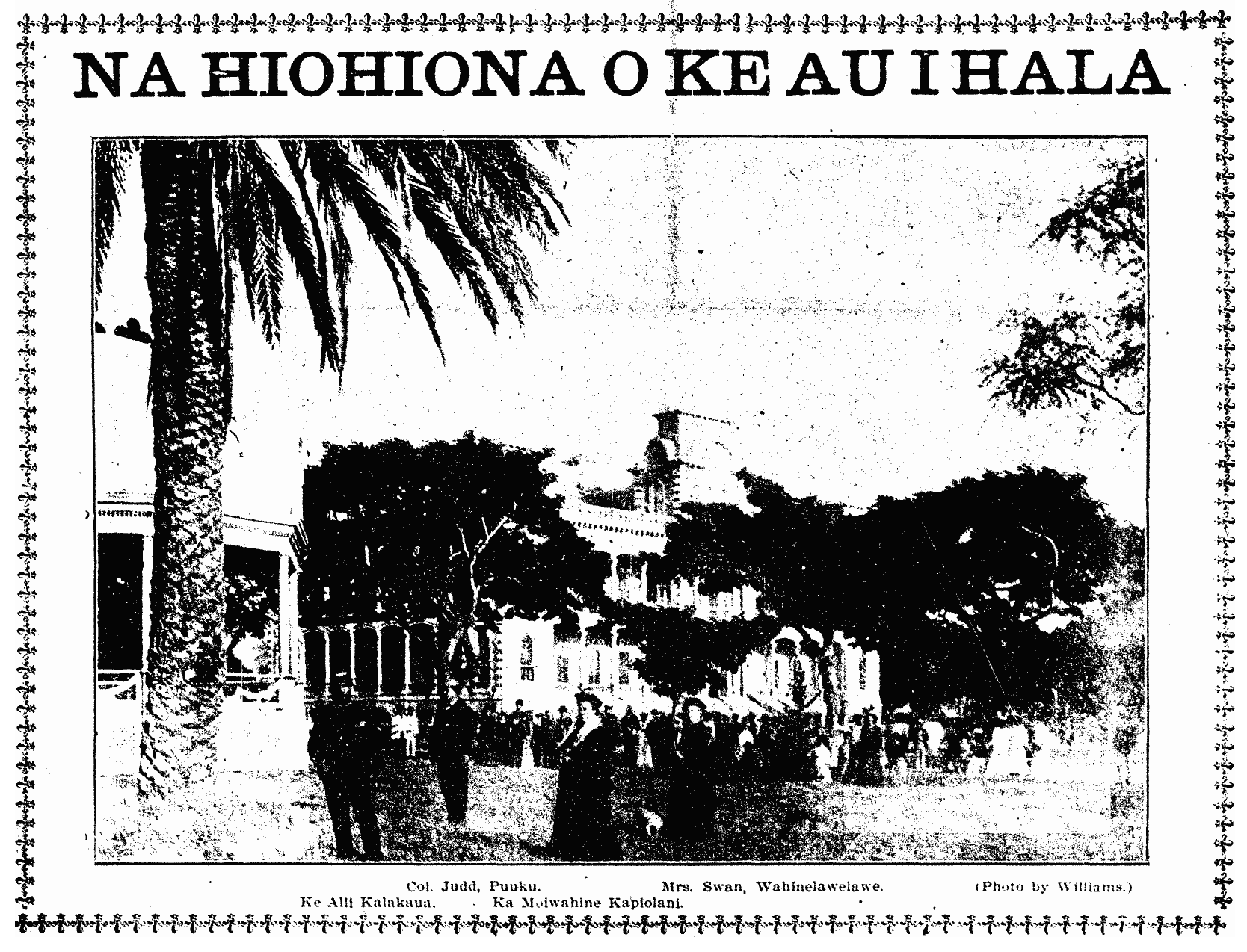
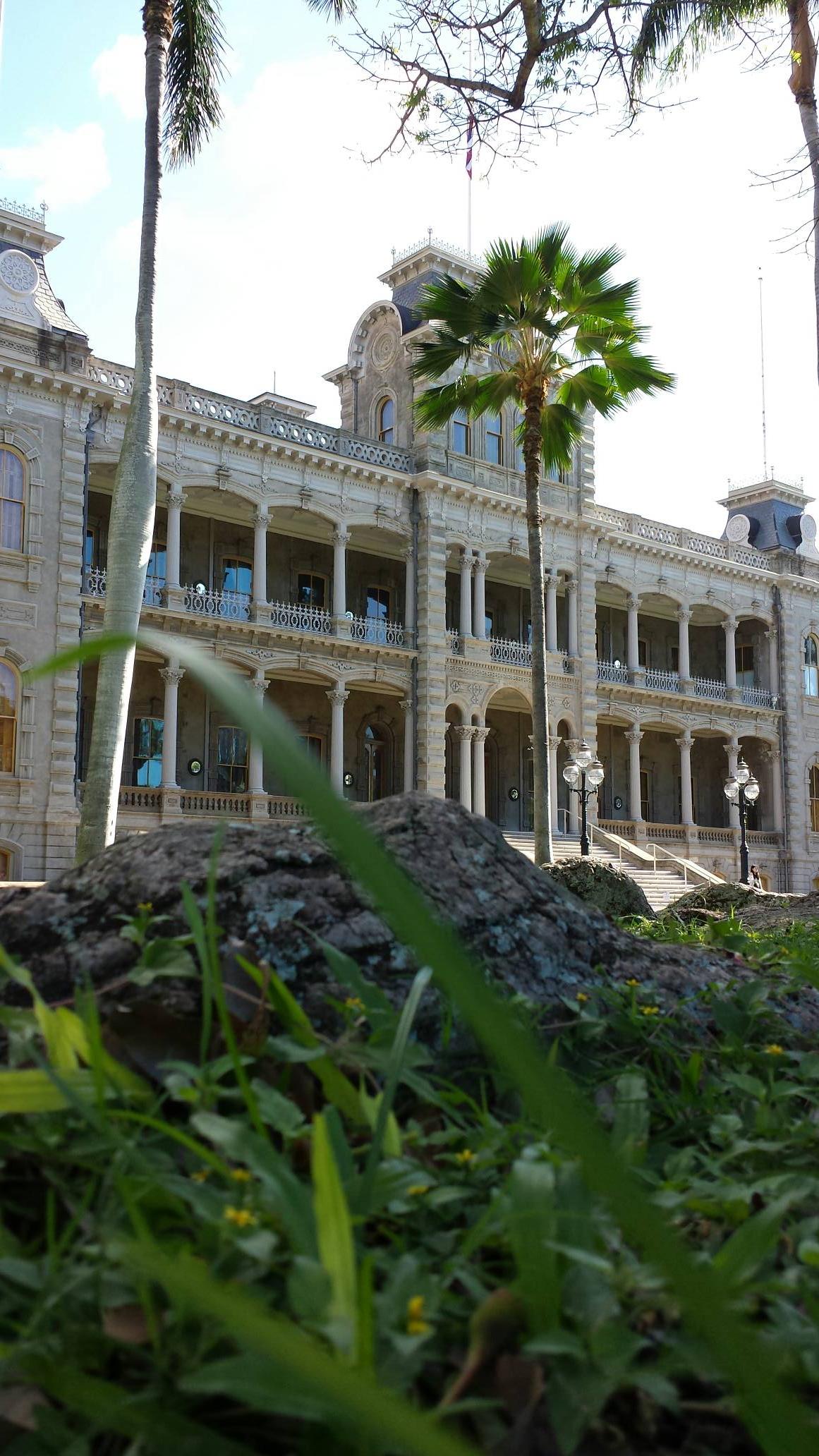
King Kalakaua and Queen Kapiolani and Iolani Palace, 1903.

IMAGES FROM DAYS GONE BY

Col. Judd, Chamberlain [Puuku]         Mrs. Swan, Chambermaid [Wahinelawelawe.]         (Photo by Williams.)

King Kalakaua                                Queen Kapiolani

(Kuokoa, 4/17/1903, p. 1)

NA HIOHIONA O KE AU I HALA

Ka Nupepa Kuokoa, Buke XLI, Helu 16, Aoao 1. Aperila 17, 1903.

The Queen’s Protest, 1893.

KUKALA KUE A KE ALIIAIMOKU.

“O wau, Liliuokalani, ma ka lokomaikai o ke Akua, malalo o ke Kumukanawai o ke Aupuni Hawaii, Moiwahine, ma keia ke hoike paa nei i Ko’u kue i kekahi hana a mau hana paha a pau i lawelawe ia e kue ana Ia’u iho a me ke Aupuni Kumukanawai o ke Aupuni Hawaii e kekahi poe e koi ana ua kukulu lakou he Aupuni Kuikawa no ka manawa no keia Aupuni.

“Ke ae wale nei no Au mamuli o ka mana oi ikaika o Amerika Huipuia nona hoi ke Kuhina Elele Nui, ka Meamahaloia John L. Stevens, ua kauoha aku i na koa o Amerika Huipuia e hoopae ia mai ma Honolulu, a ua kukala ae e kokua no oia i ua Aupuni Kuikawa ʼla no ka Manawa i oleloia.

“Nolaila, i mea e kaupale aku ai i na hookuia ana o na puali i hoolawa ia me na lako kaua, a malia paha o hoopoino ia ke ola; nolaila, malalo o keia Kuahaua Kue a i kauhola ia hoi e ua mana ikaika ʼla, ke ae wale nei no Au e panee aku i Ko’u Mana a hiki i ka manawa a ke Aupuni o Amerika Huipuia, mamuli o na mea oiaio e waiho ia aku ai imua ona, e hoololi ai i na hana a kona Luna Aupuni a e hoonoho hou Ia’u maluna o ka mana A’u e koi nei ma ke ano Aliiaimoku o ka Paeaina Hawaii.”

“Hanaia ma Honolulu, i keia la 17 o Ianuari, M. H. 1893.”

“[Kakauinoaia:]

LILIUOKALANI, R.

Samuel Parker,
Kuhina o ko na Aina E.

Wm. H. Cornwell,
Kuhina Waiwai.

Jno. F. Colburn,
Kuhina Kalaiaina.

A. P. Peterson,
Loio Kuhina.

“Ia S. B. Dole a me kekahi poe e ae o ke Aupuni Kuikawa no ka Manawa o ka Paeaina Hawaii.”

[The Queen’s protest was printed in entirety the very next day in the Hawaiian-Language Newspaper, Hawaii Holomua. Images of this paper are unfortunately not available online, and it is only word searchable at nupepa.org, and not at papakilodatabase.com, but click the link below for an image of the page in which the protest was printed.

For English, see for instance: p. 120 of Report of Commissioner to the Hawaiian Islands, 1893.]

(Hawaii Holomua, 1/18/1893, p. 2)

HawaiiHolomua_1_18_1893_2

Kaipoleimanu, okolehao, place names, and such, 1895 / 2014.

KAIPOLEIMANU.

This Tuesday, Captain Kalei of the Schooner Rob Roy, which is a schooner travelling between Honolulu nei and Molokai, was arrested for having an Okolehao jug containing liquor; there were a great many officers sent to the seaside to arrest the Captain of the schooner.

There was much found in a dark room: four gin jugs, two Whiskey jugs, but the majority found were bottles that were empty with no whiff of Okolehao.

One of the sailors of this ship, distanced himself with a dismal look on his face, and another scratched his head while looking pale.

When it was clear to an officer that he saw alcohol was brought into Honolulu town to be sold, and because of orders received by the officers, should there be a person or persons that were confirmed to have alcohol, they were to be taken to Jail [Halewai], that indeed is what happened as per what was ordered; and the officers and some others went along to the Jailhouse while bringing in a Demijohn [“basketry filled with a bottle”] containing some Okolehao; there was the stench of Ipoleimanu, and this made us recall these lines of mele.

He manao he aloha,
No Kaipoleimanu,
He manu ku’u hoa,
Noho mai ka nahele,
Iiwi a o uka,
Polena i kaua,
Ua ao Hanalei,
Anu au maeele,
[Ua anu hoi au
I ka ua noe anu
Na hau o Maihi
Au ana i ke kai
Na ulu o Weli
Punohu mai ana
E mapu mai ana
Ke ala o ka Hala
Hala o Mapuana
Honi ana i ka ihu
Ke ala pua rose
Hooheno i kuu poli
Naue kuu kino
Ko hiki ana mai
Haina ia ka puana
No ka ipo leimanu.]

¹Kaipoleimanu was during this time a slang for okolehao.

[I took a step back from “Hawaii’s Story,” but not too far. This mele by Queen Kapiolani for her King Kalakaua, Kaipoleimanu, is still widely sung today. But who today still knows that along with Hanalei, Maihi, Weli, and Mapuana, that Kaipoleimanu is a place on Kauai. In a Hawaii where we are so used to places called Diamond Head, Pearl City, Bowls, Sunset, Yokohama, and the like, is there value in re-membering more traditional names?

On that note, before i take some time away from these posts, i thought i would try a little survey. If you have the time, please think about the question rationally, then choose an answer or add one of your own. And as always, do feel free to leave comments in the box all the way at the bottom.]

(Oiaio, 8/23/1894, p. 3)

KAIPOLEIMANU.

Nupepa Ka Oiaio, Buke VII, Helu 25, Aoao 3. Augate 23, 1895.

The Queen leaves Washington, D. C., 1900.

LILIU ARRIVES IN SAN FRANCISCO

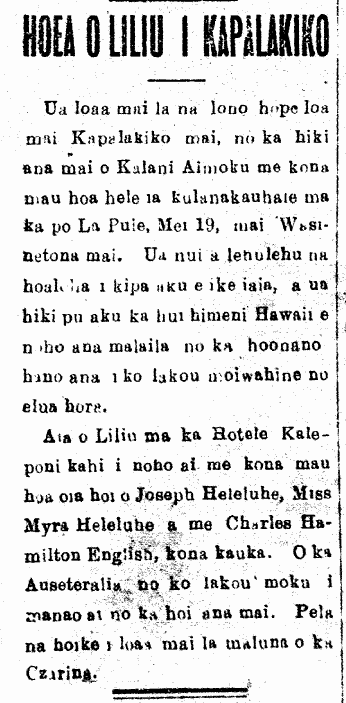
We have received the latest news from San Francisco [Kapalakiko], about the arrival of the Queen and her travelling companions in that city on Sunday, May 19th from Washington. There are many friends who visit to see her, and the Hawaiian singing group living there came to honor their queen for two hours.

Liliu is at the California Hotel with her companions, Joseph Heleluhe; Miss Myra Heleluhe; and Charles Hamilton English, her doctor. They are planning to return home on the Australia. That is what we hear from the Czarina.

(Aloha Aina, 6/2/1900, p. 4)

HOEA O LILIU I KAPALAKIKO

Ke Aloha Aina, Buke VI, Helu 22, Aoao 4. Iune 2, 1900.