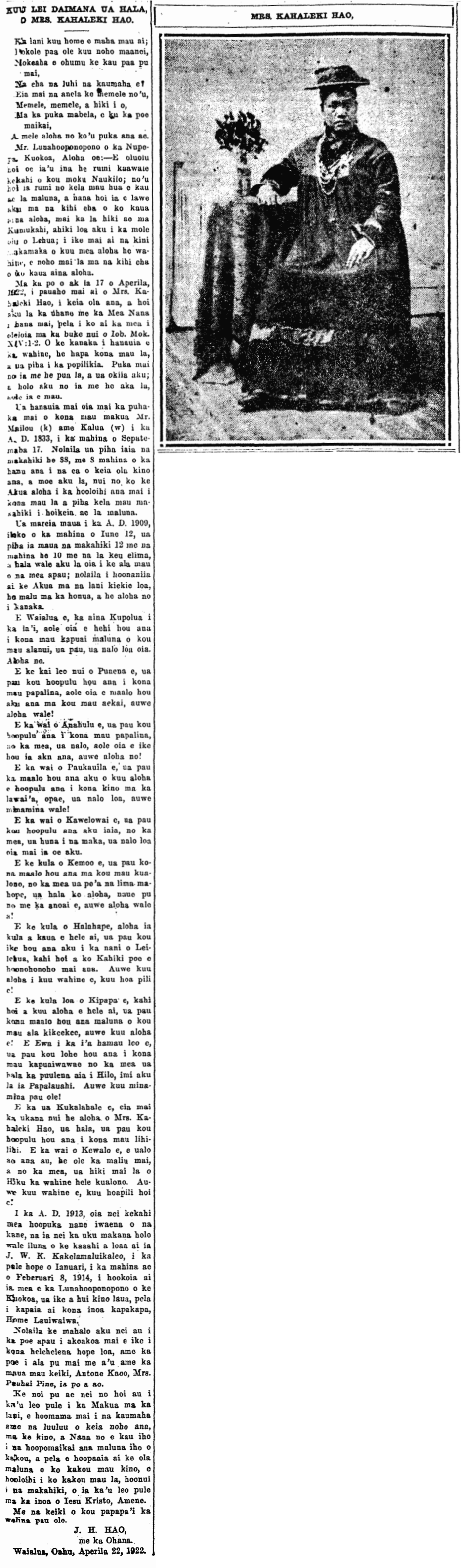
Primo across the sea, 1912.

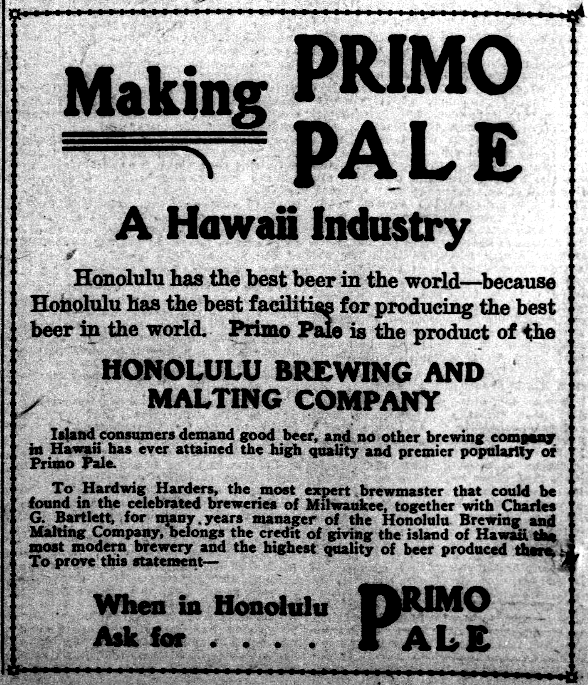
Making PRIMO PALE

A Hawaii Industry

Honolulu has the best beer in the world—because Honolulu has the best facilities for producing the best beer in the world. Primo Pale is the product of the

HONOLULU BREWING AND
MALTING COMPANY

Island consumers demand good beer, and no other brewing company found in the celebrated breweries of Milwaukee, together with Charles G. Bartlett, for many years manager of the Honolulu Brewing and Malting Company, belongs the credit of giving the island of Hawaii this most modern brewery and the highest quality of beer produced there. To prove this statement—

When in Honolulu Aks for… PRIMO PALE

[The issue of the SF Call that this advertisement appears in is the Hawaiian Publicity Edition, sixteen pages of articles and pictures dealing with Hawaii nei.]

(San Francisco Call, 8/14/1912, p. 6)

Making PRIMO PALE

The San Francisco Call, Volume CXII, Number 75, Page 6. August 14, 1912.

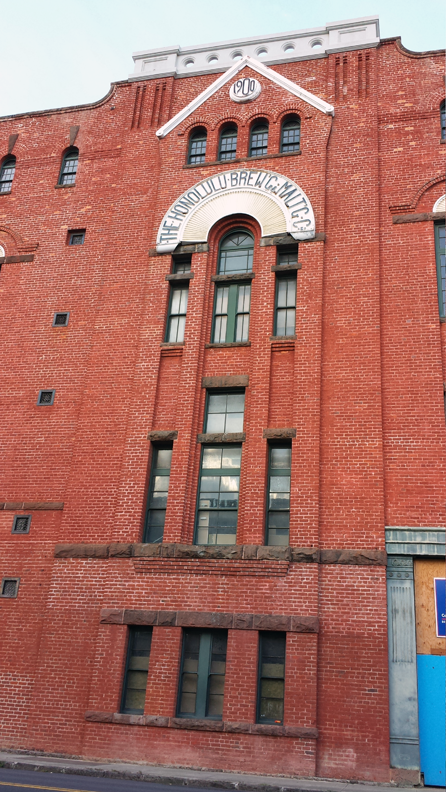
Honolulu Brewing and Malting Company, 1900.

The Brewery

You’ll Drink Until Satiated—The Workers are Rushing So It Can Start Up Soon.

The employees of the “Honolulu Brewing Company” are speedily putting in the finishing touches on the brewery on Queen Street.

This is one of the largest endeavors seen in Honolulu in a long time. There have been many large stone buildings built, and some other structures as well for work related to this brand-new undertaking.

The ice factory is three stories tall, and within the same building will be stored the beer kegs.

There are two bright haole who are assembling the machinery and they believe their work will be completed in the next few weeks.

(Kuokoa, 8/24/1900, p. 5)

KA HALE HANA BIA.

Ka Nupepa Kuokoa, Buke XXXVIII, Helu 32, Aoao 5. Augate 24, 1900.

“Hooheno Keia.” 1891.

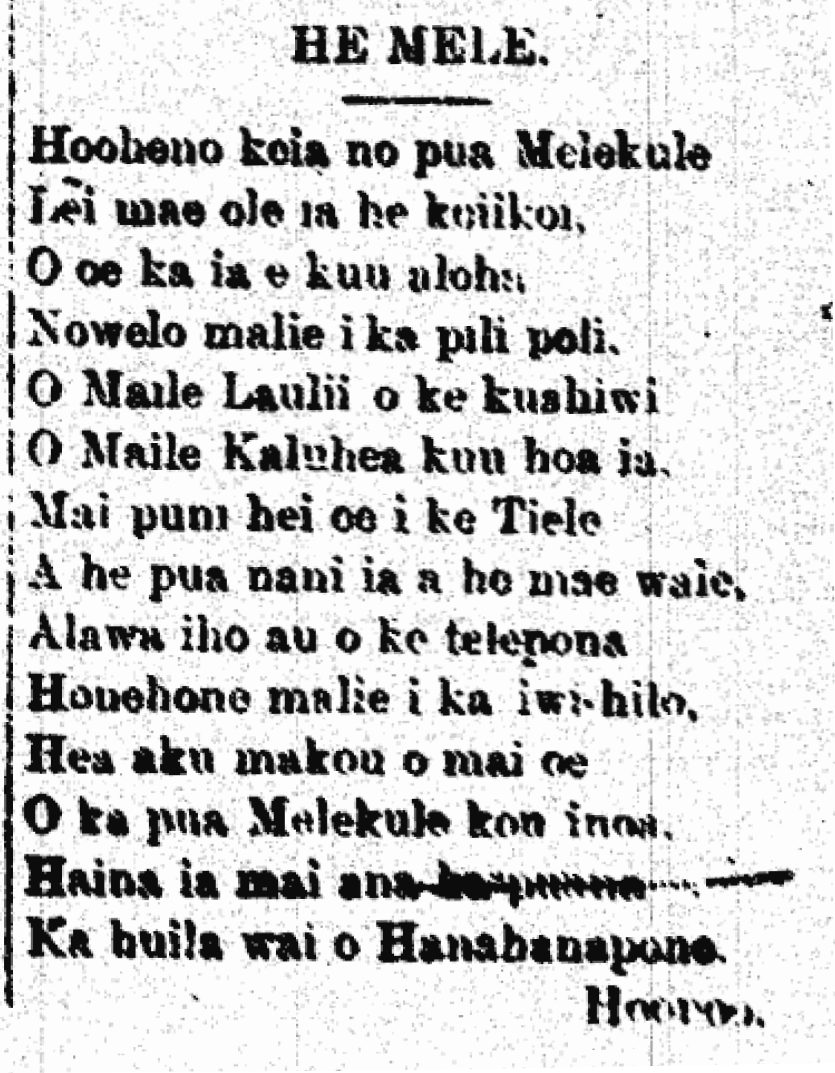
HE MELE.

Hooheno keia no pua Melekule
Lei mae ole ia he koiikoi,
O oe ka ia e kuu aloha
Nowelo malie i ka pili poli
O Maile Laulii o ke kuahiwi
O Maile Kaluhea kuu hoa ia
Mai puni hei oe i ke Tiele
A he pua nani ia a he mae wale
Alawa iho au o ke telepona
Honehone malie i ka iwi-hilo
Hea aku makou o mai oe
O ka pua Melekule kou inoa
Haina ia mai ana ka puana
Ka huila wai o Hanahanapono.

Hoopoo.

[Check out more on this another variant of this mele and its translation by Liliuokalani as well, here on the fascinating and educational Instagram page: http://instagram.com/naneaarmstrongwassel!

Was Hoopoo a pen name for Kalanianaole??]

(Leo o ka Lahui, 11/20/1891, p. 2)

HE MELE.

Ka Leo o ka Lahui, Buke II, Helu 320, Aoao 2. Novemaba 20, 1891.

Moanikeala, 1893.

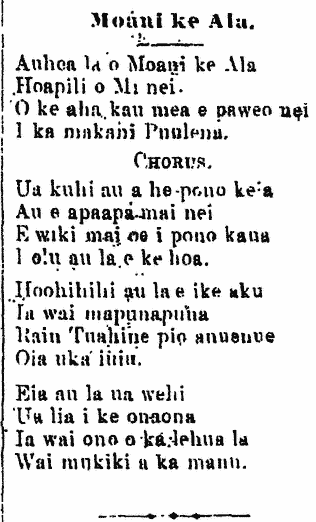
Moani ke Ala.

Auhea la o Moani ke Ala
Hoapili o Mi nei
O ke aha kau mea e paweo nei
I ka makani Puulena.

Chorus.

Ua kuhi au a he pono keia
Au e apaapa mai nei
E wiki mai oe i pono kaua
I olu au la e ke hoa.

Hoohihihi au la e ike aku
Ia wai mapunapuna
Rain Tuahine pio anuenue
Oia uka iuiu.

Eia au la ua wehi
Ua lia i ke onaona
Ia wai ono o ka lehua la
Wai mukiki a ka manu.

[This song credited to Leleiohoku is still often heard today. It would be nice to hear it sung with these lyrics!]

(Lei Momi, 7/5/1893, p. 3)

Moani ke Ala.

Ka Lei Momi, Buke I, Helu 11, Aoao 3. Iulai 5, 1893.

Republicans and Hawaiians, 1902.

TO JOSEPH KALANA

Mr. Editor: Please give me a column in the fearless spokesmen of the lahui.

I am very regretful should you be a true Hawaiian, being that I always see in our newspapers of the mother tongue you announcing to the far and wide of the Archipelago, “Let Us be Republican.”

Do you not know the one who overthrew the monarchy? Do you not know the “head” of those who overthrew the government? Do you not know the desire of the people you support to obliterate us Hawaiians, and that this is verified from Governor Dole’s very own mouth? Do you not know the great desire of the Republicans to limit our voting power which was corroborated by the Governor in Boston by him saying: “We demand that the whites be supported and the native Hawaiians put down.’ ‘Ke kauoha nei makou e kakooia ka poe keokeo a e kulai a kuaia na kanaka Hawaii ilalo.” Continue reading

Sanford B. Dole, the Congregationalists, and Annexation, 1902.

THE HAWAIIAN SITUATION.

On Monday evening, April 28 last, Governor Dole was the guest of the Congregational Club of Boston. Elsewhere in this issue will be found a sketch made by Dole of the Hawaiian situation. It is characteristic of the man. Having the full support of the Administration behind him he is not afraid to say in public what he has been thinking in private for many long years. Let us see and take up his points one by one.

Point No. 1.—”The monarchy was overthrown and annexation was accomplished for the sake of good government for the islands; that is, for their benefit.”—It is true! Annexation was accomplished, by a handful of Congregationalists because the reciprocity treaty between the United States and Hawaii was in imminent danger of being abrogated. The monarchy was overthrown, so as to save the $40 per ton duty on sugar. It was then as it is now for the Congregationalists:—Money before principle.

Point No. 2:—”We have given you everything we have by being annexed.”—That is, Sanford B. Dole, and his Congregationalist friends have given to the United States that which did not belong to them. With the help of an American cruiser, American marines and an American Minister, they have robbed the native Hawaiians of their country so as to enable a few Congregationalist planters to keep up receiving big dividends from their sugar stocks which would have been materially cut down had a $40 duty been imposed upon each ton of sugar. The Springfield Republican adds the following comment to Point No. 2: “But the second point that they have given us all they have is not at all consistent with his first point that they sought Annexation for the benefit of the Islands, and it shows that they are still trying to work the United States for the benefit of the Hawaiians.” Continue reading

Mrs. Kahaleki Hao, Nane-ist, is no more, 1922.

MY LEI OF DIAMONDS, MRS. KAHALEKI HAO, HAS GONE.

Ka lani kuu home e maha mau ai;
Pokole paa ole kuu noho maanei,
Nokeaha e ohumu ke kau paa pu mai,
Na eha na luhi na kaumaha e?
Eia mai na anela ke memele no’u
Memele, memele, a hiki i o,
Ma ka puka mabela, e ku ka poe maikai,
A mele aloha no ko’u puka ana ae.¹

Mr. Editor, Aloha oe:—Please should there be space on your ship the Nautilus,² allow me space for the words placed above, and may the ship take them to the four corners of our beloved land, from the rising sun at Kumukahi all the way to the pleasant base of Lehua; so that the many friends of my beloved wife, who live across the four corner of our aina aloha may know.

On the night of the 17th of April, 1922, Mrs. Kahaleki Hao grew weary of this life, and her soul returned to the One who made it, and fulfilled was the words in Job XIV:1–2. O ke kanaka i hanauia e ka wahine, he hapa kona mau la, a ua piha i ka popilikia. Puka mai no ia me he pua la, a ua okiia aku; a holo aku no ia me he aka la, aole ia e mau.

She was born from the loins of her parents Mr. Mailou (m) and Kalua (f) in 1833, in the month of September 17. Therefore, it was after 88 years and 8 months of breathing the air of this worldly life that she took her sleep; God’s love was great indeed in extending her days for that many years mentioned above.

We were wed in 1909, in the month of June 12, and we were married for 12 years and 10 months and a number of days when she left on that path all must take; and so blessed be God in the high heavens, peace on earth, goodwill toward men.

O Waialua, land fragrant in the calm, her feet will no more tread upon your pathways, no more, she is gone. Aloha no.

O Roaring sea of Puaena, no more will you moisten her cheeks, she will no longer pass along your shores, auwe aloha wale!

O Waters of Anahulu, no more will you moisten her cheeks, for she has gone, and she will not be seen again, auwe aloha ino!

O Waters of Paukauila, my beloved will never again pass by to moisten her body fishing for opae, she has gone forever, auwe, how very regrettable!

O Waters of Kawelowai, you will no more moisten her, for her face is now hidden and she is lost to you forever.

O Plains of Kemoo, she will no more pass by your ridges, for her hands are crossed behind her back, my beloved has gone, she moved along with acknowledgement, auwe, so much aloha!

O Plains of Halahape, aloha to those plains that we traveled; you will no longer see the beauty of Leilehua, where the people of foreign lands are stationed. Auwe my aloha for my dear wife, my close companion!

O Wide expanse of Kipapa, where my beloved went; she will pass no more upon your meandering roads; auwe my love! O Ewa of the fish requiring silence, you will no more hear her footsteps, for the Puulena wind has gone off to Hilo in search of Papalauahi. Auwe for my endless regret!

O Kukalahale rain, here is important news of love, Mrs. Kahaleki Hao has gone; you will no more moisten her lashes. O Waters of Kewalo, I call out without being heard, for Hiku, the woman who travels on the ridges has arrived. Auwe, my wife, my close companion!

In the year 1913, she was one of those who published nane alongside the men, and it was she who sponsored the prize which traveled on the steam engine in the last week of January, and was caught by J. W. K. Kakelamaluikaleo the next month, on February 8, 1914; this was conducted by the Editor of the Kuokoa, and they met face to face, and that is why she is called by the pen name, Home Lauiwaiwa.

And so I give my appreciation to all those who gathered to see her last countenance, and those who stayed up with me and my children Antone Kaoo, Mrs. Puahai Pine, that night and day.

I also beseech in my prayer to the Father in heaven to lighten the burdens and sadnesses of this life in body, and it is He who will give blessings upon us, and and such gives life to our bodies, extending our days, and prolonging our years; that is my prayer in the name of Jesus Christ, Amen.

My endless regards to the boys of your press.

J. H. HAO,

and Family.

Waialua, Oahu, April 22, 1922.

[You will never know what you can find in death announcements. The mention of Kahaleiki Hao being a woman nane artist associated with the identity “Home Lauiwaiwa” was an exciting find. Most of the riddles in the newspapers were signed with pen names, and only a few of their actual identities are known today.]

¹Number 585, “My home is in heaven, my rest is not here.” Found in Lyons, Lorenzo, ed. Buke Himeni Hawaii. New York: Ko Amerika Ahahui Teraka, 1872.

²From the time Jules Verne’s “Twenty Thousand Leagues Under the Sea” was translated into Hawaiian and published in the Kuokoa (12/18/1875–3/30/1878), various motifs from the story were incorporated in Hawaiian writing.

(Kuokoa, 4/28/1922, p. 3)
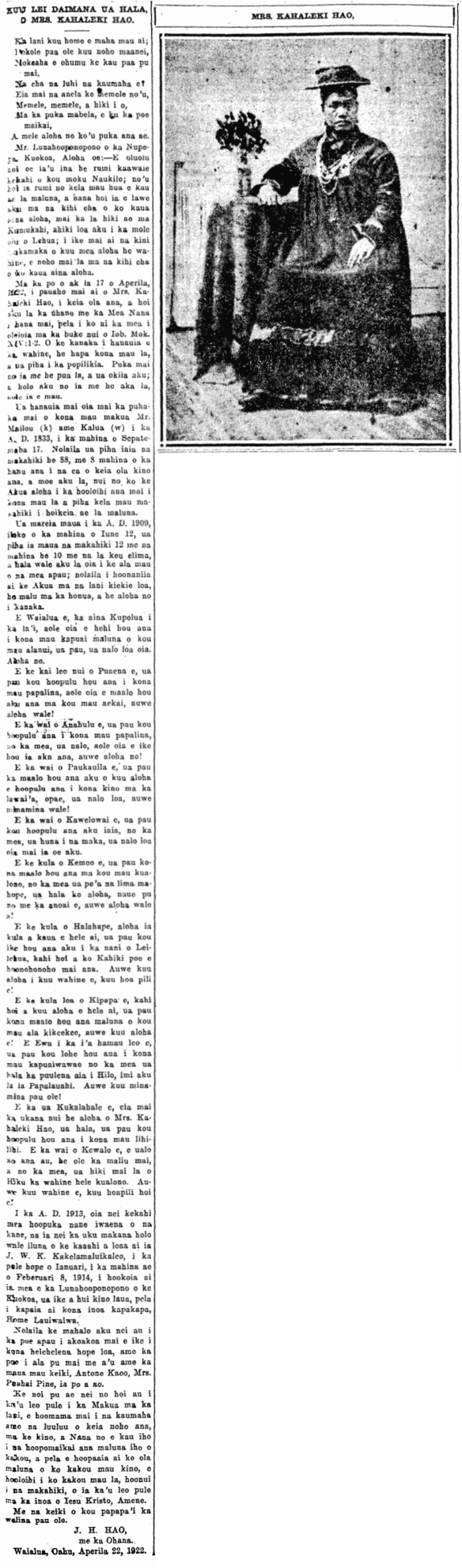
KUU LEI DAIMANA UA HALA, O MRS. KAHALEKI HAO.

Ka Nupepa Kuokoa, Buke LXI, Helu 17, Aoao 3. Aperila 28, 1922.

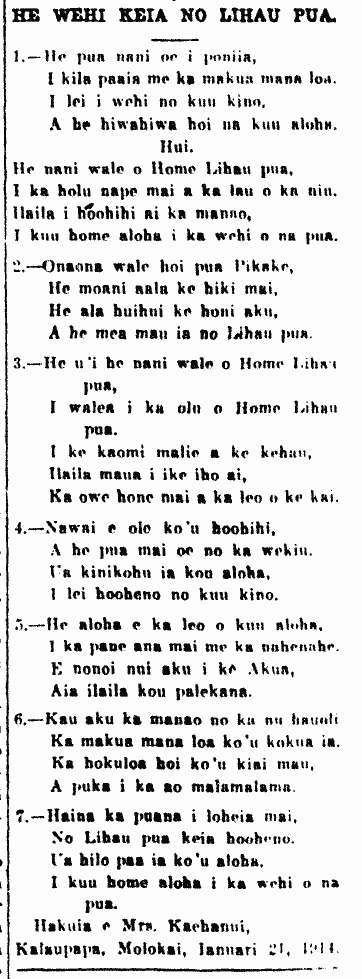
A sweet mele for Home Lihau Pua, 1914.

HE WEHI KEIA NO LIHAU PUA.

1.—He pua nani oe i poniia,
I kila paaia me ka makua mana loa,
I lei i wehi no kuu kino,
A he hiwahiwa hoi na kuu aloha.

Hui.

He nani wale o Home Lihau pua,
I ka holu nape mai a ka lau o ka niu,
Ilaila i hoohihi ai ka manao,
I kuu home aloha i ka wehi o na pua.

2.—Onaona wale hoi pua Pikake,
He moani aala ke hiki mai,
He ala huihui ke honi aku,
A he mea mau ia no Lihau pua.

3.—He u’i he nani wale o Home Lihau pua,
I walea i ka olu a Home Lihau pua,
I ke kaomi malie a ke kehau,
Ilaila maua ike iho ai,
Ka owe hone mai a ka leo o ke kai.

4.—Nawai e ole ko’u hoohihi,
A he pua mai oe no ka wekiu,
Ua kinikohu ia kou aloha,
I lei hooheno no kuu kino.

5.—He aloha e ka leo o kuu aloha,
I ka pane ana mai me ka nahenahe,
E nonoi nui aku i ke Akua,
Aia ilaila kou palekana.

6.—Kau aku ka manao no ka nu hauoli,
Ka makua mana loa ko’u kokua ia,
Ka hokuloa hoi ko’u kiai mau,
A puka i ka ao malamalama.

7.—Haina ka puana i loheia mai,
No Lihau pua keia hooheno,
Ua hilo paa ia ko’u aloha,
I kuu home aloha i ka wehi o na pua.

Hakuia e Mrs. Kaehanui,

Kalaupapa, Molokai, Ianuari 21, 1914.

[Does anyone know where Home Lihau Pua is? Might it be someone’s home in Kalaupapa itself, or a home that Mrs. Kaehanui left to go to Kalaupapa?]

(Kuokoa, 2/13/1914, p. 5)

HE WEHI KEIA NO LIHAU PUA.

Ka Nupepa Kuokoa, Buke LII, Helu 7, Aoao 5. Feberuari 13, 1914.

Republican candidates for Maui, 1904.

REPUBLICAN TICKET ON MAUI ISLE

HON. PHILIP PALI OF LAHAINA.

MOSES K. NAKUINA OF MOLOKAI.

W. J. COELHO OF WAILUKU.

GEORGE COPP.

A. N. HAYSELDEN, NOMINEE FOR SENATOR.

HON. W. P. HAIA OF HANA.

JOHN KALINO OF HAMAKUAPOKO.

(Hawaiian Gazette, 9/23/1904, p. 5)

REPUBLICAN TICKET ON MAUI ISLE

Hawaiian Gazette, Volume XXXIX, Number 77, Page 5. September 23, 1904.