The birthday of Pauahi, 1901.

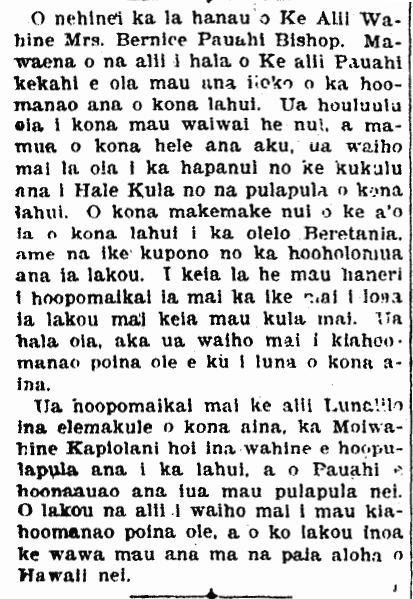
Yesterday was the birthday of The Chiefess Mrs. Bernice Pauahi Bishop. Amongst the alii who passed on, Ke alii Pauahi is one who lives on in the minds of her lahui. She accumulated her great wealth and before her passing, she left most of it to build a School for the children of her people. Her strong desire was that her lahui be taught English and the proper knowledge for them to progress. Today there has been hundreds who have benefited from the knowledge they gained from these schools. She has gone on but left an unforgettable monument standing upon her land.

Lunalilo blessed the old people of his aina; Queen Kapiolani, the women who are increasing the race; Pauahi, educates those children. Those are the alii who left enduring monuments; and their names shall forever reverberate against the beloved walls of Hawaii nei.

(Kuokoa, 12/20/1901, p. 2)
O nehinei ka la hanau o Ke Alii Wahine Mrs. Bernice Pauahi Bishop...

Ka Nupepa Kuokoa, Buke XXXIX, Helu 25, Aoao 2. Dekemaba 20, 1901.

Birthday of Mrs. A. Pauahi Bishop, 1869.

[Found under: “NU HOU KULOKO: Oahu.”]

Birthday of the Alii Pauahi.—On the 20th of December, a party was held at Koholaloa, to celebrate the birthday of one of our young chiefs, that being the Honorable Mrs. A. Pauahi Bishop, recognizing her reaching thirty-eight years old. This past 19th was a Sunday and was her actual birthday, but because it fell on a Sunday, it was not observed. It was left until the following Monday. The lanai where the party was held was honored by the arrival of the Governess of Hawaii [Keelikolani], the Hon. Mrs. L. Kamakaeha, Mrs. L. Kaaniau [Kekaaniau], and the other dignitary women of this town. Later that night, the chiefess whose birthday it was was entertained at her home, relying on Pauli, Malo, Kapoli, and Wakeki, who sang some name songs for that alii. They were appreciated for their singing.

(Kuokoa, 12/25/1869, p. 2)

La Hanau o Pauahi Alii.

Ka Nupepa Kuokoa, Buke VIII, Helu 51, Aoao 2. Dekemaba 25, 1869.

Death of Abner Kuhooheiheipahu Paki, 1855.

The death of A. Paki, on the 13th of this June.

The chief A. Paki. He appears in the genealogy of the Chiefs of this Nation, from ancient times, and he is a high Chief of this land descended from Haloa, that being the one father of the children living in this world, and the father of our people.

Part of his genealogy is taken from the High Chiefs of the land, and he is part of Kamehameha’s, and he is part of Kiwalao’s, and he is a hereditary chief of a single line from ancient times; and he was a father who rescued from trouble his people of this nation from Hawaii to Kauai.

His accomplishments during his life. When he promised to stop drinking and to become a Christian, from that time on he did not drink alcohol again until the day he died.

He was a Chief who was steadfast in his work for the nation, and he was an Alii who would be furious when he heard his deceased child being spoken ill of, as well as of his children who survive him.

From what I have seen of this Alii while he was alive. In the year 1837, he began his governmental work, and at one point he was appointed Chief Justice [L. K. Kiekie] of the country, and at another point he served as Governor, and another time he was included in the Privy Council, and still another time he was the steward for his child, this during his lifetime. Continue reading

Konia’s kanikau for Paki, 1855.

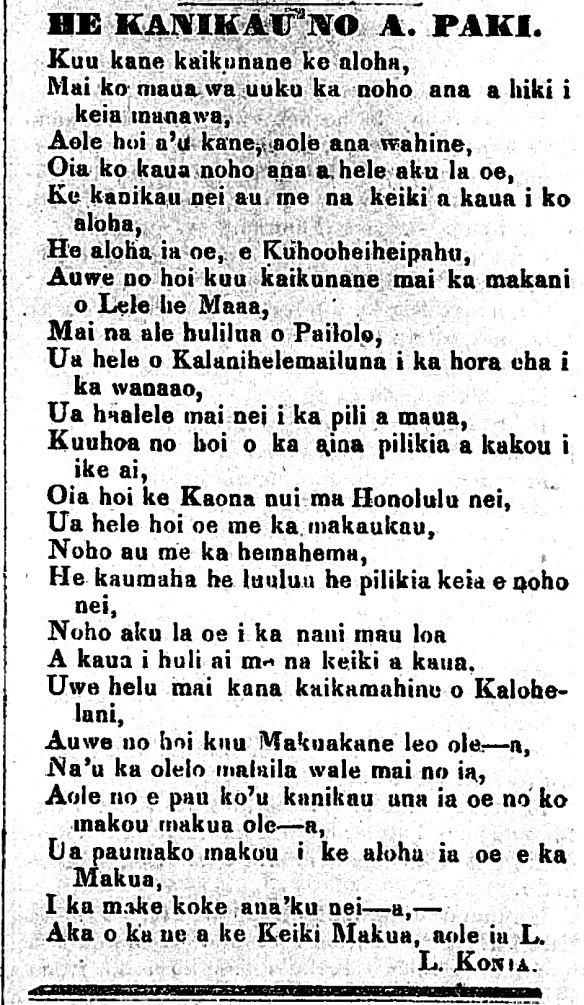
HE KANIKAU NO A. PAKI.

Kuu kane kaikunane ke aloha,
Mai ko maua wa uuku ka noho ana a hiki i keia manawa,
Aole hoi a’u kane, aole ana wahine,
Oia ko kaua noho ana a hele aku la oe,
Ke kanikau nei au me na keiki a kaua i ko aloha,
He aloha ia oe, e Kuhooheiheipahu,
Auwe no hoi kuu kaikunane mai ka makani o Lele he Maaa,
Mai na ale hulilua o Pailolo,
Ua hele o Kalanihelemailuna i ka hora eha i ka wanaao,
Ua haalele mai nei i ka pili a maua,
Kuu hoa no hoi o ka aina pilikia a kakou i ike ai,
Oia hoi ke Kaona nui ma Honolulu nei,
Ua hele hoi oe me ka makaukau,
Noho au me ka hemahema,
He kaumaha he luuluu he pilikia keia e noho nei,
Noho aku la oe i ka nani mau loa,
A kaua i huli ai me na keiki a kaua,
Uwe helu mai kana kaikamahine o Kalohelani,
Auwe no hoi kuu Makuakane leo ole—a,
Na’u ka olelo malaila wale mai no ia,
Aole no e pau ko’u kanikau ana ia oe no ko makou makua ole—a,
Ua paumako makou i ke aloha ia oe e ka Makua,
I ka make koke ana’ku nei—a,—
Aka o ka ne a ke Keiki Makua, aole ia L.

L. Konia.

(Elele E, 6/16/1855, p. 20)

HE KANIKAU NO A. PAKI.

Ka Elele E, Buke 10, Aoao 20. Iune 16, 1855.

Funeral of Konia, 1857.

The Funeral of Konia.

The obsequies of the late chiefess Konia were performed on Tuesday, and notwithstanding the sickness which has been so general prevented numbers of persons from attending, the aggregate of those collected to show their respect on the occasion was very large, whilst the crowd that thronged both sides of the streets, as the procession moved along, was so great as to require a strong force to preserve the line of march from the late residence of the deceased lady to the Royal cemetery, in which the coffin was placed. The religious services were performed by the Rev. Mr. Clark, and the ceremony was conducted throughout with a decorum and feeling which was remarked by all present.

(Polynesian, 8/8/1857, p. 108)

The Funeral of Konia.

The Polynesian, Volume XIV, Number 14, Page 108. August 8, 1857.

Death of Laura Kanaholo Konia, 1857.

On this past 2nd, L. Konia, the widow of A. Paki, died at 50 years of age. She was an alii nui, and was a child of Kaoleioku, and Kalaniopuu was the father of Kaoleioku, an actual cousin of the father of Kamehameha I. Konia was a loving chiefess, and her friends and all the people of this archipelago are very saddened for there is no high chiefess in this land remaining; they have all gone. Her friends weep with greatly pained hearts.

(Hae Hawaii, 7/15/1857, p. 62)

I ka la 2 iho nei...

Ka Hae Hawaii, Buke 2, Ano Hou—-Helu 16, Aoao 62. Iulai 15, 1857.

Hawaiian News Company, 1915.

Music and Holidays

We always remember those two things. Luau parties days without musical instruments are lifeless [malohaha] days.

We have the famous Phonographs [Pahuolelo] of EDISON just right for your pocketbooks, with this instrument, you can supply your home with the great music of this world.

Also with guitars, ukulele, and small stringed instruments, etc.

We want to show your the newest sheet music [pepamele]. Come see us.

Hawaiian News Co., Ltd.

In the Young Building [Hale Young]

We sell the famous Hawaiian Songs.

(Kuokoa, 12/17/1915, p. 3)

Na Mele Me Na La Kulaia

Ka Nupepa Kuokoa, Buke LIII, Helu 51, Aoao 3. Dekemaba 17, 1915.

On the moving of the Na-ha Stone to Hilo Library 100 years ago, and its history (6 of 6), 1915.

….all of the districts from Hawaii all the day to Kauai, however, if Naha is shook and removed by you today from where it lies, it will be the removing of binds that secure the Districts. You will then live; your people will live; and I too will live, the Kahuna.

When the Prophetess Kalaniwahine was done speaking, it was at that point that Kamehameha traced his strong hands upon the good places to grab on to the stone, and then Kamehameha made ready to attempt to move the Naha Stone; the eyes of the all the people were fixed on him. When the hands of Kamehameha were locked onto the sides of the stone, Kamehameha spoke these words of prayer. “E! You are a Naha, the Alii who frees your kapu is a Naha Chief, and I am a Niaupio, the arching smoke of the forest. [??? E! He Na-ha oe, he Na-ha hoi ke Alii e noa ai kou kapu, a he Niau-pio hoi wau, a he uwahi pio i ka wao laau.]”

That was when Paiea pried the stone with amazing strength, and that Pohaku Alii did indeed move, and then the people surrounding the place where Kamehameha was moving the Naha Stone felt a rumbling of the land there, and some actually thought an earthquake was assisting Kamehameha. The Alii and Makaainana truly saw the moving of the Sacred Pohaku of the Naha Alii Line, and that it was shook by the amazing strength of Kalaninui Kamehameha. They realized the earlier words of the Prophetess Kalaniwahine came true, and some Alii immediately knew that this young Chief would become the person to shake the Islands of this Archipelago. This moving of the Naha Stone became something to always to encourage Kamehameha thereafter, and during heated battles on the battlefields to come, the moving and overturning of the Naha Stone was always in the fore of Kamehameha’s memories, and it was something that always bolstered his thoughts thereafter. Continue reading

On the moving of the Na-ha Stone to Hilo Library 100 years ago, and its history (5 of 6), 1915.

THE STORY OF THE NA-HA STONE

(Conclusion)

In the morning of another day, when the rays of the beautiful sun shone on Kumukahi and warmed the cold and damp earth, this young Chief of the Apaapaa winds of Kohala woke, and before taking the morning meal, they prepared for their journey to see the Naha Stone, and this journey of Kamehameha to see it was accompanied by the Chiefs of Hilo. The Chiefly Mother of the Chiefs, Ululani, also was in accompaniment, as well as her court and many of Hilo’s dignitaries. Amongst these going with the malihini Chief was Kalaniwahine, the Royal Prophet, who was escorting her hanai Chief who travelled across the sea along with her. This Prophetess was the one who instructed Kamehameha to go to Hilo to meet with his piko, the Alii in the line of High Naha Chiefs, that being Keaweokahikona, the strongest one known in those days. On this procession of Kamehameha to see the Naha Stone, Keaweokahikona also was accompanying his Chiefly Cousin, but he did not believe in the ability of Kamehameha to move the Naha Stone for it was a kapu stone of the Alii Class who had the Naha Kapu and the other lines of Alii had no rights to it; and it was this Keaweokahikona who was the only one known of who could move this Royal Pohaku.

At this time when Kamehameha folks were on the move, the Chiefly Mother of theirs spoke to him with these words: Continue reading

Naha Stone to be moved, 1916.

NA-HA STONE TO BE SKIDDED ON GIANT ROLLERS

(Special Star-Bulletin Correspondence)

HILO, March 10.—At last preparations are being made for the conveying of the famous Na-ha stone fro the John Scott property to the site selected for it on the Hilo library lot. The big stone, which must weigh several tons, is to be brought down on rollers, as it is too heavy and cumbersome to handle by motor-truck or any other kind of vehicle.

Big rollers have been procured, and they will be placed under the stone in such a way that the rock can be slid down from its present resting place to the desired location, where it will be so placed that tourists and town folk can inspect it at their leisure.A plate will be attached to the stone and on it the legend in connection with the wanderings of the historic relic will be set forth.

The stone originally came from Kauai where it was used in certain religious ceremonies after the birth of a child of high degree. The legend has it that the first Kamehameha rolled the stone over after a terrific struggle in which he used so much strength that the blood burst from his eyes.

(Star Bulletin, 3/14/1916, p. 14)

NA-HA STONE TO BE SKIDDED ON GIANT ROLLERS

Honolulu Star-Bulletin, Volume XXIII, Number 7463, Page 14. March 14, 1916.