On the moving of the Na-ha Stone to Hilo Library 100 years ago, and its history (4 of 6), 1915.

As soon as Ululani heard these words of her children, she exited the house, and soon saw Kamehameha approaching, and that is when Ululani began a wailing call of love [uwe helu] and then she also called out the name song for Kamehameha with these words:

Au—we hoi—e, he mai hoi paha,
O oe ka ia e Kalaninuilanimehameha—a,
E hea aku ana i ka Iwa kiloulou moku la,
E komo e kuu Laninui hoi—a,
Ao i wehewehena ao i waihona—e,
Kona po o ka hoa keia—la,
A’u lei o ka ua haao hoi—e,
E lele ae la mauka o Auaulele—a,
E komo hoi paha i ka hale o Kealohalani—e,
Auau i ke kiowai kapu o Ponahakeone,
Ae inu hoi i ka awa a Kane i kanu ai i Hawaii,
A ola hoi ke kini o ke akua ia oe,
He mai hoi e kuu Laninuimehameha—a.

[Ah indeed, do come,
Might it be you, O Kalaninuilanimehameha?
I call out to the island-hooking Frigate bird,
Come in, my Heavenly Chief,
The day opens, the day closes,
In his night, this is the companion,
My lei of the Haao rains,
Soaring in the uplands of Auaulele,
Entering the home of Kealohalani,
Bathing in the sacred pool of Ponahakeone,
Drinking the awa which Kane planted in Hawaii,
The multitudes of the gods will live through you,
Come, my dear Laninuimehameha.] Continue reading

Name chant for Kamehameha V, 1868.

HE INOA NO KAMEHAMEHA V.

Kalaninui Kapuaiwa i ke kapu he inoa,
He kua kapu oe no Waialii kukai kapu na Lono,
O Lono o ke kai maeleha kapu ka leo i Kolea la,
Ka Ewauli o Laakona ke’lii nona ia kua—e,
Hanohano Lahaina i ka ua Nalina,
Ke kipu mai la i na kahawai,
O ka omaka o ka wai ke iho la i kai,
Ilina opala aku la kai o Hauola,
I ka hoonuua ia e ka makani Malanai,
He noe ke kino oia makani ke pa mai,
Ulu iho la maha pepe ka lau o ka maia,
Ana ole i ka hookinaia e ke kaao—e,
Ua—i—I aku la oe iaia nei—e.

Ike iho la oe he mea pono ia,
Heaha ka mea i lawelawe ole iho ai ka lima,
I koho kau nana iaia—e,
Ua i—I aku la oe iaia nei—e.

Kau ka hae o Lele i ka pohu,
Me he ia moku i ka malie,
Kauilani i ka makani Ma—aa,
E honi ana i ke Kakaalani,
Kii Kaunuloa powa i ka pohu,
Nana’ku oe o na lehua o Lihau,
Ua maeele i ka ua ia e ka ua,
Opili Kahili maeele i ke anu—e,
Ua i—I aku la oe iaia nei—e.

He anu no ko’u noho nei,
Ina e mehana moe iho la hoi,
Ua i—I aku la oe iaia nei—e,
Ua i—I aku la oe iaia nei—e.

S. KANAE.

Kalaninui Kapuaiwa i ke kapu he inoa,
Ke kua e o i ko olua kua no,
Opu no oukou a i ekolu,
Ka ihea lepo iluna o Iolani,
O ka lani koe iluna lilo,
Ke ‘lii nona ia kua—e,
Hana i ka lani ke kiowai,
He kiowai ua no Kulanihakoi,
I hanini mai pulu ke kahawai,
Helelei piha ke kahawai o ka honua,
E hana ino ana i ka lai o Lele,
Hone ka Maaa a pepehi i ke Kaomi,
Hoi e moe i Kauamakaupili—e,
Ua i—I aku la oe iaia nei—e.

Oia nei ke hoa he alapahi ke ano,
He nolunolu olelo i kahi alii,
I hewa mai ai ke kahu o ka moe—e,
Ua i—I aku la oe iaia nei—e.

Moe e no Puna lolii i ka makani,
Hooio i na lei lehua a Kamoani,
Hukihuki hele i ke kai o Punahoa,
Hahihahi ku i ke one o Paikaka,
Kaka kahela na lima o Mokaulele,
E apo ana i paa Omaolala,
O lilo e aku i ka ua nahunahu,
O Konohiki lau aku i ka Luaopele—e,
Ua i—I aku la oe iaia nei—e.

He pele ia nei he mea a loa,
Hookahi no mea i pio ai o Kamapuaa,
I ka haunuu haulani a Kama i ka eku—e,
Ua i—I aku la oe iaia nei—e,
Ua i—I aku la oe iaia nei—e.

KAPOLI HAWANAWANA.

[There is one oki of this mele found in the 5/28/1868 issue of Au Okoa by Kekuanaoa, one in the 6/18/1868 issue without an attribution, one in the 7/23/1868 issue by Kamehameha III; three in the 7/30/1868 issue, one by Kalama, one by Kaomi, and the other by Liliha. There are also many issues that are missing for this newspaper, and who knows what treasures might be found once copies of those issues are found!]

(Au Okoa, 9/24/1868, p. 1)
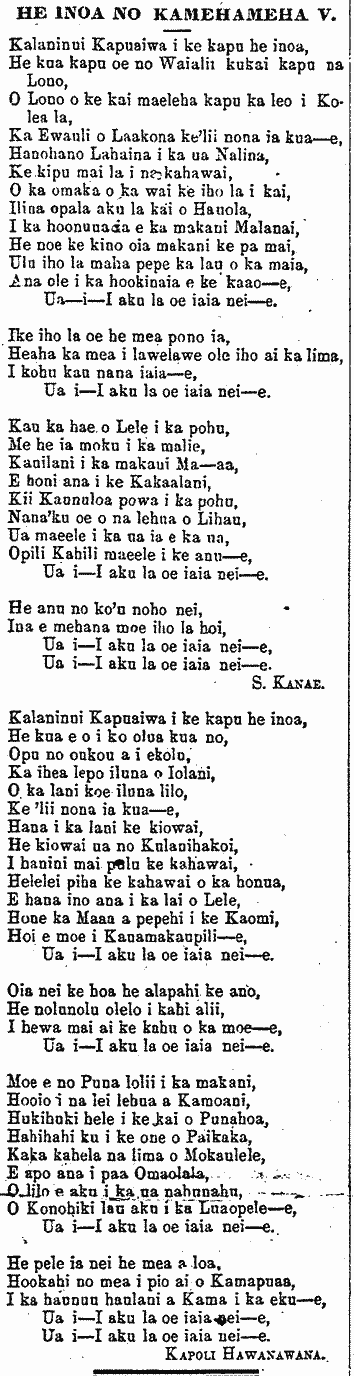
HE INOA NO KAMEHAMEHA V.

Ke Au Okoa, Buke IV, Helu 23, Aoao 1. Sepatemaba 24, 1868.

Kamehameha V’s birthday and an opportunist, 1871.

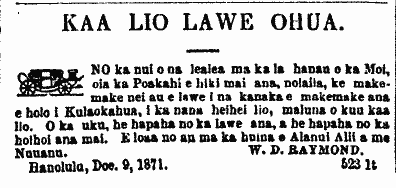
PASSENGER HORSE CARRIAGE.

In response to the many entertainments on the birthday of the King, that being this coming Monday, I therefore want to take those who want to go to Kulaokahua to watch the horse races, on my horse carriage. The fare is a quarter to go and a quarter to return. Find me at the corner of King Street and Nuuanu Avenue.  W. D. RAYMOND.

Honolulu, Dec. 9, 1871.

(Kuokoa, 12/9/1871, p. 3)

KAA LIO LAWE OHUA.

Ka Nupepa Kuokoa, Buke X, Helu 49, Aoao 3. Dekemaba 9, 1871.

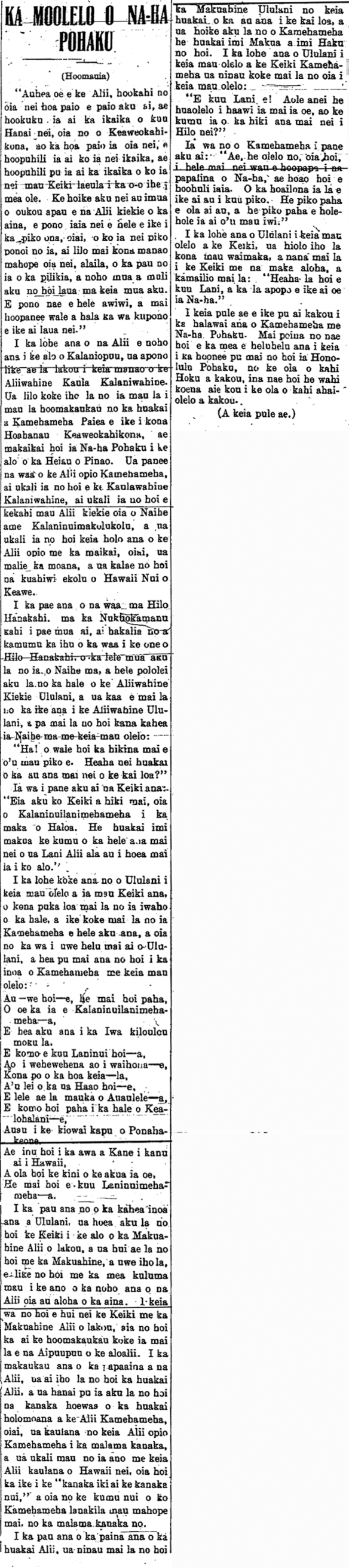
On the moving of the Na-ha Stone to Hilo Library 100 years ago, and its history (3 of 6), 1915.

THE STORY OF THE NA-HA STONE

(Continued)

“Hear me, O Alii; he has but one opponent to fight where the strength of this hanai of mine will be challenged, that is Keaweokahikona, and this is his one opponent that will thwart his strength, and who will also thwart the strength of his young experts in spear throwing, making it into nothing. I say before you all, O high Chiefs of the land, he must go see this relative of his, for he [Keaweokahikona] is his own blood relative [piko], and should he [Keaweokahikona] decide to follow him, then there will be no more difficulties and they will live as leader and follower from here forth. But he must go quickly and not put it off until the time they should meet has past.

When the alii living in the court of Kalaniopuu heard this, they all approved of this idea of this Prophet Chiefess Kalaniwahine. The days were soon spent preparing for the journey of Kamehameha Paiea to see his cousin Keaweokahikona, and to visit the Naha Stone in the front of Pinao Heiau. The canoes of the young chief Kamehameha were set forth, and they were escorted by a number of high chiefs, they being Naihe and Kalaninuimakolukolu, and these travels of the young chief was accompanied by grace with the seas being calm and the three mountains of Great Hawaii of Keawe were clear.

When the canoes landed at Hilo Hanakahi, they first came ashore at Nukuokamanu [Kanukuokamanu], and as soon as the prow of the canoe rumbled against the sand of Hilo Hanakahi, Naihe folks disembarked first and headed straight for the house of the High Chiefess Ululani; the news had reached the Chiefess Ululani in advance and she called out to Naihe with these words:

“Ha! Hey, my relatives have arrived. What is the reason for your taking this trip across the wide sea?”

At this time her children responded: “Your child is arriving, that is Kalaninuilanimehamehaikamakaohaloa. This is a voyage of that Heavenly Chief to seek a mother, and that is why I appear before you.”

(Hoku o Hawaii, 12/16/1915, p. 2)

KA MOOLELO O NA-HA POHAKU

Ka Hoku o Hawaii, Buke 10, Helu 28, Aoao 2. Dekemaba 16, 1915.

On the moving of the Na-ha Stone to Hilo Library 100 years ago, and its history (2 of 6), 1915.

…the bitter words of Keawemauhili for his charge, Naeole gathered the young leaves of the bitter gourd [ipu awaawa] and broiled them until cooked, and fed them to Kamehameha as if it were young taro leaves,  and it is said that Naeole did this so that the biting and bitter words of Keawemauhili for his charge were neutralized, and those words spoken were those famous words of Hawaii nei of the olden days. “Nip the bud of the wauke while still young.” [“E o-u ka maka o ka wauke oi opiopio.”]

When Kamehameha grew older, and his own father, Keouanui, died, believed to have “been fed a cup of koheoheo by Alapainui here in Hilo,” [“hanai apu koheoheo ia e Alapainui ma Hilo nei,”] that is given poison in his food; Kalaniopuu, Keoua’s elder brother, was in the district of Kau, but moved forth to war with Alapainui, and war was fought where Kalaniopuu retreated. Afterwards war was waged upon the Son of Alapainui, and he died near Kawaihae, and all of Hawaii Island became ruled by Kalaniopuu. Continue reading

On the moving of the Na-ha Stone to Hilo Library 100 years ago, and its history (1 of 6), 1915.

THE STORY OF THE NA-HA STONE

These passing days, the Board of Trade of Hilo [Papa o ka Hui Kalepa o Hilo] is considering moving the Naha Stone [Na-ha Pohaku] from where it now is placed and putting it by the Library of the Hilo Town, and the Editor of the Hoku o Hawaii [S. L. Desha] was asked to tell of some things pertaining to this Royal Stone, and which were contained in the old history of this land, and that will become something for the Natives of this land to understand things about the history of this Birth Stone of the Alii of the Naha Class.

The Naha Stone spoken of in this story is the great Pohaku that is lies in Piihonua in Hilo Town on the Hilo side of Waianuenue Avenue, and is in front of the first house foundation of Governor Kipi of Hilo, and that place is named after an old Heiau called “Pinao.”

In the history of this Royal Stone, it is said that the Pohaku was brought from the Wailua River on Kauai, and it was brought upon double-hulled canoes, and it was brought by a high Chief of long ago named MAKALIINUIKUAKAWALE (m), and this pohaku was brought as a sign of chiefly births and this Pohaku Alii was placed before the Pinao Heiau. Continue reading

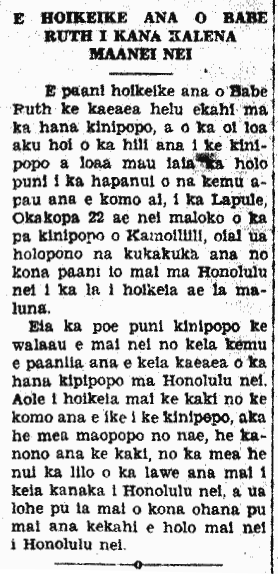
Babe Ruth at the Honolulu Stadium, 1933.

BABE RUTH WILL EXHIBIT HIS TALENTS HERE

Babe Ruth, the foremost champion at baseball, and the greatest batter, constantly making homeruns in a majority of the games he is in, will play in an exhibition on this coming Sunday, October 22 at the ball field of Kamoiliili, being that the negotiations for his actually playing here in Honolulu on the day shown above went well.

The people who are into baseball are talking about this game to be played by this baseball champ in Honolulu nei. The price [kaki] for entrance to see the game has not been announced, but it is certain that the fee will be a blow [kanono], because the expense to bring this man here to Honolulu is great, and we hear that his family will be coming to Honolulu as well.

(Alakai o Hawaii, 10/19/1933, p. 4)

E HOIKEIKE ANA O BABE RUTH I KANA KALENA MAANEI NEI

Ke Alakai o Hawaii, Buke 6, Helu 25, Aoao 4. Okatoba 19, 1933.

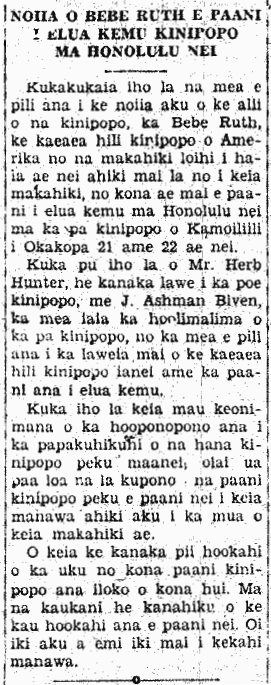
Bebe Ruth in Hawaii, 1933.

BABE RUTH ASKED TO PLAY TO BALL GAMES HERE IN HONOLULU

There recently were discussions pertaining to the asking of the king of baseball, Babe Ruth [Bebe Ruth], the champion batter of America for many years in the past until this year, to get him to agree to play two games here in Honolulu at the Kamoiliili ball field this upcoming October 21 and 22.

Mr. Herb Hunter, a ball player promoter, spoke with J. Ashman Biven [J. Ashman Beaven], the one who leases out the ball field, about bringing the champion batter here and playing two games [kemu].

These two gentlemen recently spoke to work out the football game schedule since all the days good for football games are booked from now until the beginning of next year.

This is the highest paid player on his team. He gets paid seventy thousand a season for playing. It is a little more sometimes or little less sometimes.

(Kuokoa, 9/28/1933, p. 3)

NOIIA O BEBE RUTH E PAANI I ELUA KEMU KINIPOPO MA HONOLULU NEI

Ke Alakai o Hawaii, Buke 6, Helu 22, Aoao 3. Sepatemaba 28, 1933.

Isenbergs, Cookes, and Rices, 1911.

“A THING OF BEAUTY IS A JOY FOREVER”

THE ISENBERG-COOKE-RICE MEMORIAL

NOT with the purpose oft vain–glorious shows,
But to express the rooted faith that grows
Like that small mustard see. Beauty and Art,
Like two twin souls nor care nor fret can part,
Here meet in chaste embrace; in sweet combine
Their tender tendrils clasp and strong entwine
The wisdom of the ages long to teach,
The all-prevailing truth, –the one great speech–
To lift our eyes, our hearts, our minds above,
To learn, to feel to know that—‘GOD IS LOVE.’

MRS. C. M. COOKE

MRS. DOROTHEA ISENBERG

Mrs. C. M. Cooke Unveils Monument

To the memory of the loved ones who have gone before us, we present this monument to the public. Hoping that it may be a lasting reminder of those lives and the ennobling influences they have left to us, we now unveil it to you.

In Memorian; Loving Tribute

This Monument was erected by Amos C. Cooke, Mary Dorothea Rice Isenberg, Rev. Hans Isenberg, Hon. D. P. R. Isenberg, and Annie Beatrice Isenberg.

In memory of their beloved dead: Hannah Marie Isenberg, Wm. Harrison Rice, Mary Sophia Rice, Paul Isenberg, Mary H. Rice, H. Alexander Isenberg, Charles M. Cooke and Emily Dole De la Vergne.

The beautiful and artistic memorial of the Isenberg-Cooke-Rice families, erected in Lihue’s “God’s Acre,” and dedicated to the public in memory of those, ‘not lost, but gone before.’

HON. D. P. R. ISENBERG

REV. HANS ISENBERG

ARTIST STEFAN SINDING

STEFAN Sinding, the celebrated sculptor of this beautiful monument, is Norwegian by birth, one of three brothers, each having attained a name for himself, one an artist and another a musical composer. Sinding married an actress of high repute, a favorite at the Court of Copenhagen, who, during the early years of their married life, followed her profession in order to assist her husband until his name was made, he, as in the case with so many of real genius, having to work strenuously to acquire that perfection in art which placed him t0-day at the top of his profession. Mr. Sinding and his wife have one son, a civil engineer.

(Garden Island, 10/3/1911, p. 1)

"A THING OF BEAUTY IS A JOY FOREVER"

The Garden Island, Volume 8, Number 39, Page 1. October 3, 1911.

Henry and Anna Dimond celebrate golden anniversary, 1884.

Golden Marriage.

This past Monday, Nov. 3, was the 50th anniversary of Mr. and Mrs. Dimond of this town, in the golden bond of holy marriage, and there are but a few of our kamaaina living here who have reached this milestone. And as something done for couples who reach this milestone, a festive party is prepared for the reaching of this “golden anniversary” and so forth; however this is not being done being barred by one thing, that being the weakness of Mrs. Dimond. The two were married in New York, America. November 3, 1834; and at the same time Mr. and Mrs. E. O. Hall were married. Mr Dimond came to Hawaii nei as a book binder for the Missionaries, while Mr. Hall came as a printer.

(Kuokoa, 11/8/1884, p. 2)

Mare Gula.

Ka Nupepa Kuokoa, Buke XXIII, Helu 45, Aoao 2. Novemaba 8, 1884.