PASSENGERS.
For San Francisco per Idaho, Feb 6—M. S. Grinbaum, E. P. Adams, J. Bollmann, Mrs. Noble and son, C. L. Richards and wife, Miss Richards, Miss Makee, Miss Julia Makee, Continue reading

For San Francisco per Idaho, Feb 6—M. S. Grinbaum, E. P. Adams, J. Bollmann, Mrs. Noble and son, C. L. Richards and wife, Miss Richards, Miss Makee, Miss Julia Makee, Continue reading
Hawaiian Youth Headed to California.—When the steamer “Idaho” left on this past Saturday, sailing on board was Mose Kipi, the son of S. Kipi Esq., of Hilo. Continue reading
The news of the outrages on life and property, by the religious fanatics in the district of Kona, had scarcely reached the Government on Wednesday night, when orders were given at once to protect the life and property of the peaceable inhabitants of the district and to restore everywhere the authority of the law in the most prompt and energetic manner. An armed force, under command of Governor Dominis, consisting of 5 officers and 75 men Household Troops, 4 officers and 52 men of the Light Artillery Company (Volunteers) with one 6 pounder field-piece, was placed at the disposal of the Attorney General. At a quarter to 2 p. m. on Thursday, the 22d, the expedition, fully organized, made sail on board the schooners Kamaile and Prince for Lahaina, which port it reached next morning, and where it was transhipped with all possible speed on board the steamer Kilauea, the Governor Nahaolelua of Maui joining the expedition,to which also Dr. Lee was attached for medical assistance. Continue reading
The Sheriff of the island of Keawe [Hawaii] was here in Honolulu, that being Mr. J. H. Coney [J. H. Koni] Esq., of Hilo, Continue reading
The King appointed F. S. Laimana (Fele) of the Kanilehua rain of Hilo as Circuit Judge for the District of Hilo in place of R. A. Laimana [Rufus Anderson Lyman], Lieutenant Governor, because of the amount of work on his hands.
(Kuokoa, 2/20/1869, p. 2)

Ka Nupepa Kuokoa, Buke VIII, Helu 8, Aoao 2. Feberuari 20, 1869.
Returning Manahikians.—On Thursday last, forty-two men and women, and twenty-three children, natives of the Humphrey’s and other islands to the southward of the line, who were brought here two years ago under contracts of service, sailed in the ketch Lunalilo, to be returned to their homes. Continue reading
While the moon shone brightly these past nights, a portion of the Hawaiians crowded on Queen Street mauka side of Mokuaikaua. They watched the singing of the Manihiki which took place in the estate of the late M. Kekuanaoa. Continue reading
On this past Thursday, the 22nd of June, the single-masted ship Lunalilo, a ship of 93 tons, left Honolulu nei, returning the remaining Manihiki people. Continue reading
This vessel, which sailed hence on the 6th of September last, for the Islands of the South Pacific, returned on Monday last from an unsuccessful voyage, having only brought twenty-six females and sixteen males. There are five married couples among them, and their services are eagerly sought for. Most of them are very young and appear to be thoroughly healthy. They are engaged for two years, with a contract to return them at the end of that time. They do not speak a language which our own people can understand, though, it appears that the Manihiki [Manahiki] people, who came by the Maunaloa, can establish an imperfect communication with them. They are natives of Danger Island, which lies in lat. 10° 54′ S., and lon. 165° 54′ W.
Capt. English after leaving here, touched first, at the lee end of “Manahiki,” where he expected to take up a young chief of Niue or Savage Island, but our old acquaintance, Capt. Hayes, whose ship had foundered at sea, a short time after Capt. English had left the Island on his former voyage in the Maunaloa, had proceeded in his boats to the Navigator’s, taking the young chief with him. Capt. English thence proceeded on his voyage to Suwarrow [Sawarrow], in hope that they might have stopped there, but did not find him, and proceeded on to (Niue,) or Savage Island.
This Island is small and does not appear to be fertile. It is said to have a large population, by some put ashigh as 7,000 though this appears scarcely probable. There he had an interview, or some interviews, with the Wesleyan Missionary Mr. Laws, who put into his hand the following letter:
[English translation of a letter written in the Niue language by the Rulers of Niue Island.]
The letter of the Judges and Rulers of Niue (Savage) Island to the Captains of vessels and others whom it may concern, to make known to them one of the laws of this Island:
Many vessels are continually coming to this Island for men as laborers in other lands: in Tahiti, Samoa, Queensland, and elsewhere. In consequence of these, we have now written this letter; but it is not in consequence of these that we have made the law above referred to. The law is an old one, but we have now for the first time written it to make other lands acquainted with it.
Some years ago, several vessels came from Callao, and stole a large number of our people. Our hearts were cold, and great was the weeping on account of our sons and brothers stolen by those ships. The Rulers of this land then made a law that no canoe should go to any ship that may be off the Island. After a long time the Rulers repealed that law, but confirmed that which forbade going away in ships to other lands. Many times since then this law has been confirmed at meetings of the Rulers of this Island.
The captains of some vessels that have come have respected our law, and have gone without taking any men; others have not so respected our law, but have taken many men in opposition to it.Those men were not authorized to go, but went in spite of the law.
This is our word. The Rulers of Niue to the Captains that may come for men: We do not wish to usurp authority over you, or oppose you in any lawful pursuit,but we beg of you to respect our laws, and not take away our children who may go off to you. Your lands are great and powerful, and your chiefs make laws for them. Our land is small, but we think that it is right that we should have authority over our own land and people.
One more request we have to make of you, and that is, that you will not bribe any Niue man to get natives for you. If any should receive payment for such a purpose, we shall punish him, for such is not in accordance with our law.
We request one of our Missionaries to write these words for us,and also to translate them into English, and send a copy to Sydney, Tahiti, and Samoa, and also to each of the traders resident here.
We, the Judges and Rulers, confirm this letter at our meeting at Alofi, this day, February 9, 1869.
Capt. English was not able to come in contact with any of these Judges or Rulers, or to learn who they were. It appeared that many were willing to come with him, but Capt. English’s instructions were not to received any persons on board without the concurrence of the recognized authorities.
Capt. English had heard of the disastrous occurrence on board the Moaroa,—the Tahitian bark,—and therefore did not think it expedient to go among the Islands whence she obtained her men. The story which he heard differed somewhat from the published account, but as it had passed about from mouth to mouth, may not have had any truth in it. It was, however, to the effect that one of the women who came off, and who was not one of the people engaged, appeared comely to someone living in the cabin, and was placed in a stateroom, and fastened in there. Her brother demanded her to go on shore, and his demand not being heeded, attempted to get her, and was knocked down. Then began the rush and fight which ended so tragically.
From Savage Island, Capt. English returned to Danger Island, and there obtained those who have come with him. It will be observed by our advertising columns that the Board proposes that the unmarried women, or some of them, should go into families in town. Those desirous of receiving them would do well to apply immediately.
(Hawaiian Gazette, 12/22/1869, p. 2)
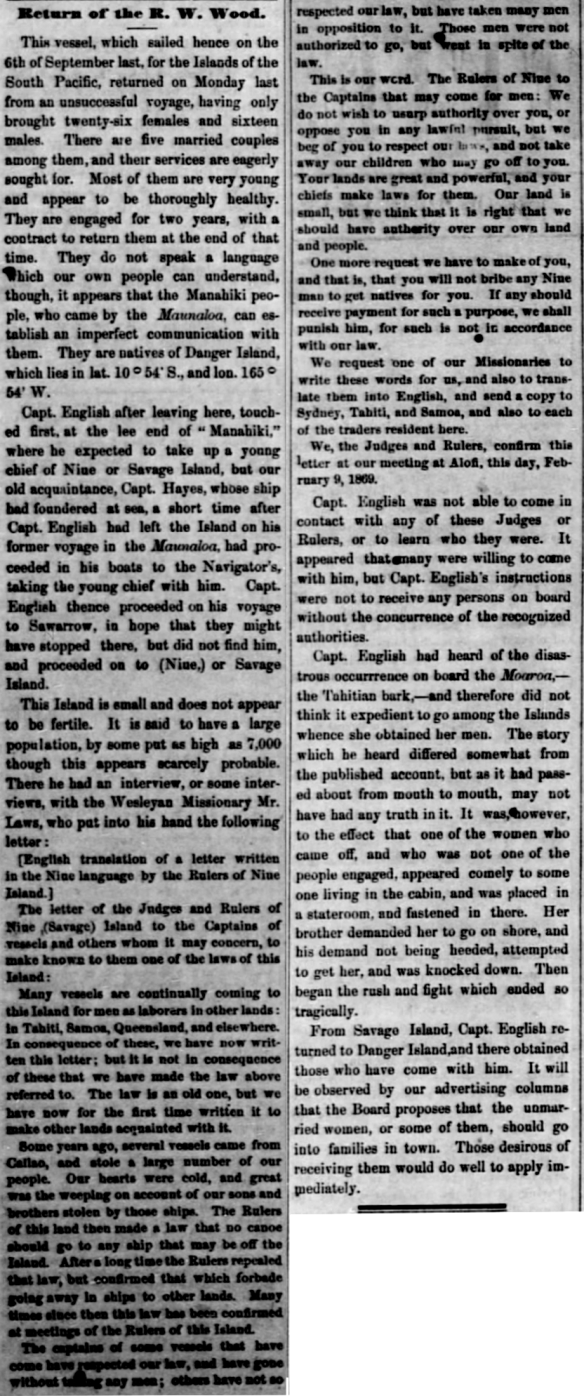
Hawaiian Gazette, Volume V, Number 49, Page 2. December 22, 1869.
Prince Kawananakoa was born on the 19th day of February 1868, upland of Kaalaa, in Pauoa Valley amongst the sacred lehua buds of Kupanihi. His birth father was the High Chief David Kahalepouli Piikoi, his birth mother was Princess Kinoiki Kekaulike.
 nupepa