Unknown's avatar

About nupepa

Just another place that posts random articles from the Hawaiian Newspapers! It would be awesome if this should become a space where open discussions happen on all topics written about in those papers!! And please note that these are definitely not polished translations, but are just drafts!!! [This blog is not affiliated with any organization and receives no funding. Statements made here should in now way be seen as a reflection on other organizations or people. All errors in interpretation are my own.]

Translation of H. Rider Haggard’s, “Morning Star,” 1910.

THE HEART-STIRRING TALE

—:OF:—

THE MORNING STAR

—AND—

RAMSES HER BELOVED SWEETHEART

“The Heir of Pharoah
The Favorite of Amen-Rah
The Proud Beauty of Egypt
The Darling of Her People.”

An Old Story from Egypt.
(Translated for the Hoku o Hawaii.)

Introduction.

We are printing this famous story of the Kingdom of Egypt. And it was near the time when Moses was living in Egypt. It is a story of speaking of the religion of that ancient people, and a story of their Chiefly kapu intertwined with their Godly kapu.

We published before our readers some years ago stories of our own Alii of ancient times of our land, and Tales of Hawaii which are nearly not remembered by the  current people of these times, and through this story which we are sharing with our readers, they will see some things about that ancient people of the land in the east. It is toilsome to translate these stories for the benefit of the people who enjoy reading stories in the Hoku. And from the Hoku, we lovingly urge its readers to please remember the life of this Hoku of ours. Printing a newspaper is very costly, and its existence and progress is reliant upon its readers.

We hope that some of the subscribers of the Hoku who are delinquent in their payments to the life of the Hoku will be moved with aloha, and they will make their payment towards the life of this patient servant.

Forgive us for these words that are not related to our story, however, “Ears do not get filled up with words.” And it is our responsibility to call out with aloha to our readers who have not paid their subscription, for the good of the newspaper to print educational stories and wise discussions of this new age.

[That was the introduction by the Hoku o Hawaii newspaper to their translation of the story, “The Morning Star” by H. Rider Haggard, which was printed just earlier that year in 1910. It ran in the weekly Hoku from March 17, 1910 to February 1, 1912.

It would be a cool thing if immersion students were introduced to old translations like these. They could see what kind of vocabulary and turns of phrase that were common during the period. I realize that trying to get through a novel in this format is tiresome and tedious, and I am considering reformatting a story (in the original orthography so that students can get more practice at reading material as they were presented in the newspapers) so that it reads continuously as a book. However, I am not sure if immersion teachers or students out there think that it would be beneficial. Perhaps it is already being done.]

(Hoku o Hawaii, 3/17/1910, p. 1)

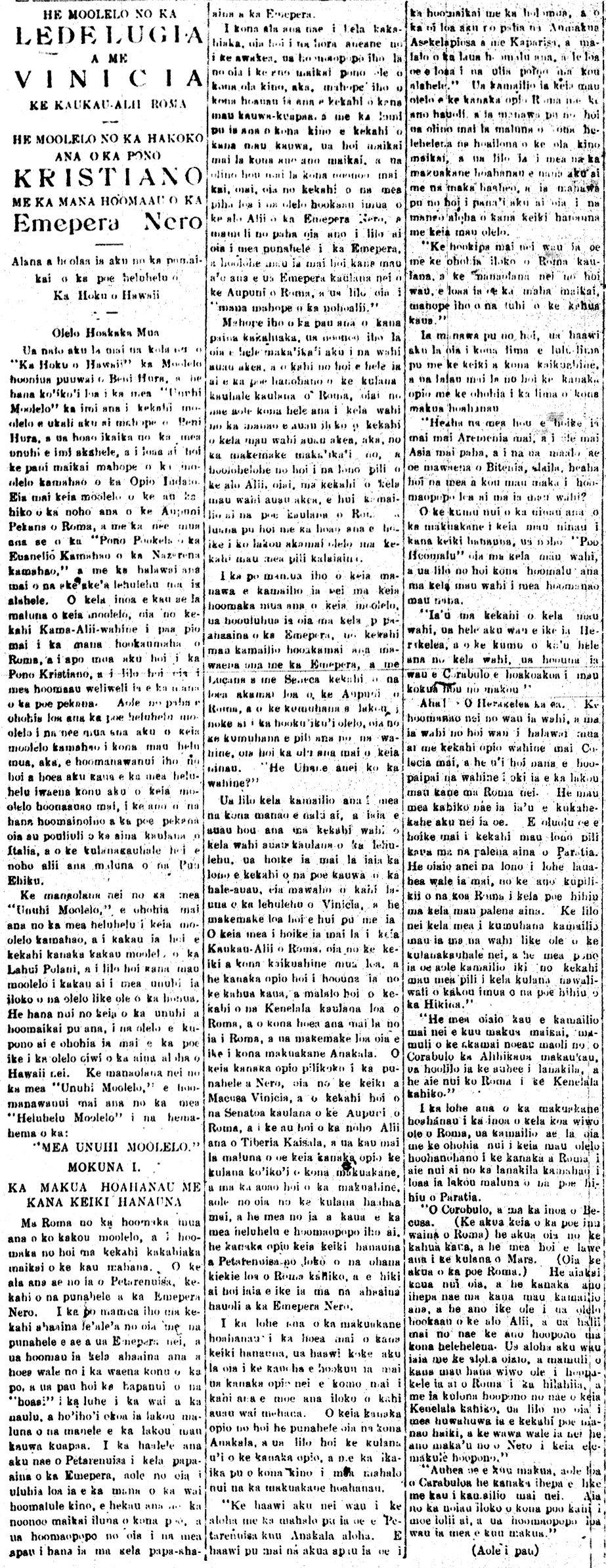
HE MOOLELO HOONIUA PUUWAI NO KA HOKU KAKAHIAKA

Ka Hoku o Hawaii, Buke IV, Helu 46, Aoao 1. Maraki 17, 1910.

Isaac Testa dies, 1909.

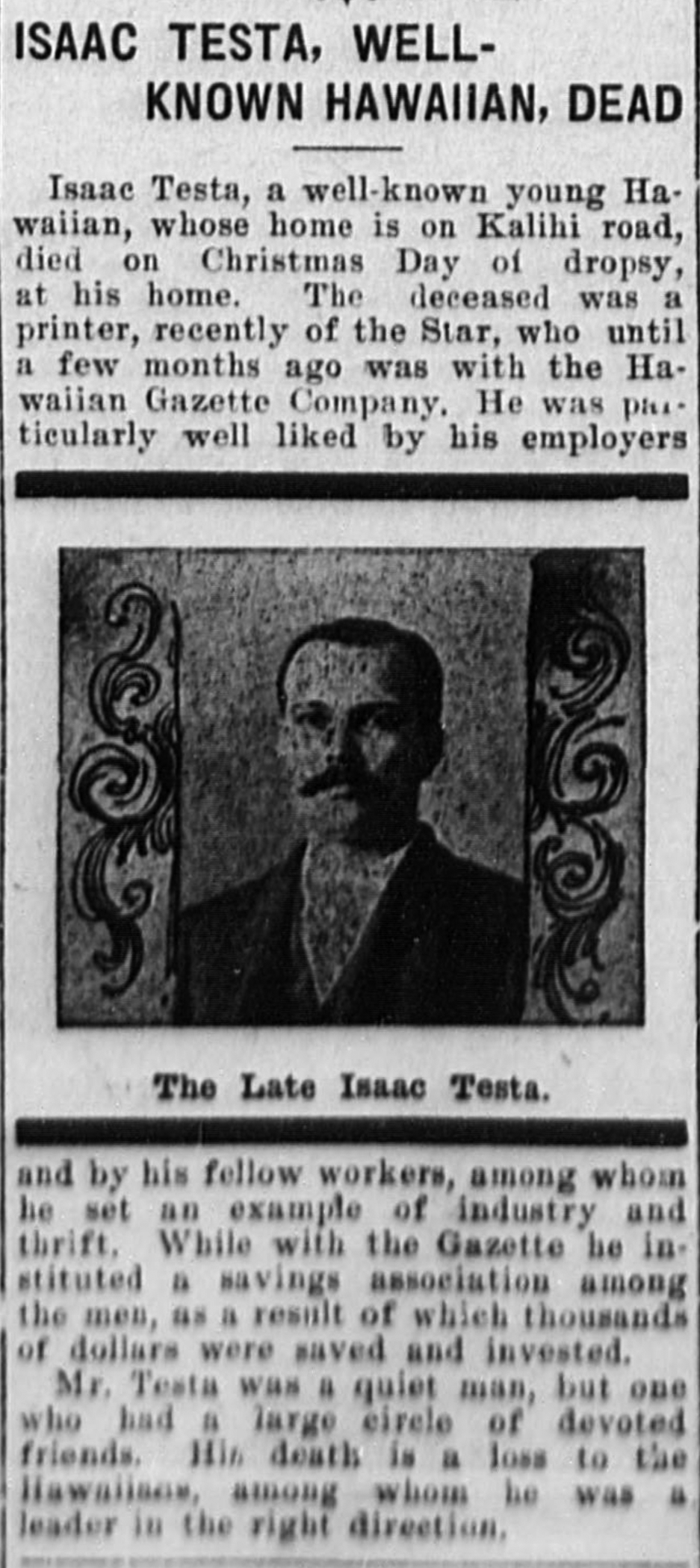
ISAAC TESTA, WELL-KNOWN HAWAIIAN, DEAD

Isaac Testa, a well-known young Hawaiian, whose home is on Kalihi road, died on Christmas Day of dropsy, at his home. The deceased was a printer, recently of the Star, who until a few months ago was with the Hawaiian Gazette Company. He was particularly well liked by his employers…

The Late Isaac Testa.

…and by his fellow workers, among whom he set an example of industry and thrift. While with the Gazette he instituted a savings association among the men, as a result of which thousands of dollars were saved and invested.

Mr. Testa was a quiet man, but one who had a large circle of devoted friends. His death is a loss to the Hawaiians, among whom he was a leader in the right direction.

[It seems that this is the son of the sister of Hoke (Francisco Jose Testa).]

(Hawaiian Gazette, 12/28/1909, p. 3)

ISAAC TESTA, WELL-KNOWN HAWAIIAN, DEAD

Hawaiian Gazette, Volume LII, Number 104, Page 3. December 28, 1909.

Mary Kealohapauole Timoteo passes away, 1908.

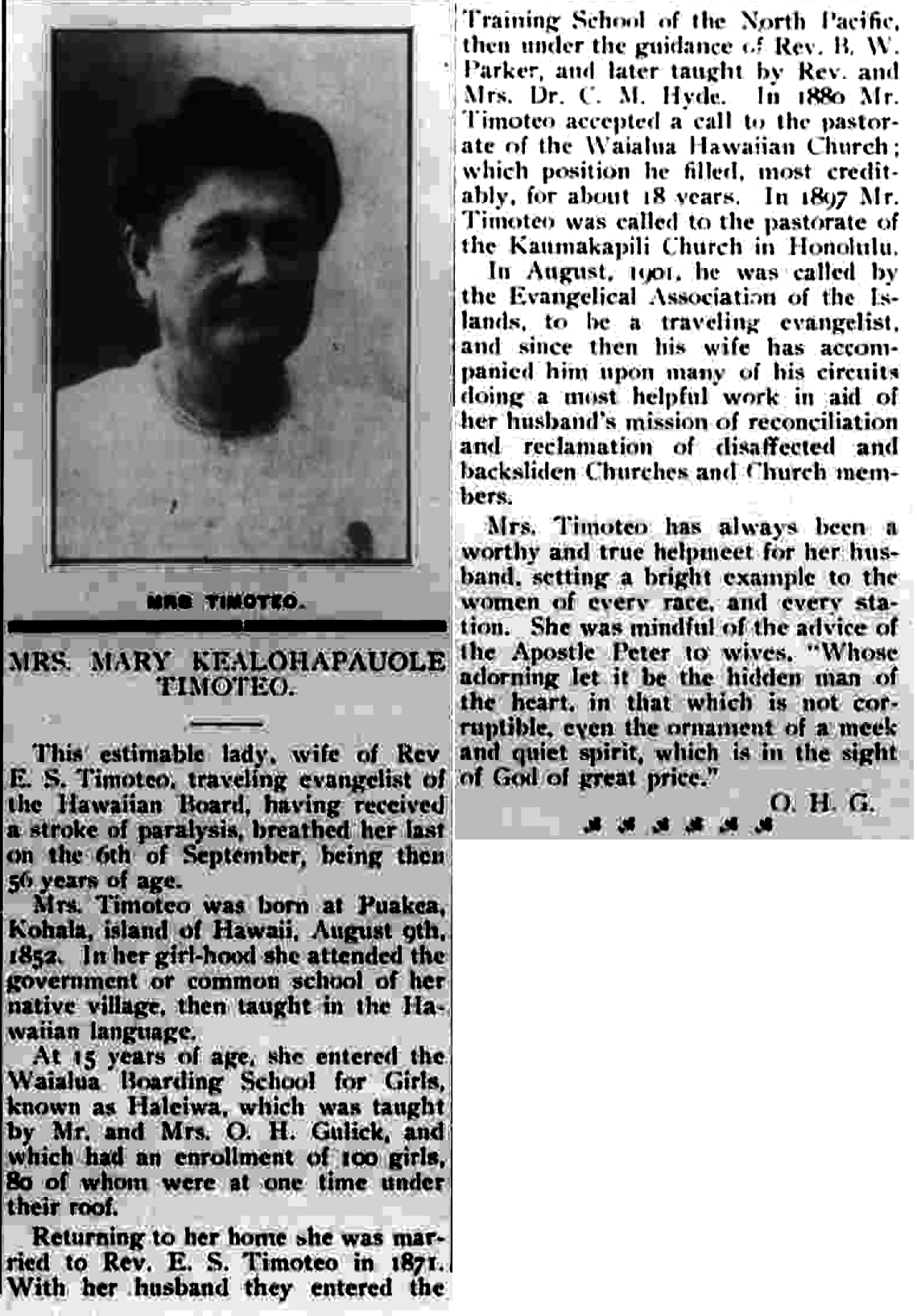
MRS. TIMOTEO.

MRS. MARY KEALOHAPAUOLE TIMOTEO.

This estimable lady, wife of Rev. E. S. Timoteo, traveling evangelist of the Hawaiian Board, having received a stroke of paralysis, breathed her last on the 6th of September, being then 56 years of age.

Mrs. Timoteo was born at Puakea, Kohala, island of Hawaii, August 9th, 1852. In her girl-hood she attended the government or common school of her native village, then taught in the Hawaiian language.

At 15 years of age, she entered the Waialua Boarding School for Girls, known as Haleiwa, which was taught by Mr. and Mrs. O. H. Gulick, and which had an enrollment of 100 girls, 80 of whom were at one time under their roof.

Returning to her home she was married to Rev. E. S. Timoteo in 1871. With her husband they entered the Training School of the North Pacific, then under the guidance of Rev. B. W. Parker, and later taught by Rev. and Mrs. Dr. C. M. Hyde. In 1880 Mr. Timoteo accepted a call to the pastorate of the Waialua Hawaiian Church [Liliuokalani Protestant Church]; which position he filled, most creditably, for about 18 years. In 1897 Mr. Timoteo was called to the pastorate of the Kaumakapili Church in Honolulu.

In August, 1901, he was called by the Evangelical Association of the Islands, to be a traveling evangelist, and since then his wife has accompanied him upon many of his circuits doing a most helpful work in aid of her husband’s mission of reconciliation and reclamation of disaffected and backsliden Churches and Church members.

Mrs. Timoteo has always been a worthy and true helpmeet for her husband, setting a bright example to the women of every race, and every station. She was mindful of the advice of the Apostle Peter to wives, “Whose adorning let it be the hidden man of the heart, in that which is not corruptible, even the ornament of a meek and quiet spirit, which is in the sight of God of great price.”

O. H. G.

[This publication, The Friend, is word-searchable, and can be found on the Mission Houses Museum website here.]

(Friend, 10/1908, p. 16)

MRS. MARY KEALOHAPAUOLE TIMOTEO.

The Friend, Volume LXV, Number 10, Page 16. October, 1908.

James H. K. Kaiwi has gone, 1915.

REV. J. H. K. KAIWI HAS PASSED.

My dear Hoku;

Aloha oe.—Please allow me an open space in your slim body, for these words placed above, so that the many friends, companions, and fellow laborer in the work of our loving Lord in the Archipelago may learn of this sad news.

On Sunday, the 14th of this past February, at 10 p. m. of that evening, the angel of destruction of all bodily spirits came visiting at their Residence at Keaalama, Opihikao, Puna, and took away the breath of life from his body, and left his remains to his wife, children, grandchildren, friends, and the Church which the two of them were connected with aloha. The sickness which caused his death was a tumor in his breast; which he had for perhaps 8 months.

He was born into this world from the loins of his parents. Kaiwi was his father and Kalua was his mother, at Keahialaka, Puna, in the month of April, the 17th, in the year 1860; he was 54 years old and 9 months and 27 days; and the hours of his breathing in the air of this earth are gone. Continue reading

Timeless words to drivers from a hundred years ago, 1915 / 2015.

BE VIGILANT

Following the three casualties on Volcano Road [Alanui Kaluaopele] near Glenwood, because of the overturning of the automobile of the Volcano Stables Company [Hui Kaa Kaluaopele]; it is necessary to somewhat decrease the numbers of cars so the road isn’t disorderly [kipalale] as we know it is narrow. It is also important for the drivers [hookelekaa] to be cautious when driving, lest there be more casualties like these. When one driver wants to overtake another, that is stupid; be very careful in every way, whether the road is wide or narrow; because that is how this Hawaiian met with disaster, and took two haole women as victims. Think, O Drivers, and drive appropriately on narrow portions of the road so that you don’t get into accidents and lives are lost. This will be a reason world travellers will not often come here to Hilo, because of this kind of dreadful happenings that are heard of, and it is the very first in the history of Hilo.

[Not only Volcano—be careful anytime you are behind the wheel!]

(Hoku o Hawaii, 3/4/1915, p. 2)

E MAKAALA

Ka Hoku o Hawaii, Buke 9, Helu 38, Aoao 2. Maraki 4, 1915.

Mrs. Haokekai passes away, 1922.

OUR BELOVED MAMA HAS GONE BEYOND.

MRS. HAOKEKAI.

Mr. Solomon Hanohano, Aloha between us:—Please allow me some room in our pride.

In the dawn of Thursday, at 4 o’clock, May 25, our beloved mama, Mrs. Haokekai, grew weary of living in this world and went on the path all must travel.

Haokekai was born at Pauwela, Maui, in the month of September. 5, 1861, from the loins of Kekane, her mother, and Mose Kahiapo, her father; from the two of them, they had three boys and one girl. From their children are great and many living on Maui and here in Honolulu nei.

One of their grandchildren is the pastor of the Paia Church on Maui, Mose Kahiapo [Moses Kahiapo], who took the name of his grandfather.

Their mother went a long time ago [aole e kala i hele ai]; it is now 46 years. Their father was taken to Kalawao. One son went, and another, and then our mother; there is just one still living, that is William Opunui Kahiapo, the last of the direct family of Kahiapo.

As for the mother of the two of us who has gone, she had a stroke [? lolo], but it was not a severe stroke, for she could go out here and there; then she got a different sickness which is what she died of.

From what the doctor told me, it was ma’i ma ka umauma, (Cancer on the breast); the blood did not flow, and her heart was weak; there was much searching for a cure, but the knowledge of the doctors was stumped.

Her last wish she made to me was, “When I die, return me to Pauwela and lay me to rest with my mother.” I said to her, that can be done because you have put away your savings in a safe place without being undecided and turning this way and that [?? ua malama oe i na hunahuna metalia ma kahi maluhia, aole hoi e kunana a hou hewa i o ianei].

On the 29th of May, we were upon the swaying billows of the ocean and then whirring at the Kahului harbor where we got on a hearse for Pauwela; that afternoon, she was gone for all times, and her child, the Rev. Moses Kahiapo did the blessing, praying to the Father in heaven to welcome her before him.

This was a woman who had a large family that would take up a whole halau. As for her age, she was 61 and ten months.

Here I give my thanks to you, Mr. Editor of the Kuokoa, and the workers of your press, aloha kakou,

KAKAIO KAOLELO,

W. OPUNUI KAHIAPO,

Z. KAPULE.

[In the obituaries in the Kuokoa of 6/1/1922, it lists under Deaths, Haokekai Kapule, on Kawaiahao Street, May 25.]

(Kuokoa, 6/22/1922, p. 3)

KO MAUA MAMA ALOHA UA HALA MAO.

Ka Nupepa Kuokoa, Buke LXI, Helu 25, Aoao 3. Iune 22, 1922.

Much more on the protest mat, 1990.

For much, much more on Kalai’s mat of protest, see Roger G. Rose’s “Patterns of protest : a Hawaiian mat-weaver’s response to 19th-century taxation and change,” found in Bishop Museum Occasional Papers, Vol. 30 (June 1990). It can be found online by clicking here below:

Patterns of protest : a Hawaiian mat-weaver’s response to 19th-century taxation and change

Patterns of protest : a Hawaiian mat-weaver’s response to 19th-century taxation and change, Roger G. Rose

Kalai’s fame spreads to far away Pennsylvania, 1874.

[Found under: “Varieties.”]

King Kalakaua, of the Sandwich Islands, has requested an old woman named Kalai, who sent him a mat into which she had woven a petition praying for the removal of taxes on animals, to weave two mats, one with the American and the other with the English coat-of-arms, to be exhibited at our Centennial Exhibition as specimens of Hawaiian handiwork.

[There is mention of this also in the National Republican (Washington, DC) on 6/19/1874.]

(Juniata Sentinel and Republican, 6/24/1874, p. 1)

King Kalakaua...

Juniata Sentinel and Republican, Volume XXVIII, Number 25, Page 1. June 24, 1874.

Message in a mat, 1874.

[Found under: “Nu Hou Kuloko.”]

We have heard that the woman who wove the pawehe mat of Niihau, that being Kalai, was asked by the king to weave a moena pawehe, two of them, with the symbol [kii hoailona] of America and so too of Britain.

(Kuokoa, 5/2/1874, p. 2)

Ua lohe makou, ua kauohaia...

Ka Nupepa Kuokoa, Buke XIII, Helu 18, Aoao 2. Mei 2, 1874.