Unknown's avatar

About nupepa

Just another place that posts random articles from the Hawaiian Newspapers! It would be awesome if this should become a space where open discussions happen on all topics written about in those papers!! And please note that these are definitely not polished translations, but are just drafts!!! [This blog is not affiliated with any organization and receives no funding. Statements made here should in now way be seen as a reflection on other organizations or people. All errors in interpretation are my own.]

Mrs. Haokekai passes away, 1922.

OUR BELOVED MAMA HAS GONE BEYOND.

MRS. HAOKEKAI.

Mr. Solomon Hanohano, Aloha between us:—Please allow me some room in our pride.

In the dawn of Thursday, at 4 o’clock, May 25, our beloved mama, Mrs. Haokekai, grew weary of living in this world and went on the path all must travel.

Haokekai was born at Pauwela, Maui, in the month of September. 5, 1861, from the loins of Kekane, her mother, and Mose Kahiapo, her father; from the two of them, they had three boys and one girl. From their children are great and many living on Maui and here in Honolulu nei.

One of their grandchildren is the pastor of the Paia Church on Maui, Mose Kahiapo [Moses Kahiapo], who took the name of his grandfather.

Their mother went a long time ago [aole e kala i hele ai]; it is now 46 years. Their father was taken to Kalawao. One son went, and another, and then our mother; there is just one still living, that is William Opunui Kahiapo, the last of the direct family of Kahiapo.

As for the mother of the two of us who has gone, she had a stroke [? lolo], but it was not a severe stroke, for she could go out here and there; then she got a different sickness which is what she died of.

From what the doctor told me, it was ma’i ma ka umauma, (Cancer on the breast); the blood did not flow, and her heart was weak; there was much searching for a cure, but the knowledge of the doctors was stumped.

Her last wish she made to me was, “When I die, return me to Pauwela and lay me to rest with my mother.” I said to her, that can be done because you have put away your savings in a safe place without being undecided and turning this way and that [?? ua malama oe i na hunahuna metalia ma kahi maluhia, aole hoi e kunana a hou hewa i o ianei].

On the 29th of May, we were upon the swaying billows of the ocean and then whirring at the Kahului harbor where we got on a hearse for Pauwela; that afternoon, she was gone for all times, and her child, the Rev. Moses Kahiapo did the blessing, praying to the Father in heaven to welcome her before him.

This was a woman who had a large family that would take up a whole halau. As for her age, she was 61 and ten months.

Here I give my thanks to you, Mr. Editor of the Kuokoa, and the workers of your press, aloha kakou,

KAKAIO KAOLELO,

W. OPUNUI KAHIAPO,

Z. KAPULE.

[In the obituaries in the Kuokoa of 6/1/1922, it lists under Deaths, Haokekai Kapule, on Kawaiahao Street, May 25.]

(Kuokoa, 6/22/1922, p. 3)

KO MAUA MAMA ALOHA UA HALA MAO.

Ka Nupepa Kuokoa, Buke LXI, Helu 25, Aoao 3. Iune 22, 1922.
Much more on the protest mat, 1990.

For much, much more on Kalai’s mat of protest, see Roger G. Rose’s “Patterns of protest : a Hawaiian mat-weaver’s response to 19th-century taxation and change,” found in Bishop Museum Occasional Papers, Vol. 30 (June 1990). It can be found online by clicking here below:

Patterns of protest : a Hawaiian mat-weaver’s response to 19th-century taxation and change

Patterns of protest : a Hawaiian mat-weaver’s response to 19th-century taxation and change, Roger G. Rose

Kalai’s fame spreads to far away Pennsylvania, 1874.

[Found under: “Varieties.”]

King Kalakaua, of the Sandwich Islands, has requested an old woman named Kalai, who sent him a mat into which she had woven a petition praying for the removal of taxes on animals, to weave two mats, one with the American and the other with the English coat-of-arms, to be exhibited at our Centennial Exhibition as specimens of Hawaiian handiwork.

[There is mention of this also in the National Republican (Washington, DC) on 6/19/1874.]

(Juniata Sentinel and Republican, 6/24/1874, p. 1)

King Kalakaua...

Juniata Sentinel and Republican, Volume XXVIII, Number 25, Page 1. June 24, 1874.

Message in a mat, 1874.

[Found under: “Nu Hou Kuloko.”]

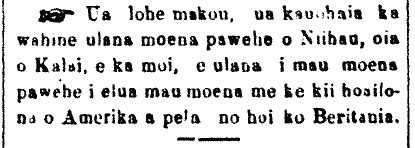
We have heard that the woman who wove the pawehe mat of Niihau, that being Kalai, was asked by the king to weave a moena pawehe, two of them, with the symbol [kii hoailona] of America and so too of Britain.

(Kuokoa, 5/2/1874, p. 2)

Ua lohe makou, ua kauohaia...

Ka Nupepa Kuokoa, Buke XIII, Helu 18, Aoao 2. Mei 2, 1874.

The famous Niihau protest mat on display at the Bishop Museum, 1874 / 2015.

[Found under: “NOTES OF THE WEEK.”]

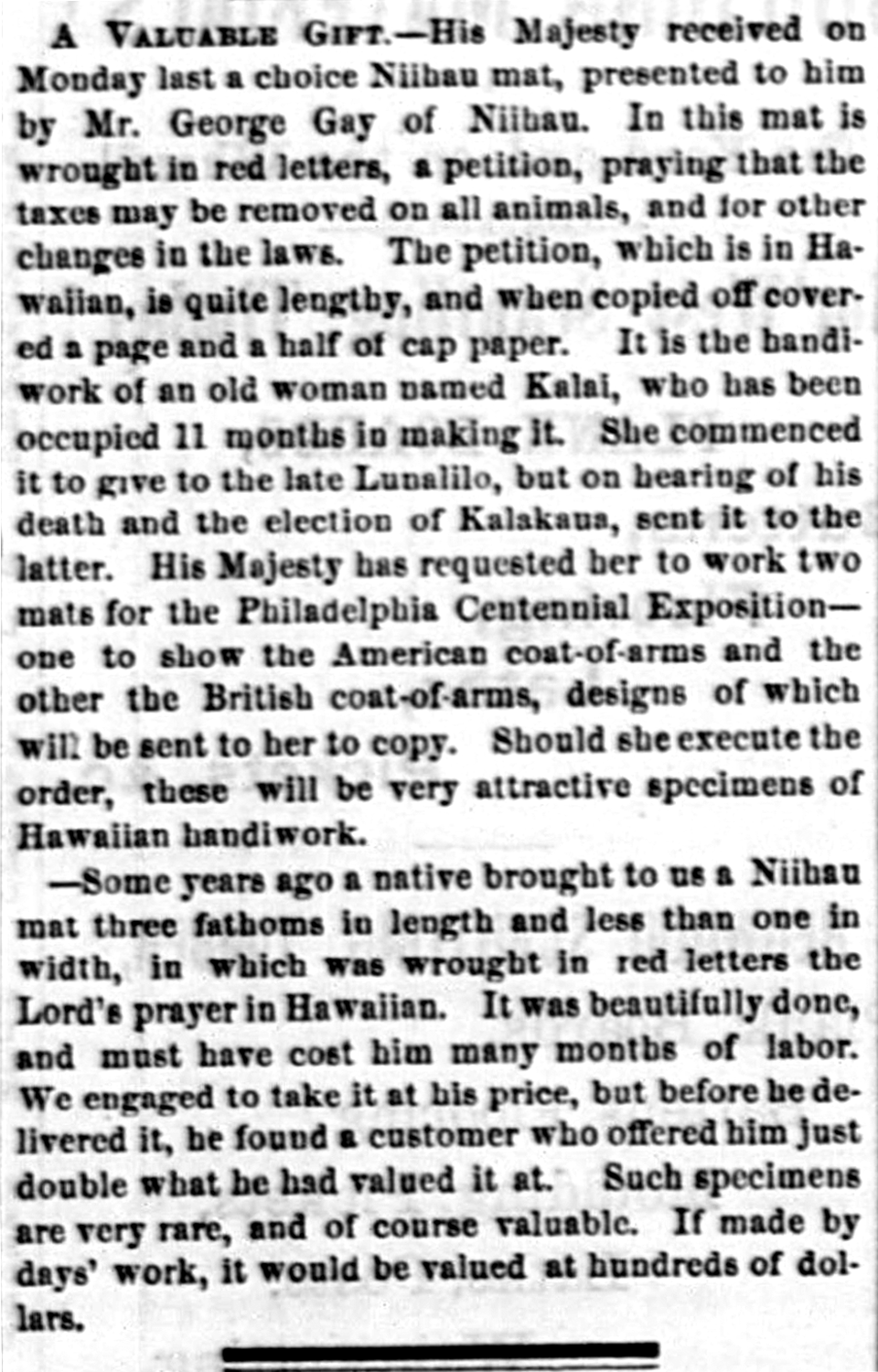
A Valuable Gift.—His Majesty received on Monday last a choice Niihau mat, presented to him by Mr. George Gay of Niihau. In this mat is wrought in red letters, a petition, praying that the taxes may be removed on all animals, and for other changes in the laws. The petition, which is in Hawaiian, is quite lengthy, and when copied off covered a page and a half of cap paper. It is the handiwork of an old woman named Kalai, who has been occupied 11 months in making it. She commenced it to give to the late Lunalilo, but on hearing of his death and the election of Kalakaua, sent it to the latter. His Majesty has requested her to work tow mats for the Philadelphia Centennial Exposition—one to show the American coat-of-arms and the other the British coat-of-arms, designs of which will be sent to her to copy. Should she execute the order, these will be very attractive specimens of Hawaiian handiwork.

—Some years ago a native brought to us a Niihau mat three fathoms in length and less than one in width, in which was wrought in red letters the Lord’s prayer in Hawaiian. It was beautifully done, and must have cost him many months of labor. We engaged to take it at his price, but before he delivered it, he found a customer who offered him just double what he had valued it at. Such specimens are very rare, and of course valuable. If made by days’ work, it would be valued at hundreds of dollars.

[This mat was put on display at the Bishop Museum just yesterday. Go check it out if you are on Oahu nei.]

(Hawaiian Gazette, 4/29/1874, p. 3)

A Valuable Gift.

Hawaiian Gazette, Volume X, Number 17, Page 3. Aprila 29, 1874.

Hooulu Lahui, 1874.

[Found under: “Nu Hou Kuloko.”]

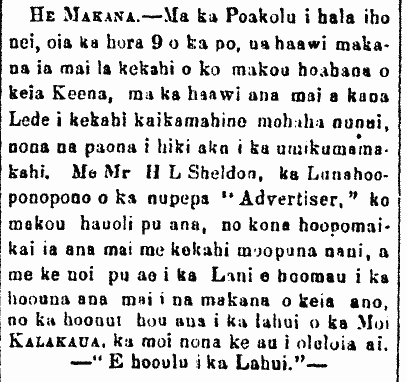
A Gift.—This past Wednesday, at 9 o’clock at night, one of our coworkers at this Office was given a gift, by his Lady giving him a large, well-developed girl, who weighed even eleven pounds. To Mr. H. L. Sheldon, the Editor of the newspaper “Advertiser,” goes our shared joy for his being blessed with a beautiful grandchild, as we ask of the Heavens to continue to send this type of gifts, to once again increase the lahui of King Kalakaua, the king of whose reign is said,

—”E hooulu i ka Lahui.”¹—

¹One of the great goals of King Kalakaua was to Hooulu Lahui, or to increase the Hawaiians.

(Kuokoa, 8/22/1874, p. 2)

He Makana.

Ka Nupepa Kuokoa, Buke XIII, Helu 34, Aoao 2. Augate 22, 1874.

“The Victory of Hawaii” by Eleanor Prendergast, 1893.

KA LANAKILA O HAWAII.

1st. Ua hooko ia ke koii
Ka iini kau a ka manao
Ua lanakila mau Hawaii
Ka Hoku o ka Pakipika.

Hui: No Hawaii no ke aloha
Aina o ka lokomaikai
Lahui malama i ka pono
Me ka laahia o ke Kalaunu.

2nd. Aole kupueu o Kahiki
Nana e hoonioni mai
Ua ewe ua mole ua paa
Eia i ka piko o Wakea.

3rd. Eia Hawaii ua wehi
I ka lei nani o ka Lanakila
Kilakila na pua na mamo
Na ewe kupa o ka aina.

Miss Kekoaohiwaikalani.

Puahaulani Hale.

Honolulu, Mar. 25, 1893.

(Leo o ka Lahui, 4/21/1893, p. 3)

KA LANAKILA O HAWAII.

Ka Leo o ka Lahui, Buke II, Helu 689, Aoao 3. Aperila 21, 1893.

Observations from an Englishman, 1893.

From a Travelling Englishman.

From the time I arrived in Honolulu until today, I’ve heard often of matters pertaining to those referred to as the circle of missionaries, and the dimness of their ideas; I’ve observed their actions very carefully.

I saw today in the Advertiser [Avalataisa] about the party being given for Captain Wiltse, and how they will sit at this party for two hours and a half with just wine to drink and nothing to eat.

Giving a banquet for a high ranking Captain without serving Glasses of Champaigne [Kamapeni] during all that time is like acting out Hamlet without the ghost.

This will not become something that is greatly ridiculed, but this goes back to the way of life of the old Missionaries, with  their humbling station of evil thoughts.

On the day after this party, I saw that Queen Liliuokalani was sent an invitation under the name Mrs. J. O. Dominis, and this is something quite vile by the Committee who did it; Should the Committee think that are considered adults, then it was improper of them to have sent such an invitation to the Queen.

The first thing taught to schoolchildren in Britain is not to kick a man when he falls down. But this is a woman they are kicking, and that woman is Queen Liliuokalani. This is action that can be called despicable of the meanest form, and should this Committee want to be freed of these words, then they must explain it from their side, or this contemptible act will be carried upon their backs.

Charles G. Nottage.

Hawaiian Hotel [Hotele Hawaii], Feb. 28, 1893.

[Perhaps this was meant to say that there was no wine, and only sparkling water? The article he seems to be talking about is found here on the Chronicling America site. PCA 2/28/1893, p. 2.

There is also reference to a separate party that he was invited to. The Queen is mentioned as “Mrs. J. O. Dominis”. This can be found also at Chronicling America, PCA 2/25/1893, p. 4.]

(Leo o ka Lahui, 3/3/1893, p. 3)

Mai Kekahi Haole Pelekane Kaahele Mai.

Ka Leo o ka Lahui, Buke II, Helu 654, Aoao 3. Maraki 3, 1893.

Captain Charles G. Nottage arrives, 1893.

[Found under: “LOCAL AND GENERAL.”]

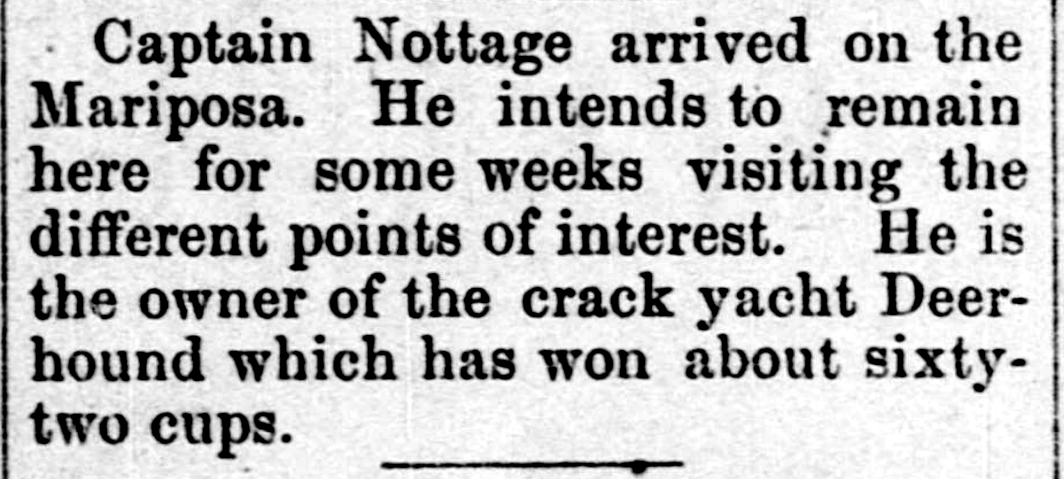
Captain Nottage arrived on the Mariposa. He intends to remain here for some weeks visiting the different points of interest. He is the owner of the crack yacht Deerhound which has won about sixty-two cups.

(Pacific Commercial Advertiser, 1/12/1893, p. 3)

Captain Nottage Arrived...

The Pacific Commercial Advertiser, Volume XVII, Number 3275, Page 3. January 12, 1893.