Unknown's avatar

About nupepa

Just another place that posts random articles from the Hawaiian Newspapers! It would be awesome if this should become a space where open discussions happen on all topics written about in those papers!! And please note that these are definitely not polished translations, but are just drafts!!! [This blog is not affiliated with any organization and receives no funding. Statements made here should in now way be seen as a reflection on other organizations or people. All errors in interpretation are my own.]

Beauty and the Beast, 1862.

HE KAAO NO
KANANI!
ME KA
HOLOHOLONA.

HELU 1.

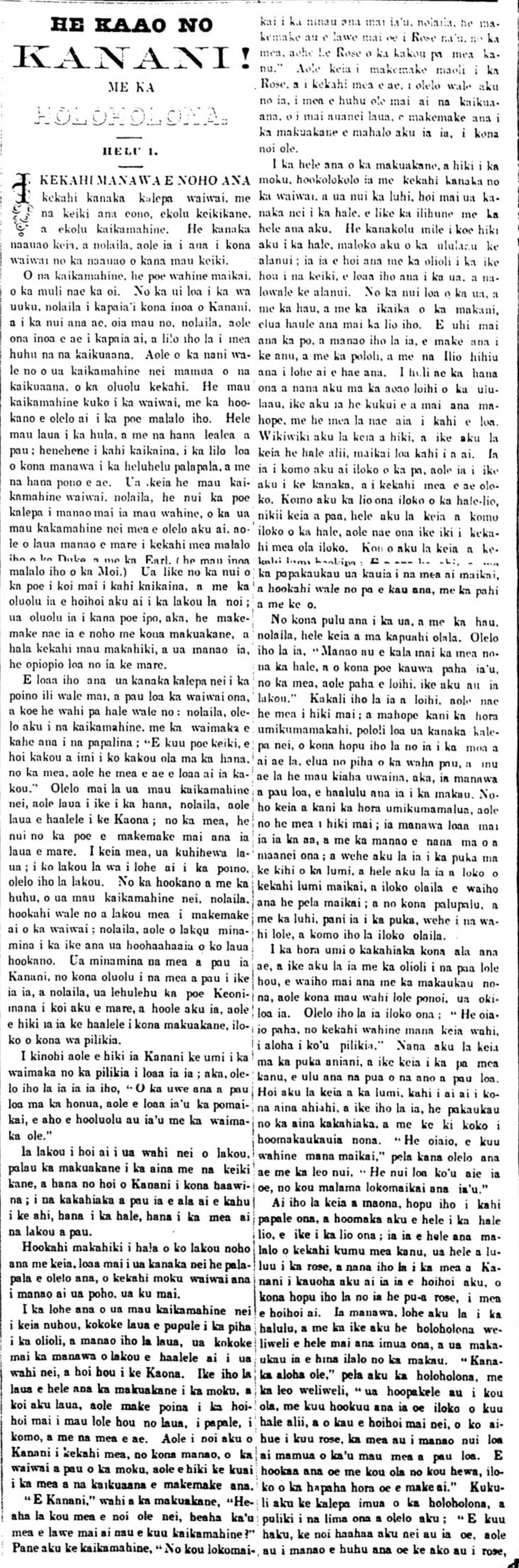
I KEKAHI MANAWA E NOHO ANA kekahi kanaka kalepa waiwai, me na keiki ana eono, ekolu keikikane, a ekolu kaikamahine. He kanaka naauao keia, a nolaila, aole ia i aua i kona waiwai no ka naauao o kana mau keiki.

O na kaikamahine, he poe wahine maikai, o ka muli nae ka oi. No ka ui loa i ka wa uuku, nolaila i kapaia’i kona inoa o Kanani, a i ka nui ana ae, oia mau no, nolaila, aole ona inoa e ae i kapaia ai, a lilo iho la i mea huhu na na kaikuaana. Aole o ka nani wale no o ua kaikamahine nei mamua o na kaikuaana, o ka oluolu kekahi. He mau kaikamahine kuko i ka waiwai, me ka hookano e olelo ai i ka poe malalo iho. Hele mau laua i ka hula, a me na hana lealea a pau; henehene i kahi kaikaina, i ka lilo loa o kona manawa i ka heluhelu palapala, a me na hana pono e ae. Ua ikeia he mau kaikamahine waiwai, nolaila, he nui ka poe kalepa i manao mai ia mau wahine, o ka ua mau kakamahine nei mea e olelo aku ai, aole o laua manao e mare i kekahi mea malalo iho o ke Duke a me ka Earl, (he mau inoa malalo iho o ka Moi.) Ua like no ka nui o ka poe i koi mai i kahi kaikaina, a me ka oluolu ia e hoihoi aku ai i ka lakou la noi; ua oluolu ia i kana poe ipo, aka, he makemake nae ia e noho me kona makuakane, a hala kekahi mau makahiki, a ua manao ia, he opiopio loa no ia ke mare…

[Jeanne-Marie LePrince de Beaumont’s “Beauty and the Beast” was translated in the Kuokoa from 4/12/1862 to 4/26/1862 by J. W.]

(Kuokoa, 4/12/1862, p. 1–2)
HE KAAO NO KANANI! ME KA HOLOHOLONA.

Ka Nupepa Kuokoa, Buke I, Helu 20, Aoao 1. Aperila 12, 1862.
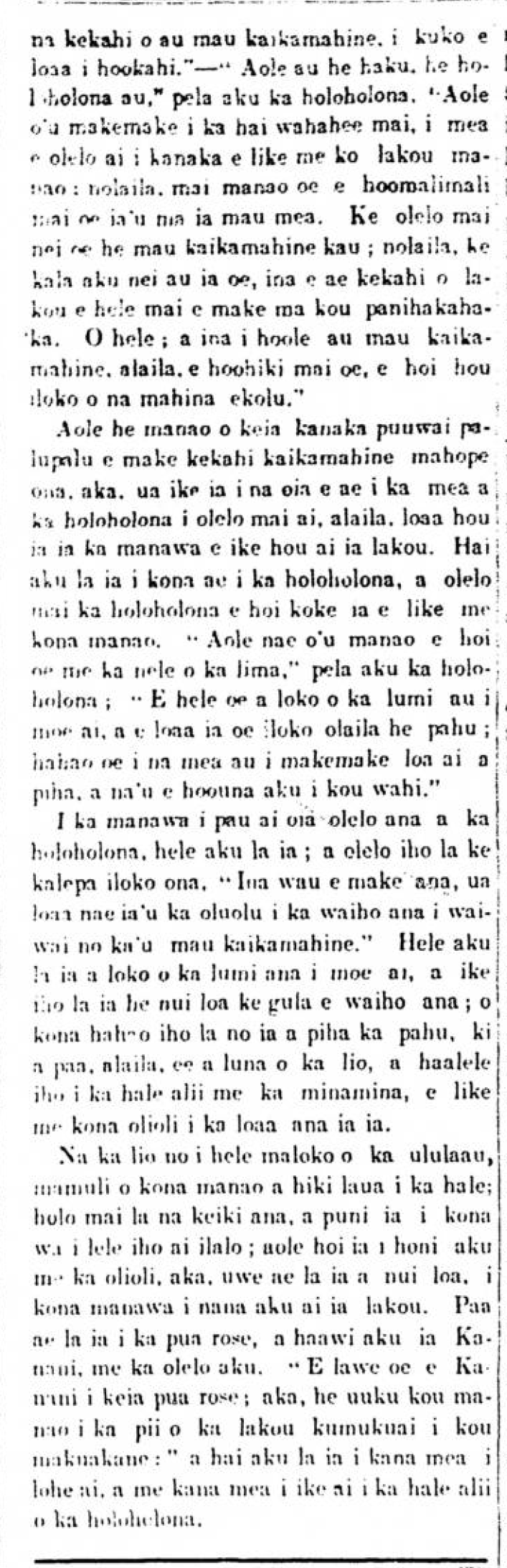
na kekahi o au mau kaikamahine...

Ka Nupepa Kuokoa, Buke I, Helu 20, Aoao 2. Aperila 12, 1862.

Response to the incorrect translation of bills, 1909.

There would be no trouble over translating bills if the Legislature would obey the law and conduct its proceedings in English.

(Hawaiian Gazette, 3/2/1909, p. 4)

There would be no trouble over translating...

Hawaiian Gazette, Volume LII, Number 19, Page 4. March 2, 1909.

More on translations, 1909.

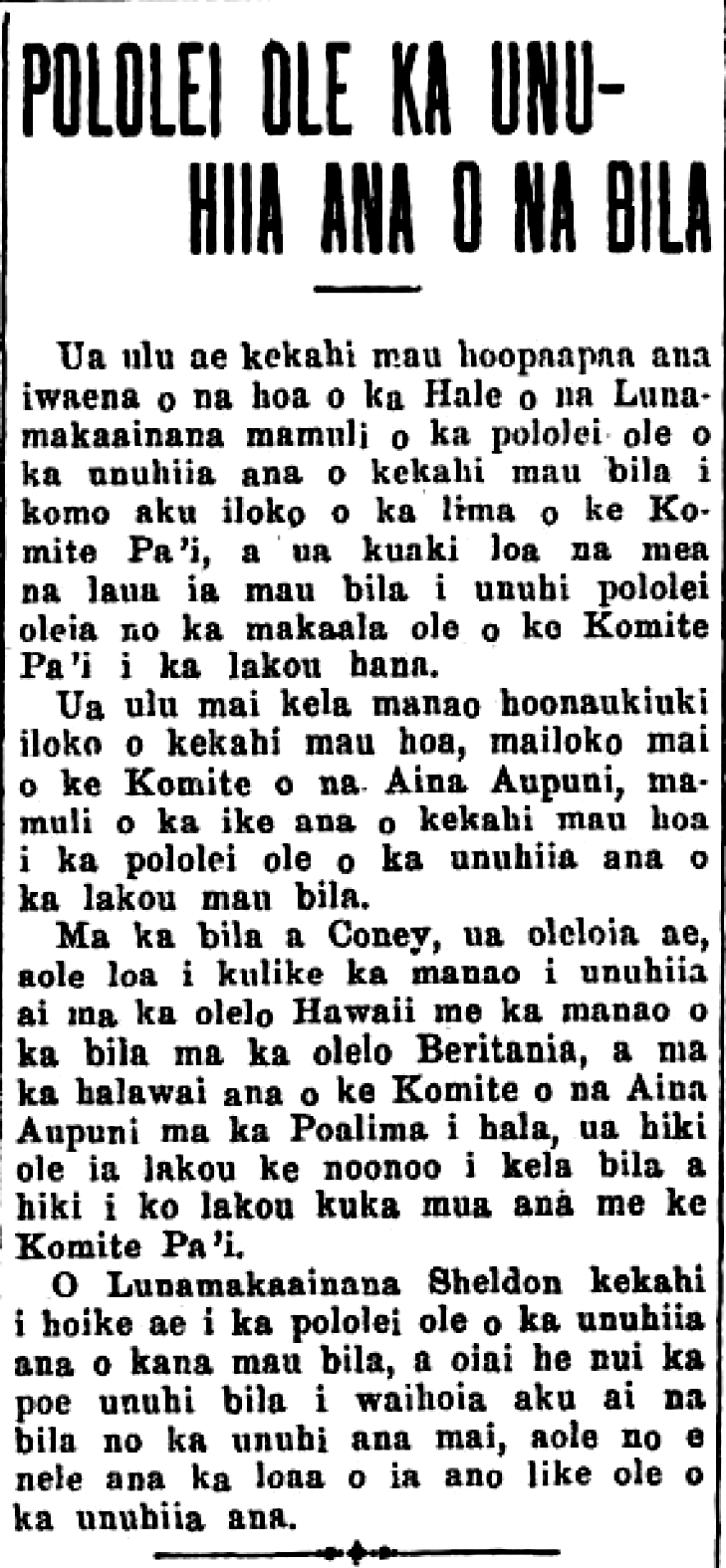
TRANSLATIONS OF BILLS ARE NOT CORRECT

Altercations arose between members of the House of Representatives over the incorrect translations of bills which were placed in the hands of the Publication Committee [Komite Pa’i], and the two from whom the incorrectly translated bills originated were upset at the inattentiveness of the Publication Committee in their work.

This anger of some of the members originated with the Public Lands Committee [Komite o na Aina Aupuni], because some of the members noticed the incorrect translation of their bills.

For the bill of Coney, it is said that the translation in Hawaiian is not at all like the idea of the bill in English, and at the meeting of the Committee on Public Lands on this past Friday, they could not consider that bill until they consult with the Publication Committee.

Representative Sheldon was one who made known the incorrect translation of his bills, and being that there are many bill translators with whom the bills were left with for translations, there will be no shortage of those types of divergent translations.

(Kuokoa, 3/5/1909, p. 1)

POLOLEI OLE KA UNUHIIA ANA O NA BILA

Ka Nupepa Kuokoa, Buke XLVI, Helu 10, Aoao 1. Maraki 5, 1909.

Ivanhoe! 1871.

A MOOLELO
OF
IVANHOE!

CHAPTER 1.

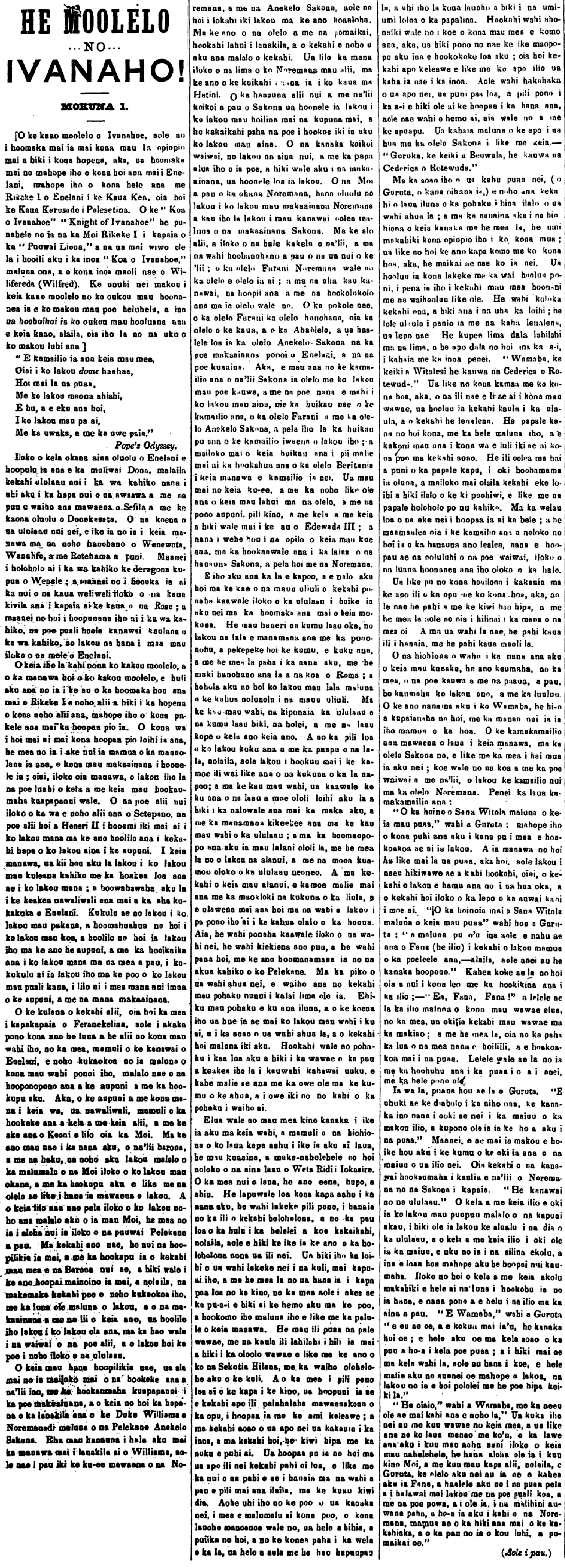
The kaao moolelo of Ivanhoe does not begin from his youth until the end, but it begins after his return to England right after he goes with Richard I of England on the Crusades “War of the Cross,” that being the Crusades in Palestine. The Knight of Ivanhoe was a favorite of King Richard I, called the “Lion Hearted,” and it was that fearless king who gave him the name “Knight of Ivanhoe,” but his real name was Wilfred. We are translating this kaao moolelo for your entertainment, our readers, and should your association with this story be made enjoyable, then that is payment for our labors.]

“E kamailio ia ana keia mau mea,
Oiai i ko lakou dome haahaa,
Hoi mai la na puaa,
Me ko lakou maona ahiahi,
E hu, a e eku ana hoi,
I ko lakou mau pa ai,
Me ka uwaka, a me ka uwe paia.”

Pope’s Odyssey.

Iloko o kela okana aina oluolu o Enelani e hoopulu ia ana e ka muliwai Dona, malaila kekahi ululaau nui i ka wa kahiko nana i uhi aku i ka hapa nui o na awaawa a me na puu e waiho ana mawaena o Sefila a me ke kaona oluolu o Donekesata. O na koena o ua ululaau nui nei, e ike ia no ia i keia manawa ma na noho hanohano o Wenewota, Wanalife, a me Rotehama a puni. Maanei i holoholo ai i ka wa kahiko ke deragona kupua o Wenale; a maanei no i hoouka ia ai ka nui o na kaua weliweli iloko o na kaua kivila ana i kapaia ai ke kaua o na Rose; a maanei no hoi i hoopunana iho ai i ka wa kahiko, na poe puali hoole kanawai kaulana o ka wa kahiko, no lakou na hana i maa mau iloko o na mele o Enelani…

[“Ivanhoe” by Sir Walter Scott is found in Au Okoa from 2/9/1871 until 8/29/1872.  The story is almost completed. Unfortunately, the issue that the last section of the story would have appeared in (9/5/1871) is missing the last two pages! The Ivanaho translation usually appeared on the fourth page of each issue. There are many missing pages and issues and volumes of Hawaiian-Language Newspapers, hopefully someday they will be found, if not in Hawaii, then somewhere across the ocean. Hawaiians lived all over the world, and they had the papers sent to them so that they would not lose touch with the sands of their birth…]

(Au Okoa, 2/9/1871, 4)

HE MOOLELO NO IVANAHO!

Ke Au Okoa, Buke VI, Helu 43, Aoao 4. Feberuari 9, 1871.

“Puss in Boots” in Hawaiian, 1862.

[Translated for the Kuokoa.]

POPOKI
ILOKO O NA KAMAA BUTI.

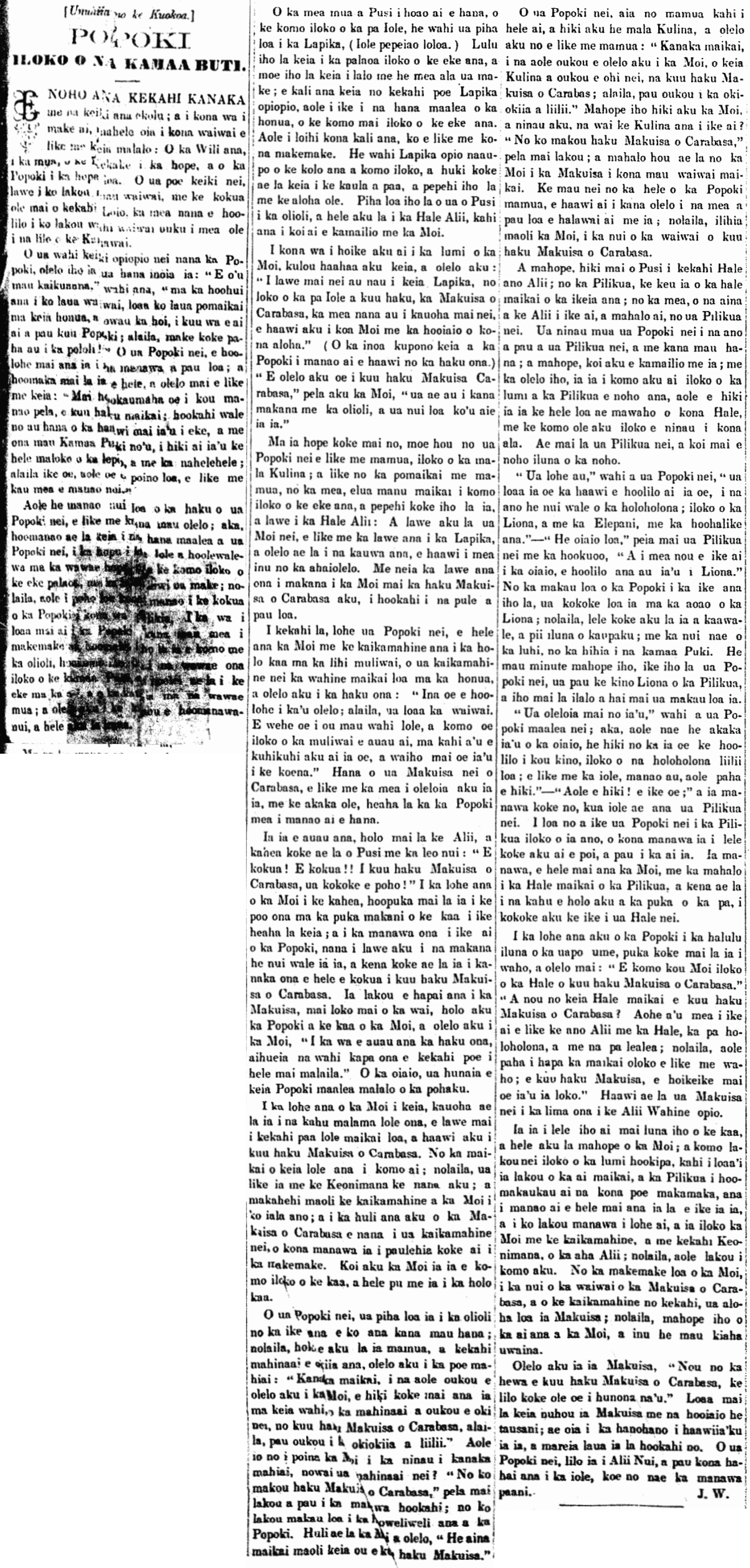
E NOHO ANA KEKAHI KANAKA me na keiki ana ekolu; a i kona wa i make ai, kaahele oia i kona waiwai e like me keia malalo: O ka Wili ana, i ka mua, o ke Kekake i ka hope, a o ka Popoki i ka hope loa. O ua poe keiki nei, lawe i ko lakou mau waiwai, me ke kokua ole mai o kekahi Loio, ka mea nana e hoolilo i ko lakou wahi waiwai uuku i mea ole i na lilo o ke Kanawai.

O ua wahi keiki opiopio nei nana ka Popoki, olelo iho la ua hana inoia ia: “E o’u mau kaikuaana,” wahi ana, “ma ka hoohui ana i ko laua waiwai, loaa ko laua pomaikai ma keia honua, a owau ka hoi, i kuu wa e ai ai a pau kuu Popoki; alaila, make koke paha au i ka pololi!” O ua Popoki nei, e hoolohe mai ana ia i na manawa a pau loa; a hoomaka mai la ia e hele, a olelo mai e like me keia: “Mai hookaumaha oe i kou manao pela, e kuu haku maikai; hookahi wale no au hana o ka haawi mai ia’u i eke, a me ona mau Kamaa Puki no’u, i hiki ai ia’u ke hele maloko o ka lepo, a me ka nahelehele; alaila ike oe, aole oe e poino loa, e like me kau mea e manao nei.”…

[Here is J. W. again, this time translating Charles Perrault’s “Puss in Boots.” Notice how bad the digital image is. Hopefully pages like this can be rescanned clearly soon! If you can’t read the information, is it really information?]

(Kuokoa, 5/31/1862, p. 1)

POPOKI ILOKO O NA KAMAA BUTI.

Ka Nupepa Kuokoa, Buke I, Helu 27, Aoao 1. Mei 31, 1862.

More from the Grimms: “Little Snow-White,” 1861.

A KAAO ABOUT BEAUTIFUL-SNOW.

Translated from the German.

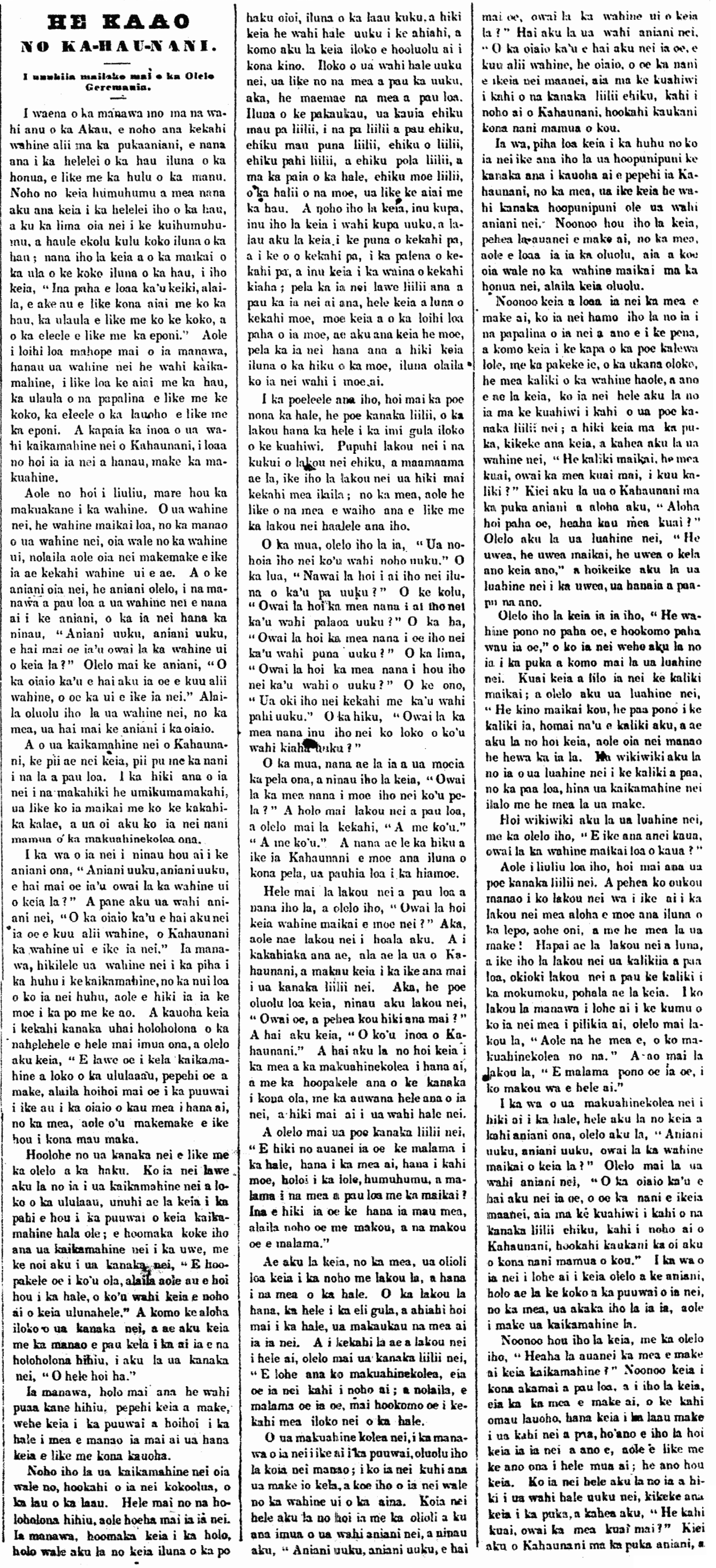
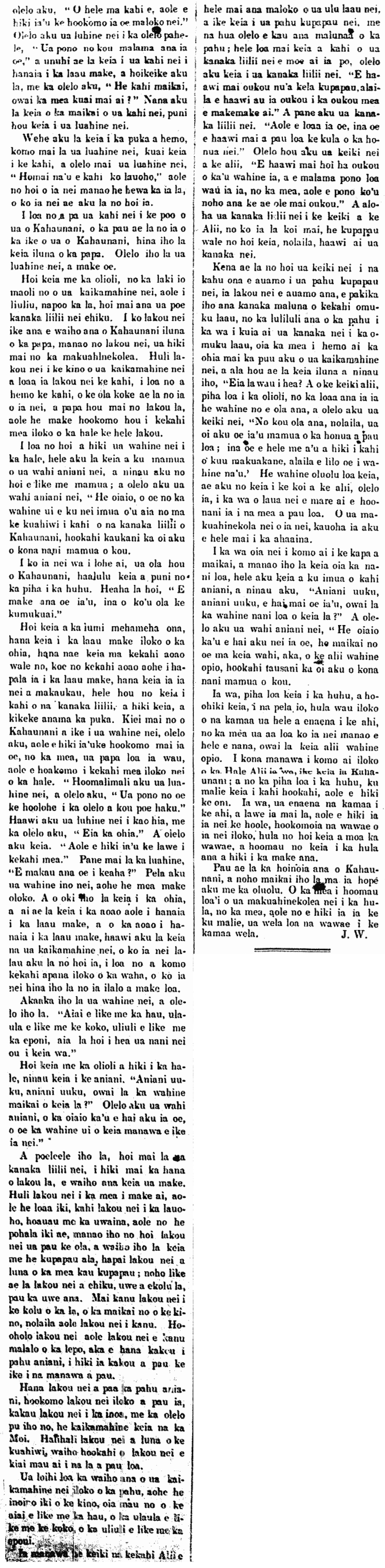
I waena o ka manawa ino ma na wahi anu o ka Akau, e noho ana kekahi wahine alii ma ka pukaaniani, e nana ana i ka helelei o ka hau iluna o ka honua, e like me ka hulu o ka manu. Noho no keia humuhumu a mea nana aku ana keia i ka helelei iho o ka hau, a ku ka lima oia nei i ke kuihumuhumu, a haule ekolu kulu koko iluna o ka hau; nana iho la keia a o ka maikai o ka ula o ke koko iluna o ka hau, i iho keia, “Ina paha e loaa ka’u keiki, alaila, e ake au e like kona aiai me ko ka hau, ka ulaula e like me ko ke koko, a o ka eleele e like me ka eponi. ” Aole i loihi loa mahope mai o ia manawa, hanau ua wahine nei he wahi kaikamahine, i like loa ke aiai me ka hau, ka ulaula o na papalina e like me ke koko, ka eleele o ka lauoho e like me ka eponi. A kapaia ka inoa o ua wahi kaikamahine nei o Kahaunani, i loaa no hoi ia ia nei a hanau, make ka makuahine….

[Here is another (perhaps more familiar) tale Grimms translated by J. W.]

(Kuokoa, 12/16/1861, pp. 1–2)

HE KAAO NO KA-HAU-NANI.

Ka Nupepa Kuokoa, Buke I, Helu 5, Aoao 1. Dekemaba 16, 1861.

...olelo aku, "O hele ma kahi e...

Ka Nupepa Kuokoa, Buke I, Helu 5, Aoao 2. Dekemaba 16, 1861.

Water of Life… from the Grimms, 1862.

WAI O KE OLA.

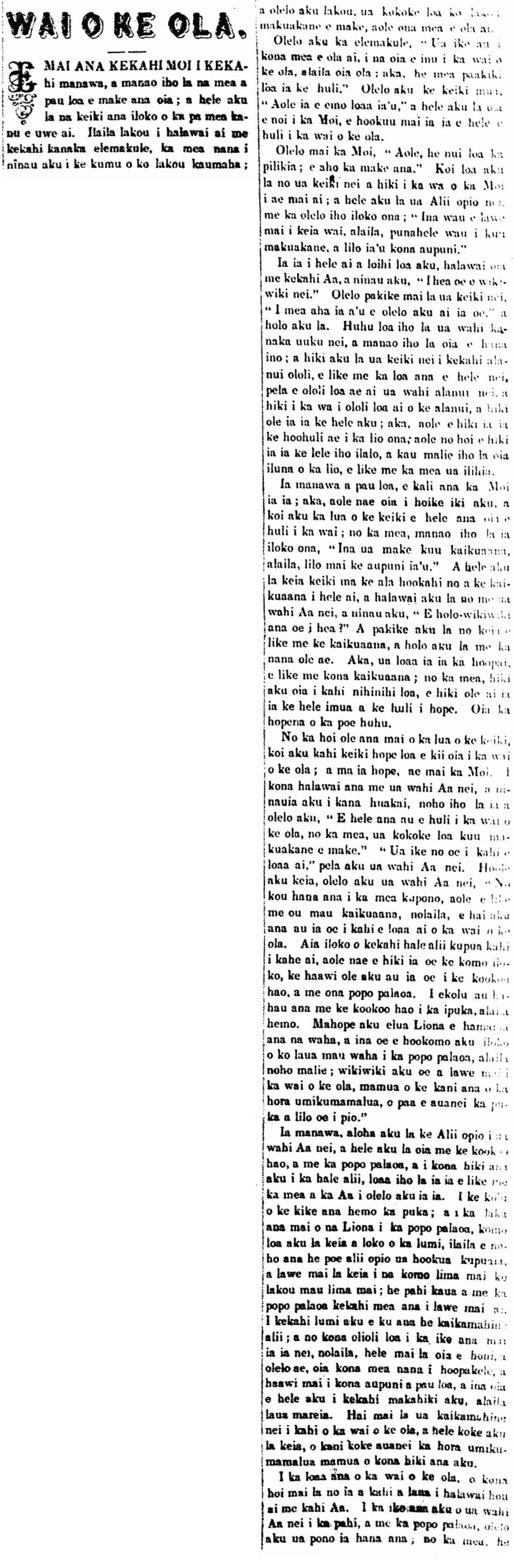
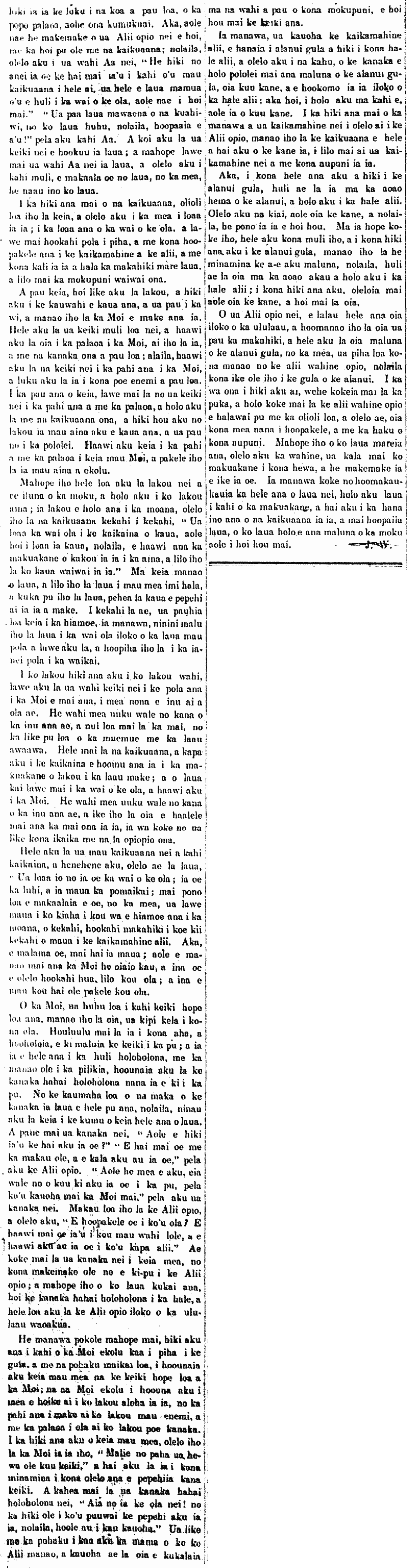
E MAI ANA KEKAHI MOI I KEKAhi manawa, a manao iho la na mea a pau loa e make ana oia; a hele aku la na keiki ana iloko o ka pa mea kanu e uwe ai. Ilaila lakou i halawai ai me kekahi kanaka elemakule, ka mea nana i ninau aku i ke kumu o ko lakou kaumaha; a olelo aku lakou, ua kokoke loa ko lakou makuakane e make, aole ona mea e ola ai…

[This is one of many stories from the Grimms’ Fairy Tales which was translated into Hawaiian by someone calling himself J. W.]

(Kuokoa, 11/29/1862, 1–2)

WAI O KE OLA.

Ka Nupepa Kuokoa, Buke I, Helu 53, Aoao 1. Novemaba 29, 1862.

...hiki ia ia ke luku i na koa a pau loa...

Ka Nupepa Kuokoa, Buke I, Helu 53, Aoao 2. Novemaba 29, 1862.

Another “Memoirs of Obookiah” translation, 1867.

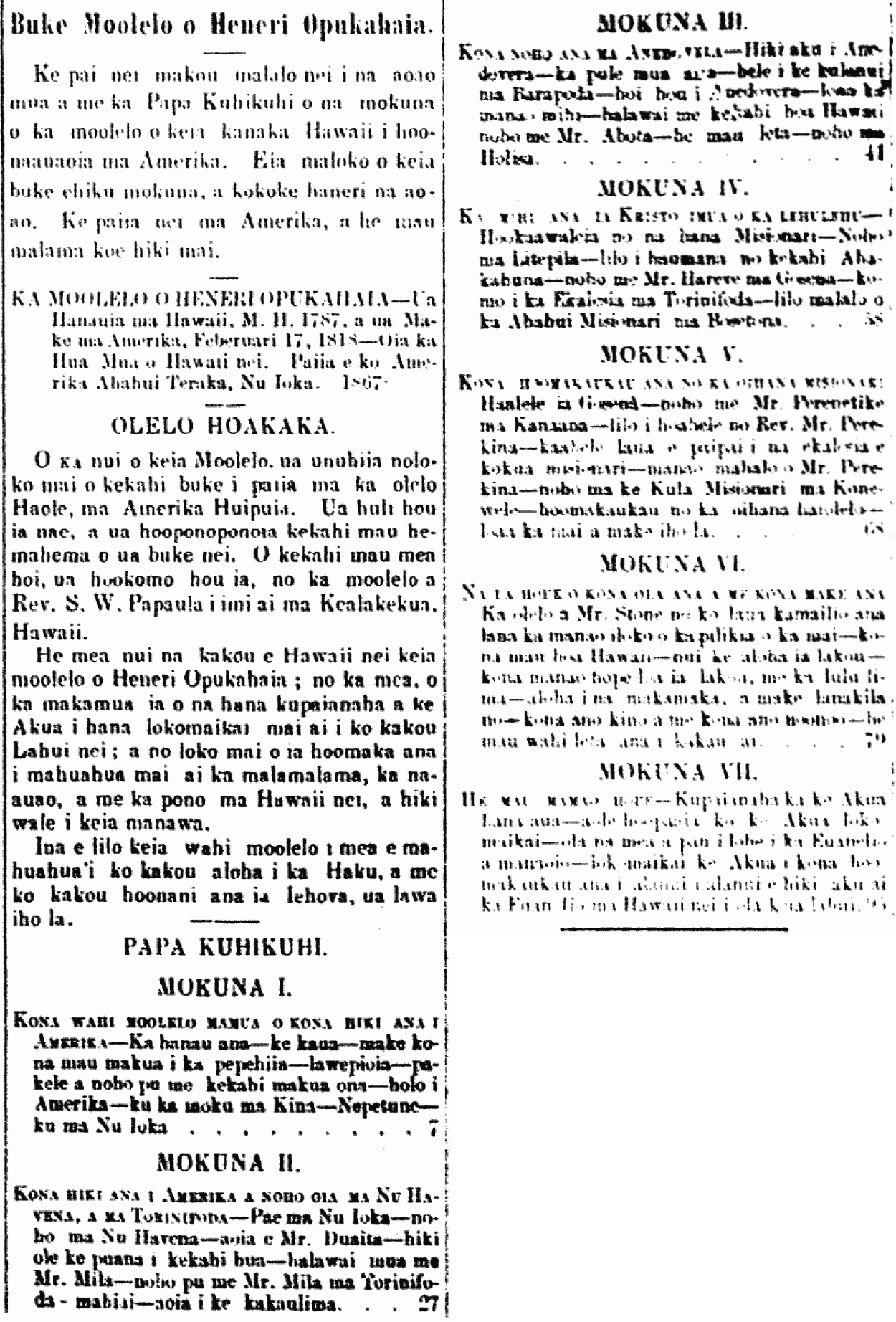
Book of the Moolelo of Heneri Opukahaia.

We are printing below the first pages of and the Table of Contents of the Chapters of the story of this Hawaiian that was educated in America. In this book is seven chapters, and it is almost a hundred pages. It is being printed in America and it will be here in a few more months.

THE STORY OF HENERI OPUKAHAIA—Born in Hawaii, A. D. 1787, and Died in America, February 17, 1818—The First Fruit of Hawaii nei. Printed by the American Tract Society [Amerika Ahahui Teraka], New York, 1867.

INTRODUCTION.

The majority of this Moolelo was translated from a book published in English in the United States of America. However, information was researched, and some of the errors of the book was corrected. Some things were added from the moolelo that Rev. S. W. Papalua investigated at Kealakeakua, Hawaii.

This story of Heneri Opukahaia is something important to us Hawaiians; for this is the first of the miracles that God performed benevolently upon our People; and through this start, the enlightenment, the knowledge, and the righteousness of Hawaii has increased until this day.

Should this moolelo become something which increases our love for God and our glorification of Jehovah, that will be enough…

[A couple of years later in 1867, the original translation was appended to and corrected with the information collected by that same S. W. Papaula of Napoopoo, and published in book form under the title: “KA MOOLELO O HENERI OPUKAHAIA, UA HANAUIA MA HAWAII, M. H. 1787, A UA MAKE MA AMERIKA, FEBERUARI 17, 1818. OIA KA HUA MUA O HAWAII NEI.”]

(Kuokoa, 5/18/1867, p. 3)

Buke Moolelo o Heneri Opukahaia.

Ka Nupepa Kuokoa, Buke VI, Helu 20, Aoao 3. Mei 18, 1867.

Speaking of Hewahewa, the great kahuna o Kamehameha…, 1837.

[Found under: “DEATHS.”]

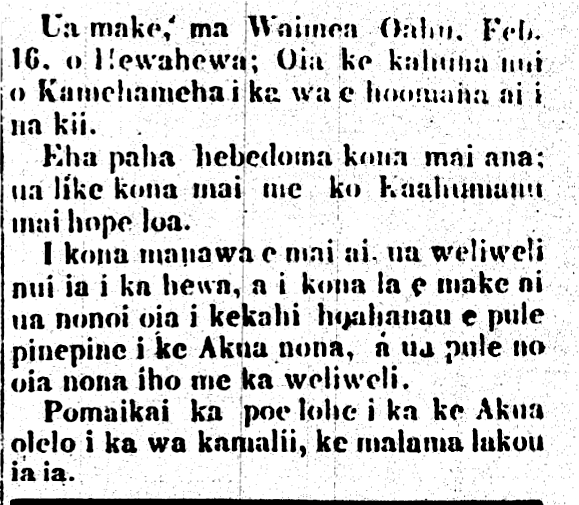
Hewahewa died at Waimea, Oahu, Feb. 16; he was the great kahuna of Kamehameha during the time when the idols were worshiped.

He was ill for perhaps four months; his illness was like that of Kaahumanu’s final illness.

While he was sick, he was terrified of sins, and on the day that he died, he asked one of the brethren to pray often to God for him, and he prayed for himself in fear.

Blessed are those who hear Godʻs teachings while they are young, should they heed them.

(Kumu Hawaii, 4/26/1837, p. 96)

Ua make ma Waimea, Oahu...

Ke Kumu Hawaii, Buke 2, Pepa 24, Aoao 96. Aperila 26, 1937.

More on Opukahaia, 1865.

The Story of Opukahaia.

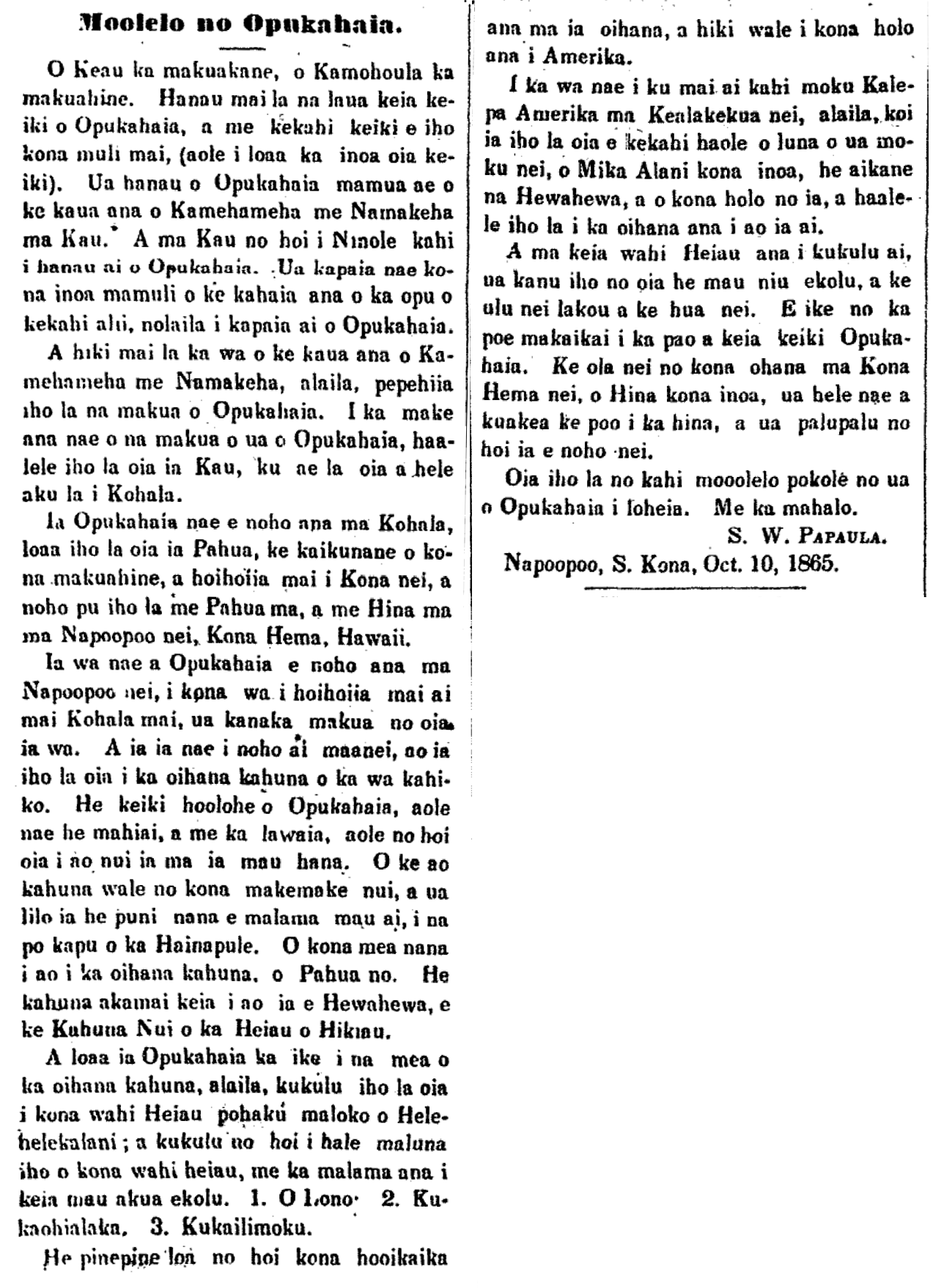
Keau was the father, Kamohoula was the mother. From the two was born this child, Opukahaia, along with another younger child (the name of that child is not known). Opukahaia was born soon before the battle between Kamehameha and Namakeha at Kau. And at Kau in Ninole, is where Opukahaia was born. He was named for the slitting of the stomach of a certain alii, and that is why he was called Opukahaia [“the cutting of the stomach”].

When the time of warfare between Kamehameha and Namakeha arrived, the parents of Opukahaia were killed. When his parents were killed, Opukahaia fled Kau, and went to Kohala.

While he lived in Kohala, Opukahaia was found by Pahua, the brother of his mother, and he was returned here to Kona, and lived with Puhua them and Hina them here in Napoopoo, South Kona, Hawaii.

The time when Opukahaia was living here in Napoopoo, when he was brought back from Kohala, he was an adult at the time. While he lived here, to him belonged the occupation of the kahuna of the olden days. Opukahaia was obedient; he was however not a farmer nor a fisherman, for he was not taught much about those things. He really just wanted to be taught kahuna things, and this was something that he was very interested in doing constantly, on sacred nights of Prayer [? Hainapule]. The one who taught him the ways of the kahuna was Pahua. He was a skilled kahuna taught by Hewahewa, the Great Kahuna of the Heiau of Hikiau.

After Opukahaia received the knowledge of the occupation of the kahuna, he constructed his stone Heiau within Helehelekalani, and he built a house atop his heiau, while he worshiped three gods. 1. Lono, 2. Kukaohiakala, 3. Kukailimoku.

He was constantly honing his skills, until he left for America.

When the American trading ship appeared here at Kealakekua, he was prodded by a haole aboard the ship, named Mika Alani, who was an aikane of Hewahewa; and so he went and left the work that he was trained in.

And at this Heiau which he built, he planted three coconuts, and they are growing and fruiting. The cave [? pao] of this boy, Opukahaia, can be seen by those who visit here. His relative still lives here in South Kona, her name is Hina; she is gray-haired and is frail now.

This is a short story of what is heard of Opukahaia. With mahalo.

S. W. Papaula.

Napoopoo, S. Kona, Oct. 10, 1865.

[This seems to be written in response to the translation being published in Kuokoa at the same period. Papaula is adding to the information given in the translation. This ability to quickly add to or correct information published in the newspapers was one of the many advantages newspapers had over books.]

(Kuokoa, 11/4/1865, p. 4)

Moolelo no Opukahaia.

Ka Nupepa Kuokoa, Buke IV, Helu 44, Aoao 4. Novemaba 4, 1865.