Unknown's avatar

About nupepa

Just another place that posts random articles from the Hawaiian Newspapers! It would be awesome if this should become a space where open discussions happen on all topics written about in those papers!! And please note that these are definitely not polished translations, but are just drafts!!! [This blog is not affiliated with any organization and receives no funding. Statements made here should in now way be seen as a reflection on other organizations or people. All errors in interpretation are my own.]

Birth announcement outside of the vital statistics column, 1913.

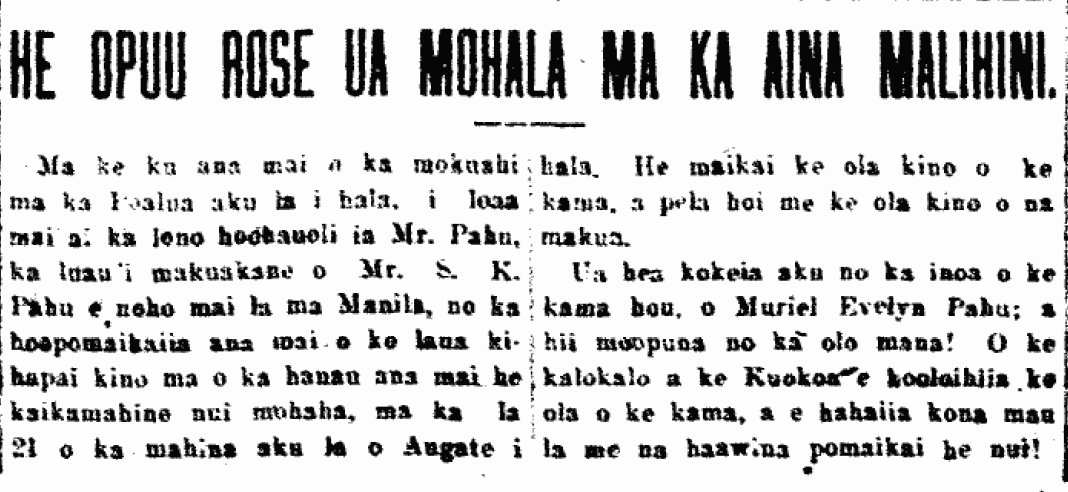
A ROSE BUD HAS BLOSSOMED IN A FOREIGN LAND.

When the steamship arrived last Tuesday, joyous news was received by Mr. Pahu, the birth father of Mr. S. K. Pahu who lives in Manila, about the blessing of their garden with the birth of a well-developed girl, on the 21st of this past month, August. The child is healthy, and so too are the parents.

The name of the newborn was soon called Muriel Evelyn Pahu; and the old man has become a grandfather! It is the prayer of the Kuokoa that the child lives long, and that her days be accompanied by many blessings!

(Kuokoa, 9/19/1913, p. 1)

HE OPUU ROSE UA MOHALA MA KA AINA MALIHINI.

Ka Nupepa Kuokoa, Buke LI, Helu 37, Aoao 1. Sepatemaba 19, 1913.

Vital Statistics, 2013.

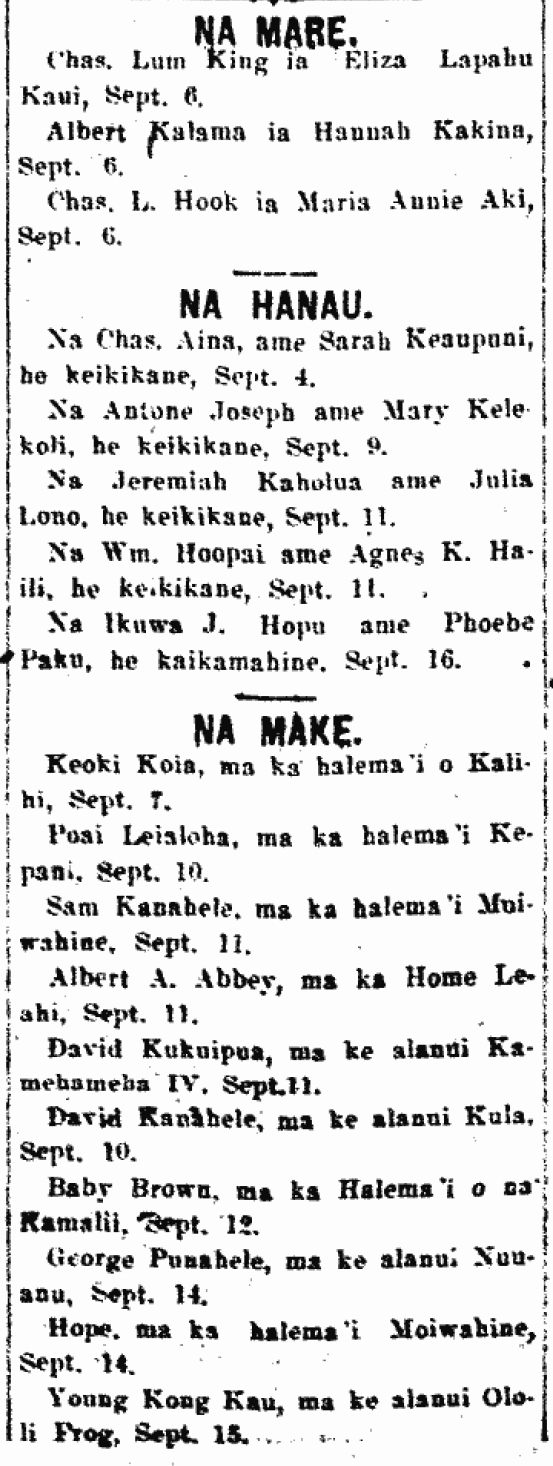
MARRIAGES.

Charles Lum King to Eliza Lapahu Kaui, Sept. 6.
Albert Kalama to Hannah Kakina, Sept. 6.
Charles L. Hook to Maria Annie Aki, Sept. 6.

BIRTHS.

To Charles Aina and Sarah Keaupuni, a son, Sept. 4.
To Antone Joseph and Mary Kelekoli, a son, Sept. 9.
To Jeremiah Kaholua and Julia Lono, a son, Sept. 11.
To William Hoopai and Agnes K. Haili, a son, Sept. 11.
To Ikuwa J. Hopu and Phoebe Paku, a daughter, Sept. 16.

DEATHS.

Keoki Koia, at the Kalihi Hospital, Sept. 7.
Poai Leialoha, at the Japanese hospital, Sept. 10.
Sam Kanahele, at Queen’s Hospital, Sept. 11.
Albert A. Abbey, at Leahi Home, Sept. 11.
David Kukuipua, on Kamehameha IV Road, Sept. 11.
David Kanahele, on School Street, Sept. 10.
Baby Brown, at the Children’s Hospital, Sept. 12.
George Punahele, on Nuuanu Avenue, Sept. 14.
Hope, at Queen’s Hospital, Sept. 14.
Young Kong Kau, on Frog Lane, Sept. 15.

(Kuokoa, 9/19/1913, p. 4)

NA MARE. / NA HANAU. / NA MAKE.

Ka Nupepa Kuokoa, Buke LI, Helu 37, Aoao 4. Sepatemaba 19, 1913.

More on the first opening of “Pacific Hall” and the Kamehameha School for Girls, 1894.

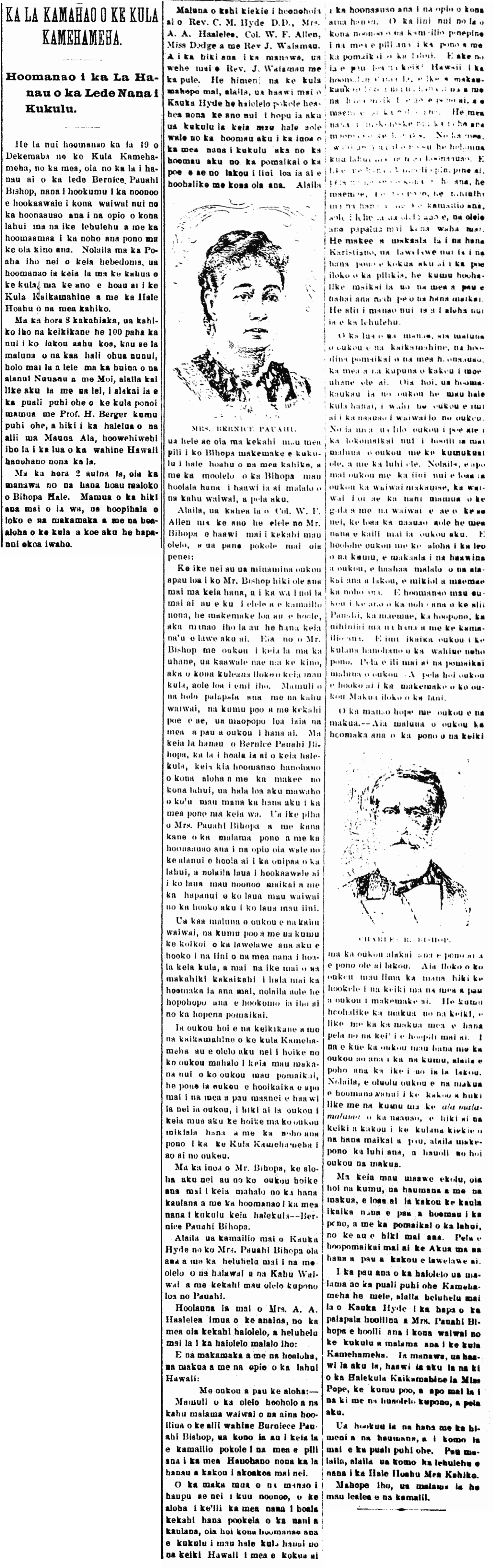
SPECIAL DAY FOR KAMEHAMEHA SCHOOL.

Remembrance of the Birthday of the Founding Lady.

The 19th of December is a much celebrated day for Kamehameha School, for it is the day of birth of the lady, Bernice Pauahi Bishop, the one who came up with the idea to set aside her great estate for the educating of the youth of her people in the many fields of knowledge and in living healthily. Therefore on the past Thursday, the day was commemorated on the grounds of the school, by dedicating the Girls’ School and the Museum.

At 8 o’clock in the morning, perhaps 100 boys were dressed in military uniform and put aboard and rode trolleys [kaa hali ohua nunui], getting off at the corner of Nuuanu and King Streets, and from there they marched with lei, led by the school’s band in front, with Prof. H. Berger as the conductor, until the crypt of the alii at Mauna Ala, where they decorated the grave of the honorable Hawaiian woman for whom the day was for.

2 o’clock in the afternoon was the time for the dedication in Bishop Hall [Bihopa Hale]. Before the hour, the room was filled with intimates and friends of the school with a majority outside.

Rev. C. M. Hyde, D. D.; Mrs. A. A. Haalelea; Col. W. F. Allen; Miss Dodge; and Rev. J. Waiamau were sitting in a raised area. And when the time came, Rev. J. Waiamau began with a prayer. After that was a hymn by the school, and then Doctor Hyde gave a short speech of welcome of which the gist was that these structures were built not just to memorialize the name of the founder, but for the continued benefit of those who it is hoped will emulate her life. Thereafter…

MRS. BERNICE PAUAHI.

he moved on to matters dealing with Bishop’s desire to build a museum, and the story of Bishop’s planning given under the board of trustees, and so forth.

Then Col. W. F. Allen was called up as a representative for Mr. Bishop to give some words, and he spoke shortly in this manner:

I know that you all regret the absence of Mr. Bishop on this occasion, and when asked to represent and speak for him I should much rather have declined but felt it a duty to accept. That Mr. Bishop is with you today in spirit you all know, and though absent in person, he interest in these schools never wanes. By correspondence with the trustees, principals, and others, he has kept well posted in all the progress you have made. On this the natal day of Bernice Pauahi Bishop, the founders day of this Institution, such a grand monument to her love and care for her people, it is beyond my powers to do justice to the occasion or theme. Both Mrs. Bishop and her husband fully realized that the proper care and teaching of the young was the only way to insure the stability of the people, and so they have devoted their best thought, and much of their property to carry out these ideas.

To you, trustees, principals and teachers the responsibility of carrying out the wishes of the founders of this institution belongs, and from the experience of the few years since the opening, no fears are entertained of the ultimate result.

To you, boys and girls of Kamehameha School, I would say that to show your appreciation of the great gifts of your benefactors, you should ever strive to take advantage of all that is here offered you, so that in the future you can show by your industrious and virtuous lives what the Kamehameha School has done for you.

On behalf of Mr. Bishop, I thank you all for showing such an appreciation for the grand work and memory of the founder of this institution—Bernice Pauahi Bishop. [English for W. F. Allen’s speech taken from Hawaiian Star, 12/19/1894, p. 3.]

Then Dr. Hyde spoke about Mrs. Pauahi Bishop’s life, and read the minutes of meetings of the Board of Trustees as well as some appropriate words about Pauahi.

Mrs. A. A. Haalelea was introduced before the assembly because she was one of the speakers, and she read the following speech below:

O Associates and Friends, Parents and Youth of the Hawaiian People:

With all of you is my aloha:—

Because of the decision of the trustees of the estate of Bernice Pauahi Bishop, I was invited on this day to speak a bit about the Honorable one for whose birthday we are gathered.

The first thing to come to mind, is that it was the aloha of this alii which initiated this greatest work of beauty and fame, that is her idea to build boarding schools for the Hawaiian children to help educate the youth of her homeland. That was her great desire and spoke often things pertaining to the good and benefit of the lahui. [Image is unclear for a number of lines.] She was devout and vigilant in her Christian duties; she undertook many worthy causes to help those in need, and she is a fine example for all to follow after in good deeds. She was an alii who was thought much of and well loved by the people.

The second point: upon you, O Girls, is the inheritance of education, something our kupuna did not dream of. That being for you is prepared some boarding schools where you can find knowledge that will be truly valuable for you. So you will be indebted for the great kindness given upon you at no expense or trouble. Therefore, strive with great effort to acquire this precious treasure, a treasure more beautiful than gold or any of the other riches of this world; should you gain an education, there is no one that can take it away from you. Listen with aloha to the teachings of your instructors, pay attention to the lessons, be humble to their instruction, and be neat and clean in your daily life. Constantly recall the character of the alii Pauahi: her purity, righteousness, and decorum in actions and words. Always strive for the honorable standing of a woman who lives properly. In that way, you will be blessed. And in that way you will be carrying out the desire of your Father in heaven.

The last thought goes to you, O Parents.—Upon you lie the beginnings of the good character of your children…

CHARLES R. BISHOP.

…by your guidance will your children be upright or not so. Within your hands is the power to steer the children towards all that you desire. The parents are examples for the children; for instance, how a parent acts is what a child will follow. Should your actions and your instructions contradict those of the teachers’, then what is taught to them will be wasted. Therefore, O Parents, please strive to support and cooperate with the teachers on the pathway to knowledge, so that our children may reach a high level in all fine occupations, an this will make the effort worthwhile, and you, O Parents, will rejoice.

With these three plies, that being the teachers, the students, and the parents, we can get a strong cord which will hold fast and push forward the righteousness and blessings of the lahui for the coming age. In that way will God bless us in all our endeavors.

At the end of her speech, the Kamehameha band played a song, then Dr. Hyde read the portion of the will of Mrs. Pauahi Bishop giving her wealth for the building and caring for the Kamehameha School. This is when the keys of the Girls’ School handed over to Miss Pope, the principal, and she took the keys with some appropriate words, and so forth.

The activities were let out with the singing of the students, along with the band. When that was done, the crowd went in to see the Museum.

After that, some fun activities for the children were held.

[Much of the text on the top of the column on the right is hard to read. It is time that these Hawaiian-Language Newspapers were rescanned as cleanly as possible! If you can’t read the information, is it really information?]

(Kuokoa 12/22/1894, p. 2)
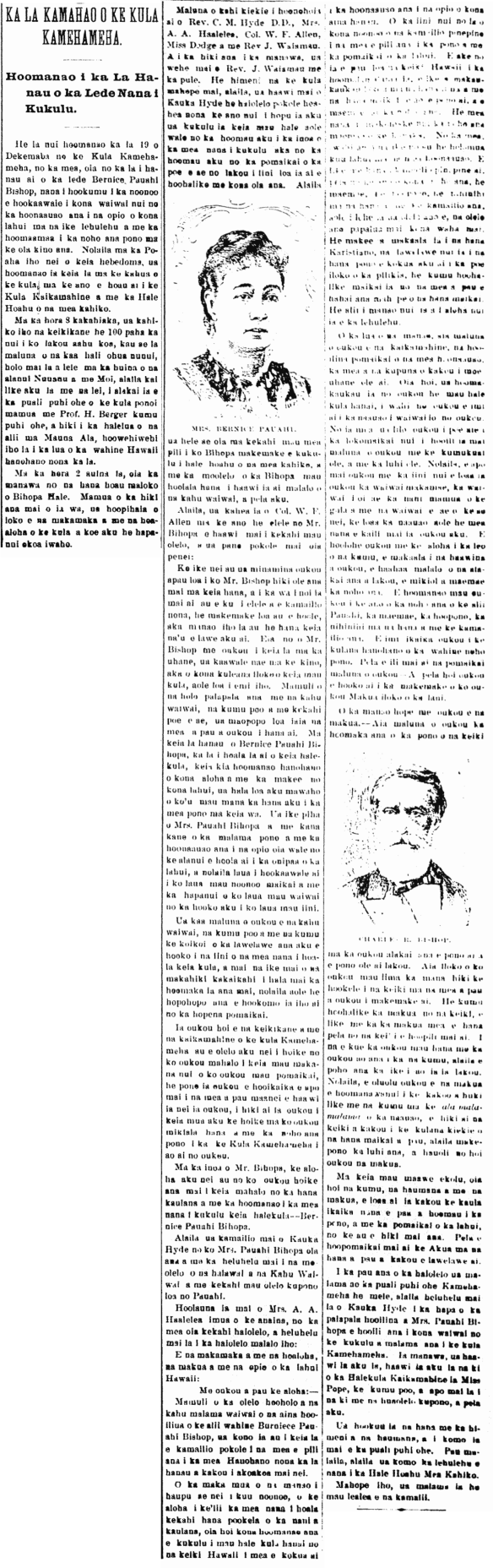
KA LA KAMAHAO O KE KULA KAMEHAMEHA.

Ka Nupepa Kuokoa, Buke 33, Helu 51, Aoao 2. Dekemaba 22, 1894.

More from Bishop Museum and Kamehameha Schools, 1894.

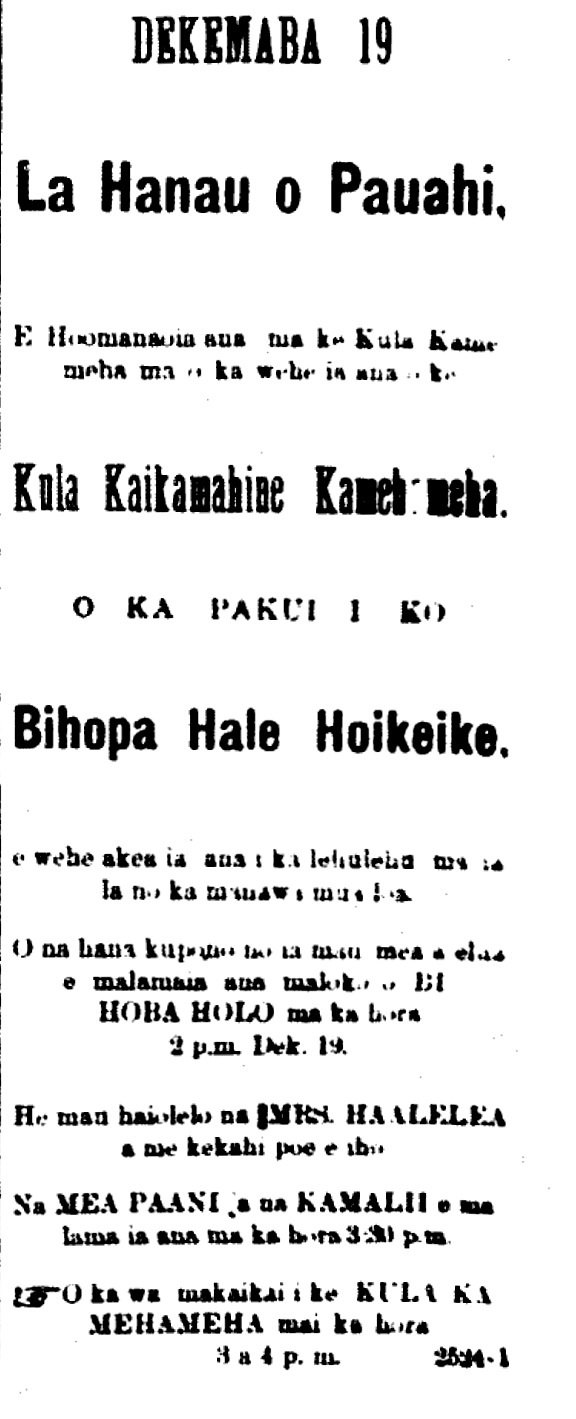
DECEMBER 19

Birthday of Pauahi.

Commemorated at the Kamehameha School with the opening of the

Kamehameha School for Girls.

THE ANNEX TO

Bishop Museum.

will be opened to the public on that day for the very first time.

Those are two fitting events held in BISHOP HALL [BiHOBA HOLO] at the hour of 2 p. m. Dec. 19.

Speeches by MRS. HAALELEA and some others.

GAMES for CHILDREN will be held at 3:30 p. m.

Period for touring the KAMEHAMEHA SCHOOL from 3 to 4 p. m.

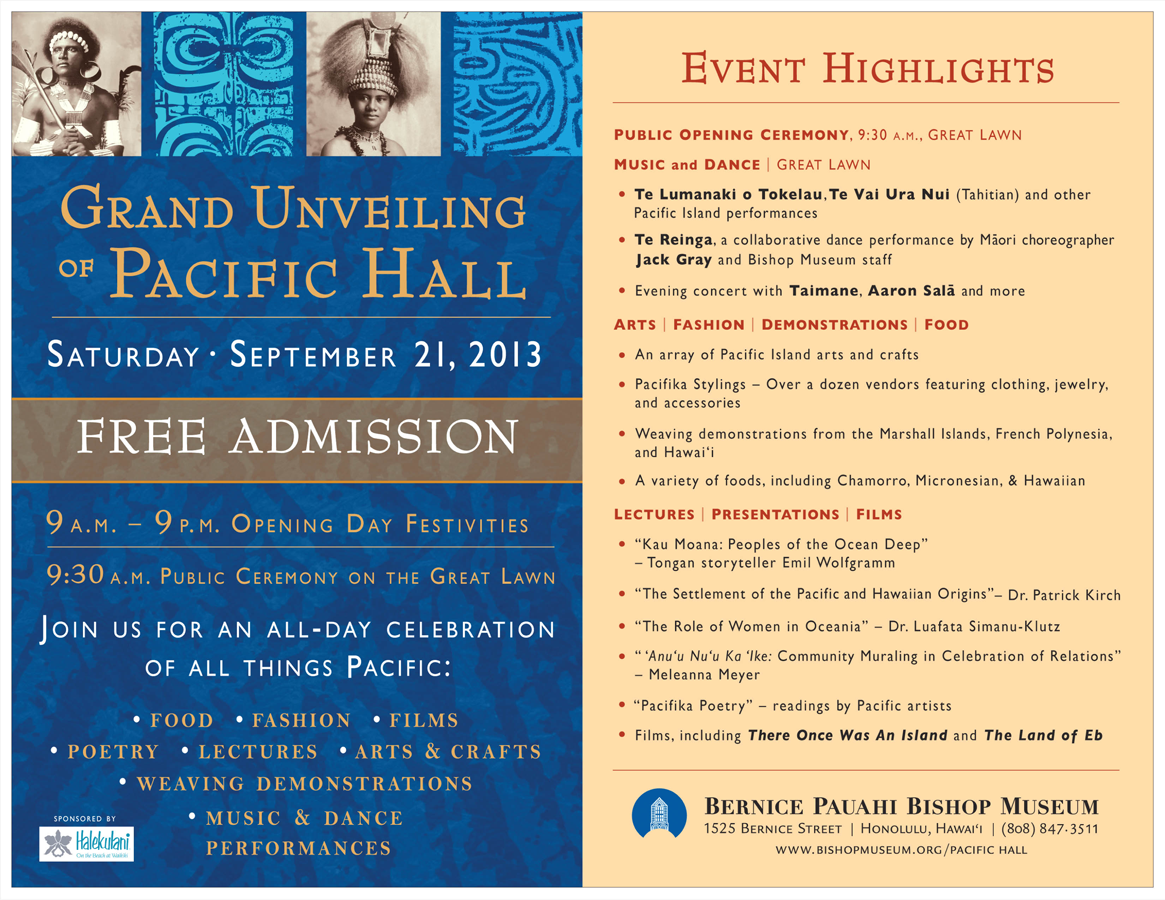
[Mahalo to DeSoto Brown for commenting on this opening. This Annex to the Bishop Museum was unveiled to the public on the 19th of December, 1894, became Polynesian Hall, and today is reopening to the public after extensive renovations as Pacific Hall! If you are here on Oahu, go check it out!! Free admission all day today (Saturday, September 21, 2013, until 9:00 p. m.)!!!]

(Kuokoa, 12/15/1894, p. 2)

DEKEMABA 19 La Hanau o Pauahi

Ka Nupepa Kuokoa, Buke XXXIII, Helu 50, Aoao 2. Dekemaba 15, 1894.

The Kamehameha Museum and the Kamehameha Schools, 1894.

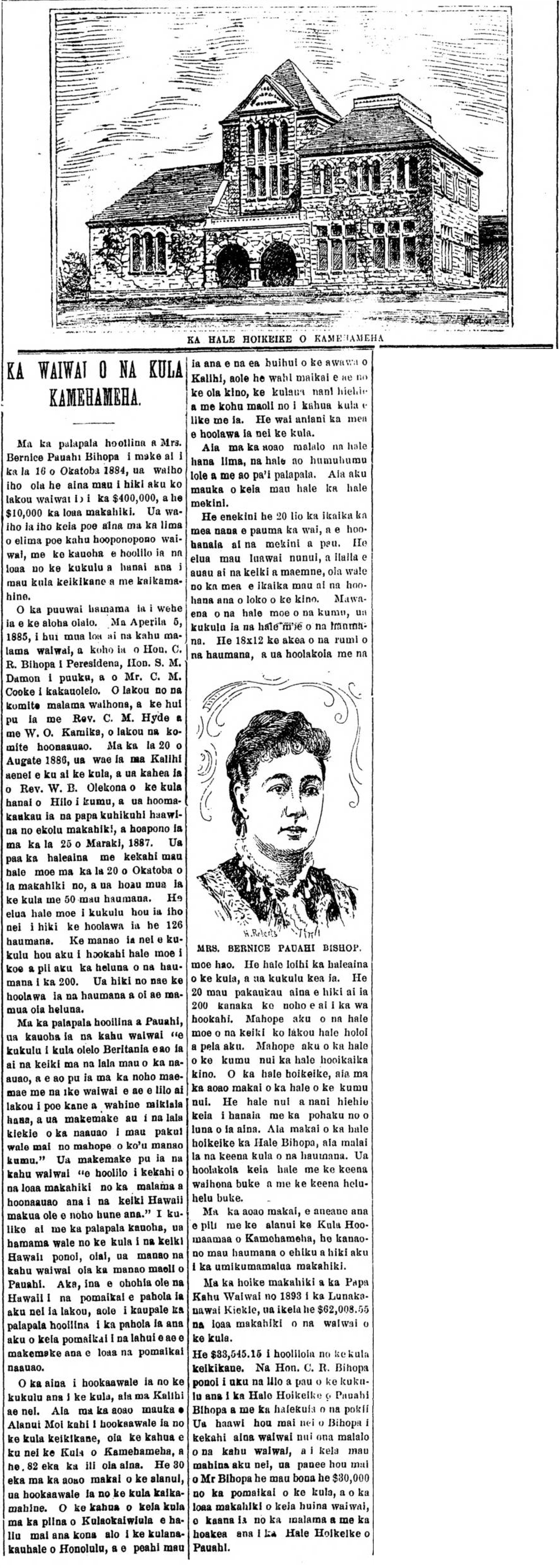
KA HALE HOIKEIKE O KAMEHAMEHA

THE ASSETS OF THE KAMEHAMEHA SCHOOLS.

In the will of Mrs. Bernice Pauahi Bishop, who died on the 16th of October 1884, she set aside lands whose true value comes to $400,000, with $10,000 profit per year. These lands are in the hands of five trustees, with the stipulation that the profits go to the building and caring for a school for boys and girls.

This generosity was based on true aloha. On the 5th of April, 1885, the trustees met for the first time and selected the Hon. C. R. Bishop as President, Hon. S. M. Damon as treasurer, and Mr. C. M. Cooke as secretary. They are the finance committee, along with Rev. C. M. Hyde and W. O. Smith, made the education committee. On the 20th of August, 1886, up in Kalihi was chosen as the place where the school would stand, and Rev. W. B. Olsen of the Hilo boarding school to be a teacher, and the curriculum for three years was prepared and approved on the 25th of March, 1887. The cafeteria and some dormitories were completed on the 20th of October of that same year, and the school began with 50 students. There were two dormitories just built, which can house 126 students. One more dormitory is planned which will increase the number of students to 200. However more than that number of students can be accommodated.

In the will of Pauahi, the trustees were instructed to “build an English-language school where the children were to be educated in the regular branches of knowledge, and they were also to be educated to live morally and with important knowledge to make them industrious men and women, and I want high branches of knowledge to supplement those basics.” It is desired that the trustees “use a portion of the profits to go to the education and care of the indigent orphaned Hawaiian children.” As per the will, the school is opened to native Hawaiians, being that the trustees believe that was the true intent of Pauahi. However, the Hawaiians are not interested in the good put before them, the will does not preclude the the provision of those blessings to the other races who want to receive the benefits of an education.

The land set aside for the building of the school is up in Kalihi. The land mauka of King Street is set aside for the boys’ school; this is where the Kamehameha School now stands; the area of that land is 82 acres. There are 30 acres makai of the street, which is set aside for the girls’ school. The area for this school is in the heights of Kulaokaiwiula with it face overlooking the cit of Honolulu, and it is constantly fanned by the cool air of the valley of Kalihi; there is no other finer place for the health, the beauty, and the suitability as a school campus like this. Clear water is supplied to the school.

Below that are the workshops, the sewing shop and the printing shop. And mauka of these buildings is the mechanic shop.

The strength of the engine pumping the water is 20 horses, and the total power is utilized. There are two huge pools where the children will bathe until clean, and that is what will keep their bodies working strong. Between the sleeping quarters of the teachers were built the dormitories of the students. The student rooms are 18 x 12 wide, and are furnished with…

MRS. BERNICE PAUAHI BISHOP.

…iron beds. The schools cafeteria is a long building, and it was built in the form of a cross. There are 20 dining tables accommodating 200 people at a time. Behind the children dormitories, are their laundry building, and so forth. Behind the principal’s house is the gymnasium. The museum is on the makai side of the principal’s house. This is a grand a beautiful structure constructed with rock from atop the land. Makai of the museum is Bishop Hall, and this is where the school rooms of the students are. This building is furnished with a library and a reading room.

On the makai side, almost adjacent to the road is the Kamehameha Preparatory School; there are sixty students from seven until twelve years of age.

In the yearly report of the Trustees for 1893 to the Chief Justice, it was seen that the school’s annual income was $62,008.55.

$33,545.15 was spent on the boys’ school. It was the Hon. C. R. Bishop who paid for the entire cost of the building of the Pauahi Bishop Museum and the preparatory school. Bishop also recently gave some of his valuable land holdings under the trustees, and several months ago, Mr. Bishop forwarded bonds of $30,000 for the benefit of the school, and the yearly income of these assets will be apportioned for the care and the expansion of the Pauahi Museum.

[It was just serendipity that caused me to notice this article the other day, and I thought with the re-opening of the new Pacific Hall at the Bernice Pauahi Bishop Museum, there was no better time to post this article about the actual beginnings of the Museum and of the Kamehameha Schools.

Check the early years of this familiar building (minus the dome) on campus as well, from an earlier post!

The public opening of Pacific Hall is tomorrow. Admission is free! Go check out all of the special events, and the newly redone Pacific Hall!!]

(Kuokoa 5/26/1894, p. 1)

KA WAIWAI O NA KULA KAMEHAMEHA.

Ka Nupepa Kuokoa, Buke XXXIII, Helu 21, Aoao 1. Mei 26, 1894.

Another Aladdin translation, 1916.

A MOOLELO KAAO
OF
ALADDIN, THE PEASANT CHILD
AND THE SUPERNATURAL LAMP

Aia maloko o ke kapitala o kekahi o na okana aina waiwai loa a palahalaha hoi o ke aupuni nui o Kina, e noho ana kekahi kanaka humuhumu lole o Masetafa kona inoa, aohe ana hana i kaulana e ae a o keia hana wale no o ka humuhumua tela lole paha, elike me ia e kamaaina nei iwaena o kekahi poe Pake o nei mau la.

MOKUNA I.

He iluhune keia Masetafa, aohe i lawa kana mau wahi loaa e hiki ai e hoolawa kupono iaia iho ame kana wahine ame hookahi keikikane a ke Akua i hoopomaikai mai ai iaia ma keia ola ana, elike me ke kupono nei i makemake ia.

O keia keikikane o Masetafa, nona ka inoa o Aledian, a nona hoi keia moolelo kaao e paneeia aku nei no ka pomaikai o ko ke Kilohana Pookela poe heluhelu moolelo, no ka ilihune no hoi paha o na makua, elike no hoi me na keiki a ka poe ilihune o nei mau la, aole i hoonaauao maikaiia, ua hoopalaleha loaia kona malama a a’oia ana, a ma ia ano ua lilo keia i keiki palaualelo, a e hookuu mauia ana oia e hele a e hana elike me kona makemake, a e hoomaopopoia, o na hana apau ana i hana ai he mau hana hewa loa, no ka mea, aole oia i a’oia i na aoao maikai ame na hana maikai, ame na hua maikai e loaa mai ana mailoko mai o na hana maikai…

[Perhaps this and the translation of the previous post were done from G. S. Beaumont’s “The Arabian Nights’ Entertainments: or, The Thousand and One Nights,” published in 1811. However, the S. K. Kaai version seems a little more simplistic. This later translation seems to follow closely Beaumont’s English and appears in the Nupepa Kuokoa from 11/3/1916 and concludes on 3/9/1917.]

(Kuokoa, 11/3/1916, p. 6)

HE MOOLELO KAAO NO ALEDINA, KE KEIKI LOPA AME KA IPUKUKUI KUPUA

Ka Nupepa Kuokoa, Buke LIV, Helu 44, Aoao 6. Novemaba 3, 1916.

Aladdin from One Thousand and One Nights, 1862.

A Mooolelo about
Aladdin and the Lamp that was
AMAZING!

Translated for the “Hoku o ka Pakipika” from
“The One Thousand and one Nights of Arabia.”
Translated by S. K. Kaai.

Aia hoi ma ke kulanakauhale nui o Kina, e noho ana kekahi kanaka humuhumu lole i kapaia kona inoa o Masekafa. He wahine kana, a me ke keiki, i  kapaia o Aladana. No kona ilihune loa, aole i lawa pono ka ai na lakou e hala ai ka la.

O ka mea mau i ka laua keiki, o ka auana hele io ia nei, me kekahi poe keiki kolohe e aku, a he molowa hoi i ka hana. I ka manawa a pau, ua hooikaika mau aku kona makuakane i ke ao ana ia ia i kekahi oihana, i hiki ai ia ia ke malama ia ia iho a me kona makuahine, ke hiki mai kona manawa e loohia ai e ka make. Aka, aole i hoolohe mai ua keiki kuli la, nolaila, ua lilo ia i mea nona e mai ai a make aku la…

[Tales from the One Thousand and One Arabian Nights seems to be one of the most often translated selection of stories throughout the life of the Hawaiian-Language Newspapers. This story of Aladdin and the Enchanted Lamp itself appears several times. Does anyone know what Simona K. Kaai based his translation off of? Could he have been translating from the French of Antoine Galland?

This story appears in Hoku o ka Pakipika from 5/1/1862 and concludes on 6/26/1862.]

(Hoku o ka Pakipika, 5/1/1862, p. 1)

He Mooolelo no Aladana a me ka Ipukukui KUPANAHA!

Ka Hoku o ka Pakipika, Buke I, Helu 32, Aoao 1. Mei 1, 1862.

Ben Hur translation, 1913.

FINE STORY
OF

BEN HUR

THE JEWISH BOY

A STORY FROM THE TIME
OF

CHRIST

(Translated and provided for the benefit of the readers of the Hoku.)

INTRODUCTION

Some months past, we were asked by some of the readers of the Hoku o Hawaii if we could try printing the famous story written by General Lew Wallace, one of the very famous authors of America who just died, and we agreed. Many months have gone by and we have only now come through with what we first agreed to do. This is a moolelo which a portion of the beginning chapters were first translated into Hawaiian by Mrs. A. A. Haalelea, one of the ladies who was very adept at English and the mother tongue of the Native Land, and due to the kindness of her younger surviving sister, we have acquired what was translated earlier by this honored lady of this land.

This moolelo will perhaps not be greatly liked by some of the readers of the Hoku o Hawaii, however, let it be considered that there are valuable lessons in every moolelo published in the columns of the newspapers as well as books. Amongst our readers are Pastors, Church Leaders, and brethren of the many Churches, and within this moolelo which we are translating and publishing in the columns of Hoku o Hawaii, there are many very valuable things dealing with the life of this Jewish boy, along with his searching to find a life for his loved ones in distress. This story is one dealing with combat of that ancient times of the People in the East. This moolelo is one of aloha, pointing out to the reader the Steps of the  Wonderful Redeemer of the world. The translator hopes that the “Famous Story of Ben Hur,” the Jewish boy who took part in the glorious races with the other Nations of the time in the East, will be welcomed into the Homes of readers of the Hoku.

FIRST BOOK.
CHAPTER I
IN THE DESERT

E moe loihi ana ka Pae Mauna o Iesebela Zubela ma na aina e kokoke ana i ka waoakua neoneo o Arabia, a ua aneane e kanalima mile ka loihi o keia lalani mauna, a ua moe ae no hoi me he peelua ala ke nana ia aku e ka maka o ke kanaka. Ua lilo nae keia lalani mauna i mea paku aku i ka makani Hikina e pa hoopoino ana i na poe mahiai kanu waina o ke awawa nani o Ieriko.

Malalo iho o ka paepae o keia lalani mauna o Iesebela Zubela e ku ana na puu one i puhi ia mai e ka makani Hikina, a ina aole io no keia lalani mauna kohu peelua, ina la ua uhi pu ia no na awawa momona o ka aina o Moaba ame Amona. Ua lilo keia lalani mauna ano neoneo i kiai naue ole, e pale aku ana i na poino a ka makani wela o ka waoakua o Arabia e halihali mai ai, nolaila, e hoomaopopo ana no kaua i ka mea heluhelu, na hana no ka mea Hookumu Honua i keia lalani mauna neoneo, a maikai ole i ka nana ana a na maka o ke kanaka, no kekahi pomaikai o na kanaka e noho ana ma kahi kokoke i ua lalani mauna ola…

[Lew Wallace’s “Ben-Hur: A Tale of Christ” was translated by MEA UNUHI MOOLELO, “Translator of Stories,” in Hoku o Hawaii from 2/20/1913 to 7/4/1918. Unfortunately, the issues from the beginning (1913) until the early months of 1917 of the Hoku o Hawaii are still not available online.]

(Hoku o Hawaii, 2/20/1913, p. 1)

HE MOOLELO MAIKAI NO BENA HURA

Hoku o Hawaii, Buke 7, Helu 38, Aoao 1. Feberuari 20, 1913.