Author Archives: nupepa
La Hoihoi Ea, 1843.
THE RESTORATION.
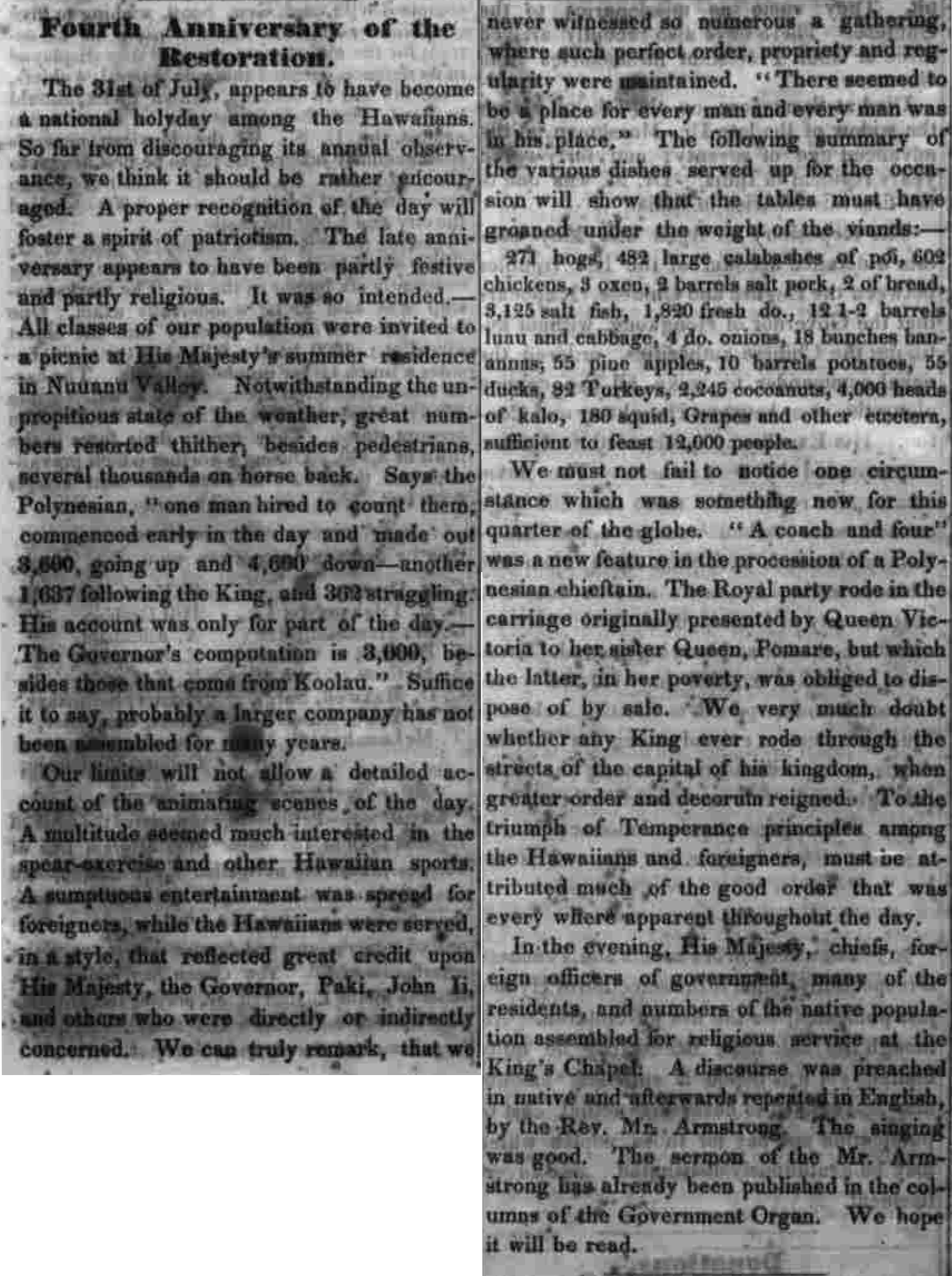
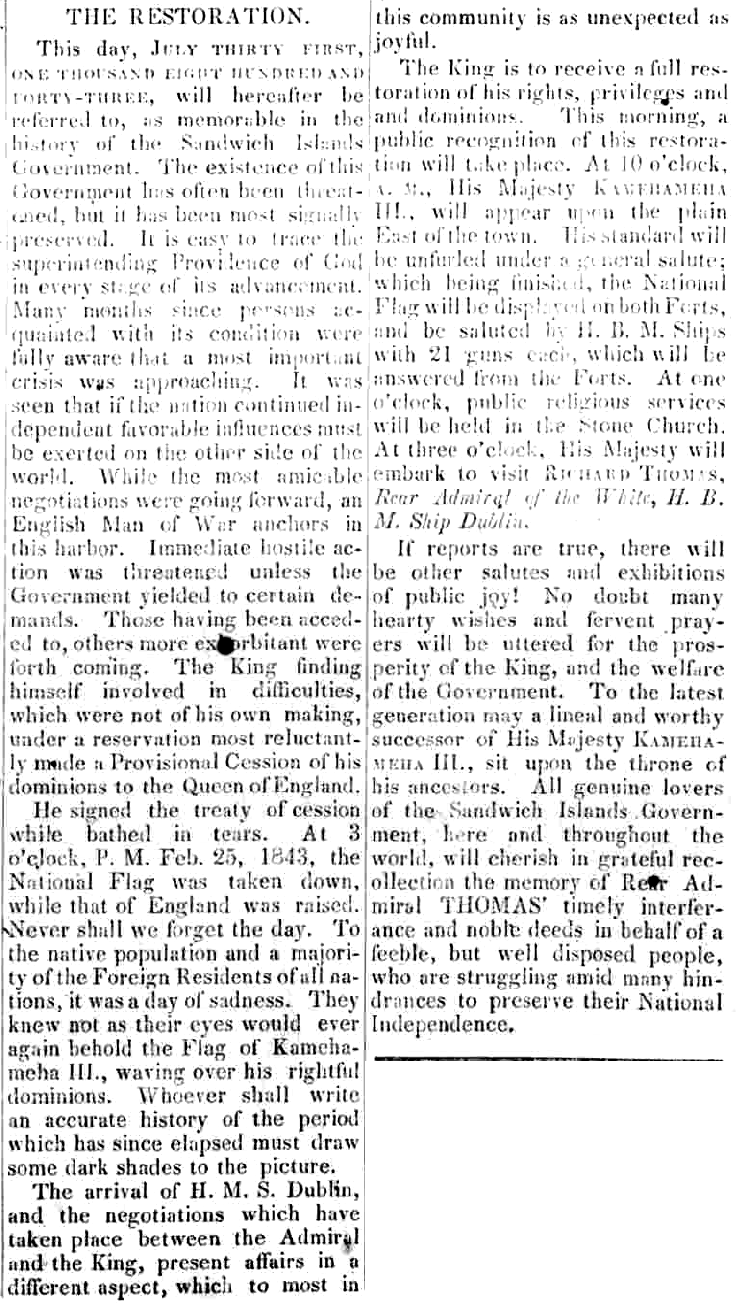
This day, July thirty first, one thousand eight hundred and forty-three, will hereafter be referred to, as memorable in the history of the Sandwich Islands Government. The existence of the Government has often been threatened, but it has been most signally preserved. It is easy to trace the superintending Providence of God in every stage of its advancement. Many months since persons acquainted with its condition were fully aware that a most important crisis was approaching. It was seen that if the nation continued independent favorable influences must be exerted on the other side of the world. While the most amicable negotiations were going forward, an English Man of War anchors in this harbor. Immediate hostile action was threatened unless the Government yielded to certain demands. Those having been acceded to, others more exhorbitant were forth coming. The King finding himself involved in difficulties, which were not of his own making, under a reservation most reluctantly made a Provisional Cession of his dominions to the Queen of England.
He signed the treaty of cession while bathed in tears. At 3 oʻclock, P. M. Feb. 25, 1843, the National Flag was taken down, while that of England was raised. Never shall we forget the day. To the native population and a majority of the Foreign Residents of all nations, it was a day of sadness. They knew not as their eyes would ever again behold the Flag of Kamehameha III., waving over his rightful dominions. Whoever shall write an accurate history of the period which has since elpased must draw some dark shades to the picture.
The arrival of H. M. S. Dublin, and the negotiations which have taken place between the Admiral and the King, present affairs in a different aspect, which to most in this community is as unexpected as joyful.
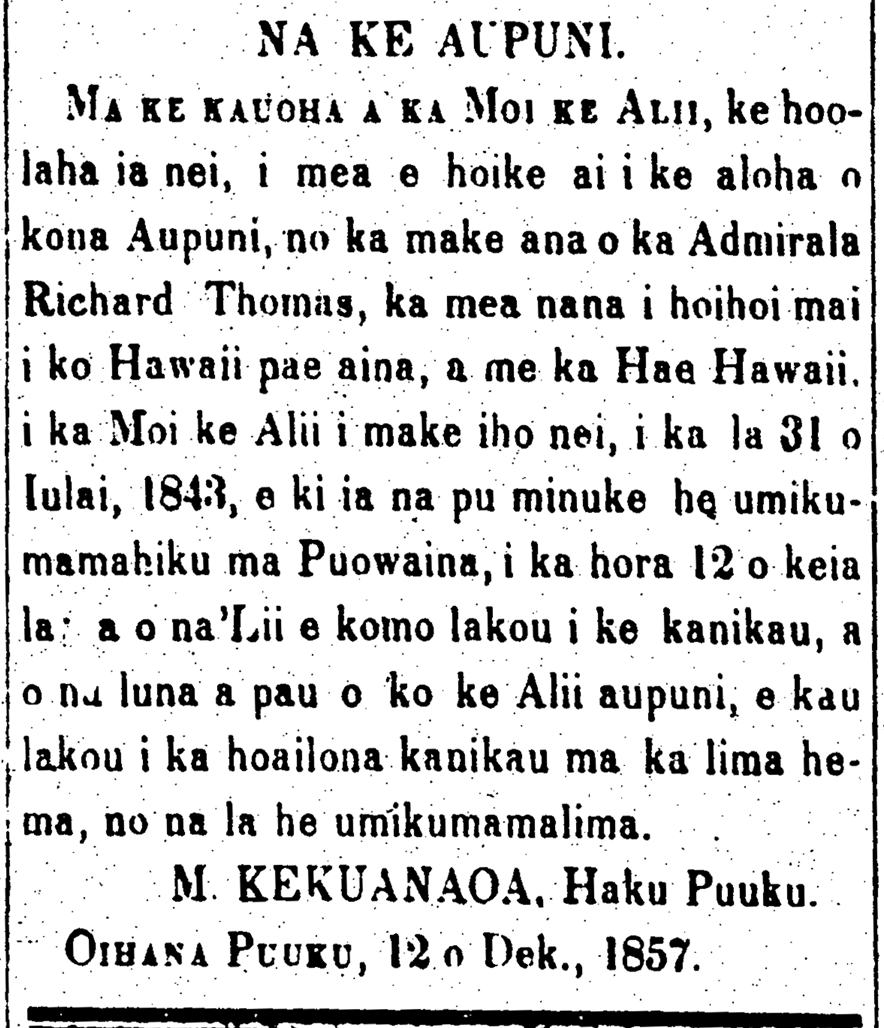
The King is to receive a full restoration of his rights, privileges and and dominions. This morning, a public recognition of this restoration will take place. At 10 oʻclock, A. M., His Majesty Kamehameha III., will appear upon the plain East of the town. His standard will be unfurled under a general salute; which being finished, the National Flag will be displayed on both Forts, and be saluted by H. B. M. Ships with 21 guns each, which will be answered from the Forts. At one oʻclock, public religious services will be held in the Stone Church. At three oʻclock, His Majesty will embark to visit Richard Thomas, Rear Admiral of the White, H. B. M. Ship Dublin.
If reports are true, there will be other salutes and exhibitions of public joy! No doubt many hearty wishes and fervent prayers will be uttered for the prosperity of the King, and the welfare of the Government. To the latest generation may a lineal and worthy successor of His Majesty Kamehameha III., sit upon the throne of his ancestors. All genuine lovers of the Sandwich Islands Government, here and throughout the world, will cherish in grateful recollection the memory of Rear Admiral THOMASʻ timely interferance and noble deeds in behalf of a feeble, but well disposed people, who are struggling amid many hindrances to preserve their National Independence.
[This is from a special edition of the Advocate and Friend published on the very day of the restoration. The rest of the coverage can be seen here on the Mission Houses Museum page! Mahalo to Dwight Baldwin (descendant of the Temperance Advocate, and Seamenʻs Friend editor Samuel C. Damon) via Nathan Napoka for reminding me that there are indeed Hawaii newspapers other than Hawaiian-Language Newspapers.]
(Advocate and Friend, 7/31/1843, p. 38)
Humor in the papers, 1870.
Pearls found in Heeia, 1918.
PEARLS FOUND IN OYSTERS.
According to the Japanese newspaper, Hawaii Shinpo, down in Heeia, Koolau, from six oysters [papaua] got by a Japanese who was diving in the ocean a few days ago, he found two pearls [pohaku momi].
From what was said, this is a Japanese used to diving in search of pearls, and the place he is accustomed to diving is the Seas of the South, where he spent a lot of his time searching for pearls in oysters.
When he dove at Heeia, it was not much work searching for papaua, and he found six easily; checking inside of them, two had pearls inside, and the other four did not.
In the South Seas, according to that Japanese, it is very rare to find an pearl in an oyster; from a hundred papaua, you will only find two pearls.
However he believes that the papaua here are different from the ones of the South Seas; and he is certain that if the diving for papaua continues here, a lot of pearls will be found, and this endeavor will benefit a number of people.
(Kuokoa, 2/8/1918, p. 8)
Child of Robert Waipa Parker born, 1889.
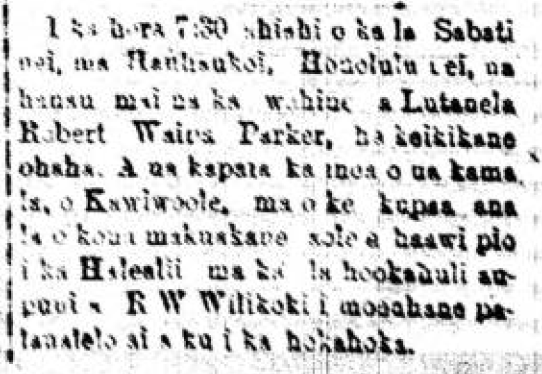
At 7:30 in the evening of this Sabbath at Hauhaukoi, Honolulu nei, born to the wife of Lieutenant Robert Waipa Parker, was a plump boy. The child was named Kawiwoole, because of the steadfastness of his father not to surrender the Palace on the day of the overthrow of the government [hookahuli aupuni] which R. W. Wilcox lazily dreamt up and was thwarted.
(Ko Hawaii Pae Aina, 8/10/1889, p. 1)
Columbia Records in Hawaii, 1911.
TO RECORD HAWAIIAN SINGING.
H. L. Marker, an employee of the Columbia Phonograph Company, arrived aboard the steamship Amerika Maru, and the main reason for his trip is to record Hawaiian singing in a horn [ipu leo] of the Company for which he works. There have been many a fake recording of Hawaiian songs, and after a close check, it was found that they weren’t Hawaiian songs.
Therefore, so as no more people purchasing music from this Phonograph Company will be deceived, that haole was sent here. Hawaiian songs and hula songs and chanting is what this haole will be recording in his horns. He will be travelling around the islands to accomplish this great effort, and when his work here is done, he will be going to Japan and China to do this job of recording songs of those people.
(Aloha Aina, 6/24/1911, p. 1)
Henry May & Co., Ltd. advertisement, 1919.
Tastigood
OLEOMARGARINE
Be careful about pronouncing the name correctly, and check if your merchant gave you the right package. Cut out this picture, and show it to your grocer, then he will know what to retrieve to give to you. He can get it from
Henry May & Co., Ltd.
Distributors [Poe Hoolawa] Honolulu
SPREAD YOUR BREAD WITH
Tastigood
(meaning “Really tasty”)
Tastigood is a good condiment for spreading on bread, and at a much less expense than anything else, because it is low priced, keeps for a long time, and good to eat, and truly delicious.
(Kuokoa, 3/7/1919, p. 3)
Autobiography of Joseph Kawai Opunui, 1929.
THE STORY OF JOSEPH KAWAI OPUNUI AND HIS DESCENDANTS
Joseph Kawai Opunui was born on June 16, 1853 of Hapuku Opunui (m) and Kauhailama Waiwaiole (f) at Kalapana, Puna, Hawaii; and when he grew older, he would go around Kapoho, Puna; and when he was 15, came to Honolulu. Here he entered the English school at Kawaiahao in 1868, on the 3rd day of the month of May; David Malo was the teacher there. He stopped attending that school on July 20, 1870, and entered the Royal School of Kehehuna [Kula Alii o Kahehuna] in 1871. He left that school on April 6, 1872 and went to work for C. P. Ward [Ka Pepee] at Old Plantation as a grass cutter, as a pond worker at the pond of Koula, and as a coconut tree planter of the coconut grove growing there to the present.
He took a wife on October 6, 1873, and had his first child on September 29, 1874. My wife gave birth in Honolulu.
I took care of the jitney cart [kaa kika-ne] for my boss, Mr. Ward, for wages of four dollars a week. That was a lot of money in those days. After that, I went to work for Henry May & Co., food purveyors, weighing coffee, rice, sugar, potatoes, and so forth. They pay was ten dollars per week. I stayed with that employer until they merged with J. T. Waterhouse and McIntyer under the company name of Henry May & Co. It is still in operation today.
From there, I went to work for the government on roads for $1.25 a day, for 15 years. This was under the territory, and then 12 years under the county. I am retired now, but am receiving a pension.
This past 16th of June, I made 76 years old.
We have 1 son and 3 daughters from our loins;
Philamina, Joseph, Christina and Kealohapauole.
Philamina had 17 children. She was married twice. Her first husband was Herman Kaouli, and the second was William Keiki. With him she had six children, and with H. K. Ha’o she had eleven children.
The second child of Joseph Jr. died at the age of three.
One child is living in China. Kealohapauole is childless.
Between Philamina and Herman Kaouli, 2 children are living; with H. K. Ha’o, 2 children are living.
The first child is Margaret; the second child is Victoria. Margaret married J. Kaakua, and they had two children: Mary Laniwahine (deceased) and the second child, Hiram K. Kaakua.
Victoria married Isaac K. Kaawa and they had three children: Thomas K., Margaret Kahalelaulani, and Victoria.
The one living child of William K. Keiki is Clara, and she has five children: Philamina Nohokula, Manuel Kawai, Clara Hiilani, William Weheikekapu, and Frank.
Andrade is the name of Clara’s husband, and he is the father of those children.
I have three generations. With aloha.
Joseph Kawai Opunui
1805 Kalani St., Honolulu.
[I came across this interesting autobiography the other day. Usually, this type of information is submitted by someone else when a person dies, but here, Joseph Kawai Opunui is telling his own story.]
(Alakai o Hawaii, 6/27/1929, p. 4)
Kuu Aina Hanau E. 1871.
Kuu Aina Hanau e.
1. Kuu aina hanau e,
Nou au e mele nei,
Aina maikai,
O na makua o’u,
Me na keiki pu,
E o, mai o a o,
Kuu mele nei.
2. Kuu aina hanau e,
Kuu aina makamae,
Aloha au
I kou mau kahawai,
Na kualono e,
Na kula uli mau,
He oli ko’u.
3. Hookani na laau,
Na aheahe hau
I kou maikai;
Poha na leo e
Mai na pohaku mai,
Kanaka, kamalii,
Hookani ae.
4. E ka Makua e,
Nou mai ka malu nei,
E haliu mai,
Hoomau i na maikai,
Ka maluhia e,
A nou ko makou ‘Lii
Ka hoomaikai.
Mele Kula Sabati.
My Dear Land of Birth.
1. My dear land of birth,
For thee I sing,
Beautiful land,
Of my parents,
And my children,
Respond from far and wide
To my song.
2. My dear land of birth,
My cherished land,
I love
Your rivers,
The mountain ridges,
The ever-green plains,
I am jubilant.
3. The trees sound forth,
The gentle cool breezes
Of your splendor;
The voices boom
From the rocks,
Men, children,
Sounding forth.
4. O Father,
From whom comes our protection,
Look down upon us,
Let the goodness continue,
The peace,
And for you, our King
Is the praise.
Sunday School Song.
[This is the song sung at the opening of the first meeting of the Kona chapter of the Kaahumanu Society held on March 30, 1913. It is one of the many compositions of Lorenzo Lyons. The song was sung to the tune of “My Country ‘Tis of Thee,” and it seems some of the sentiment was taken from its lyrics as well.]
(Lau Oliva, 2/1871, p. 1)
Lei o Kaahumanu, 1916.
LEI O KAAHUMANU.
Lei Kaahumanu i ke aloha,
Lei haaheo i ka lanakila;
Lei i ka mamo hulu melemele,
Lei Hawaii i kou inoa.
Hui:
E ala e ka I ame ka Mahi,
E ala na kini o ka aina;
Hookahi puuwai me ka lokahi,
E ola ka inoa o Kaahumanu.
Eia ko lei e lei ai,
Na ke aloha i lawe mai nei;
I lei hoohie mau ia nou,
E ola ka inoa o Kaahumanu.
LEI OF KAAHUMANU.
Kaahumanu is adorned with a lei of aloha,
A proud lei in victory;
Adorned with the yellow-feathered mamo,
Hawaii is adorned by your name.
Chorus:
Rise, O I and Mahi,
Rise, O People of the land;
With one heart and in unity,
May the name of Kaahumanu live.
Here is the lei for you to wear,
Carried here by aloha;
It is an ever distinguished lei for you,
May the name of Kaahumanu live.
(Kuokoa, 12/29/1916, p. 2)