Unknown's avatar

About nupepa

Just another place that posts random articles from the Hawaiian Newspapers! It would be awesome if this should become a space where open discussions happen on all topics written about in those papers!! And please note that these are definitely not polished translations, but are just drafts!!! [This blog is not affiliated with any organization and receives no funding. Statements made here should in now way be seen as a reflection on other organizations or people. All errors in interpretation are my own.]

Kaahumanu Society Chapter V of Kona a century old! 1913 / 2013.

KAAHUMANU SOCIETY ESTABLISHED.

At 3:30 p. m. on Sunday, and through the kindness of Rev. E. S. Timoteo of the Church of Kealakekua, he allowed the coconut frond lanai of his home to hold the meeting to establish the Kaahumanu Society [Ahahui Kaahumanu] of the calm of Kona.

The members of the various branches of Kohala, Waimea, Hamakua, Laupahoehoe and the society of the famous rain of Hilo Hanakahi; they were members who came for duties of the Evangelical Association [Ahahui Euanelio], Sunday School Association [Ahahui Kula Sabati], and Christian Endeavor Association [Ahahui C. E.].

The meeting was presided over by the head president of the Parent Association of Honolulu, Miss Lucy K. Peabody, and the secretary of that parent association, Mrs. Lahilahi Webb took the minutes of the meeting.

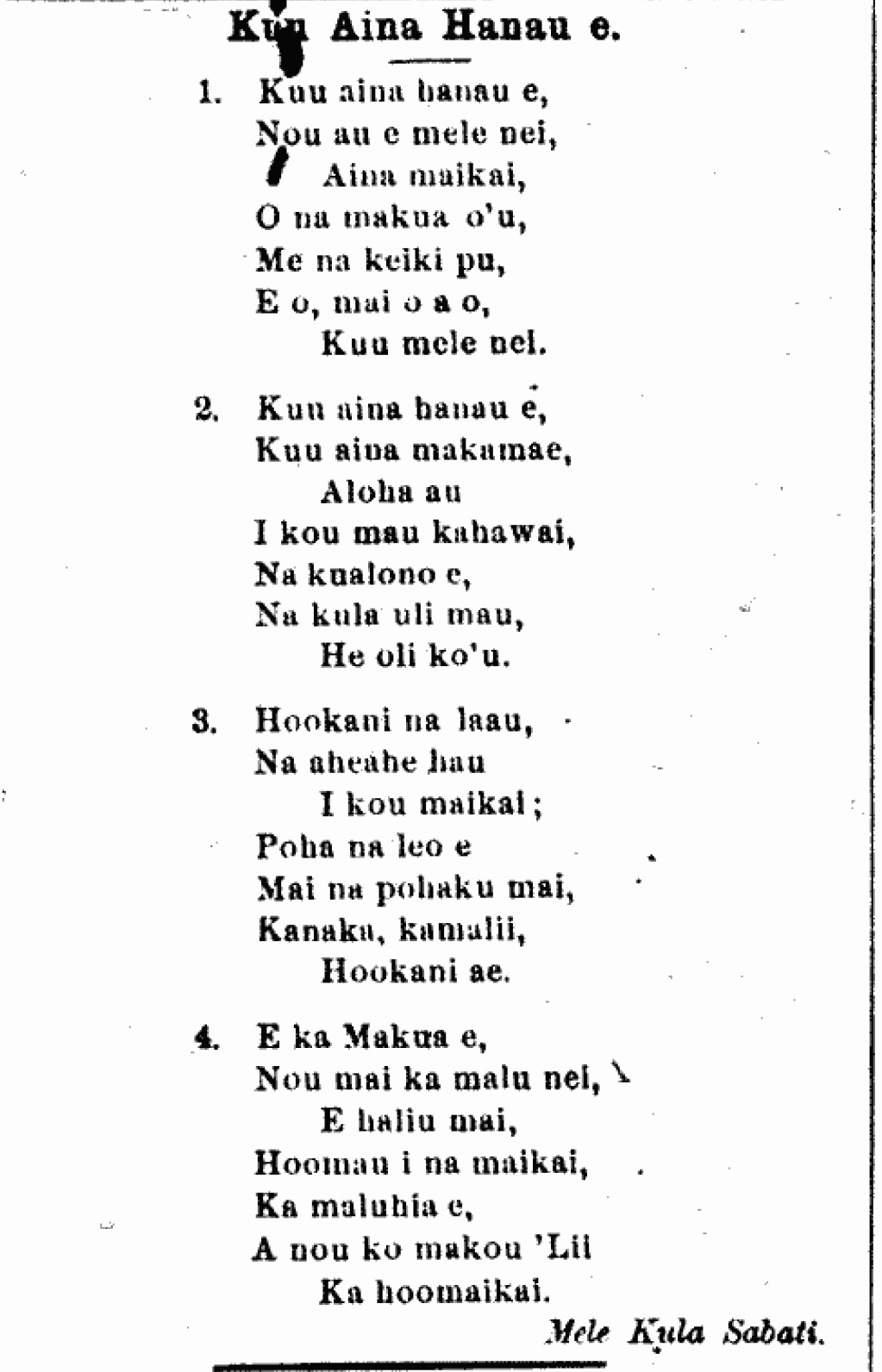
The meeting was begun with the singing of the hymn, “Kuu aina hanau e” and a prayer given by S. L. Desha.  The proclamation was read by Mrs. Lahilahi Webb for the establishment of the Kaahumanu Society Chapter Five at Napoopoo, South Kona, Hawaii, and at the completion of the reading of the text of the proclamation from the parent association of Honolulu, the establishing members of the new Association, Chapter Five, was made known.

There were twenty members who signed the membership book, and in that way, the Kaahumanu Society Chapter Five was started; and at that time, an election was held to choose the officers of this association whose names are below:

Mrs. Esther Baker, president; Mrs. Kealoha Kamauoha, vice president; Miss Maggie Hooper, treasurer; Miss Sarah Kamauoha, secretary; Mrs. Lydia Kekuewa, vice secretary; Mrs. Kaai, auditor; and Mrs. Emily Haae,  committee of the whole [? komite nui].

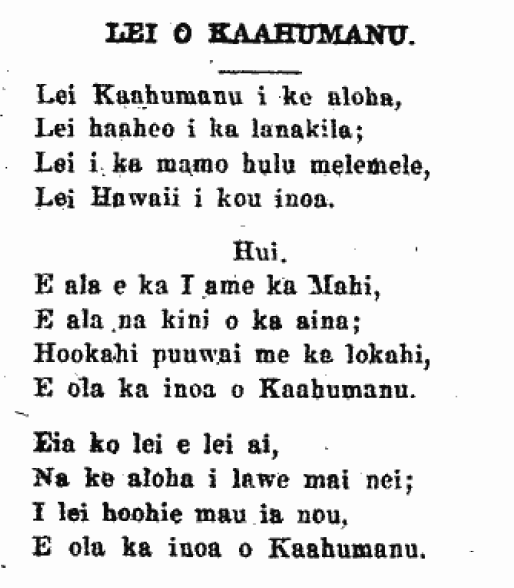
After the election of the officers was over, all the members of the many associations stood along with the new members of the Kaahumanu Society Chapter Five, and the new members were adorned with paper lei, and at that time the members of Chapter Three of Hilo sang the song “Ka Lei o Kaahumanu.”

When that truly lovely song was being sung, the members were filled with awe and tears welled up in some, and the two mothers who established this junior Kaahumanu society felt that this was perhaps one of the most awe-inspiring initiations seen;  and after the song was over, the new association was blessed with a prayer by the brother of the Ahahui Kaahumanu, Rev. S. J. Desha of the Church of Haili, the one who is a great help to the efforts of the mothers of this association.

The money donated for the treasury of this new association was 27.75.

The sisters of the Kaahumanu committees who arrived and participated in the activities were these below:

Mrs. Hattie Hapai, the honorary president of the association of Hilo; Mrs. Alai Akana, president of the Association of Hilo; Mrs. Beke Keliikahi, secretary of Hilo; Mrs. Sarah Kaiwi, Mrs. Mary Kahenui, Mrs. Elena Mahaiula, Mrs. Helela, and Miss Kaimi Mahaiula, member of Hilo; Mrs. Emma Laeha, president of the association of Laupahoehoe, Mrs. Kealalaina Ne, from the association of Kohala, as well as Mr. Annie Hussey. Mrs. Becky Kawai and Mrs. Eliza Maguire from the association of Waimea, Mrs. Esther K. Haina, secretary of the association of Hamakua; Mrs. Kelalaina Robikana, Mrs. Haili Timoteo and Mrs. Bessie Kopa, from the parent association of Honolulu.

There were letters from Mrs. Aima Nawahi and Mrs. J. Saffery, the president of the Kaahumanu Society of Hamakua, expressing to their sisters of their aloha and of their support for this endeavor.

As for the two of us, the mothers who came to endorse this endeavor, we extend our unending thanks to the officers and members of the Evangelical association of the Island of Hawaii for their generosity in allowing us time to carry out our work for which we travelled over the ocean.

We also give our appreciation to the good kamaaina, Mr. and Mrs. G. P. Kamauoha, for their very kind hospitality in their comfortable home; and the head of the Church, Rev. E. S. Timoteo and his amiable wife, and we extend our thanks to the members of all the associations which joined in to help us for the good of the junior association of the calm of Kona. We also thank the brother of the Kaahumanu members, Rev. S. L. Desha, for his great assistance, as well as to our good sister: Mrs. Aima Nawahi for her assistance in planning to move the endeavor forward; and we also extend our thoughts of aloha and unending blessings to our kind kamaaina who lent her car to take us to where our duties took us, that being Mrs. Kelalaina Robikana of Honolulu.

We pray to our Heavenly Father to give great blessings upon us all; and we hope that with the assistance of benevolent God that you younger sisters of Kaahumanu Society Chapter Five  will move forward, and your works will progress, and may the sisterly love amongst us all last forever.

The two of us,

Lucy K. Peabody, president of the Kaahumanu Society Chapter 1.

Lahilahi Webb, Secretary.

March 31, 1913.

(Kuokoa, 4/11/1913, p. 2)

KU KA AHAHUI KAAHUMANU.

Ka Nupepa Kuokoa, Buke LI, Helu 14, Aoao 2. Aperila 11, 1913.

Mrs. Kiliwehi Hoapili Kaauwai passes on. 1873.

Mrs. Kiliwehi Kaauwai Dies.

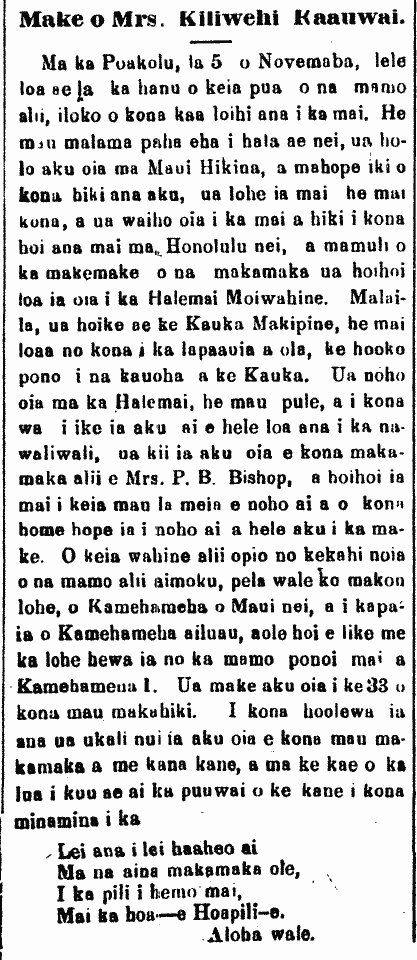
On Wednesday, the 5th of November, the breath of this descendant of chiefs left her, after being sick for a long while. Perhaps some four months ago, she travelled to East Maui, and a short while after she reached there, it was heard that she was ill, and she remained in this state until returning to Honolulu, and at the request of her friends, she was taken to the Queen’s Hospital. There, Dr. McKibbin [Kauka Makibine], said that she had sickness that was curable if she followed closely the Doctor’s advice. She remained at the Hospital for a number of weeks, and when it was seen that she was becoming very weak, she was taken by her royal companion, Mrs. P. B. Bishop, to live with her these past days, and this was Kiliwehi’s last home where she dwelt until her death. This young chiefess is indeed one of the descendants of rulers, according to what we hear, of Kamehameha of Maui, who was called Kamehameha Ailuau; and not as was mistakenly heard, that she was a direct descendant of Kamehameha I. She died at the age of 33. At her funeral, she was escorted by her friends and her husband [Hoapili Kaauwai], and at the edge of her grave, her husband heart let out its regret with:

Adorned by a lei of pride
In friendless lands,
The link that has been severed,
From the companion—O Hoapili—e,
Much Aloha.

(Kuokoa, 11/8/1873, p. 2)

Make o Mrs. Kiliwehi Kaauwai.

Ka Nupepa Kuokoa, Buke XII, Helu 45, Aoao 2. Novemaba 8, 1873.

Kiliwehi Hoapili Kaauwai, 1873.

[Found under: “Local News.”]

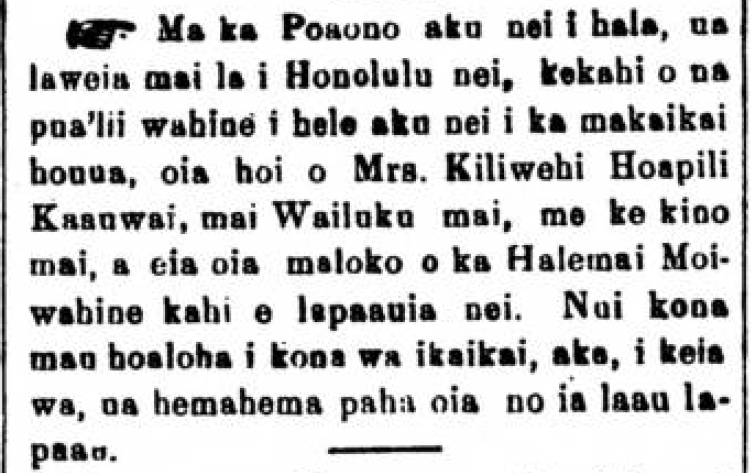
Last Saturday, brought to Honolulu from Wailuku was one of the royal women who had gone on a tour of the world, that being Mrs. Kiliwehi Hoapili Kaauwai, with an ailing body, and here she is now at the Queen’s Hospital being treated. She had many a friend when she was in good health, but now, she perhaps is lacking in this medicine.

(Kuokoa, 10/18/1873, p. 2)

Ma ka Poaono aku nei i hala...

Ka Nupepa Kuokoa, Buke XII, Helu 42, Aoao 2. Okatoba 18, 1873.

Poi calabash made by plaiting hala leaves? 1869.

[Found under: “LOCAL NEWS: Oahu.”]

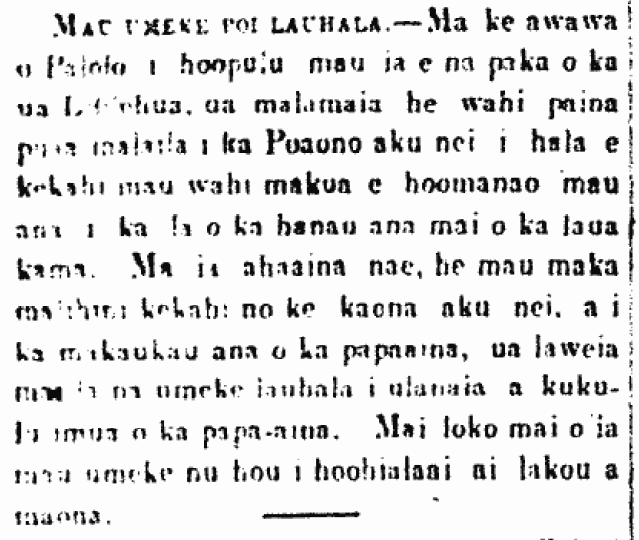
Lau Hala Poi Umeke (Calabashes).—In Palolo Valley which is ever moistened by the patter of the Lililehua rain, there was held a small feast of pig there on this past Saturday by parents who regularly celebrate the birthdays of their child. At the party, there were also present visitors from town, and when the table of food was being prepared, umeke made out of woven lau hala were brought and placed at the front of the table. From these new type of calabashes did they eat heartily until full.

[Does anyone still make these? Has anyone seen examples of these??]

(Kuokoa, 4/10/1869, p. 3)

Mau Umeke Poi Lauhala.

Ka Nupepa Kuokoa, Buke VIII, Helu 15, Aoao 3. Aperila 10, 1869.

Salt production, 1869.

[Found under: “LOCAL NEWS: Oahu.”]

Salt Storehouse.—We’ve seen makai of Kakaako in Honolulu nei, a huge wooden Structure is being constructed by the King [Kamehameha V], and the great riches that will be stored in that building is salt. This is the salt that now stands near the banks of the salt ponds. The past few days it has been drizzling a bit, and it would be best if it [the salt] was stored in a safe location.

(Kuokoa, 9/18/1869, p. 3)

HALE HOAHU PAAKAI.

Ka Nupepa Kuokoa, Buke VIII, Helu 38, Aoao 3. Sepatemaba 18, 1869.

Sending mynahs to the Philippines, 1928.

PHILIPPINES TELEGRAPH TO SEND OVER BIRDS

For the first time it is believed that the mynahs have value, being that there was received a telegraph from the Philippines from R. H. King of Honolulu to send birds caught to him. This haole is advertising in the newspaper that he will give a half dollar for young and adult birds brought to him if they are alive and healthy. These birds are wanted in the thousands to be taken to the Philippines to kill off the locusts destroying the crops there.

This land and we as well will be blessed to be rid of these birds that take away food.

[This sounds a little messed up…]

(Alakai o Hawaii, 6/28/1928, p. 4)

KELEKALAPA O PILIPINE I NA MANU E HOOUNA IA AKU

Ke Alakai o Hawaii, Buke 1, Helu 9, Aoao 4. Iune 28, 1928.

Governor to veto bills protecting native wildlife? 2013.

Mynah bird.

Manu piheekelo, 2013.

It seems that the governor decided to veto a bill making petroleum distributors more responsible for protecting native wildlife (HB988) and another bill making the feeding of feral birds a nuisance (HB619). This reminded me of a couple of previous posts:

A description of life before the invasion of foreign birds.

and

A look back at the folly of introducing foreign animals.

New birds introduced, 1865.

Containers of New Birds.—Aboard the trading ship of the Chinese that arrived were brought containers of new birds. The purpose of these birds are to eat bugs found in the dirt like caterpillars [peelua], koe [worms], etc. Last Wednesday, the birds were released. When they were immediately released, they quickly went in search of bugs. The number of those birds was one-hundred and eighty-four. Some of them died, but the majority are living. Therefore, anyone who sees these new birds is prohibited from killing them lest they be in trouble with the Law.

[This article most likely refers to the manu pihaekelo—mynah bird, now seen everywhere across the archipelago…]

(Au Okoa, 10/2/1865, p. 2)

He mau hinai manu hou.

Ke Au Okoa, Buke I, Helu 24, Aoao 2. Okatoba 2, 1865.

Great Britain to buy Niihau? 1892.

[Found under: “LOCAL NEWS.”]

There has been much talk in the American newspapers about Great Britain, in that they received news that Britain is interested in purchasing Niihau, one of the islands of the Hawaiian Archipelago, and according to them, if it is true, this would be greatly go against the good will of some other major powers of Europe and America as well.

(Leo o ka Lahui, 9/29/1892, p. 2)

Nui ke kamailio o na nupepa...

Ka Leo o ka Lahui, Buke II, Helu 554, Aoao 2. Sepatemaba 29, 1892.

Mele for the birthplace of alii, Kukanikolo, 1925.

HE MELE NO KUKANILOKO.

No Kukaniloko ko’u aloha,
Ke kupa noho kula a o Kalakoa,
Kahi hanau hoi o na alii,
Wohi hoi a o Hawaii nei;
Walea i ke kui lei Ahihi,
Lei hookipa no ka malihini;
Paa mai uka i ka uhiwai,
O ke kehau anu ko ke kuahiwi;
Halihali mai ana i ke ala,
Ke ala o maile Nohoanu;
Auau aku i ka wai o Kuaikua,
Wai hooheno a na’lii;
Na mamo hoi a Kakuhihewa,
A na pua a ka Na’i Aupuni;
Nana i rula mai a pololei,
Me ka ihe laumeki i ka lima;
A he puuwai koa me ka wiwoole;
Imi maluhia no ka lahui;
Hui pau ia mai na ailana,
Mai Hawaii a Niihau,
Noho hoomalu ia me ke kaulike,
Mamalahoa kanawai;
Hainaia mai ana ka puana,
No Kukaniloko ko’u aloha.

Hakuia e JOHN HOLANI HAO,
Waialua, Oahu.

HE MELE NO KUKANILOKO.

For Kukaniloko is my aloha,
Native dwelling on the plains of Kalakoa,
Birthplace of the alii,
Wohi chiefs of Hawaii nei;
Taking pleasure in stringing lei of Ahihi,
A lei of welcome for the visitor;
The uplands are covered by fog,
The cold mist of the mountains;
Carrying along the scent,
The fragrance of maile in the cold;
Bathing in the waters of Kuaikua,
Cherished waters of the alii;
The descendants of Kakuhihewa,
And progeny of the Conqueror of the Nation;
Who ruled with righteousness,
With barbed spear in hand;
And a brave and fearless heart;
In pursuit of peace for the people;
Completely joining the islands,
From Hawaii to Niihau,
Living in peace with equality,
The law of Mamalahoa;
Let the refrain be told,
For Kukaniloko is my aloha.

Composed by JOHN HOLANI HAO,
Waialua, Oahu.

(Kuokoa, 5/28/1925, p. 7.)

HE MELE NO KUKANILOKO.

Ka Nupepa Kuokoa, Buke LXIV, Helu 22, Aoao 7. Mei 28, 1925.