Unknown's avatar

About nupepa

Just another place that posts random articles from the Hawaiian Newspapers! It would be awesome if this should become a space where open discussions happen on all topics written about in those papers!! And please note that these are definitely not polished translations, but are just drafts!!! [This blog is not affiliated with any organization and receives no funding. Statements made here should in now way be seen as a reflection on other organizations or people. All errors in interpretation are my own.]

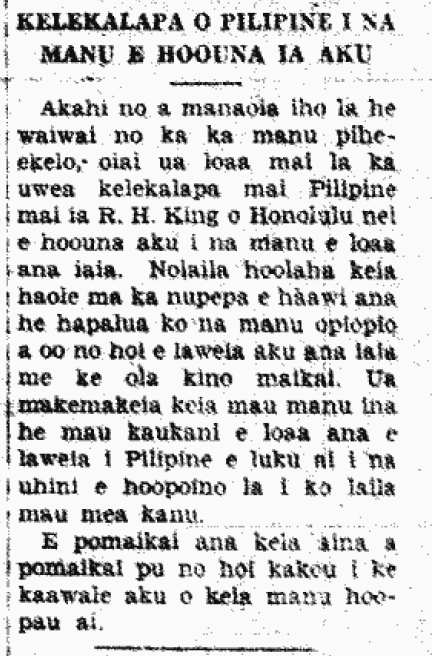
Sending mynahs to the Philippines, 1928.

PHILIPPINES TELEGRAPH TO SEND OVER BIRDS

For the first time it is believed that the mynahs have value, being that there was received a telegraph from the Philippines from R. H. King of Honolulu to send birds caught to him. This haole is advertising in the newspaper that he will give a half dollar for young and adult birds brought to him if they are alive and healthy. These birds are wanted in the thousands to be taken to the Philippines to kill off the locusts destroying the crops there.

This land and we as well will be blessed to be rid of these birds that take away food.

[This sounds a little messed up…]

(Alakai o Hawaii, 6/28/1928, p. 4)

KELEKALAPA O PILIPINE I NA MANU E HOOUNA IA AKU

Ke Alakai o Hawaii, Buke 1, Helu 9, Aoao 4. Iune 28, 1928.

Governor to veto bills protecting native wildlife? 2013.

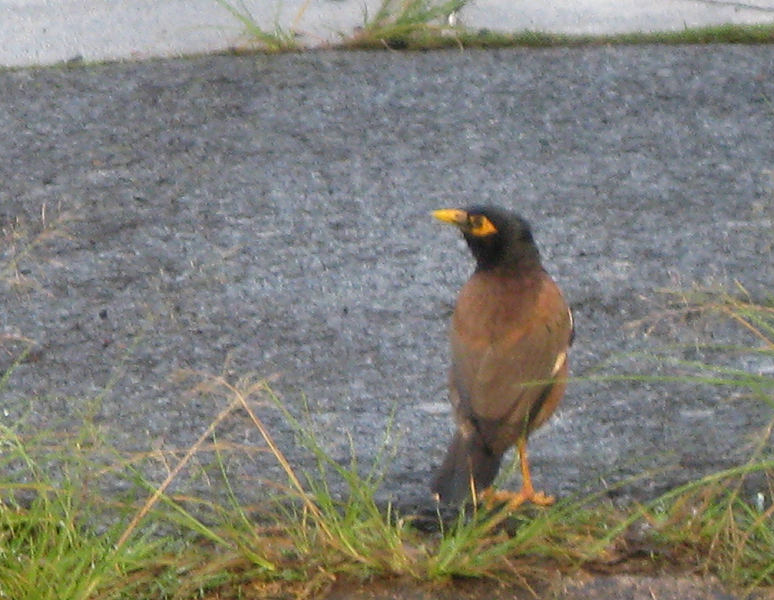
Mynah bird.

Manu piheekelo, 2013.

It seems that the governor decided to veto a bill making petroleum distributors more responsible for protecting native wildlife (HB988) and another bill making the feeding of feral birds a nuisance (HB619). This reminded me of a couple of previous posts:

A description of life before the invasion of foreign birds.

and

A look back at the folly of introducing foreign animals.

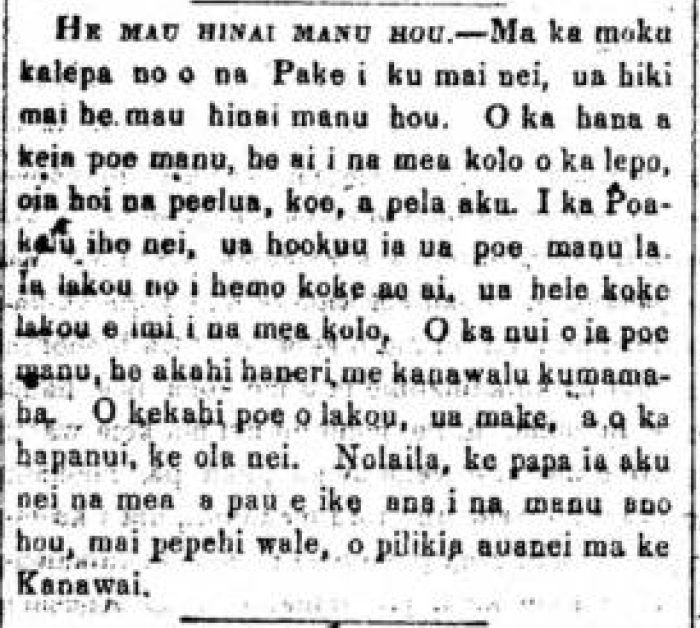
New birds introduced, 1865.

Containers of New Birds.—Aboard the trading ship of the Chinese that arrived were brought containers of new birds. The purpose of these birds are to eat bugs found in the dirt like caterpillars [peelua], koe [worms], etc. Last Wednesday, the birds were released. When they were immediately released, they quickly went in search of bugs. The number of those birds was one-hundred and eighty-four. Some of them died, but the majority are living. Therefore, anyone who sees these new birds is prohibited from killing them lest they be in trouble with the Law.

[This article most likely refers to the manu pihaekelo—mynah bird, now seen everywhere across the archipelago…]

(Au Okoa, 10/2/1865, p. 2)

He mau hinai manu hou.

Ke Au Okoa, Buke I, Helu 24, Aoao 2. Okatoba 2, 1865.

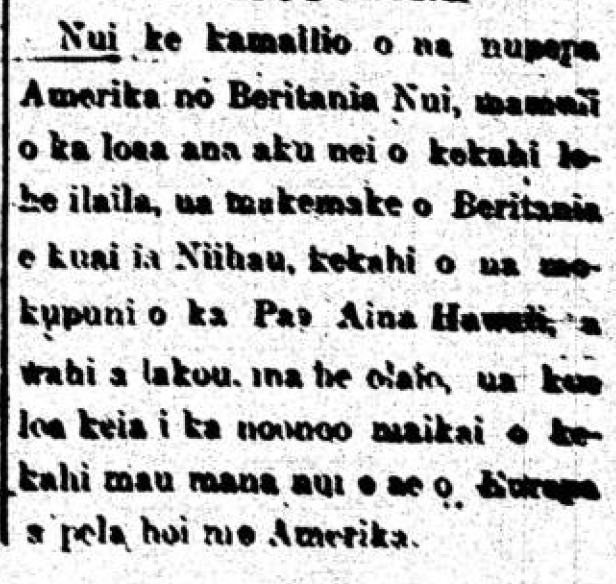
Great Britain to buy Niihau? 1892.

[Found under: “LOCAL NEWS.”]

There has been much talk in the American newspapers about Great Britain, in that they received news that Britain is interested in purchasing Niihau, one of the islands of the Hawaiian Archipelago, and according to them, if it is true, this would be greatly go against the good will of some other major powers of Europe and America as well.

(Leo o ka Lahui, 9/29/1892, p. 2)

Nui ke kamailio o na nupepa...

Ka Leo o ka Lahui, Buke II, Helu 554, Aoao 2. Sepatemaba 29, 1892.

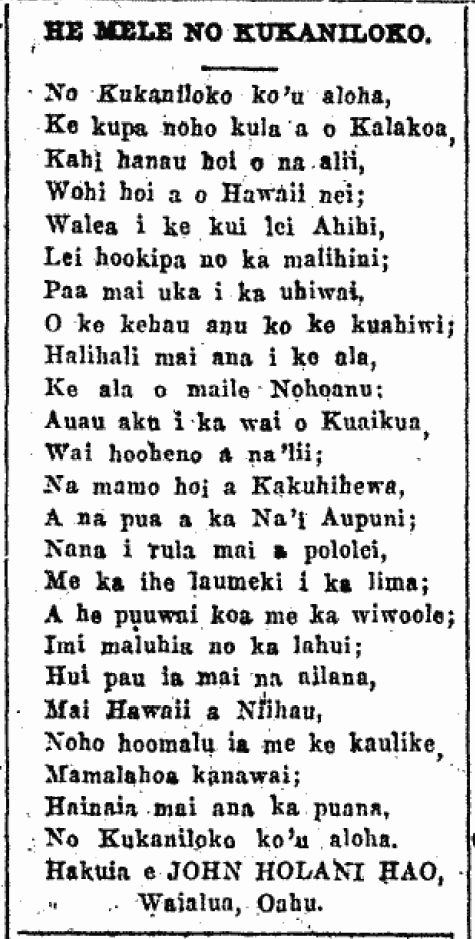
Mele for the birthplace of alii, Kukanikolo, 1925.

HE MELE NO KUKANILOKO.

No Kukaniloko ko’u aloha,
Ke kupa noho kula a o Kalakoa,
Kahi hanau hoi o na alii,
Wohi hoi a o Hawaii nei;
Walea i ke kui lei Ahihi,
Lei hookipa no ka malihini;
Paa mai uka i ka uhiwai,
O ke kehau anu ko ke kuahiwi;
Halihali mai ana i ke ala,
Ke ala o maile Nohoanu;
Auau aku i ka wai o Kuaikua,
Wai hooheno a na’lii;
Na mamo hoi a Kakuhihewa,
A na pua a ka Na’i Aupuni;
Nana i rula mai a pololei,
Me ka ihe laumeki i ka lima;
A he puuwai koa me ka wiwoole;
Imi maluhia no ka lahui;
Hui pau ia mai na ailana,
Mai Hawaii a Niihau,
Noho hoomalu ia me ke kaulike,
Mamalahoa kanawai;
Hainaia mai ana ka puana,
No Kukaniloko ko’u aloha.

Hakuia e JOHN HOLANI HAO,
Waialua, Oahu.

HE MELE NO KUKANILOKO.

For Kukaniloko is my aloha,
Native dwelling on the plains of Kalakoa,
Birthplace of the alii,
Wohi chiefs of Hawaii nei;
Taking pleasure in stringing lei of Ahihi,
A lei of welcome for the visitor;
The uplands are covered by fog,
The cold mist of the mountains;
Carrying along the scent,
The fragrance of maile in the cold;
Bathing in the waters of Kuaikua,
Cherished waters of the alii;
The descendants of Kakuhihewa,
And progeny of the Conqueror of the Nation;
Who ruled with righteousness,
With barbed spear in hand;
And a brave and fearless heart;
In pursuit of peace for the people;
Completely joining the islands,
From Hawaii to Niihau,
Living in peace with equality,
The law of Mamalahoa;
Let the refrain be told,
For Kukaniloko is my aloha.

Composed by JOHN HOLANI HAO,
Waialua, Oahu.

(Kuokoa, 5/28/1925, p. 7.)

HE MELE NO KUKANILOKO.

Ka Nupepa Kuokoa, Buke LXIV, Helu 22, Aoao 7. Mei 28, 1925.

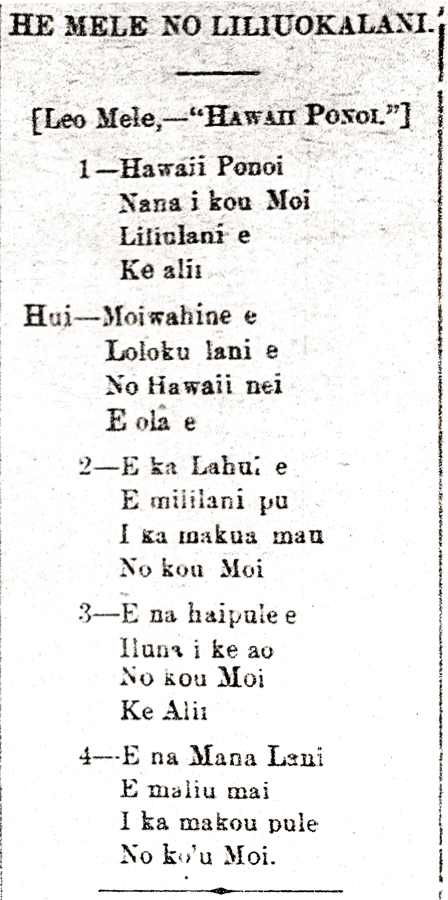
A twist on “Hawaii Ponoi,” 1894.

HE MELE NO LILIUOKALANI.

[Leo Mele,—”Hawaii Ponoi.”]

1—Hawaii Ponoi
Nana i kou Moi
Liliuokalani e
Ke alii

Hui—Moiwahine e
Loloku lani e
No Hawaii nei
E ola e

2—E ka Lahui e
E mililani pu
I ka makua mau
No kou Moi

3—E na haipule e
Iluna i ke ao
No kou Moi
Ke alii

4—E na Mana Lani
E maliu mai
I ka makou pule
No ko’u Moi.

A MELE FOR LILIUOKALANI.

[Tune,—”Hawaii Ponoi.”]

1—Hawaii’s Own
Look to your Sovereign
Liliuokalani
The alii

Chorus—Queen
Lolokulani
For Hawaii nei
Prevail

2—O Nation
Let us give praise
To the eternal father
For your Sovereign

3—O Pious ones
[Lift your voices] toward the clouds
For your Sovereign
The Alii

4—O Heavenly Powers
Do pay heed
To our prayer
For my Sovereign.

[The issue in which this mele appears cannot be found online. There in fact are many, many issues of Hawaii Holomua that are still not available anywhere online!]

(Hawaii Holomua Puka Pule, 6/23/1894, p. 3)

HE MELE NO LILIUOKALANI.

Hawaii Holomua (Puka Pule). Buke I, Helu 25, Aoao 3. Iune 23, 1894.

Cowboy Mokuike Smythe passes, 1924.

A EXPRESSION OF AFFECTION FOR MY HUSBAND WHO HAS GONE AFAR.

Mr. Sol. Hanohano. Aloha oe:—Be so kind as to place this in an empty space of your paper, so that the family, familiars, and friends of my beloved husband who has left this life will know.

My beloved husband who has left me, his companion wife, was a big hearted, welcoming, and acknowledged all his family. Auwe my never-ending regret for my beloved husband!

My beloved my husband has left me, as well as our children who grieve after him; how sad…

MR. MOKUIKE SMYTH [SMYTHE]

…is the pain down deep for my dear companion, my kane!

My husband who has departed this life, he was born in Nuu, Kaupo; He was born in the year 1894 in the month of April on the 23rd.

He grew weary of this life on the 22nd of April, and he made 30 years old on the day he was put to rest. Auwe my never-ending regret for you!

My husband who has left me, he wife, was familiar to all here; he was a man who was loved by all. Aloha to all the places my husband travelled; the cold was nothing, and facing the rain was not a big thing for my beloved.

He was an long time cowboy for Raymond Ranch, until his passing.

We were wed in the sacred covenant of marriage in the year 1910, and we have happily lived 15 whole years together in this world; and my kane has left bare on the road of no return. How sorrowful!

Sickness wasted away at his body of my beloved kane for a long time until he took his own life. Auwe, my sorrow at the foolish action of my dear kane!

I am filled with regret for my dearly beloved kane who left this life; he was a happy man filled with joy. Auwe for this heaviness in my heart!

With this small expression of love, I will close here.

I give my deep appreciation to those who offered their bouquets of flowers which adorned my beloved; I also give thanks to the Editor of the press of the Kuokoa.

I am with sadness,

MRS. MOKUKIKE SMYTHE.

(Kuokoa, 6/26/1924, p. 2)

HE HOALOHALOHA NO KUU KANE HELELOA.

Ka Nupepa Kuokoa, Buke LXIII, Helu 26, Aoao 2. Iune 26, 1924.

The first Kamehameha Day out in the country, continued, continued, 1872.

At Kailua, Kona.

“Here is what is new here in the land of calm. The day of Kamehameha I was celebrated grandly in Kailua; this is the biggest day I’ve witnessed. The chiefess [probably Keelikolani, governess of Hawaii Island], prepared for the activities of the day as she saw fit. The grounds of Hulihee was filled with old men and women, and the sands were packed with visitors; and this is what was reenacted from the times of Kamehameha I:

The women wore white, with lei of whale ivory [palaoa] around their necks, and bracelets of palaoa on their wrists. There were two torches lit at 12 midnight and taken to where his body lay; and there they stood until daylight, until the procession began over the sands of Niumalu until where his body was placed; there were two torches of Hopili and Makainai who carried them before the procession, and following was the chiefess, and so forth. Makanoanoa gave a speech and after it was over, the procession returned to the lanai, and Makanoanoa spoke again assisted by Hopili. The chiefess was the last to speak.”

[This is the last part of the article describing the celebration of the first Kamehameha Day in Lahaina, Wailuku, and Kailua in Kona.]

The first Kamehameha Day out in the country, continued, 1872.

At Wailuku.

The children of the Hawaiian nation celebrated this day to commemorate the day believed to be the incorrect [? kupaewa] day of birth of the old chief who passed on, the one who joined Hawaii nei together to become one.

Here below are the activities done in celebration on that day. A crowd gathered at the protestant church in Wailuku; people were separated into those who were born during the time of Kamehameha I, who had a separate seating section, and so too of the people of Kamehameha IIʻs time, and all the way until those of Kamehameha Vʻs time; when looking about, a majority of the audience was born in the time of Kamehameha III.

The program was opened with the singing of a hymn to Almighty God; Hymn 33 and Mr. Napue gave a prayer; there was a second Hymn 196, and that came to an close. J. A. Napela [J. H. Napela] served as the Chairman, and spoke about things of Kamehameha Iʻs time and his deeds, his strength, and so forth. This was the first speech, and it was given for the commemoration, appropriately done by one who is well-immersed in the ways of those times.

Speech number two. C. P. Kealakai, teacher of Halehaku; his speech was about the one being commemorated; his main topic which he expounded upon was aloha for God.

Speech number three. D. H. Hakuole, teacher of Kauaula; his speech was about Opukahaia, and not about the remembrance of Kamehameha I.

Speech number four. Kamoku, a student of the theological seminary; this speech was on the mark [pilipono ka la i papaenaena] and did not go astray; it was the first delightful speech for the audience.

Speech number five. A. Keohokalole, audience member from the island of Maui; this was a speech suited for the learned; the items were woven skillfully together, and was fitting to the program.

Speech number six. I donʻt have the name; it was a speech that was not pertinent to the topic; he was made to sit down by the Chairman.

Speech number seven. Mr. Kaleohano; the speech was about electricity, but it was related to the topic. He spoke about these famous words before the audience, because the haole sugar farmers don’t recall the words of the alii, Kamehameha V, who said: “If I had a million dollars in my pocket, I would be able to demolish these sugar mills for their contempt of the royal proclamation.

Speech number eight. P. Kaluna, teacher of Papohaku, it was electric; it was apparent that his speech showed his great thought for the celebration of the day.

Speech number nine. Kawelau, teacher of the district of that famous rain, the Ukiukiu [of Makawao]; I will not say that he wasn’t electric, but it was somewhat like speech number four.

Speech number ten. Nahunahupu; this was a speech not appropriate for the person who was being commemorated that day.

Speech number eleven. D. Mamaki, teacher of Lahaina; this was a fine speech.

After this speech was over, that concluded the activities of the day. Everyone proceeded down to the place of N. Kepoikai, Esq. There, they were supplied with every type of Hawaiian food, along with haole food, all except liquor. This feast was appreciated for its peaceful nature and great pride, well-suited for gentlemen. The majority of those who partook in the food were government school teachers of the from all around Maui.

[This is a continuation of “Day Commemorating Kamehameha I.” There is one more section describing the celebration held at Kailua, Kona, with quite a display of whale ivory! I will try to get that up sometime in the future.]

The beginnings of Fathers’ Day, 1911.

THE DAY FOR FATHERS

Started by Mrs. John B. Dodd of Spokane, Washington, and observed in that city in the year 1910, was the first remembrance for fathers, the right hands of mothers, the ones who strive to look after the well being of their families.

The day for fathers is the third Sunday of June, like the one for mothers which is celebrated on the Second Sunday of May.

There is much criticism about the day for fathers, because there are many fathers who forget their homes on Saturday nights and throw their money at all sorts of worldly entertainments. But this is not true of all fathers; there are fathers who think first of their homes, their wife, and their children, and then after their entertainment; and for those fathers, and all fathers, Aloha for them should be given by the children who are living.

The symbol of remembrance for fathers is a Rose of any color; that is while the father is still living, this should be pinned on the chest, but for the father who has died, a White Rose should be pinned;  just as remembrances are held on the day for mothers, so too should the be for fathers. The theme on fathers’ will be announced at the Churches.

[Let Fathers’ Day be everyday while you can!]

(Aloha Aina, 5/13/1911, p. 1)

KA LA O NA MAKUAKANE.

Ke Aloha Aina, Buke XV, Helu 19, Aoao 1. Mei 13, 1911.