Unknown's avatar

About nupepa

Just another place that posts random articles from the Hawaiian Newspapers! It would be awesome if this should become a space where open discussions happen on all topics written about in those papers!! And please note that these are definitely not polished translations, but are just drafts!!! [This blog is not affiliated with any organization and receives no funding. Statements made here should in now way be seen as a reflection on other organizations or people. All errors in interpretation are my own.]

The first Kamehameha Day out in the country, 1872.

Day Commemorating Kamehameha I.

According to the news we received, the day the nation remembers Kamehameha I was preciously observed in different places of the nation, and this is good news for the very beginning of this day. Here below you will find what took place in various places, and here it is:

In Lahaina

“The activities of the day for the commemoration of Kamehameha I began at 9:12 A. M. with G. W. Pehu as the Chairman of the day’s events.”

A prayer was given by Hanunu. Chairman G. W. Pehu stood and explained to the crowd. This is the day that we were told in the announcements in our newspapers that this day is one that we are to commemorate, but not just on this day and that’s it; no, we are to continue this until the end, for he is the pillar of our world, the one who cleared away the thorny wilderness of this archipelago and made it into a fine garden, and it for him which we have pride: the wondrous one, the victor of victors, the one who shorn off the roughness  of these islands and smoothed it out making it a peaceful nation.

The one for whom we are starting off with this very first day, for whom we are celebrating for all times, with humble hearts, modesty, and aloha. He is our famed conqueror across the whole world. He is called the Napoleon of the Pacific Ocean, for his dexterity and his bravery and fearlessness; the victor of victors in battle for these 12 islands. He is the 1st of the Kamehamehas, who has gone, leaving our sacred offspring, King Kapuaiwa, Aliiolani, now living amongst us, the fifth of the Kamehamehas, one of his blossoms now appears clearly before us. And we proclaim together O Crowd gathered here at the church of Wainee, the House made by his royal ancestors who are passed on, while some of their descendants live on, along with the one who occupies the throne today.

For we now say in unison with aloha and humble hearts, May He Live! May the King Live in God!!

Therefore O People, let us keep the activities of the day well under control.

The first event. The singing of the Choir of Wainee, the hymn, “He Akua Hemolele.” There was a prayer by Hanunu, the pastor of the day. The Choir sang once more, “Ke Akua Mana Mau.”

The old ladies stood, along with the old men; some of the old men were right below the pulpit of Wainee, decked out in  layers of pa’upa’u kapa, and sang memorized songs of old. Like the Second Alphabet [Pi-a-pa-lua], sung like this: “Aha, Ahi, Aho, Ahu,” and so forth. Kenoi was the leader along with A. Makekau; this came to an end.

A. Makekau called out once more to this group of oldsters, with the Pi-a-pa-lua, exhorting in this manner:

“Don’t care after wooden idols,
Let us turn to the ever-living ruler,
It is good to glorify the ever-living God,
This, according to Iolani, the King of Hawaii.”

With this singing of the old ones, there was not a single one there who did not feel gratitude for the work done in times past. And after this was done, the makua then sang the Pi-a-pa-lua.

When the speaker, J. K. Unauna, stood, he was wearing a Large Whale Ivory Lei [Palaoa], which curved at the front like a banana of Kaea whose blossom containers [okai] are twisted. By the speech, of the speaker, the audience was immensely pleased, like a fish caught on the hook, weaving this way and that.

He spoke of the different famous feats of the Chief Kamehameha I. The audience was filled with thanks and appreciation. And, at the end of the speech of the speaker, the audience stomped their feet, like these lines of mele:

“I have nothing but praise for the beauty of Aipo,
Shuddering at the cold of Hauailiki”

[“Aole a’u mea mahalo ole i ka nani o Aipo,
E li ana ka io i ke anu o Hauailiki.”]

And when the audience calmed down, the voices of the men and women burst forth, singing the national anthem [mele lahui] composed by one of our chiefly children, Lilia K. Dominis. To witness this, it was as if the current was drawing to Alae [e ko ana ke au i Alae].

The program was over, and the audience was released, and the went to the other festivities at Keawaiki, which was teeming with people; there were so many people seen at the activities of the white ones of Lahaina nei. At the hour of 11 A. M., the games began:

First event, boat race, won by the boat of A. C. Smith. Event 2, Mule race, won by Castle Jr.’s mule. Event three, sack race, won by Arika of Kaanapali. Event 4, swimming race, won by Poepoe. Event 6, pig chase [alualu puaa], which was won by him. Event 7, tin can filled with molasses and you try to get the dollar inside using your tongue; it was miserable to watch. Won by [?Nahioihi]. Event 8, a wooden pole of 6 feet tall; the money ($2.50) atop the pole was not gotten.

[This article continues with scenes from Wailuku and Kailua, Kona. Look for the continuation at a later date. The image online is very hard to read. I can’t wait for the day when all the newspapers are rescanned clearly!]

(Au Okoa, 6/20/1872, p. 3)
La Hoomanao Kamehameha I.

Ke Au Okoa, Buke VIII, Helu 10, Aoao 3. Iune 20, 1872.
The First Kamehameha Day, 1872.

This past Tuesday, as per the Royal Proclamation, the 11th of June was observed as the day to commemorate Kamehameha I, our Royal Ancestor who conquered the land. This is a new day included in the realm of holidays; and the people were joyous at the designating of a day like this for the remembering of our precious beloved one of days gone by. The day opened beautifully, without any drops to bother the people who were well adept to celebrate the day. From early morning, the doors of the large and small shops of town were closed shut, and when the sun came out, nonexistent the sight of many people on the streets of this town, and the places of work were deserted. Everyone was ready to entertain themselves with pleasures of all sorts; some people with feasts or horse riding, but it seemed as if most of the people were at the races set up at Kulaokahua, where enjoyments of all sorts took place [? i muu ai].

The sight of the race track on that day, was as if like no other before. The lanai and tents were nicely built, and congratulations go to those responsible for that distinguished job. The lanai and grounds were filled all the way atop the hills with thousands enjoying themselves with the festivities of the day. Should a visitor stand far away and look forth, it was as if it was a scene from great racing days in Europe. The events of the day began at 10 o’clock or thereafter; and to take in all of the many fun activities of the day was great; there were no big uproars to disturb the peace; that is something unusual for big days like this.

At 10 o’clock sharp, Queen Emma made an appearance with her guests, and King Kapuaiwa with his suite. At the arrival of the King, the activities of the day were opened, and all the people joined in the festivities set aside. There are the races below as well as those who won.

The activities of the day began with the First Race for the Kamehameha Plate, which was two miles long. John A. Cummins [Keoni Kamaki] of Waimanalo won, with “Carry the News,” with a time of four minutes and thirty seconds. This was one of the fine open races [heihei pualu] of the day.

Trotting Race [Heihei Holo Kaa], for one hundred dollars, two mile long course. J. T. Chayter won with the horse Bill Taylor, with a time of seven minutes and thirty seconds.

Foot Race [Heihei Kukini], for twenty dollars, two hundred yards, won by E. Williams [Edward Williams].

King’s Cup, won by John A. Cummins [Keoni Kamaki], with his horse, “Carlotta,” one mile and  a half, with a time of two minutes and twelve seconds.

Sack Race [Heihei Eke], was one of the most humorous races of the day, won by Sam, the harbor boy who is used to winning that type of race in past years.

Honolulu Purse [Eke Honolulu nei], of $100, one mile, won by “Bosetona,” the horse of Keoni Miki [John Meek].

Mule Race [Heihei Miula], $40, won by the mule of Mr. Pilipo of Kailua, Koolaupoko.

Foot Hurdle Race [Heihei Kukini Lele-pa], four hurdles in a hundred yards; the first place went to Ed. Williams, and the second to Sam; $40 and $10.

Public Purse [Eke o ka Lehulehu], one mile, the horse of John A. Cummins [Keoni Kamaki], “Tom Riddle,” won, with a time of two minutes and fourteen seconds.

$60 Purse [Heihei Eke $60], half a mile long, between “Carlotta” and “Jack Diamond.” This was one of the best races of the day, in the first running, they were head to head; but on the second race, “Carlotta” won with a time of one minute.

Velocipede Race [Heihei Kaa Huila kahi], half a mile long, won by Edward Williams.

Hurdle Race [Heihei Lele pa], for $80, won by “Carry the News,” the horse of John A. Cummins [Keoni Kamaki]. Eight hurdles were jumped over in two miles.

The final race was the wheelbarrow race [heihei kaa palala], which was the most comical. With this race, the activities of the day came to a close, and everyone went home with hearts filled with much joy. There is one thing amongst all the activities which we appreciate greatly, that is the fraction of various sorts of commotions. There were no disturbances believed to have resulted from the gaiety of the day.

[This is quite a different type of celebration compared to today. Whatever you may have planned for today, let there be remembering of the one who unified the islands, Kamehameha Paiea.]

(Au Okoa, 6/13/1872, p. 2)

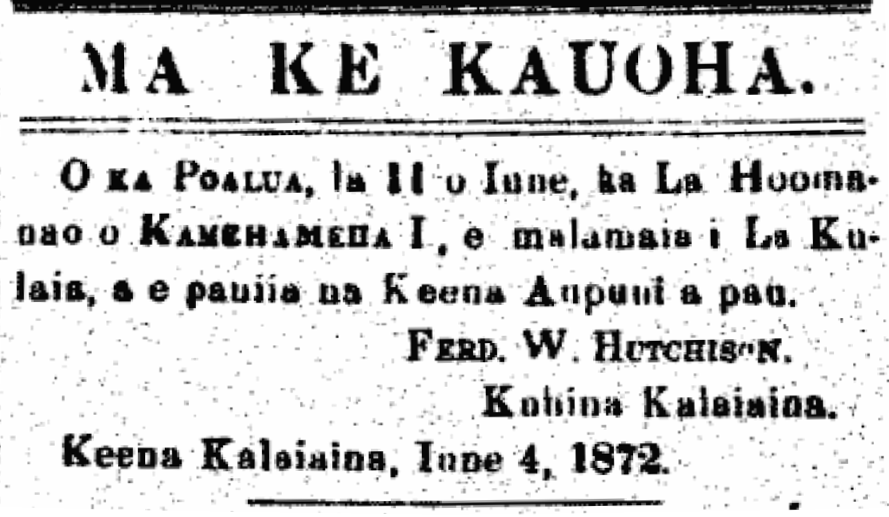
Ma ka Poalua iho nei...

Ke Au Okoa, Buke VIII, Helu 9, Aoao 2. Iune 13, 1872.

Announcing the first Kamehameha Day, 1872.

BY AUTHORITY.

Tuesday, the 11th of June, the Day of Commemoration of Kamehameha I, will be observed as a Holiday, and all Government Offices will be closed.

Ferd. W. Hutchison.

Minister of the Interior [Kuhina Kalaiaina].

Office of the Interior [Keena Kalaiaina], June 4, 1872.

(Au Okoa, 6/6/1872, p. 2)

MA KE KAUOHA.

Ke Au Okoa, Buke VIII, Helu 8, Aoao 2. Iune 6, 1872.

As it was then it is now. 1893 / 2013.

HE LEI NO KA POE ALOHA AINA.

Kaulana na pua a Hawaii
Kupaa mahope o ka Aina
Hiki mai ka Elele a ka lokoino
Palapala anunu me ka pakaha
Pane mai Hawaii Nui a Keawe
Kokua na Hono a Piilani
Kakoo mai Kauai o Mao
Pau pu me ke one o Kakuhihewa
Aole e kau kuu pulima
Maluna o ka pepa a ka Enemi
Aole makou e minamina
I ka puu kala a ke Aupuni
Ua ola makou i ka pohaku
I ka ai kamahao a ka Aina
Hoohui Aina kuai hewa
I ka pono Kiwila a o ke kanaka
Mahope makou o Liliulani
A kau hou ia i ke Kalaunu
Haina ia mai ana ka puana
No ka poe i Aloha i ka Aina.

A LEI FOR THE PATRIOTS.

Famous are the blossoms of Hawaii
Who stand steadfast behind the Land
When the evil-hearted Messengers arrives
With their documents of greed and plunder
Great Hawaii of the Chief Kakuhihewa answers
The Bays of the Chief Piilani assists
Kauai of the Chief Manokalanipo gives support
Along with the sands of the Chief Kakuhihewa
I will not affix my signature
Upon the paper of the Enemy¹
We will not feel longing
For the sums of money from the Government
We live on the rocks
On the amazing food of the Land
[Annexing and selling wrongfully
The Civil rights of the people]
We stand behind Liliulani
Her Crown shall be placed back upon her
Let the refrain be told
Of the people who Love the Land.

Miss Kekoaohiwaikalani,
Puahaulani Hale,
Honolulu, Feb. 10, 1893.

As a result of the many requests we received to reprint the mele of the Patriots, we are fulfilling your desire; and this is a totally accurate copy of this Mele gotten from the Lady who composed this mele.

[This mele was indeed printed many times in the Hawaiian-Language Newspapers, attesting to its importance. It is just as important today, 120 years since, if not more so!]

¹It appears that the bracketed lines were misplaced and should follow here. …or perhaps not, as it appears in basically this same form three years later: Aloha Aina, Buke III, Helu 24, Aoao 4. Iune 13, 1896. “E Nana Mai i ke Mele.”

(Leo o ka Lahui, 5/16/1893, p. 3)

HE LEI NO KA POE ALOHA AINA.

Ka Leo o ka Lahui, Buke II, Helu 706, Aoao 3. Mei 16, 1893.

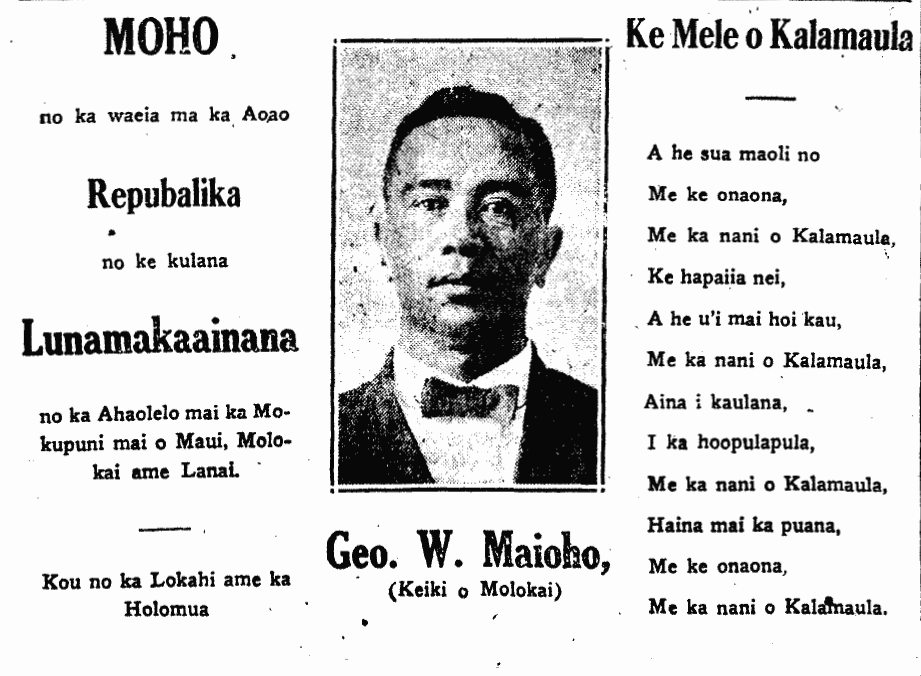
George W. Maioho (Child of Molokai) political ad, 1924.

Geo. W. Maioho,

(Child of Molokai)

CANDIDATE

for election in the Party of the

Republicans

for the position of

Representative

for the Legislature from the Islands of

Maui, Molokai and Lanai.

Yours for Unity and Progress

Ke Mele o Kalamaula

A he sua maoli no
Me ke onaona,
Me ka nani o Kalamaula,
Ke hapaiia nei,
A he u’i mai hoi kau,
Me ka nani o Kalamaula,
Aina i kaulana,
I ka hoopulapula,
Me ka nani o Kalamaula,
Haina mai ka puana,
Me ke onaona,
Me ka nani o Kalamaula.

[Speaking of Molokai and Hawaiian Homestead, check out this political advertisement, using Emma Kala Dudoit’s composition written for their new homestead! For more information on the mele, see its entry in Huapala.org!]

(Kuokoa, 9/4/1924, p. 2)

Geo. W. Maioho,...

Ka Nupepa Kuokoa, Buke LXIII, Helu 36, Aoao 2. Sepatemaba 4, 1924.

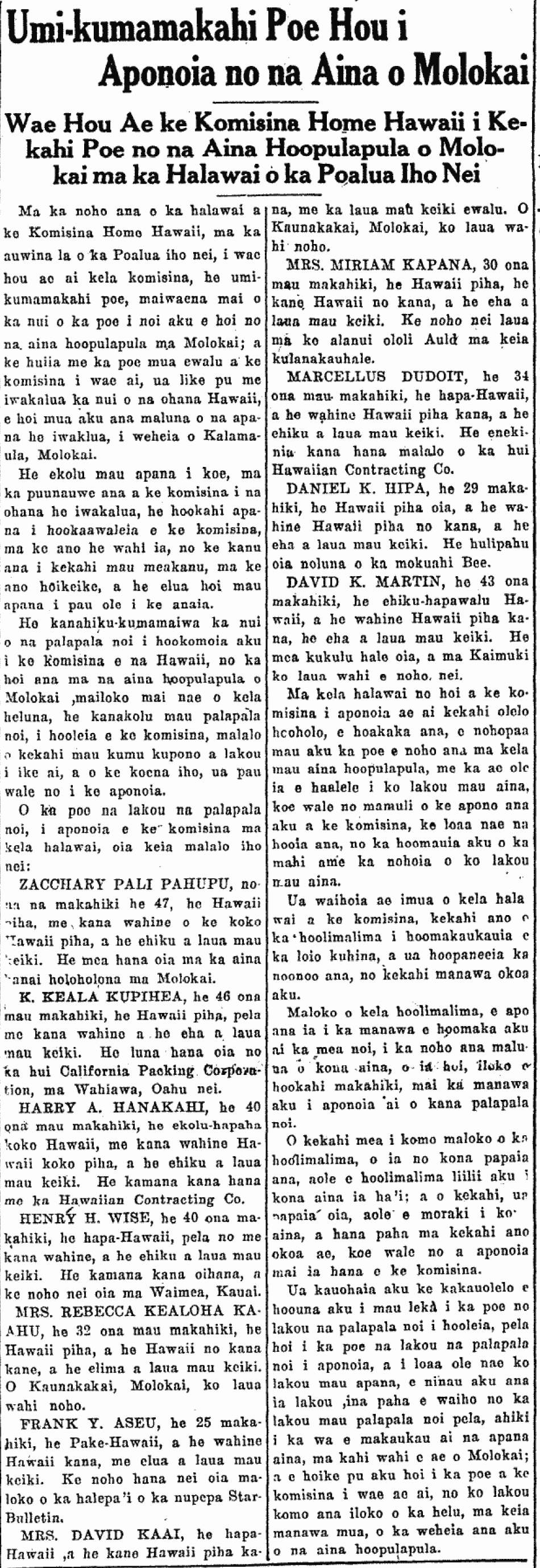
Hawaiian Homes on Molokai, 1922.

Eleven More People Approved for Lands on Molokai

The Hawaiian Homes Commission Selects Once More People for Homestead Lands on Molokai at the Meeting on this Past Tuesday

At the meeting of the Hawaiian Homes Commission on the afternoon of this past Tuesday, the commission selected eleven more people from amongst the many who applied to return to the homestead lands [aina hoopulapula] on Molokai; and added to the eight who the commission previously selected, that makes twenty Hawaiian families total who will be the first to go back to the twenty parcels opened up in Kalamaula, Molokai.

There are three parcels left to be divided up by the commission for twenty families and one section is set aside by the commission as an area to grow plants as a sample, and there are two pieces of land left to be surveyed.

There were seventy-nine applications submitted to the commission by Hawaiians, to return to homestead lands on Molokai, abut from amongst this number, there were thirty applications denied by the commission for appropriate reasons as deemed by them, and as for the rest, they were all approved.

The people whose applications were approved by the commission in that meeting are these below:

ZACCHARY PALI PAHUPU, who is 47 years old, a full Hawaiian, whose wife is also full Hawaiian, and they have seven children. He is employed at the ranch on Molokai.

K. KEALA KUPIHEA, who is 46 years old, a full Hawaiian, and so is his wife, and they have four children. He is a supervisor at the California Packing Corporation [CPC] in Wahiawa, Oahu.

HARRY A. HANAKAHI, who is 40 years old, three-fourths blooded Hawaiian, along with his wife who is full-blooded Hawaiian, and their seven children. He is a carpenter for the Hawaiian Contracting Co.

HENRY H. WISE, is 40 years old, a hapa Hawaiian, as well as his wife, along with their seven children. He is a carpenter by trade, and is living in Waimea, Kauai.

MRS. REBECCA KEALOHA KAAHU, is 32 years old, a full Hawaiian, and her husband is a Hawaiian as well, and they have five children. They reside in Kaunakakai, Molokai.

FRANK Y. ASEU, is 25 years old, Chinese-Hawaiian, and he has a Hawaiian wife, with two children. He is employed at the press of the Star-Bulletin Newspaper.

MRS. DAVID KAAI, is a hapa Hawaiian, and she has a full-Hawaiian husband, and they have eight children. They live in Kaunakakai, Molokai.

MRS. MIRIAM KAPANA, is 30 years old, she is full Hawaiian, she has a Hawaiian husband, and they have four children. They live on Auld Lane in this town.

MARCELLUS DUDOIT, is 34 years old, a hapa Hawaiian, and his wife is full Hawaiian, and they have seven children. He is an engineer working under the Hawaiian Contracting Co.

DANIEL K. HIPA, is 29 years old, a full Hawaiian, and he has a full-Hawaiian wife, and they have four children. He is a second mate aboard the ship the Bee.

DAVID K. MARTIN, is 43 years old, he is seven-eighths Hawaiian, and he has a full-Hawaiian wife, and they have four children. He is a house builder, and they reside in Kaimuki.

During that meeting of the commission, a resolution was passed clarifying that those who live on the homesteads must  live there permanently and not be allowed to move away from their land, except with approval from the commission with their promise that they will continue to farm and live on their land.

Put before the meeting of the commission were some terms of the lease drawn out by the attorney general and considerations of these were postponed until another time.

In the lease, it will specify the time when the person who applied must begin living on his land, that being within one year of his application being approved.

Another thing included in the lease is that it prohibits them from releasing out sections of their land to others; also, they are not to mortgage off their land, or do else wise other than what is approved of by the commission.

The secretary was instructed to send out letters to those whose applications were denied; as well as to those whose applications were approved but did not receive a parcel, asking them if they will leave their applications in until land is made available elsewhere on Molokai; and also to notify those who the commission selected that they will be put in a lottery [? komo ana iloko o ka helu] in the future when the homesteads open up.

(Kuokoa, 8/17/1922, p. 1)

Umi-kumamakahi Poe Hou i Aponoia no na Aina o Molokai

Ka Nupepa Kuokoa, Buke LXI, Helu 33, Aoao 1. Augate 17, 1922.

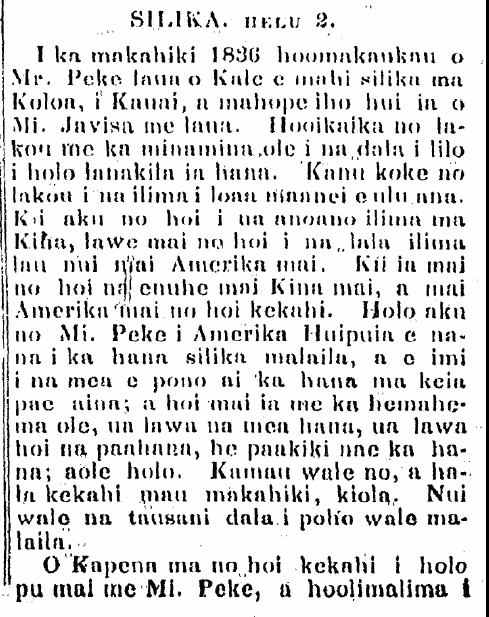
1836, the beginnings of sericulture on Kauai. 1843.

SILK. NUMBER 2.

In the year 1836, Mr. Peke and Kale made ready to farm silk [silika] in Koloa, Kauai, and afterwards the two were joined by Mr. Jarvis [Mi. Javisa]. They put much effort into this without caring about money spent to make it a success. They immediately planted ilima found growing here. They went to get ilima [? mulberry] seeds from China and brought back branches of the ilima lau nui from America. Mr. Peke went to the United States of America to see silk production there, and to find what it took to raise them in this archipelago; he returned without anything lacking, with the necessary gear, and sufficient workers, but the work was difficult and did not move forward. They kept at it, and some years went by, and they gave up. Many thousands of dollars was wasted on it.

Kapena and others also came with Mr. Peke, and leased other lands in Koloa, with thoughts of raising silk there. He planted ilima, built a residence, a building to raise the worms, and a house for the workers. They began the work, but in not much time, it was a bust. Here are the reasons that it was a waste of time in Koloa: there is a strong wind so the ilima does not grow well as the leaves are torn in the strong wind and wilt, the worms don’t grow well there; and the people also, they are not eager and do not keep at the work; they come some days and slack off, are lazy and leave. Today, the ilima of those silk lands are all pulled out and sugar is planted there. So sad for those foreigners who wasted their money in this endeavor. A new enterprise almost started there to make the nation rich.

(Nonanona, 1/3/1843, p. 78)

SILIKA. HELU 2.

Ka Nonanona, Buke 2, Pepa 16, Aoao 78, Ianuari 3, 1843.

(Nonanona, 1/3/1843, p. 79)

...kekahi aina okoa ma Koloa...

Ka Nonanona, Buke 2, Pepa 16, Aoao 79. Ianuari 3, 1843.

More on honey, 1861.

[Found under: “This and That of Hawaii nei.]

Honey [Meli].—Our forests will perhaps be filled with Honey. Earlier, a certain person in Kalihi valley had ten pounds of Honey. The Bee [Nalo Meli] hive was atop a kukui tree where that amount of Honey mentioned above was gotten.

(Kuokoa, 11/1/1861, p. 2)

Meli.

Ka Nupepa Kuokoa, Buke I, Helu 2, Aoao 2. Novemaba 1, 1861.