Unknown's avatar

About nupepa

Just another place that posts random articles from the Hawaiian Newspapers! It would be awesome if this should become a space where open discussions happen on all topics written about in those papers!! And please note that these are definitely not polished translations, but are just drafts!!! [This blog is not affiliated with any organization and receives no funding. Statements made here should in now way be seen as a reflection on other organizations or people. All errors in interpretation are my own.]

More on rubber cultivation in Hawaii nei. 1907.

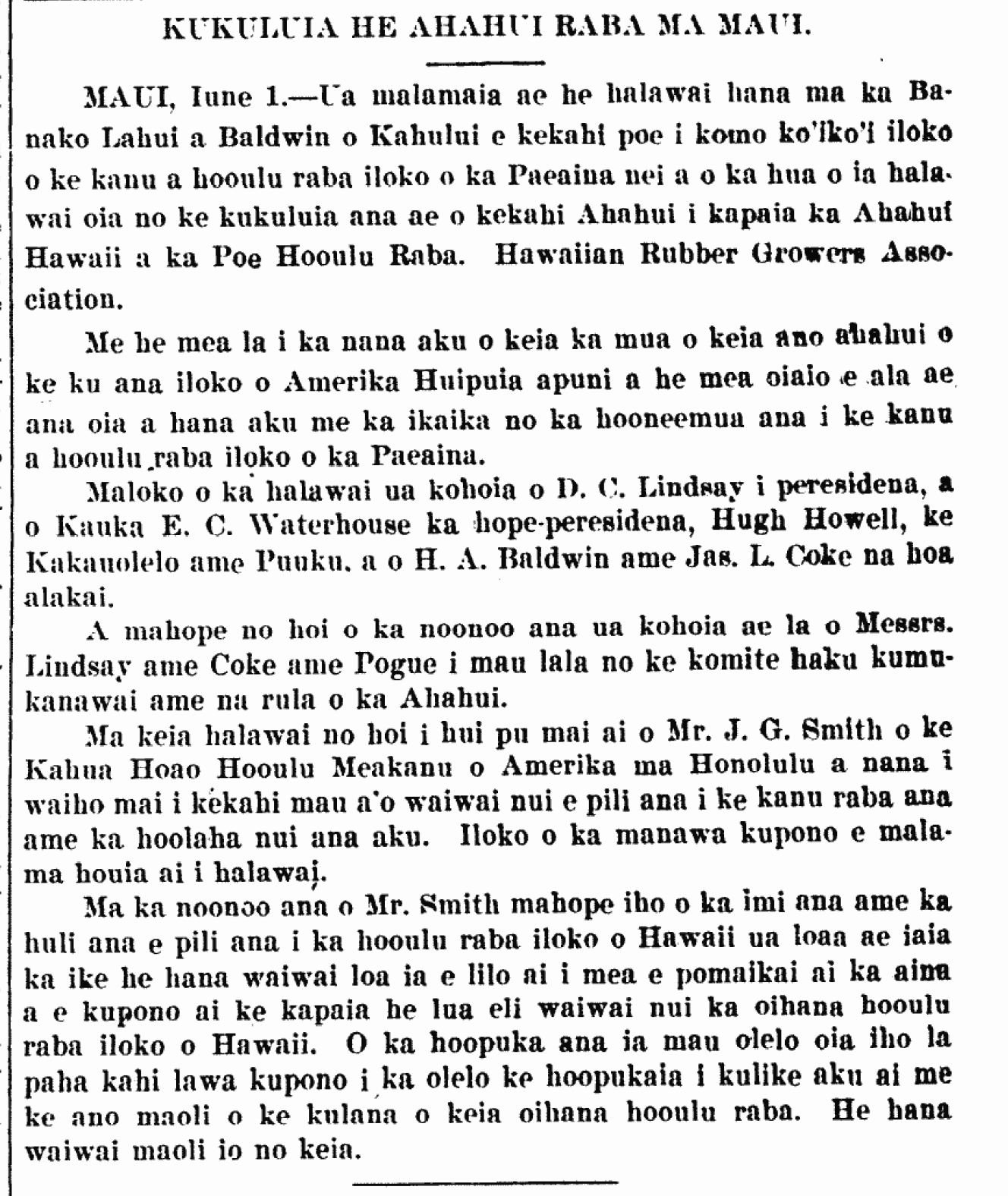
A RUBBER ASSOCIATION TO BE ESTABLISHED ON MAUI.

MAUI. June 1.—A business meeting was held at the Kahului Baldwin National Bank [Banako Lahui a Baldwin o Kahului] by people seriously planting and raising rubber [raba] in this Archipelago, and the outcome of the meeting was the establishment of an Association called “Ka Ahahui Hawaii a ka Poe Hooulu Raba [Hawaiian Rubber Growers’ Association]”.

It seems that when looking at this, this is the first association of its kind established in the whole of the United States of America, and it is a fact that it will start and strive to push forward the planting and growing of rubber in the Archipelago.

In the meeting, D. C. Lindsay was chosen as president, and Doctor E. C. Waterhouse as vice president, Hugh Howell, the Secretary and Treasurer, and H. A. Baldwin and James L. Coke as fellow advisors.

And after consideration, Messrs. Lindsay and Coke and Pogue were chosen as members of the committee to draft bylaws and rules for the Association.

Also at this meeting was Mr. J. G. Smith of the American Agricultural Experiment Station [Kahua Hoao Houlu Meakanu o Amerika] in Honolulu and he gave some valuable advice relating to the planting and the wide distribution of rubber. At a proper time, another meeting will be held.

In the thoughts of Mr. Smith, after he searched and investigated about growing rubber in Hawaii, he found that it is a very valuable endeavor that will bring good fortune to the land and it is well that the growing of rubber in Hawaii be called a rich mine. This declaration was perhaps enough of a statement befitting the importance of this effort to raise rubber. This is a truly lucrative endeavor.

(Kuokoa, 6/7/1907, p. 5)

KUKULUIA HE AHAHUI RABA MA MAUI.

Ka Nupepa Kuokoa, Buke XLII, Helu 23, Aoao 5, Iune 7, 1907.

Rubber cultivation on Maui, 1906.

RUBBER PLANTS GROWING PROFUSELY IN THE RUBBER PLANTATION OF NAHIKU.

[The picture seems to be signed F. T. P. Waterhouse. Hopefully the newspapers will be rescanned clearly soon, so that not only text can be read clearly, but pictures like this can be seen clearly!]

(Kuokoa, 12/7/1906, p. 6)

NA LAAU RABA E ULU NUI NEI  MA KA MAHI RABA O NAHIKU.

Ka Nupepa Kuokoa, Buke XLV, Helu 49, Aoao 6. Dekemaba 7, 1906.

Tobacco grown in Hawaii, 1863.

[Found under: “NEWS OF HAWAII NEI.”]

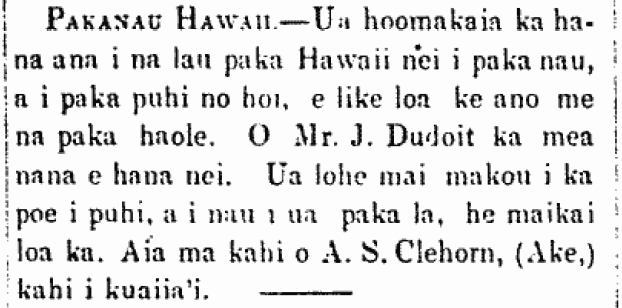
Chewing Tobacco.—Hawaiian tobacco leaves are have begun to be made into chewing tobacco and smoking tobacco as well, just like foreign tobacco. Mr. J. Dudoit is the one undertaking this. We have but heard from those who smoke tobacco and chew tobacco that it is excellent. It is available for purchase at the store of A. S. Cleghorn [Ake].

(Kuokoa, 8/22/1863, p. 2.)

Pakanau Hawaii.

Ka Nupepa Kuokoa, Buke II, Helu 34, Aoao 2. Augate 22, 1863.

Cotton grown in Hawaii, 1863.

[Found under: “NEWS OF HAWAII NEI.”]

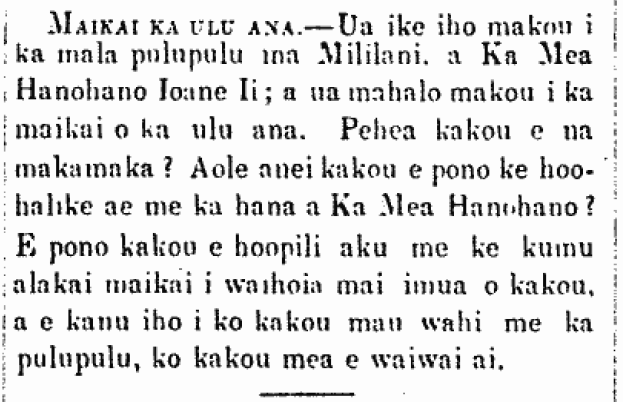
Growing well.—We have seen the cotton plantation at Mililani, of the Honorable John Ii [Ioane Ii]; and we are in admiration at how well it is growing. What about us, O Friends? Shouldn’t we emulate the efforts of the Honorable One? We must follow the good example put before us and plant our land with cotton, that thing which will make us rich.

(Kuokoa, 8/22/1863, p. 2)

Maikai ka ulu ana.

Ka Nupepa Kuokoa, Buke II, Helu 34, Aoao 2. Augate 22, 1863.

Fund raiser for the building of St. Augustine in Waikiki, 1901.

FAIR AND LUAU.

A fair and grand luau was held by the Catholic brethren in the armory [hale paikau] outside, this Saturday afternoon. There were many people who showed up to this fair, and we hear that they made a lot of money through the items sold and the luau. Amongst the dignitaries who appeared at the fair was Queen Liliuokalani. The Royal Hawaiian Band [bana aupuni] was there, entertaining the visitors that came, and with the coming of night there was held a dance in the armory. All the proceeds from this fair will be given to the church of St. Augustine being built outside of Waikiki.

(Aloha Aina, 7/20/1901, p. 5)

AHA FEA ME LUAU.

Ke Aloha Aina, Buke VII, Helu 29, Aoao 5. Iulai 20, 1901.

Festivities at Hilo Union School, 1927.

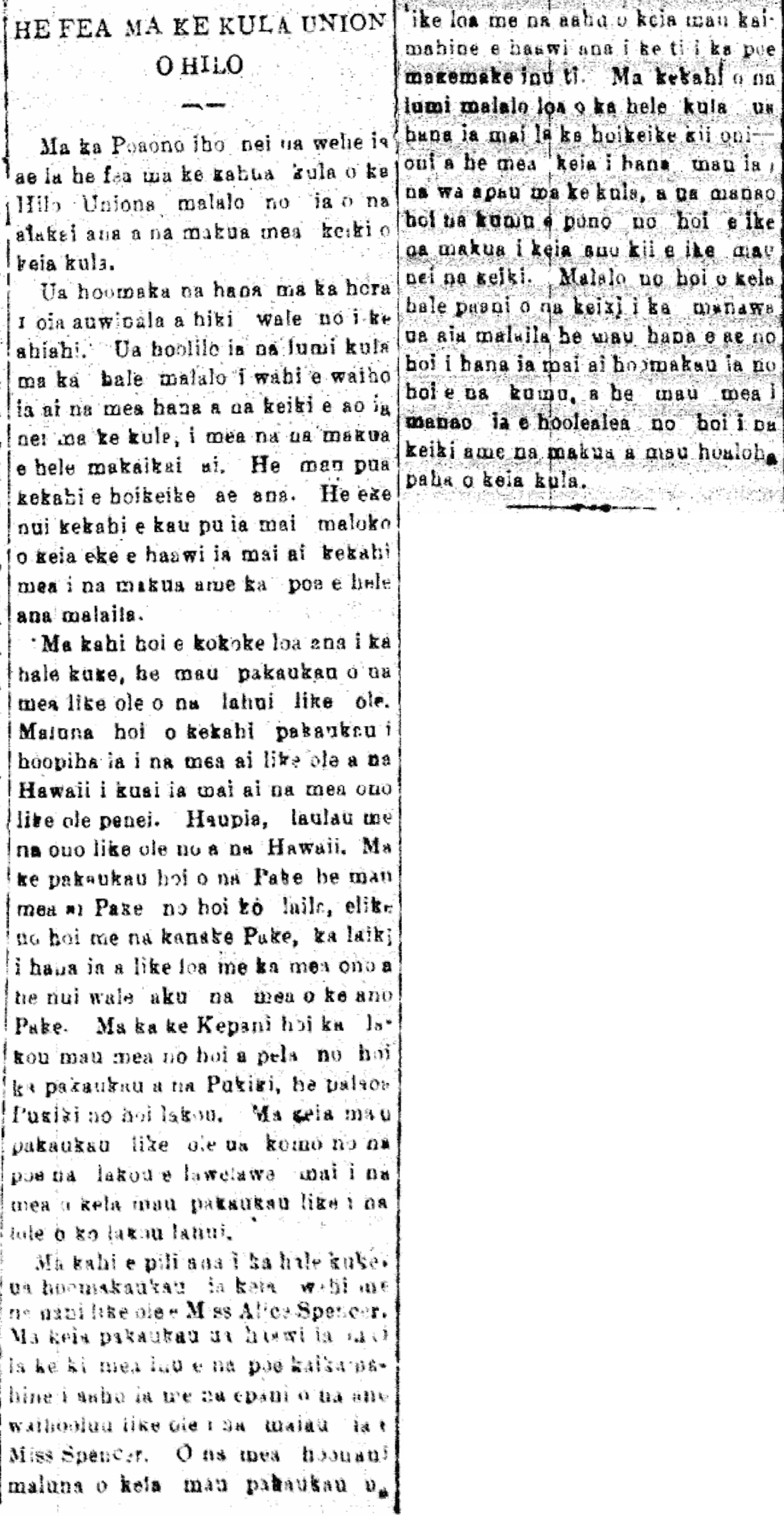
A FAIR AT HILO UNION SCHOOL

This past Saturday there was held a fair on the school grounds of Hilo Union, under the direction of the parents of the students of this school.

The activities began at 1 in the afternoon until the evening. The classrooms on the first floor was where the work of the children being taught at that school were placed, so that the parents could view them. There were also flowers on display. There was also a large bag, and from within this bag an item was given to the the parents and the people who came.

In an area near the kitchen, there were tables of all sorts of goods from all the ethnicities. One of the tables was filled with all the many delicacies of the Hawaiians. Haupia, laulau, and the other good foods of the Hawaiians. On the table of the Chinese, there was Chinese foods like Chinese candy, rice made into sweets, and many other Chinese items. On the Japanese one, was Japanese goods, and so too with the Portuguese table, they had Portuguese bread. On all of these tables, the people taking care of the items were dressed in the clothing of their people.

Near the kitchen, there was a place decorated by Miss Alice Spencer. On this table, tea to drink was served by girls dressed in aprons of all colors skillfully [made?] by Miss Spencer. The decorations on these tables were identical to the clothes of the girls serving tea to those who wanted to drink tea. In one of the rooms all the way at the bottom of the school, a movie was shown, and this is something always done, and the teachers thought it would be good for the parents to see the type of movie seen all the time by the children. Below that play house of the children in times of rain, there were other activities to do, set up by the teachers, and it was thought that these activities would entertain the children, parents, and friends of this school.

[Just passed by Hilo Union the other day and thought I’d put this article up that I had put aside some time ago.]

(Hoku o Hawaii, 5/3/1927, p. 2)

HE FEA MA KE KULA UNION O HILO

Ka Hoku o Hawaii, Buke XX, Helu 49, Aoao 2. Mei 3, 1927.

Sweet Emalia is out in Honolulu! 1908.

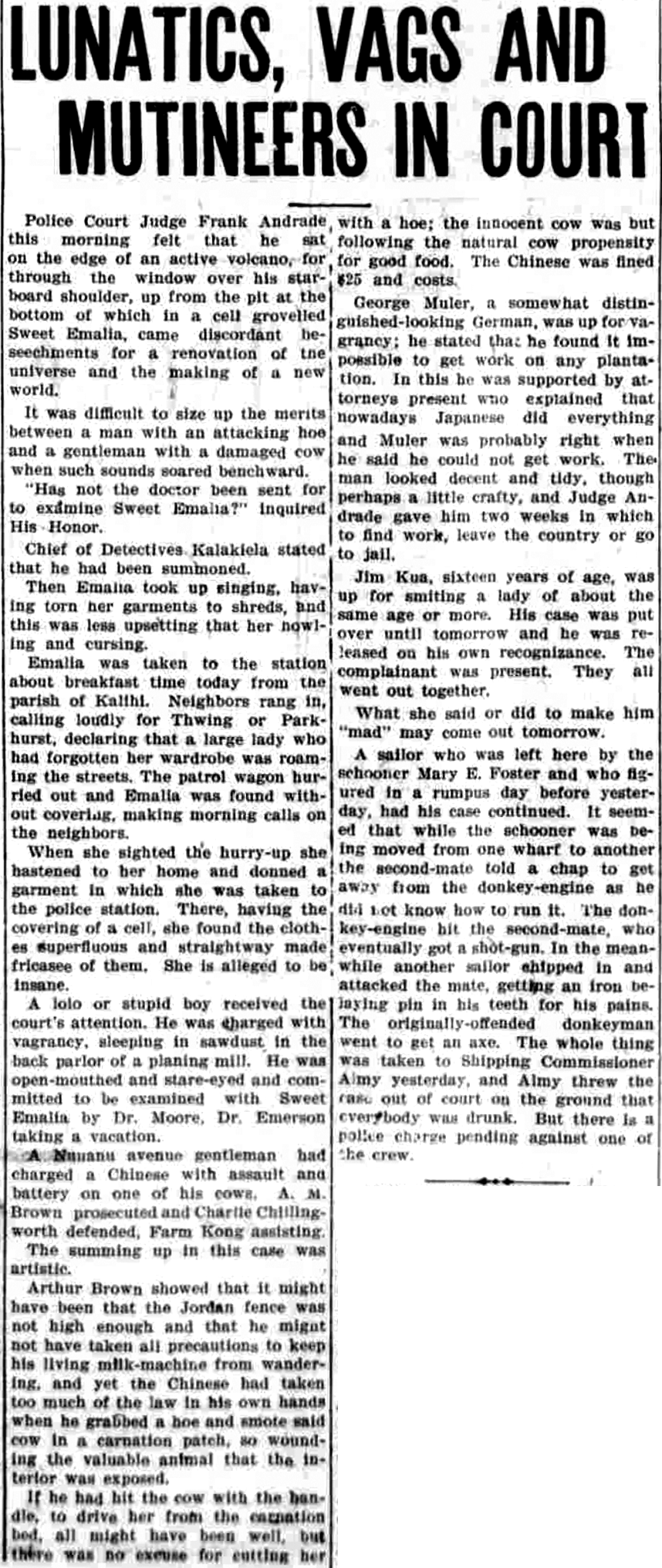
LUNATICS, VAGS AND MUTINEERS IN COURT

Police Court Judge Frank Andrade this morning felt that he sat on the edge of an active volcano, for through the window over his starboard shoulder, up from the pit at the bottom of which in a cell grovelled Sweet Emalia, came discordant beseechments for a renovation of the universe and the making of a new world.

It was difficult to size up the merits between a man with an attacking hoe and a gentleman with a damaged cow when such sounds soared benchward.

“Has not the doctor been sent for to examine Sweet Emalia?” inquired His Honor.

Chief of Detectives Kalakiela stated that he had been summoned.

Then Emalia took up singing, having torn her garments to shreds, and this was less upsetting that her howling and cursing.

Emalia was taken to the station about breakfast time today from the parish of Kalihi. Neighbors rang in, calling loudly for Thwing or Parkhurst, declaring that a large lady who had forgotten her wardrobe was roaming the streets. The patrol wagon hurried out and Emalia was found without covering, making morning calls on the neighbors.

When she sighted the hurry-up she hastened to her home and donned a garment in which she was taken to the police station. There having the covering of a cell, she found the clothing superfluous and straightway made fricasee of them. She is alleged to be insane.

A lolo or stupid boy received the court’s attention. He was charged with vagrancy, sleeping in sawdust in the back parlor of a planing mill. He was open-mouthed and stare-eyed and committed to be examined with Sweet Emalia by Dr. Moore, Dr. Emerson taking a vacation.

…..

[After coming across this article from 1908 showing Sweet Emalia out in Honolulu, I am now thinking that the Emily Kaihumua sent to Kalawao in 1906 and being examined there in 1909 by Dr. Goodhue might not be the same person…

Hopefully one day soon, all the Hawaiian-Language Newspapers will be rescanned clearly so that if there is ever enough money to do once again an OCR project, or a hand transcription project, it can be done accurately so that hopefully we can find each and every available article that could clarify what became of Emalia, or any other person or event in Hawaiian history for that matter!!]

(Hawaiian Star, 8/13/1908, p. 5)

LUNATICS, VAGS AND MUTINEERS IN COURT

The Hawaiian Star, Volume XVI, Number 5708, Page 5. August 13, 1908.

Kokua being sent out of Kalawao and Kalaupapa, 1894.

To be Discharged.

Here below is the list of assistants [kokua] living in Kalawao and Kalaupapa who are being sent away.

Kaaihue (m), Kawika (m), Kalaeloa (m), Keliikipi (m), Makakoa (m), they are from Kohala, Hawaii. Nailima (m), Ku (m), S. Keanu, Kekua (m), Kaaikauna (m), Manua (m), Manua, Jr. (m), Kaoo (f), Kealohanui (f), Malia (f), and Kaia (f), they are from Maui along with Mele Paulina. Pukooku (m), Nailima 2 (m), Kamakau (m), Kalehua (f), and Umi (f), from Kona, Hawaii. C. Kopena, Hokela (f), and Keonaona (f), they are from Honolulu. Mihi (f) and Pahukoa (m), from Niihau. Alaala (m) and Hamea (f), from Kauai. Kanuha ka, from Ewa. Maiuli (m), from Molokai. Kahananui (m), Kamaka (m), Auau (m), Pookela (f), Maleka (f), it is not known where they are from. Kapoi (f) and Kaiakonui (f), from Kalaupapa. Hanaloa (m), from Hilo. Kapeka (f), from Waipio. Apikaila (f) and Kekuni (f), from Kohala.

Here are the kokua that are married. Kaaihue (m) to Kaoo (f), Kanua (m) to Pookela (f), Kamaka (m) to Kapoi (f), Keliikipi (m) to Kaleiolono (f), C. Kopena to Keonaona (f), Kaaikauna (m) to Apikaila (f), Alaala (m) to Hamea (f).

Here are the kokua who are married to a patient: Nailima (m) to Kealoha (f), Pahukoa (m) to Keoho (f), S. Keanu to Maikini (f), Manua, Jr. to Kaiwaokalani (f), Hanaloa (m) to Kalehua (f), Hokela (f) to Lopaka (m), Mihi (f) to Haili (m), Malia (f) to Punohu (m), Umi (f) to Punilio (m), Mele Paulina to Huelo Poki, Kekuni (f) to Kane (m). Most of the kokua live mixed in with the patients. As for Kaiakonui (f), she is married to A. Hutchison, the current Superintendent.

(Makaainana, 2/5/1894, p. 2)

E Kaiehuia aku ana.

Ka Makaainana, Buke I—-Ano Hou, Helu 6, Aoao 2. Feberuari 5, 1894.

Detailed list of patients being examined at Kalawao, 1909.

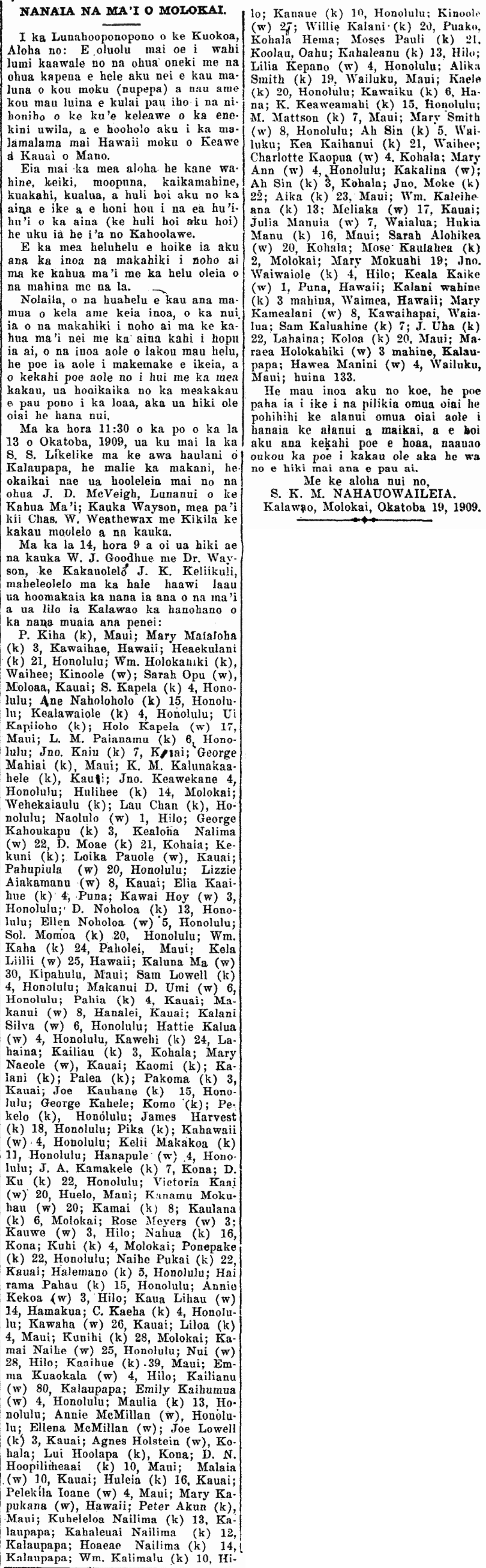
THE PATIENTS OF MOLOKAI ARE EXAMINED.

To the Editor of the Kuokoa, Aloha no: Please allow me some space on your deck along with the captain’s passengers travelling aboard your ship (newspaper) and it is for you and your sailors to [anybody care to offer insight into this nautical allusion? “a nau ame kou mau luina e kulai pau iho i na nihoniho o ke ku’e keleawe o ka enekini uwila…”] and to send knowledge from Hawaii, the island of Keawe, all the way to Kauai of Manokalanipo.

Here are your loved ones, a husband, a wife, a child, a grandchild, a daughter, a grand, a great grand; and they turn towards home, to see and to smell once again the cool air of the land (should they return); the fish is an uku, a fish of Kahoolawe.¹

O Reader, shown will be the names and the years they have lived here in the land of the sick without counting the months and days.

Therefore, the number placed before [after] each name is the total years lived here in the land of the sick and the land where they were taken from; for the names without numbers, they don’t want it to be known, and some have not met with the writer; the writer put great effort into completing it, but he could not for it was a big task.

At 11:30 at night on the 13th of October, 1909, the S. S. Likelike arrived at the restless harbor of Kalaupapa; the wind was calm, but the disembarking of the passengers was still rough, they being J. D. McVeigh, Superintendent of the Leprosy Colony; Dr. Wayson; photographer Charles W. Weatherwax and Kikila the secretary of the doctors.

On the 14th, at 9 or so, the doctors W. J. Goodhue and Wayson arrived with the Secretary J. K. Keliikuli, interpreter at the dispensary; and the examination of the patients began; and to Kalawao went the honor of the first examination, as follows:

P. Kiha (m), Maui; Mary Maialoha (m), 3, Kawaihae, Hawaii; Heaekulani (m) 21, Honolulu; William Holokahiki (m), Waihee; Kinoole (f); Sarah Opu (f), Moloaa, Kauai; S. Kapela (m) 4, Honolulu; Ane Naholoholo (m) 15, Honolulu; Kealawaiole (m) 4, Honolulu; Ui Kapiioho (m); Holo Kapela (f) 17, Maui; L. M. Paianamu (m) 6, Honolulu; John Kaiu (m) 7, Kauai; George Mahiai (m), Maui; K. M. Kalunakaahele (m), Kauai; John Keawekane 4, Honolulu; Hulihee (m) 14, Molokai; Wehekaiaulu (m); Lau Chan (m), Honolulu; Naolulo (f) 1, Hilo; George Kahoukapu (m) 3; Kealoha Nalima (f) 22; D. Moae (m) 21, Kohala; Kekuni (m); Loika Pauole (f), Kauai; Pahupiula (f) 20, Honolulu; Lizzie Aiakamanu (f) 8, Kauai; Elia Kaaihue (m) 4, Puna; Kawai Hoy (f) 3, Honolulu; D. Noholoa (m) 13, Honolulu; Ellen Noholoa (f) 5, Honolulu; Solomon Momoa (m) 20, Honolulu; William Kaha (m) 24, Paholei, Maui; Kela Liilii (f) 25, Hawaii; Kaluna Ma (f) 30, Kipahulu, Maui; Sam Lowell (m) 4, Honolulu; Makanui D. Umi (f) 6, Honolulu; Pahia (m) 4, Kauai; Makanui (f) 8, Hanalei, Kauai; Kalani Silva (f) 6, Honolulu; Hattie Kalua (f) 4, Honolulu; Kawehi (m) 24, Lahaina; Kailiau (m) 3, Kohala; Mary Naeole (f), Kauai; Kaomi (m); Kalani (m); Palea (m); Pakoma (m) 3, Kauai; Joe Kauhane (m) 15, Honolulu; George Kahele; Komo (m); Pekelo (m), Honolulu; James Harvest (m) 18, Honolulu; Pika (m); Kahawaii (f) 4, Honolulu; Kelii Makakoa (m) 11, Honolulu; Hanapule (f) 4, Honolulu; J. A. Kamakele (m) 7, Kona; D. Ku (m) 22, Honolulu; Victoria Kaai (f) 20, Huelo, Maui; Kanamu Mokuhau (f) 20; Kamai (m) 8; Kaulana (m) 6, Molokai; Rose Meyers (f) 3; Kauwe (f) 3, Hilo; Nahua (m) 16, Kona; Kuhi (m) 4, Molokai; Ponepake (m) 22, Honolulu; Naihe Pukai (m) 22, Kauai; Halemano (m) 5, Honolulu; Hairama Pahau (m) 15, Honolulu; Annie Kekoa (f) 3, Hilo; Kaua Lihau (f) 14, Hamakua; C. Kaeha (m) 4, Honolulu; Kawaha (f) 26, Kauai; Liloa (m) 4, Maui; Kunihi (m) 28, Molokai; Kamai Naihe (f) 25, Honolulu; Nui (f) 28, Hilo; Kaaihue (m) 39, Maui; Emma Kuaokala (f) 4, Hilo; Kailianu (f) 80, Kalaupapa; Emily Kaihumua (f) 4, Honolulu; Maulia (m) 13, Honolulu; Annie McMillan (f), Honolulu; Ellena McMillan (f); Joe Lowell (m) 3, Kauai; Agnes Holstein (f), Kohala; Lui Hoolapa (m), Kona; D. N. Hoopilimeaai (m) 10, Maui; Malaia (f) 10, Kauai; Huleia (m) 16, Kauai; Pelekila Ioane (f) 4, Maui; Mary Kapukana (f), Hawaii; Peter Akua (m), Maui; Kuheleloa Nailima (m) 13, Kalaupapa; Kahaleuai Nailima (m) 12, Kalaupapa; Hoaeae Nailima (m) 14, Kalaupapa; William Kalimalu (m) 10, Hilo; Kanaue (m) 10, Honolulu; Kinoole (f) 27; Willie Kalani (m) 20, Puako, South Kohala; Moses Pauli (m) 21, Koolau, Oahu; Kahaleanu (m) 13, Hilo; Lilia Kepano (f) 4, Honolulu; Alika Smith (m) 19, Wailuku, Maui; Kaele (m) 20, Honolulu; Kawaiku (m) 6, Hana; K. Keaweamahi (m) 15, Honolulu; M. Mattson (m) 7, Maui; Mary Smith (f) 8, Honolulu; Ah Sin (m) 5, Wailuku; Kea Kaihanui (m) 21, Waihee; Charlotte Kaopua (f) 4, Kohala; Mary Ann (f) 4, Honolulu; Kakalina (f); Ah Sin (m) 3, Kohala; John Moke (m) 22; Alika (m) 23, Maui; William Kaleiheana (m) 13; Meliaka (f) 17, Kauai; Julia Manuia (f) 7, Waialua; Hukia Manu (m) 16, Maui; Sarah Alohikea (f) 20, Kohala; Mose Kaulahea (m) 2, Molokai; Mary Mokuahi 19; John Waiwaiole (m) 4, Hilo; Keala Kaike (f) 1, Puna, Hawaii; Kalani wahine (m) 3 months, Waimea, Hawaii; Mary Kamealani (f) 8, Kawaihapai, Waialua; Sam Kaluahine (m) 7; J. Uha (m) 22, Lahaina; Koloa (m) 20, Maui; Maraea Holokahiki (f) 3 months, Kalaupapa; Hawea Manini (f) 4, Wailuku, Maui; total 133.

There are names left; perhaps they are those who knew the troubles ahead, for the road ahead is unclear, as the path is not laid out well, and some will return in confusion; wise are those who did not sign, but there will come a time when this will end.

With great aloha,

S. K. M. NAHAUOWAILEIA.

Kalawao, Molokai, October 19, 1909.

¹”He uku ia he i’a no Kahoolawe.” A traditional saying playing off the word “uku “which is a type of fish, but also means reward or recompense.

[Wow… this took a long time, but i think it is an awesome document well worth the time put in. My aloha goes out to S. K. M. Nahauowaileia and the type-setting boys of the Kuokoa!!]

(Kuokoa, 10/29/1909, p. 6)
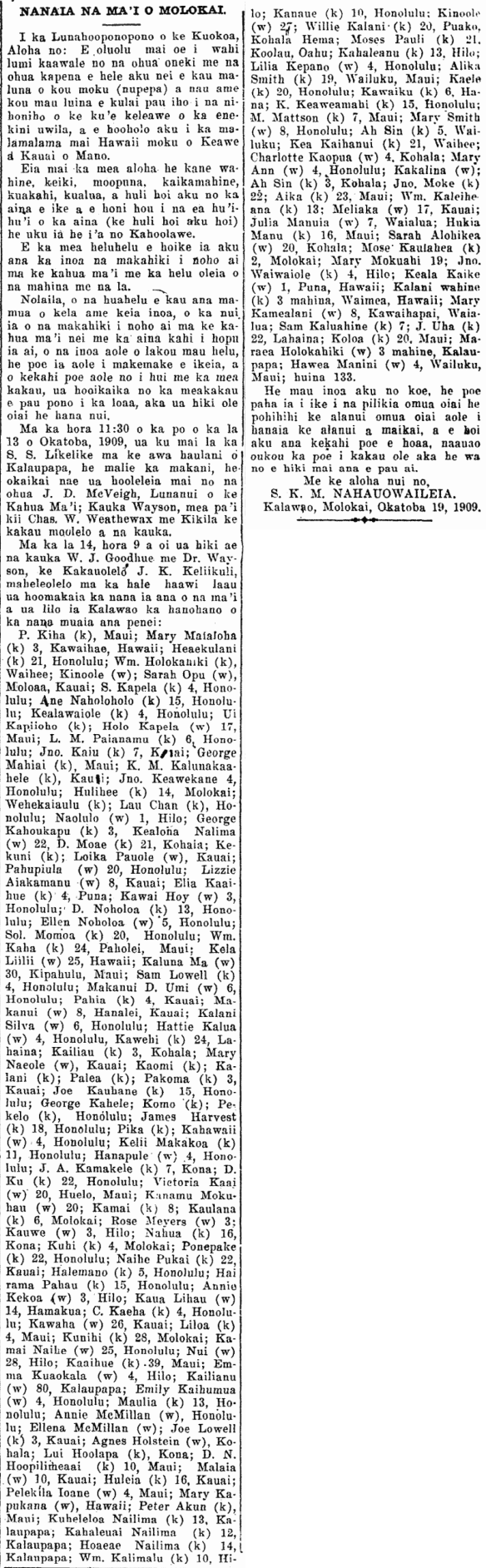
NANAIA NA MA'I O MOLOKAI.

Ka Nupepa Kuokoa, Buke XLVI, Helu 44, Aoao 6. Okatoba 29, 1909.