Hugo Kawelo, sent to Glasgow to study, returns, 1886.

HAWAIIAN YOUTH RETURNS.

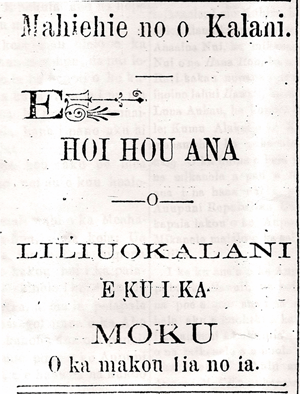
On the ship that brought the Portuguese laborers, Mr. Hugo Kawelo, one of the youths sent to Scotland [Sekotia] to seek education by working [unclear word] in an iron works factory. Because of sickness, he returned, but when he arrived back, he was the epitome of a robust and vigorous man. It was as if the air of the open ocean brought him back to health. He wishes to return to complete his education in the iron [unclear word] industry, should his health be good.

[Hugo Kawelo is one of the select Hawaiians sent abroad by Kalakaua to study and to bring back this knowledge to move Hawaii forward. For more on this program, see for instance: Agnes Quigg’s “Kalakaua’s Hawaiian Studies Abroad Program” from the Hawaiian Journal of History.

Here is one another example of a badly imaged newspaper. I guessed the meaning of some of the passage.

One of our readers, Lynda Fitzgerald, asked who can be contacted to get the original Hawaiian-Language Newspapers reshot clearly. I don’t have a specific name, but the more people that know how important this is, the more likely it will be done. So talk to your friends and coworkers and heads of boards and kumu hula and civic club officers and the aunty down the street. Why do you think seeing all of this information clearly is important…]

(Nupepa Elele, 3/6/1886, p. 2)

HAWAII OPIO UA HOI MAI.

Ka Nupepa Elele, Buke VII, Helu 36, Aoao 2. Maraki 6, 1886.
Princess Kaiulani born, 1875.

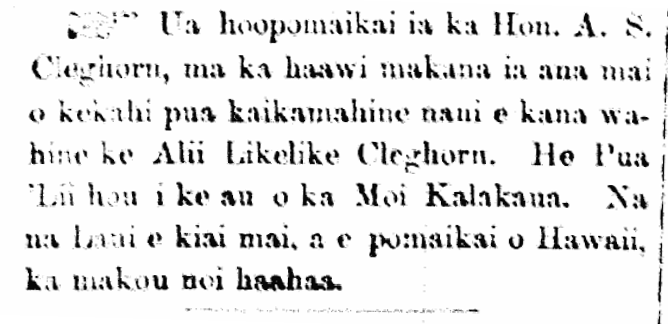
The Hon. A. S. Cleghorn was blessed with being gifted with a beautiful baby girl by his wife, the Alii Likelike Cleghorn. This is a new Royal Offspring in the era of King Kalakaua. That the Heavens watch over and bless Hawaii is our humble plea.

(Lahui Hawaii, 10/23/1875, p. 3)

Ua hoopomaikai ia ka Hon. A. S. Cleghorn...

Ka Lahui Hawaii, Buke I, helu 43, Aoao 3. Okatoba 23, 1875.

Always important to look at sources. 1893 / 2012.

HAWAII ESCAPES FROM JAPAN.

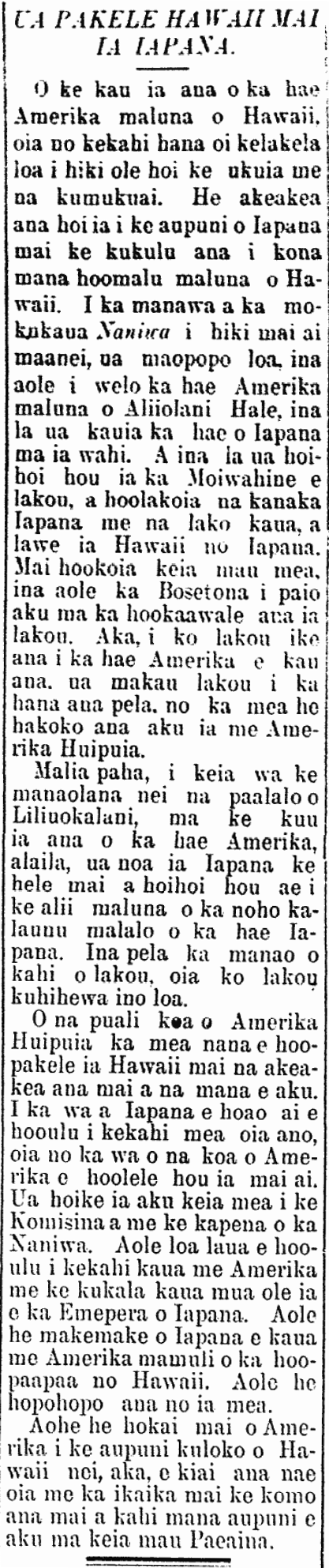
The raising of the American flag over Hawaii is one of the greatest things done that cannot be repaid. It blocks the nation of Japan from establishing its rule over Hawaii. When the warship Naniwa arrived here, it was clear that if the American flag was not waving over Aliiolani Hale, then the Japanese flag would have been put in its place. And then they would have returned the Queen and the Japanese would have been supplied with weapons and took Hawaii for Japan. It all would have happened if the Boston did not hold them off. But when they saw the American flag raised, they were afraid to do this, for it would be fighting with the United States of America.

Perhaps now Liliuokalani’s attendants are hoping that by the taking down of the American flag, the Japanese will be free to come and return the alii to the throne under the Japanese flag. Should that be the thought of some of them, they are gravely mistaken.

The American troops will save Hawaii from the interference by the other powers. When Japan tries to foment something of that sort, that will be when the soldiers of America will be deployed again. This has been announced to the Commissioner and the captain of the Naniwa. They will not start a war with America without it being proclaimed in advance by the Emperor of Japan. Japan has no desire to war against America because of the dispute over Hawaii. There is nothing to fear.

America will not interfere in the local government of Hawaii nei, however it will guard Hawaii with force against the entering of other national powers into this Archipelago.

[It is always important to look at what newspaper an article comes from. Also, long-running newspapers (and people for that matter) don’t necessarily keep their same ideologies throughout their entire life…]

(Kuokoa, 4/8/1893, p. 2)

UA PAKELE HAWAII MAI IA IAPANA.

Ka Nupepa Kuokoa, Buke XXXII, Helu 14, Aoao 2. Aperila 8, 1893.

Queen Liliuokalani’s jewelry auctioned off, 1924.

JEWELRY OF LILIU LIQUIDATED

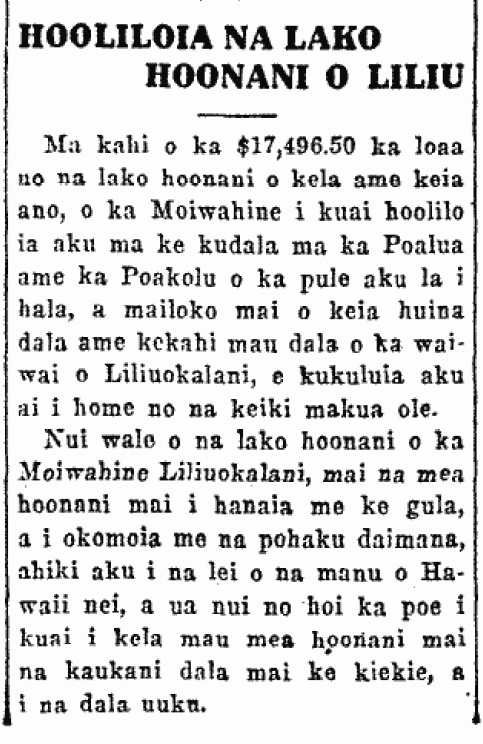
Approximately $17,496.50 was made from the jewelry of this and that sort, of the Queen’s that was auctioned off on Tuesday and Wednesday of last week, and through this sum along with some of the estate of Liliuokalani, a home for orphaned children will be built.

Queen Liliuokalani had a great deal of adornments, from those made of gold and inlaid with diamonds, to lei made with the feathers of Hawaiian birds; there were many who bought them, for as high as thousands of dollars to just a few dollars.

[All of this jewelry apparently went for a steal…]

(Kuokoa, 4/3/1924, p. 1)

HOOLILOIA NA LAKO HOONANI O LILIU

Ka Nupepa Kuokoa, Buke LXIII, Helu 14, Aoao 1. Aperila 3, 1924.

A music book gifted to the Honorable Lilia K. Dominis, 1868.

[Found under: “LOCAL NEWS: Oahu”]

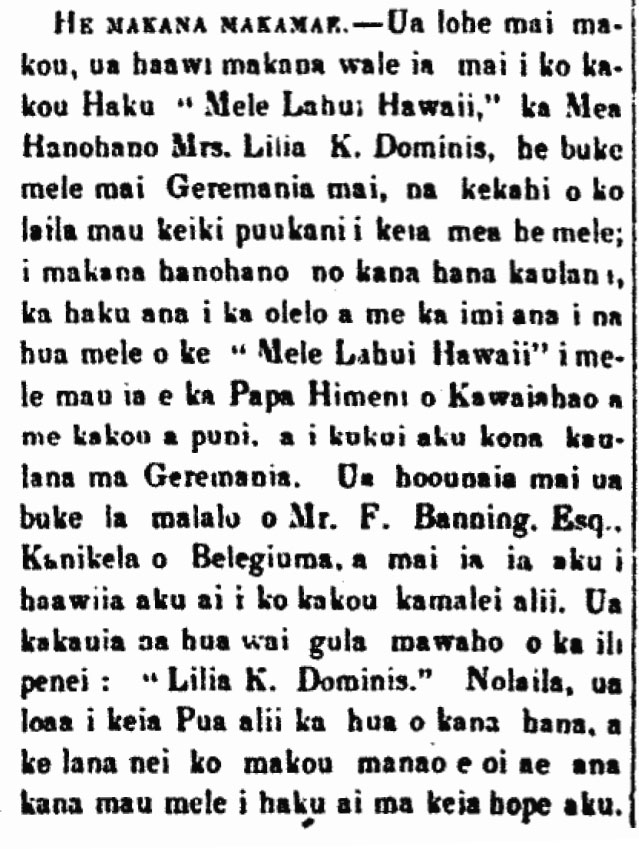
A Precious Gift.—We have heard that our Composer of “Mele Lahui Hawaii,” the Honorable Mrs. Lilia K. Dominis, was gifted a music book from Germany, by one of their singers; it was presented with honor for her famous accomplishment: the composition of the lyrics and the searching for the music of “Mele Lahui Hawaii,” which is sung all the time by the choir of Kawaiahao and by all of us everywhere and its fame has been heard of in Germany. The book was sent by way of Mr. F. Banning, Esq., Consul of Belgium, to our precious alii. Printed in gold lettering on the cover was: “Lilia K. Dominis.” This young alii has thus received the fruits of her labors, and we hope that there will be more of her compositions here after.

[Anyone know what this book is and where it is located today?]

(Kuokoa, 3/28/1868, p. 2)

He Makana Makamae.

Ka Nupepa Kuokoa, Buke VII, Helu 13, Aoao 2. Maraki 28, 1868.

More on the National Anthem, 1883.

Hawaiian National Anthem.

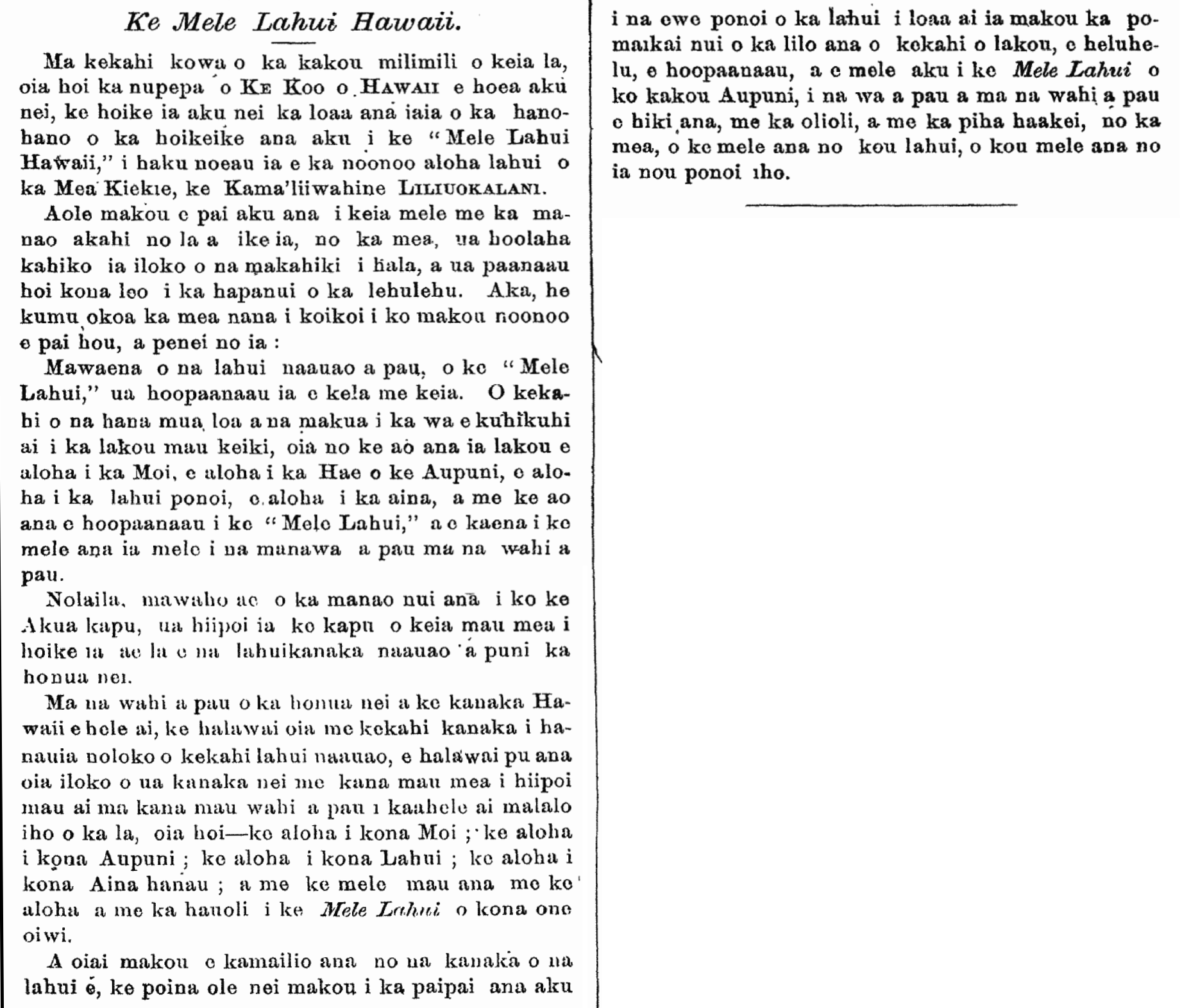
In an open space in our beloved one of this day, that being the newspaper “Ke Koo o Hawaii,” that is coming to you, it is being shown that we have the honor of putting before you the Hawaiian National Anthem [“Mele Lahui Hawaii”] which was skillfully composed with feelings of aloha for her people by Her Highness, Princess Liliuokalani.

We are not printing this mele thinking that this is the first time it will be seen, for it was printed a long ago in years past, and its melody is memorized by most. However, there is a different reason we thought it was important to reprint it, and that being:

Amongst all enlightened people, the “National Anthem” is memorized by everyone. One of the first duties of a parent when instructing their children is to teach them to love their Monarch, to love the Flag of their Nation, to love their own people [lahui], to love their land, and to memorize their National Anthem and to be proud to sing this mele at all times and at all places.

Therefore, besides respecting God’s laws, the sacredness of those things mentioned above are cherished by enlightened nations all over the world.

In all places on this earth travelled by Hawaiians, whenever he meets up with someone born in an enlightened nation, he meets also within that person [e halawai pu ana oia iloko o ua kanaka nei ?] with what he constantly cherishes in all places travelled by him under the sun, that being—love for his King; love for his Nation; love for his People, love for his Land of birth; and the singing always with love and joy of the National Anthem of his homeland.

And while we speak of those of other nations, we do not forget to encourage our own natives of this lahui who we have the great fortune to have some of them read, memorize, and sing the National Anthem of our Nation, at all times and at all places they go, with joy and filled of pride, because singing for your lahui is singing for your very own self.

(Koo o Hawaii, 8/15/1883, p. 5)

Ke Mele Lahui Hawaii.

Ke Koo o Hawaii, Buke 1, Helu 1, Aoao 5. Augate 15, 1883.

National Anthem, 1883.

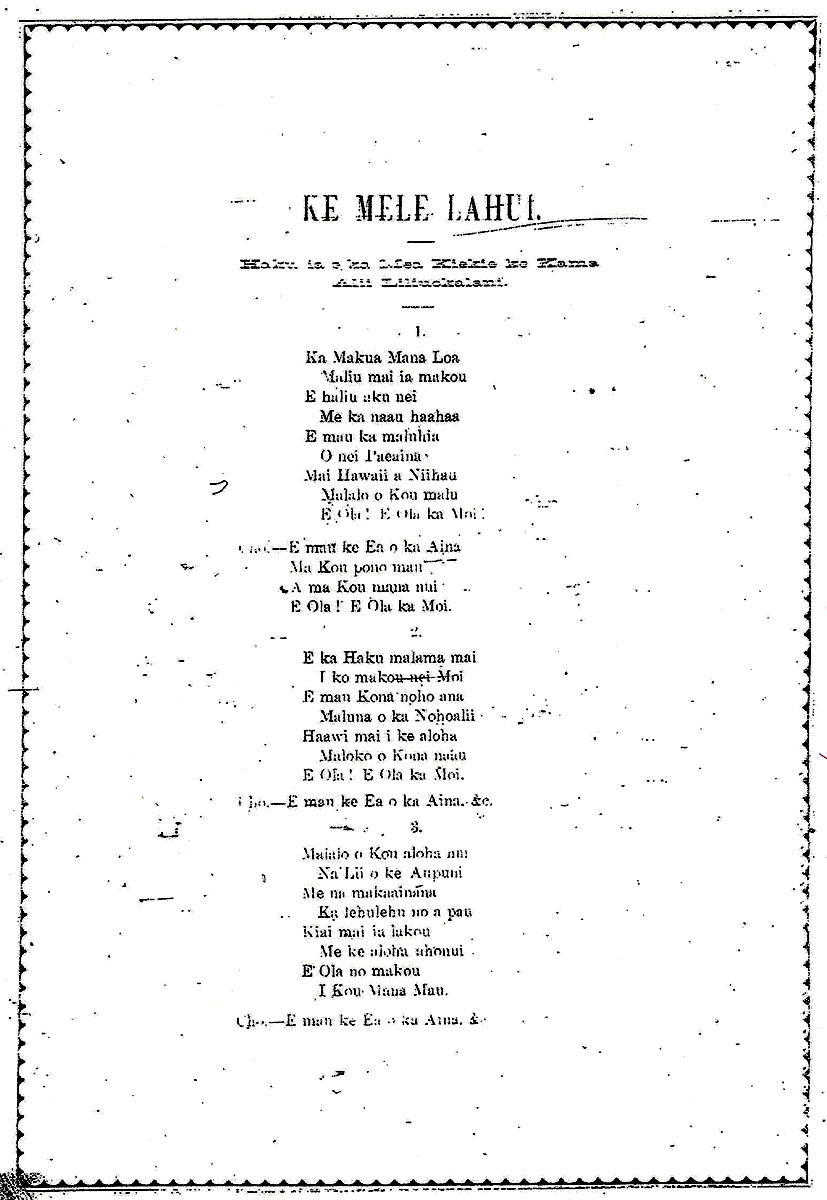
KE MELE LAHUI.

Composed by Her Highness
Princess Liliuokalani.

1.

Ka Makua Mana Loa
Maliu mai ia makou
E Haliu aku nei
Me ka naau haahaa
E mau ka maluhia
O nei Paeaina
Mai Hawaii a Niihau
Malalo o Kou malu
E Ola! E Ola ka Moi!

Cho.—E mau ke Ea o ka Aina
Ma Kou pono mau
A ma Kou mana nui
E Ola! E Ola ka Moi.

2.

E ka Haku malama mai
I ko makou nei Moi
E mau Kona noho ana
Maluna o ka Nohoalii
Haawi mai i ke aloha
Maloko o Kona naau
[A ma Kou ahonui]
E Ola! E Ola ka Moi.

Cho.—E mau ke Ea o ka Aina, &c.

3.

Malalo o Kou aloha nui
Na’Lii o ke Aupuni
Me na makaainana
Ka lehulehu no a pau
Kiai mai ia lakou
Me ke aloha ahonui
E Ola no makou
I Kou Mana Mau.

Cho.—E mau ke Ea o ka Aina, &c.

(Koo o Hawaii, 8/15/1883, p. 11)

KE MELE LAHUI.

Ke Koo o Hawaii, Buke 1, Helu 1, Aoao 11. Augate 15, 1883.

Sap of the Kukui, 1867.

[Found under: “LOCAL NEWS: Oahu”]

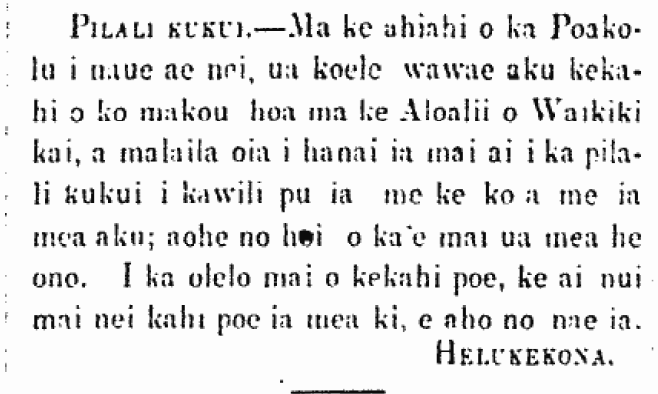
Kukui Sap.—On the evening of last Wednesday, one of our friends was walking by the Royal Court at Waikiki Kai, and there he was given the pilali of the kukui tree mixed with sugar and other things; it was just so delicious. According to some people, there are people who eat a lot of  ti [probably the baked root of the ti plant], however it is better.

[Has anyone ever tried either of these? Does anyone still do this today?]

(Kuokoa, 4/20/1867, p. 2)

Pilali Kukui.

Ka Nupepa Kuokoa, Buke VI, Helu 16, Aoao 2. Aperila 20, 1867.

Mele for Queen Emma on her mountain-climbing expedition, Kauai, 1871.

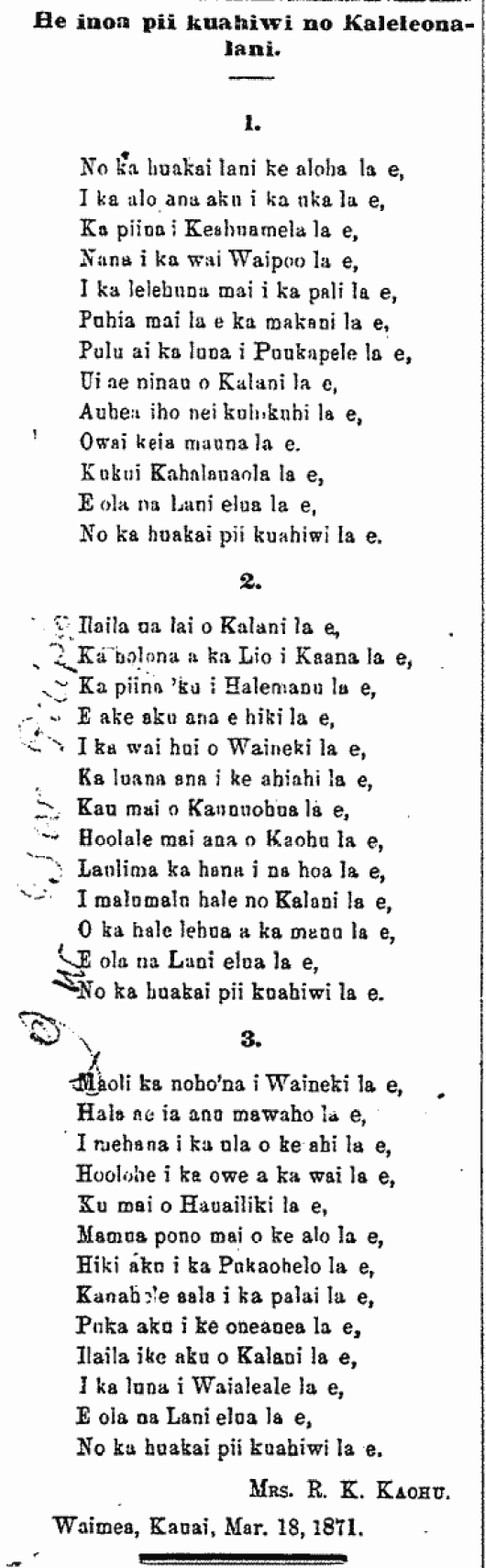
He inoa pii kuahiwi no Kaleleonalani.

1.

No ka huakai lani ke aloha la e,
I ka alo ana aku i ka uka la e,
Ka piina i Keahuamela la e,
Nana i ka wai Waipoo la e,
I ka lelehuna mai i ka pali la e,
Puhia mai la e ka makani la e,
Pulu ai ka luna i Puukapele la e,
Ui ae ninau o Kalani la e,
Auhea iho nei kuhikuhi la e,
Owai keia mauna la e,
Kukui Kahalauaola la e,
E ola na Lani elua la e,
No ka huakai pii kuahiwi la e.

2.

Ilaila ua lai o Kalani la e,
Ka holona a ka Lio i Kaana la e,
Ka piina ‘ku i Halemanu la e,
E ake aku ana e hiki la e,
I ka wai hui o Waineki la e,
Ka luana ana i ke ahiahi la e,
Kau mai o Kaunuohua la e,
Hoolale mai ana o Kaohu la e,
Laulima ka hana i na hoa la e,
I malumalu hale no Kalani la e,
O ka hale lehua a ka manu la e,
E ola na Lani elua la e,
No ka huakai pii kuahiwi la e.

3.

Maoli ka noho’na i Waineki la e,
Hala ae ia anu mawaho la e,
I mehana i ka ula o ke ahi la e,
Hoolohe i ka owe a ka wai la e,
Ku mai o Hauailiki la e,
Mamua pono mai o ke alo la e,
Hiki aku i Pukaohelo la e,
Kanahele aala i ka palai la e,
Puka aku i ke oneanea la e,
Ilaila ike aku o Kalani la e,
I ka luna o Waialeale la e,
E ola na Lani elua la e,
No ka huakai pii kuahiwi la e.

Mrs. R. K. Kaohu.

Waimea, Kauai, Mar. 18, 1871.

[For more mele in honor of Queen Emma, see “He Lei no Emalani”.]

(Au Okoa, 4/13/1871, p. 1)

He inoa pii kuahiwi no Kaleleonalani.

Ke Au Okoa, Buke VI, Helu 52, Aoao 1. Aperila 13, 1871.