Konia’s kanikau for Paki, 1855.

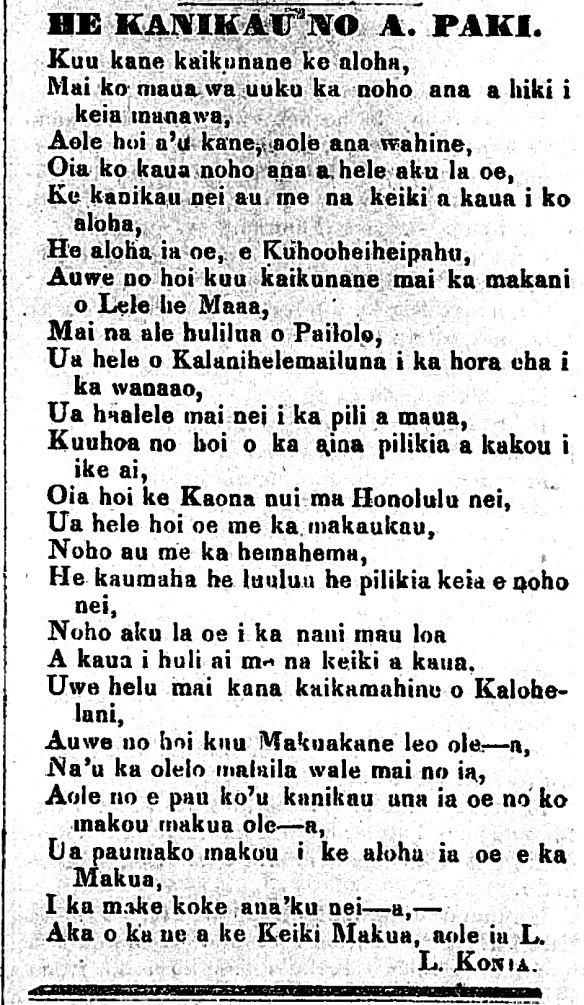
HE KANIKAU NO A. PAKI.

Kuu kane kaikunane ke aloha,
Mai ko maua wa uuku ka noho ana a hiki i keia manawa,
Aole hoi a’u kane, aole ana wahine,
Oia ko kaua noho ana a hele aku la oe,
Ke kanikau nei au me na keiki a kaua i ko aloha,
He aloha ia oe, e Kuhooheiheipahu,
Auwe no hoi kuu kaikunane mai ka makani o Lele he Maaa,
Mai na ale hulilua o Pailolo,
Ua hele o Kalanihelemailuna i ka hora eha i ka wanaao,
Ua haalele mai nei i ka pili a maua,
Kuu hoa no hoi o ka aina pilikia a kakou i ike ai,
Oia hoi ke Kaona nui ma Honolulu nei,
Ua hele hoi oe me ka makaukau,
Noho au me ka hemahema,
He kaumaha he luuluu he pilikia keia e noho nei,
Noho aku la oe i ka nani mau loa,
A kaua i huli ai me na keiki a kaua,
Uwe helu mai kana kaikamahine o Kalohelani,
Auwe no hoi kuu Makuakane leo ole—a,
Na’u ka olelo malaila wale mai no ia,
Aole no e pau ko’u kanikau ana ia oe no ko makou makua ole—a,
Ua paumako makou i ke aloha ia oe e ka Makua,
I ka make koke ana’ku nei—a,—
Aka o ka ne a ke Keiki Makua, aole ia L.

L. Konia.

(Elele E, 6/16/1855, p. 20)

HE KANIKAU NO A. PAKI.

Ka Elele E, Buke 10, Aoao 20. Iune 16, 1855.

Funeral of Konia, 1857.

The Funeral of Konia.

The obsequies of the late chiefess Konia were performed on Tuesday, and notwithstanding the sickness which has been so general prevented numbers of persons from attending, the aggregate of those collected to show their respect on the occasion was very large, whilst the crowd that thronged both sides of the streets, as the procession moved along, was so great as to require a strong force to preserve the line of march from the late residence of the deceased lady to the Royal cemetery, in which the coffin was placed. The religious services were performed by the Rev. Mr. Clark, and the ceremony was conducted throughout with a decorum and feeling which was remarked by all present.

(Polynesian, 8/8/1857, p. 108)

The Funeral of Konia.

The Polynesian, Volume XIV, Number 14, Page 108. August 8, 1857.

Death of Laura Kanaholo Konia, 1857.

On this past 2nd, L. Konia, the widow of A. Paki, died at 50 years of age. She was an alii nui, and was a child of Kaoleioku, and Kalaniopuu was the father of Kaoleioku, an actual cousin of the father of Kamehameha I. Konia was a loving chiefess, and her friends and all the people of this archipelago are very saddened for there is no high chiefess in this land remaining; they have all gone. Her friends weep with greatly pained hearts.

(Hae Hawaii, 7/15/1857, p. 62)

I ka la 2 iho nei...

Ka Hae Hawaii, Buke 2, Ano Hou—-Helu 16, Aoao 62. Iulai 15, 1857.

On the moving of the Na-ha Stone to Hilo Library 100 years ago, and its history (6 of 6), 1915.

….all of the districts from Hawaii all the day to Kauai, however, if Naha is shook and removed by you today from where it lies, it will be the removing of binds that secure the Districts. You will then live; your people will live; and I too will live, the Kahuna.

When the Prophetess Kalaniwahine was done speaking, it was at that point that Kamehameha traced his strong hands upon the good places to grab on to the stone, and then Kamehameha made ready to attempt to move the Naha Stone; the eyes of the all the people were fixed on him. When the hands of Kamehameha were locked onto the sides of the stone, Kamehameha spoke these words of prayer. “E! You are a Naha, the Alii who frees your kapu is a Naha Chief, and I am a Niaupio, the arching smoke of the forest. [??? E! He Na-ha oe, he Na-ha hoi ke Alii e noa ai kou kapu, a he Niau-pio hoi wau, a he uwahi pio i ka wao laau.]”

That was when Paiea pried the stone with amazing strength, and that Pohaku Alii did indeed move, and then the people surrounding the place where Kamehameha was moving the Naha Stone felt a rumbling of the land there, and some actually thought an earthquake was assisting Kamehameha. The Alii and Makaainana truly saw the moving of the Sacred Pohaku of the Naha Alii Line, and that it was shook by the amazing strength of Kalaninui Kamehameha. They realized the earlier words of the Prophetess Kalaniwahine came true, and some Alii immediately knew that this young Chief would become the person to shake the Islands of this Archipelago. This moving of the Naha Stone became something to always to encourage Kamehameha thereafter, and during heated battles on the battlefields to come, the moving and overturning of the Naha Stone was always in the fore of Kamehameha’s memories, and it was something that always bolstered his thoughts thereafter. Continue reading

On the moving of the Na-ha Stone to Hilo Library 100 years ago, and its history (5 of 6), 1915.

THE STORY OF THE NA-HA STONE

(Conclusion)

In the morning of another day, when the rays of the beautiful sun shone on Kumukahi and warmed the cold and damp earth, this young Chief of the Apaapaa winds of Kohala woke, and before taking the morning meal, they prepared for their journey to see the Naha Stone, and this journey of Kamehameha to see it was accompanied by the Chiefs of Hilo. The Chiefly Mother of the Chiefs, Ululani, also was in accompaniment, as well as her court and many of Hilo’s dignitaries. Amongst these going with the malihini Chief was Kalaniwahine, the Royal Prophet, who was escorting her hanai Chief who travelled across the sea along with her. This Prophetess was the one who instructed Kamehameha to go to Hilo to meet with his piko, the Alii in the line of High Naha Chiefs, that being Keaweokahikona, the strongest one known in those days. On this procession of Kamehameha to see the Naha Stone, Keaweokahikona also was accompanying his Chiefly Cousin, but he did not believe in the ability of Kamehameha to move the Naha Stone for it was a kapu stone of the Alii Class who had the Naha Kapu and the other lines of Alii had no rights to it; and it was this Keaweokahikona who was the only one known of who could move this Royal Pohaku.

At this time when Kamehameha folks were on the move, the Chiefly Mother of theirs spoke to him with these words: Continue reading

Naha Stone to be moved, 1916.

NA-HA STONE TO BE SKIDDED ON GIANT ROLLERS

(Special Star-Bulletin Correspondence)

HILO, March 10.—At last preparations are being made for the conveying of the famous Na-ha stone fro the John Scott property to the site selected for it on the Hilo library lot. The big stone, which must weigh several tons, is to be brought down on rollers, as it is too heavy and cumbersome to handle by motor-truck or any other kind of vehicle.

Big rollers have been procured, and they will be placed under the stone in such a way that the rock can be slid down from its present resting place to the desired location, where it will be so placed that tourists and town folk can inspect it at their leisure.A plate will be attached to the stone and on it the legend in connection with the wanderings of the historic relic will be set forth.

The stone originally came from Kauai where it was used in certain religious ceremonies after the birth of a child of high degree. The legend has it that the first Kamehameha rolled the stone over after a terrific struggle in which he used so much strength that the blood burst from his eyes.

(Star Bulletin, 3/14/1916, p. 14)

NA-HA STONE TO BE SKIDDED ON GIANT ROLLERS

Honolulu Star-Bulletin, Volume XXIII, Number 7463, Page 14. March 14, 1916.

On the moving of the Na-ha Stone to Hilo Library 100 years ago, and its history (4 of 6), 1915.

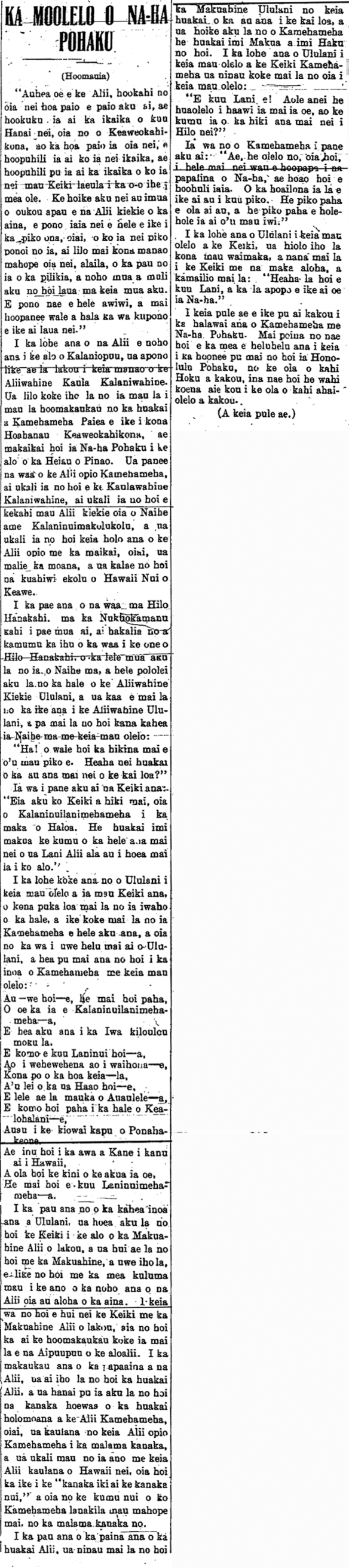
As soon as Ululani heard these words of her children, she exited the house, and soon saw Kamehameha approaching, and that is when Ululani began a wailing call of love [uwe helu] and then she also called out the name song for Kamehameha with these words:

Au—we hoi—e, he mai hoi paha,
O oe ka ia e Kalaninuilanimehameha—a,
E hea aku ana i ka Iwa kiloulou moku la,
E komo e kuu Laninui hoi—a,
Ao i wehewehena ao i waihona—e,
Kona po o ka hoa keia—la,
A’u lei o ka ua haao hoi—e,
E lele ae la mauka o Auaulele—a,
E komo hoi paha i ka hale o Kealohalani—e,
Auau i ke kiowai kapu o Ponahakeone,
Ae inu hoi i ka awa a Kane i kanu ai i Hawaii,
A ola hoi ke kini o ke akua ia oe,
He mai hoi e kuu Laninuimehameha—a.

[Ah indeed, do come,
Might it be you, O Kalaninuilanimehameha?
I call out to the island-hooking Frigate bird,
Come in, my Heavenly Chief,
The day opens, the day closes,
In his night, this is the companion,
My lei of the Haao rains,
Soaring in the uplands of Auaulele,
Entering the home of Kealohalani,
Bathing in the sacred pool of Ponahakeone,
Drinking the awa which Kane planted in Hawaii,
The multitudes of the gods will live through you,
Come, my dear Laninuimehameha.] Continue reading

Name chant for Kamehameha V, 1868.

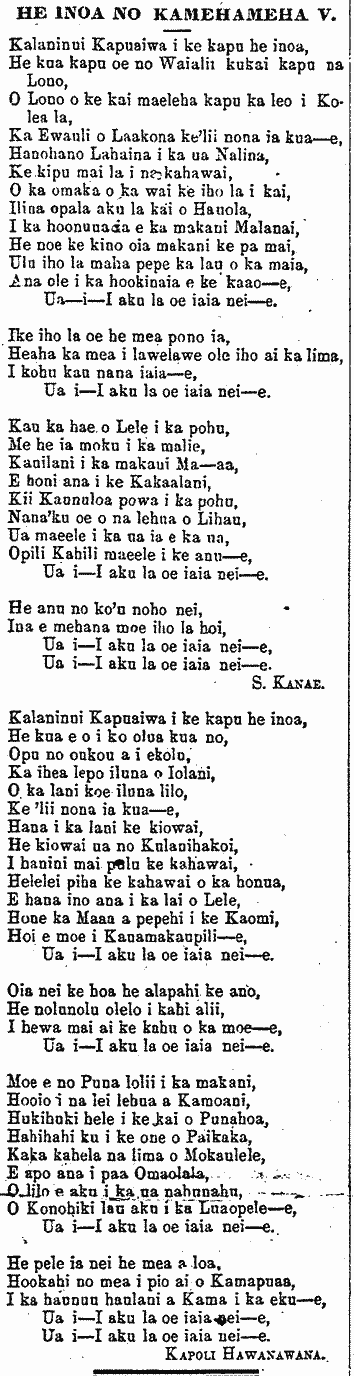
HE INOA NO KAMEHAMEHA V.

Kalaninui Kapuaiwa i ke kapu he inoa,
He kua kapu oe no Waialii kukai kapu na Lono,
O Lono o ke kai maeleha kapu ka leo i Kolea la,
Ka Ewauli o Laakona ke’lii nona ia kua—e,
Hanohano Lahaina i ka ua Nalina,
Ke kipu mai la i na kahawai,
O ka omaka o ka wai ke iho la i kai,
Ilina opala aku la kai o Hauola,
I ka hoonuua ia e ka makani Malanai,
He noe ke kino oia makani ke pa mai,
Ulu iho la maha pepe ka lau o ka maia,
Ana ole i ka hookinaia e ke kaao—e,
Ua—i—I aku la oe iaia nei—e.

Ike iho la oe he mea pono ia,
Heaha ka mea i lawelawe ole iho ai ka lima,
I koho kau nana iaia—e,
Ua i—I aku la oe iaia nei—e.

Kau ka hae o Lele i ka pohu,
Me he ia moku i ka malie,
Kauilani i ka makani Ma—aa,
E honi ana i ke Kakaalani,
Kii Kaunuloa powa i ka pohu,
Nana’ku oe o na lehua o Lihau,
Ua maeele i ka ua ia e ka ua,
Opili Kahili maeele i ke anu—e,
Ua i—I aku la oe iaia nei—e.

He anu no ko’u noho nei,
Ina e mehana moe iho la hoi,
Ua i—I aku la oe iaia nei—e,
Ua i—I aku la oe iaia nei—e.

S. KANAE.

Kalaninui Kapuaiwa i ke kapu he inoa,
Ke kua e o i ko olua kua no,
Opu no oukou a i ekolu,
Ka ihea lepo iluna o Iolani,
O ka lani koe iluna lilo,
Ke ‘lii nona ia kua—e,
Hana i ka lani ke kiowai,
He kiowai ua no Kulanihakoi,
I hanini mai pulu ke kahawai,
Helelei piha ke kahawai o ka honua,
E hana ino ana i ka lai o Lele,
Hone ka Maaa a pepehi i ke Kaomi,
Hoi e moe i Kauamakaupili—e,
Ua i—I aku la oe iaia nei—e.

Oia nei ke hoa he alapahi ke ano,
He nolunolu olelo i kahi alii,
I hewa mai ai ke kahu o ka moe—e,
Ua i—I aku la oe iaia nei—e.

Moe e no Puna lolii i ka makani,
Hooio i na lei lehua a Kamoani,
Hukihuki hele i ke kai o Punahoa,
Hahihahi ku i ke one o Paikaka,
Kaka kahela na lima o Mokaulele,
E apo ana i paa Omaolala,
O lilo e aku i ka ua nahunahu,
O Konohiki lau aku i ka Luaopele—e,
Ua i—I aku la oe iaia nei—e.

He pele ia nei he mea a loa,
Hookahi no mea i pio ai o Kamapuaa,
I ka haunuu haulani a Kama i ka eku—e,
Ua i—I aku la oe iaia nei—e,
Ua i—I aku la oe iaia nei—e.

KAPOLI HAWANAWANA.

[There is one oki of this mele found in the 5/28/1868 issue of Au Okoa by Kekuanaoa, one in the 6/18/1868 issue without an attribution, one in the 7/23/1868 issue by Kamehameha III; three in the 7/30/1868 issue, one by Kalama, one by Kaomi, and the other by Liliha. There are also many issues that are missing for this newspaper, and who knows what treasures might be found once copies of those issues are found!]

(Au Okoa, 9/24/1868, p. 1)
HE INOA NO KAMEHAMEHA V.

Ke Au Okoa, Buke IV, Helu 23, Aoao 1. Sepatemaba 24, 1868.

Kamehameha V’s birthday and an opportunist, 1871.

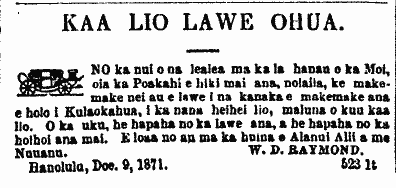
PASSENGER HORSE CARRIAGE.

In response to the many entertainments on the birthday of the King, that being this coming Monday, I therefore want to take those who want to go to Kulaokahua to watch the horse races, on my horse carriage. The fare is a quarter to go and a quarter to return. Find me at the corner of King Street and Nuuanu Avenue.  W. D. RAYMOND.

Honolulu, Dec. 9, 1871.

(Kuokoa, 12/9/1871, p. 3)

KAA LIO LAWE OHUA.

Ka Nupepa Kuokoa, Buke X, Helu 49, Aoao 3. Dekemaba 9, 1871.

On the moving of the Na-ha Stone to Hilo Library 100 years ago, and its history (3 of 6), 1915.

THE STORY OF THE NA-HA STONE

(Continued)

“Hear me, O Alii; he has but one opponent to fight where the strength of this hanai of mine will be challenged, that is Keaweokahikona, and this is his one opponent that will thwart his strength, and who will also thwart the strength of his young experts in spear throwing, making it into nothing. I say before you all, O high Chiefs of the land, he must go see this relative of his, for he [Keaweokahikona] is his own blood relative [piko], and should he [Keaweokahikona] decide to follow him, then there will be no more difficulties and they will live as leader and follower from here forth. But he must go quickly and not put it off until the time they should meet has past.

When the alii living in the court of Kalaniopuu heard this, they all approved of this idea of this Prophet Chiefess Kalaniwahine. The days were soon spent preparing for the journey of Kamehameha Paiea to see his cousin Keaweokahikona, and to visit the Naha Stone in the front of Pinao Heiau. The canoes of the young chief Kamehameha were set forth, and they were escorted by a number of high chiefs, they being Naihe and Kalaninuimakolukolu, and these travels of the young chief was accompanied by grace with the seas being calm and the three mountains of Great Hawaii of Keawe were clear.

When the canoes landed at Hilo Hanakahi, they first came ashore at Nukuokamanu [Kanukuokamanu], and as soon as the prow of the canoe rumbled against the sand of Hilo Hanakahi, Naihe folks disembarked first and headed straight for the house of the High Chiefess Ululani; the news had reached the Chiefess Ululani in advance and she called out to Naihe with these words:

“Ha! Hey, my relatives have arrived. What is the reason for your taking this trip across the wide sea?”

At this time her children responded: “Your child is arriving, that is Kalaninuilanimehamehaikamakaohaloa. This is a voyage of that Heavenly Chief to seek a mother, and that is why I appear before you.”

(Hoku o Hawaii, 12/16/1915, p. 2)

KA MOOLELO O NA-HA POHAKU

Ka Hoku o Hawaii, Buke 10, Helu 28, Aoao 2. Dekemaba 16, 1915.