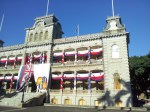
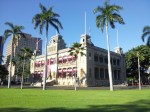
In response to gas illumination at the opening of Iolani Palace, 1913.

Palace Never Had Gas–First Electric Light

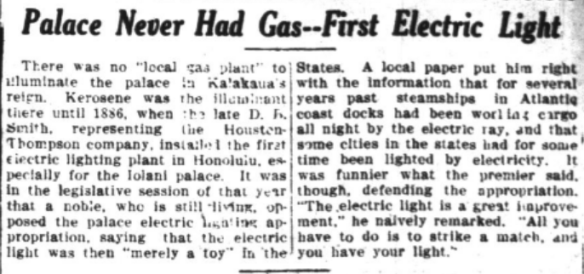
There was no “local gas plant” to illuminate the palace in Kalakaua’s reign. Kerosene was the illuminant there until 1886, when the late D. P. Smith, representing the Houston-Thompson company, installed the first electric lighting plant in Honolulu, especially for the Iolani palace. It was in the legislative session of that year that a noble, who is still living, opposed the palace electric lighting appropriation, saying that the electric light was then “merely a toy” in the States. A local paper put him right with the information that for several years past steamships in Atlantic coast docks had been working cargo all night by the electric ray, and that some cities in the states had for some time been lighted by electricity. It was funnier what the premier said, though, defending the appropriation. “The electric light is a great improvement,” he naively remarked. “All you have to do is to strike a match, and you have your light.”

(Honolulu Star-Bulletin, 1/11/1913, p. 8)

Palace Never Had Gas--First Electric Light

Honolulu Star-Bulletin, Volume XX, Number 6482, Page 8. January 11, 1913.

More on the Palace mirrors, 1913.

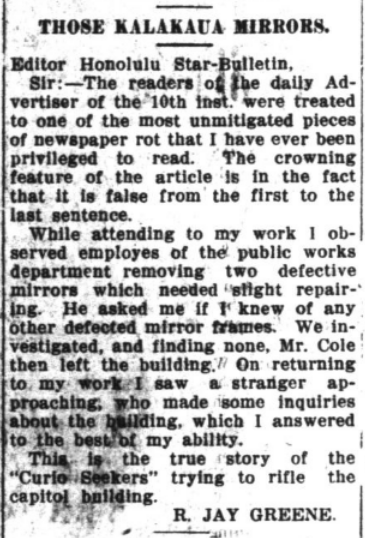
THOSE KALAKAUA MIRRORS.

Editor Honolulu Star-Bulletin,

Sir:—The readers of the daily Advertiser of the 10th inst. were treated to one of the most unmitigated pieces of newspaper rot that I have ever been privileged to read. The crowning feature of the article is in the fact that it is false from the first to the last sentence.

While attending to my work I observed employees of the public works department removing two defective mirrors which needed slight repairing. He asked me if I knew of any other defected mirror frames. We investigated, and finding none, Mr. Cole then left the building. On returning to my work I saw a stranger approaching, who made some inquiries about the building, which I answered to the best of my ability.

This is the true story of the “Curio Seekers” trying to rifle the capitol building.

R. JAY GREENE.

[Here is an interesting response from the “Roland Green” of the previous articles.]

(Honolulu Star-Bulletin, 1/11/1913, p. 4)

THOSE KALAKAUA MIRRORS.

Honolulu Star-Bulletin, Volume XX, Number 6482, Page 4. January 11, 1913.

Mahalo to Zita Cup Choy for pointing out this related article in the Pacific Commercial Advertiser, 1913.

CURIO SEEKERS TRY TO RIFLE CAPITOL

King Kalakaua’s Mirrors the Pet Object of Souvenir Hunters—Kamehameha Knocked.

Daring souvenir collectors, willing to run the risk of a term in prison to gratify their desires, made a bold attempt to carry off a number of mirrors and bronze frames from the Capitol Building some time Wednesday night. It is believed that the collectors were frightened while at work and for that reason did not accomplish their purpose.

Roland Green, keeper of the Capitol, yesterday morning discovered the work of the would-be souvenir owners on the first terrace of the Ewa side of the building. They had succeeded in partially breaking two of the mirrors from their fastenings on the wall. A board holding one of the glasses in place was broken in two in tearing it from its lodgment. Green had the glasses and bronze frames removed to the basement of the Capitol where they will be repaired, resilvered and returned to their positions on the Capitol wall.

During the past few years several of these mirrors have been torn from their fastenings and carried away. Though malihinis, sightseeing and treasure hunting on the island, have been accused of the depredations it is said that kamaainas have had knowledge of at least one or two of them.

Kamehameha’s statue has not escaped the destructive onslaughts of the vandals. Several heads of the little bronze images at the base of the statue have been knocked off and carried away by the curio-seekers.

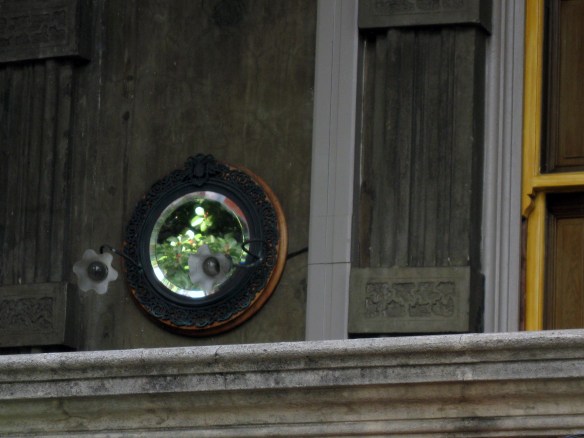
The mirrors, however, seem to have the most attraction. These mirrors are set in elaborate circular bronze frames surmounted by the coat of arms of King Kalakaua, bearing the initials of that monarch supported by two perfectly carved cherubs. It is stated that these frames originally cost $250 each and many were installed around the terraces of each floor of the palace. The idea of putting them in place is said to have originated with the King and were designed for the purpose of aiding in illuminating the palace grounds.

This was in 1883. Gas was then the modern method of illumination in Honolulu as well as on the mainland. Gas fixtures were arranged in front of each of the glasses. When these were lighted the mirrors were intended to cast the reflection to the surrounding grounds. It is said that this innovation cost the monarchy about $20,000.

For a year after the completion of the new palace it is said that King Kalakaua had one of the best illuminated palaces in the world, though practically the full capacity of the local gas plant was required to accomplish this purpose. By that time the good King learned that, after all, his bright mirrors were not the success they should be. Soon afterward the electric lights came and the gas fixtures were removed. Since then the mirrors have not only been sought after by curio hunters but have been the object of much speculation on the part of tourists.

Many of these strangers have figured that the mirrors were installed on the palace walls by the King with a view of aweing visiting native subjects, many of whom, according to fiction, had never gazed into a looking-glass.

It remained for Keeper Green to give the true version of their cause of their installation.

“It is strange how some people look upon this Capitol Building as a curio pile,” said a territorial official yesterday. “The fact that the former palace of the King is being used as the seat of a democratic government seems to appeal to them strongly and but for the vigilance used by the watchman and others the entire building would be carried off by souvenir hunters within a few years.”

[This is most likely the basis of the Hawaiian-Language article in the Kuokoa, 1/17/1913, p. 6.]

(Pacific Commercial Advertiser, 1/10/1913, p. 6)

CURIO SEEKERS TRY TO RIFLE CAPITOL

Pacific Commercial Advertiser, Volume LVII, Number 9494, Page 6. January 10, 1913.

Remembering, 2012.

Passed by yesterday and stopped to remember…

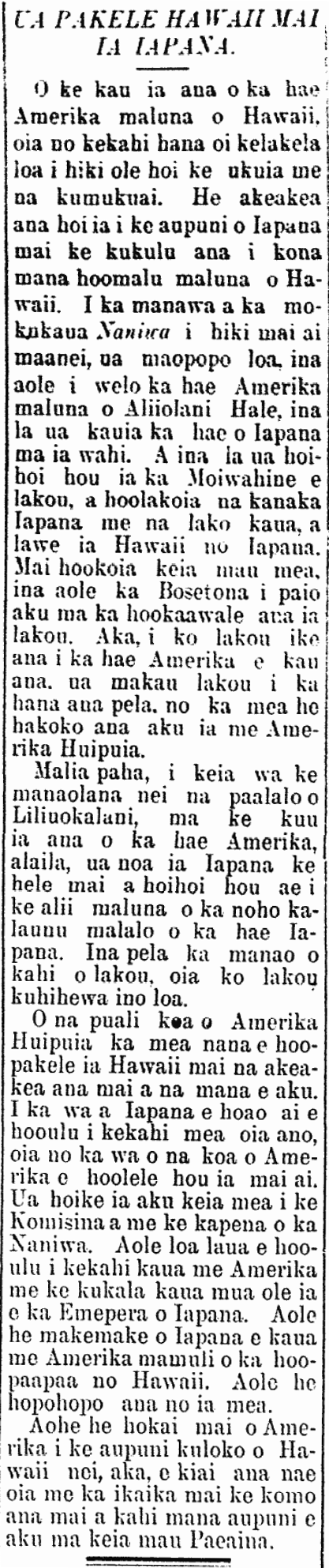
Always important to look at sources. 1893 / 2012.

HAWAII ESCAPES FROM JAPAN.

The raising of the American flag over Hawaii is one of the greatest things done that cannot be repaid. It blocks the nation of Japan from establishing its rule over Hawaii. When the warship Naniwa arrived here, it was clear that if the American flag was not waving over Aliiolani Hale, then the Japanese flag would have been put in its place. And then they would have returned the Queen and the Japanese would have been supplied with weapons and took Hawaii for Japan. It all would have happened if the Boston did not hold them off. But when they saw the American flag raised, they were afraid to do this, for it would be fighting with the United States of America.

Perhaps now Liliuokalani’s attendants are hoping that by the taking down of the American flag, the Japanese will be free to come and return the alii to the throne under the Japanese flag. Should that be the thought of some of them, they are gravely mistaken.

The American troops will save Hawaii from the interference by the other powers. When Japan tries to foment something of that sort, that will be when the soldiers of America will be deployed again. This has been announced to the Commissioner and the captain of the Naniwa. They will not start a war with America without it being proclaimed in advance by the Emperor of Japan. Japan has no desire to war against America because of the dispute over Hawaii. There is nothing to fear.

America will not interfere in the local government of Hawaii nei, however it will guard Hawaii with force against the entering of other national powers into this Archipelago.

[It is always important to look at what newspaper an article comes from. Also, long-running newspapers (and people for that matter) don’t necessarily keep their same ideologies throughout their entire life…]

(Kuokoa, 4/8/1893, p. 2)

UA PAKELE HAWAII MAI IA IAPANA.

Ka Nupepa Kuokoa, Buke XXXII, Helu 14, Aoao 2. Aperila 8, 1893.

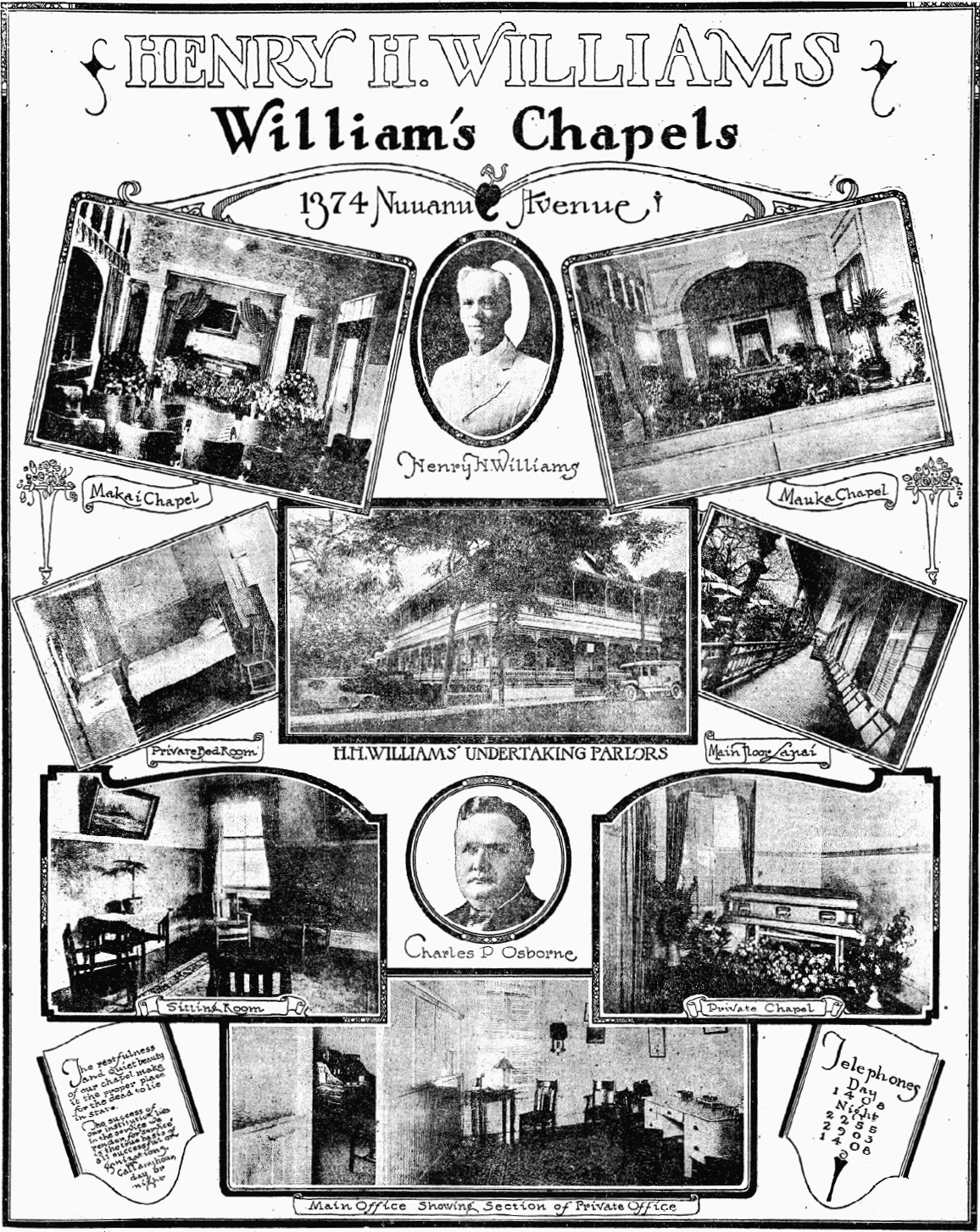
Full-page advertisement, Henry H. Willams, 1922.

HENRY H. WILLIAMS

William’s Chapels

1374 Nuuanu Avenue

Makai Chapel;  Henry H. Williams;  Mauka Chapel

Private Bed Rooms;  H. H. WILLIAMS’ UNDERTAKING PARLORS;  Main Floor Lanai

Sitting Room;  Charles P. Osborne;  Private Chapel

The restfulness and quiet beauty of our chapel make it the proper place for the dead to lie in state.

The success of our institutions lies in the service we render for service is the true basis of all successful organizations.

Call any hour, day or night.

Main Office Showing Section of Private Office.

Telephones
Day 1408
Night
2255
2903
1408

[A full-page ad by a business was not common in the Hawaiian-Language Newspapers, whether in Hawaiian or English.]

(Kuokoa, 11/9/1922, p. 3)

HENRY H. WILLIAMS

Ka Nupepa Kuokoa, Buke LXI, Helu 45, Aoao 3. Novemaba 9, 1922.

Kamehameha Serenaders, 1922.

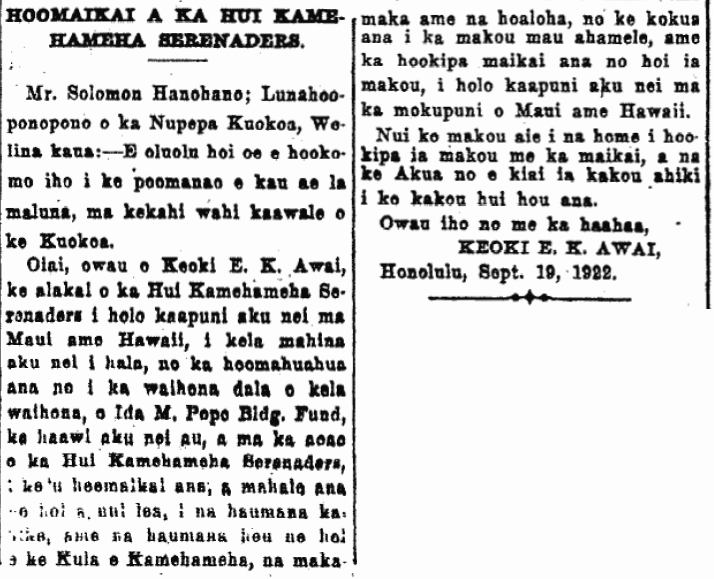
GRATITUDE FROM THE KAMEHAMEHA SERENADERS.

Mr. Solomon Hanohano; Editor of the Kuokoa Newspaper, Greetings:—Please insert this topic above in an open space in the Kuokoa.

Being that I am Keoki E. K. Awai, the leader of the Kamehameha Serenaders which travelled around Maui and Hawaii last month to increase the funds for the Ida M. Pope Bldg. Fund; I give my great appreciation and thanks to the past students and the new students as well of Kamehameha School, and intimates and friends, for their assisting our concerts and for the good care given us while we went around Maui and Hawaii.

We are greatly indebted to the homes which offered us their fine hospitality, and may God watch over us until we meet once again.

Sincerely,

GEORGE E. K. AWAI,

Honolulu, Sept. 19, 1922.

(Kuokoa, 9/21/1922, p. 8)

HOOMAIKAI A KA HUI KAMEHAMEHA SERENADERS.

Ka Nupepa Kuokoa, Buke LXI, Helu 38, Aoao 8. Sepatemaba 21, 1922.

Liliuokalani’s personal adornments sold, 1924.

Liliu’s Gold Necklaces are Auctioned Off.

In accordance with the wishes of the deceased Queen Liliuokalani, the board of trustees of the estate of the the deceased announced the auctioning off of the gold adornments of the deceased queen. In one of the rooms on the bottom of the Young Hotel in Honolulu, on this Tuesday, March 25, the auction began of the adornments: the diamond rings, the diamond bracelets, the diamond necklaces, the earrings, the stickpins, and many other items. Colonel C. Piehu Iaukea made known the wishes of Liliuokalani to build a house to care for orphaned girls of all ethnicities, in Honolulu, and the Hawaiian girls were the first in her heart.

On the first day, this Tuesday, $11,360.50 was made. The auction was continued on another day. It is not known what the total is at this time.

The houses intended for these orphaned children probably cannot be built with just the funds from these jewels, because these valuables were sold in Honolulu at a place where it was believed that they would go for cheap, and the gold craftsmen of Honolulu said that the prices bid on these treasures of Hawaii nei were just like throwing them away. If it was held in a town of ten million people or more, like London, New York, or Paris, where millionaires reside, then proper prices might have been gotten, however, here in Hawaii, where there are no millionaires, high prices are not attained.

Perhaps if it is included with the rest of Liliuokalani’s estate, then it will be enough to build this type of facility, for it will need over a hundred thousand more dollars for that kind of place. On top of that is the expenses for the care taking and for the executives, which would be some hundreds of thousands of dollars more, and where would this all come from? The treasures from the tomb of King Tutankhamen, Pharaoh of Egypt, who died over 3,000 years ago, is estimated at over a billion dollars today.

(Kuokoa, 3/27/1924, p. 2)

Na lei gula o Liliu ua kudala ia

Ka Hoku o Hawaii, Buke XVII, Helu 44, Aoao 2. Maraki 27, 1924.

Ahahui Kamehameha, 1922.

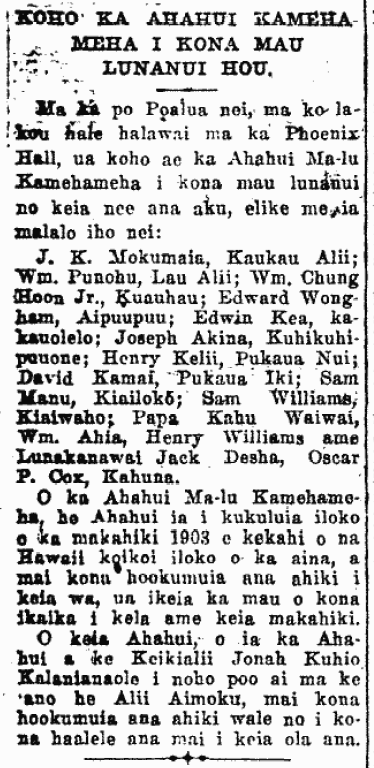
THE AHAHUI KAMEHAMEHA ELECTS ITS NEW OFFICERS.

On the Tuesday night, at their meeting house at Phoenix Hall, the Kamehameha Secret Society [Ahahui Ma-lu Kamehameha] selected their officers for to move forward, as shown below:

J. K. Mokumaia, Kaukau Alii; William Punohu, Lau Alii; William Chung Hoon, Jr., Kuauhau; Edward Wongham, Aipuupuu; Edwin Kea, secretary; Joseph Akina, Kuhikuhipuuone; Henry Kelii, Pukaua Nui; David Kamai, Pukaua Iki; Sam Manu, Kiailoko; Sam Williams, Kiaiwaho; Board of Trustees, William Ahia, Henry Williams, and Judge Jack Desha, Oscar P. Cox, Kahuna.

The Kamehameha Secret Society is an Organization established in the year 1903 by some leading Hawaiians of the land, and from its beginnings until today, its continued strength is seen yearly.

This Association is the one Prince Jonah Kuhio Kalanianaole was the head of, as the Alii Aimoku, from its inception until he left this life.

(Kuokoa, 5/11/1922, p. 4)

KOHO KA AHAHUI KAMEHAMEHA I KONA MAU LUNANUI HOU.

Ka Nupepa Kuokoa, Buke LXI, Helu 19, Aoao 4. Mei 11, 1922.