Lai Toodle? 1878.

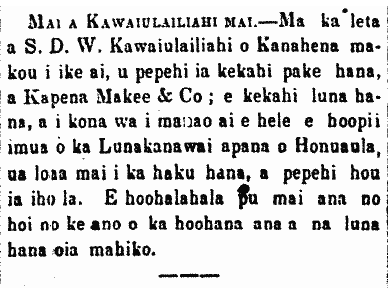
From Kawaiulailiahi.—In a letter from S. D. W. Kawaiulailiahi of Kanahena we saw that a Chinese laborer of the Captain Makee & Co. was beaten by a supervisor [luna hana], and when he decided to go to bring charges before the Judge of the Honuaula district, he was found by the boss [haku hana], and was beaten again. He will also complain about how the luna of that sugar plantation make them work.

(Kuokoa, 10/26/1878, p. 2)

Kuokoa_10_26_1878_2.png

Ka Nupepa Kuokoa, Buke XVII, Helu 43, Aoao 2. Okatoba 26, 1878.

Fishing rights to Hamohamo leased by Auwae, 1895.

FISHING RESTRICTED

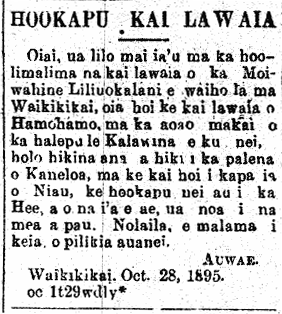
Whereas I have received the lease to the fishing rights for the seas of Queen Liliuokalani located at Waikiki Kai, that being the fishing area of Hamohamo on the makai side of where the Calvinist Church stands, then going east until the border of Kaneloa, to the seas called Niau, I therefore restrict Octopus [Hee]; but as for the other fish, they are open to all others. Therefore, abide by this or you will be in trouble.

Auwae.

Waikiki Kai, Oct. 28, 1895.

(Leo o ka Lahui, 12/13/1895, p. 4)

LOKL_12_13_1895_4.png

Ka Leo o ka Lahui, Buke II, Helu 1356, Aoao 4. Dekemaba 13, 1895.

Huge octopus caught by Anina, 1908.

HUGE OCTOPUS CAUGHT AND BROUGHT TO LAND.

On Thursday afternoon at the pier on the makai end of Allen Street, a large octopus was caught on hook by a part-Chinese boy named Anina.

While he was fishing enjoyably, he felt the pull of something and he thought it was an ulua. It pulled at his line for a long time, and because he could not pull it up, he called some people to come and help him for he was very worried that he would be pulled under. He had no concern about the line because he was using very heavy line with a hook that would not break.

When several people arrived, he was helped at pulling it up to land. Continue reading

Shark fin, sea cucumber and tree ear trade, 1864.

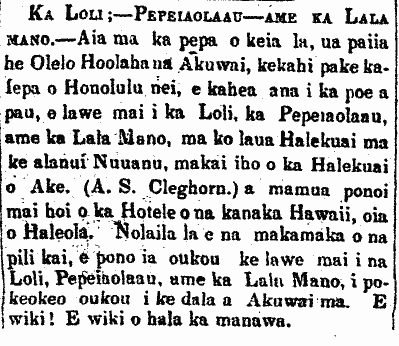
Sea Cucumber [Loli];—Tree Ear [Pepeiaolaau]—and Shark Fin [Lala Mano.]—In today’s newspaper, there is printed an Advertisement by Akuwai, one of the Chinese merchants of Honolulu nei, calling for all people to bring in Loli, Pepeiaolaau, and Lala Mano, to their Shop on Nuuanu Street, makai sdie of the store of A. S. Cleghorn [Ake], and right in front of the Hawaiian hotel, that being Haleola. Therefore O Friends near the sea, you should all go and bring in Sea Cucumber, Tree Ear, and Shark Fin, so that you get rich off of the money of Akuwai and company. Be quick! Be quick, lest you be too late.

(Kuokoa, 4/23/1864, p. 2)

Kuokoa_4_23_1864_2

Ka Nupepa Kuokoa, Buke III, Helu 17, Aoao 2. Aperila 23, 1864.

A Hawaiian Co-Op, 1918.

KA “HUI LOKAHI O NA HAWAII” KAUPALENAIA.

These passing day, Hawaiians like Mayor Joseph J. Fern, David Kalauokalani, Samuel C. Dwight, James L. Holt, Hon. William P. Jarrett, Hon. C. P. Iaukea and a number of other Hawaiians are joining together to establish a company that will deal in the sale of poi, beef, salmon, dried fish, and so forth; with the intent to help Hawaiians in all ways that will lessen their household expenses; because it is very clear these days that because the poi factory of Kalihi is not making poi now, the current poi manufacturers are greatly raising the price of poi to five cents per pound; this is a price not seen in the past ten years or more; so too with the price of beef; the Chinese are buying very fine beef from the company of C. J. Waller [Wala], but the Chinese are charging Hawaiians 35 cents per p0und; it is an exorbitant price which has never been seen before; and it is heard from the talk of the Chinese that they will raise the price of poi once again to 6 cents a pound; it was this that encouraged the Hawaiians to establish a company that could hold back the severe increasing of the prices of our foods, O Hawaiians, by the Chinese.

The establishing of a company amongst Hawaiians is important and crucial; but if we Hawaiians do not implement an endeavor that will help ourselves, there will  be no one else who will help us.

If we turn back and look at the history of Hawaii nei, we will see that the dissension amongst us Hawaiians was what wrenched away small businesses from us Hawaiians as well as all the other endeavors. Continue reading

Hasn’t the time come that Hawaiians try to help in the economic endeavors of their own people? 1914.

Announcement

KA HUI KUAI POI O KALIHI (“KALIHI TARO AND LAND CO., LTD.”)

To those who read this.

With aloha:—Whereas all of the shares of the Company named above has been acquired by W. C. Achi and some Hawaiians, and being that they are the only Hawaiians carrying out the growing of taro and the selling of poi, the food of our kupuna and makua; therefore, they humbly ask you, O Hawaiians, that you give them your assistance, by you buying your poi from their group.

The production of the poi at their poi factory is truly sanitary, and your orders will be filled with great haste.

Hasn’t the time come that Hawaiians try to help in the economic endeavors of their own people? Continue reading

Beached whale at Kailua, 1911.

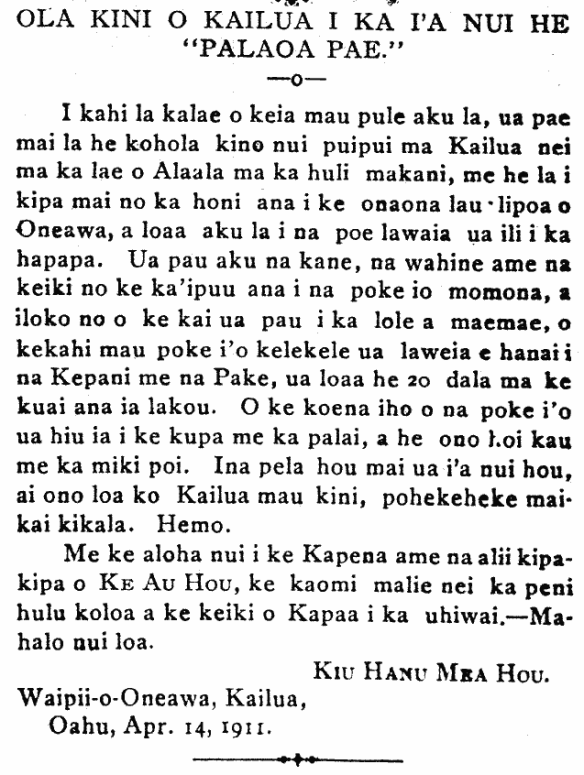
THE MANY OF KAILUA WERE SAVED BY THE GREAT FISH, THE “PALAOA PAE.”

One clear day some weeks ago, a large, heavy-bodied whale landed here in Kailua at the cape of Alaala on the windward side, and it was if we were visited by the scent of the sweet lipoa seaweed of Oneawa, and it was found by fishermen beached in the shallows. The men, women, and children all went and divided up the fatty pieces of flesh, and they all went into the water with their clothes on to get cleaned up; some of the chunks of oily flesh was taken to feed the Japanese and Chinese; 20 dollars was gotten through the sale. The remainder of the meat was thrown into soup and fried, and it was tasty with dabs of poi. If a large fish comes again, Kailua’s multitudes will eat with relish, and their hips will be nicely plump. Satisfaction.

With much aloha for the Captain and the officers [??? alii kipakipa] of Ke Au Hou; the duck feather pen of the son of Kapaa in the mist presses gently down.—Mahalo nui loa.

THE ONE WHO SNIFFS OUT NEWS

Waipii-o-Oneawa, Kailua,

Oahu, Apr. 14, 1911.

(Au Hou, 4/19/1911, p. 21)
AuHou_4_19_1911_21.png

Ke Au Hou, Buke 2, Helu 16, Aoao 21. Aperila 19, 1911.

Bumper crop of mangos, 1868.

[Found under: “NU HOU KULOKO: Oahu.”]

Mango Fruit.—The past days, and these days as well, a lot [makena wale] of this delicious fruit is seen often at the markets and on the street sides of this town, but other fruits are very rare. We have seen thirty or more or less being sold for an eighth of a dollar [hapawalu], but it was not so recently when there wasn’t any; at that time at the Chinese stores it was six or ten for an eighth of a dollar. Those who crave mango are saved these days, and the adults and children peel them as they walk about the streets; and much is the diarrhea.

(Kuokoa, 8/8/1868, p. 2)

Kuokoa_8_8_1868_2.png

Ka Nupepa Kuokoa, Buke VII, Helu 32, Aoao 2. Augate 8, 1868.

Chinese New Year beer ad, 1907.

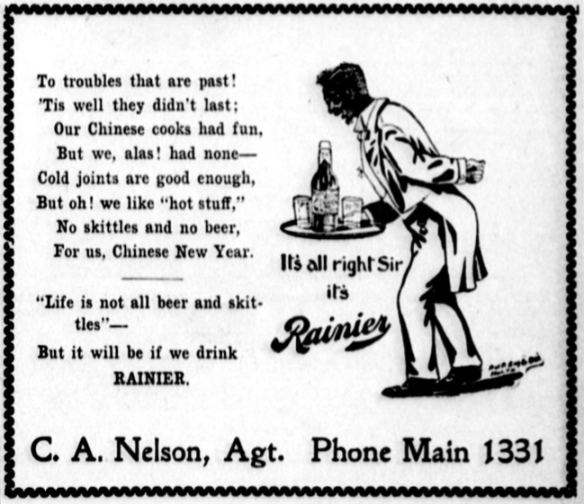
To troubles that are past!
‘Tis well they didn’t last;
Our Chinese cooks had fun,
But we, alas! had none—
Cold joints are good enough,
But oh! we like “hot stuff,”
No skittles and no beer,
For us, Chinese New Year.

“Life is not all beer and skittles”—
But it will be if we drink

RAINIER.

It’s all right Sir
it’s
Rainier

C. A. Nelson, Agt.  Phone Main 1331

(Evening Bulletin, 2/18/1907, p. 5)

EveningBulletin_2_18_1907_5.png

Evening Bulletin, Volume IX, Number 3619, Page 5. February 18, 1907.

Chinese New Year, 1905.

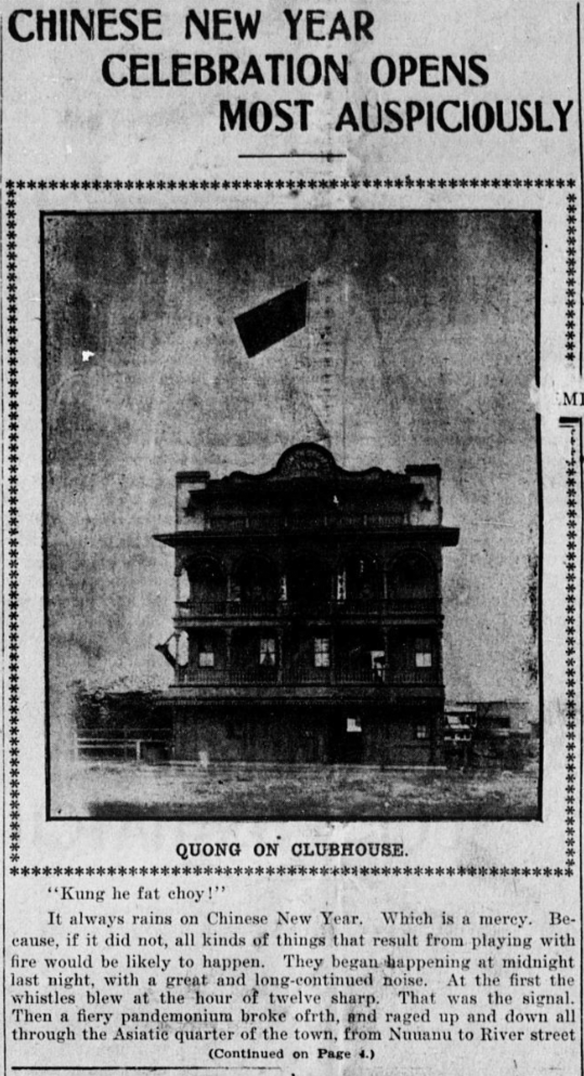
CHINESE NEW YEAR CELEBRATION OPENS MOST AUSPICIOUSLY

QUONG ON CLUBHOUSE.

“Kung he fat choy!”

It always rains on Chinese New Year. Which is a mercy. Because, if it did not, all kinds of things that result from playing with fire would be likely to happen. They began happening at midnight last night, with a great and long-continued noise. At the first the whistles blew at the hour of twelve sharp. That was the signal. Then a fiery pandemonium broke forth, and raged up and down all through the Asiatic quarter of the town, from Nuuanu to  River street…

(Hawaiian Gazette, 2/3/1905, p. 1)

HawaiianGazette_2_3_1905_1.png

Hawaiian Gazette, Volume XL, Number 10, Page 1. February 3, 1905.

…and beyond, and on all the cross streets where the sons of the Central Flowery Kingdom, who make their homes in Honolulu, have their abiding place. Continue reading