The Hawaiian Situation.
They protest too much.
This is the conclusion that is reached by the careful observer who talks with the adherents of the present Government [the Provisional Government] of the Hawaiian Islands.
They seem too anxious to impress upon you the fact that it is a most serene and peaceful atmosphere. You are not permitted to use your own judgement but are blandly told that you don’t know what you are talking about when you venture to express an opinion that is contrary to what is said to be an established fact. Of course no fault can be found with such procedure. It is a part of politics. They want certain conditions to obtain and the desire is so great that by long effort to fool others the “P. G.’s” eventually fool themselves. It may seem presumptuous for one who spent but a month in the island republic to give an opinion as to the real political status of the island, but there is so much evidence obtainable that such opinion can easily be formed, even if it does happen to be against the desire of those who now hold the reins of Government.
The stranger who visits Honolulu almost immediately feels that he is surrounded by an air of uneasiness. Things evidently are not as they seem. There is an indefinable something in the atmosphere that makes one feel as if he should be watching over his shoulder. Where the impression comes from it is difficult to say, but if you will talk politics for five minutes with any resident you cannot help but notice the lowered tone of voice, the careful watch of passers-by or the graurded manner, as if there were a constant fear of spies. Nor is this noticeable alone when talking with royalists. The adherents of the Republic are just as guarded and just as careful.
It looks as if they feared a change of Government and as if their expressions might be treasured up against them.
Yet the Republicans and the papers are persistent in their declarations that the islands were never more peaceful than at present.
Perhaps this is true, but if the the present Government is not sitting over a smouldering political volcano, then the signs are wrong, and this same Government has not failed to realize this fact. Nor has it failed to prepare a soft place to light after the explosion.
What is this soft place?
When a man who had been a resident of the islands but ten months made the public announcement of a new Government, that announcement was successful because of the American Minister, who backed up the revolutionists with the force of an American warship and the naval support of the United States. Liliuokalani was dethroned and the Re-…
(Independent, 7/11/1896, p. 1)

The Independent, Volume III, Number 323, Page 1. July 11, 1896.
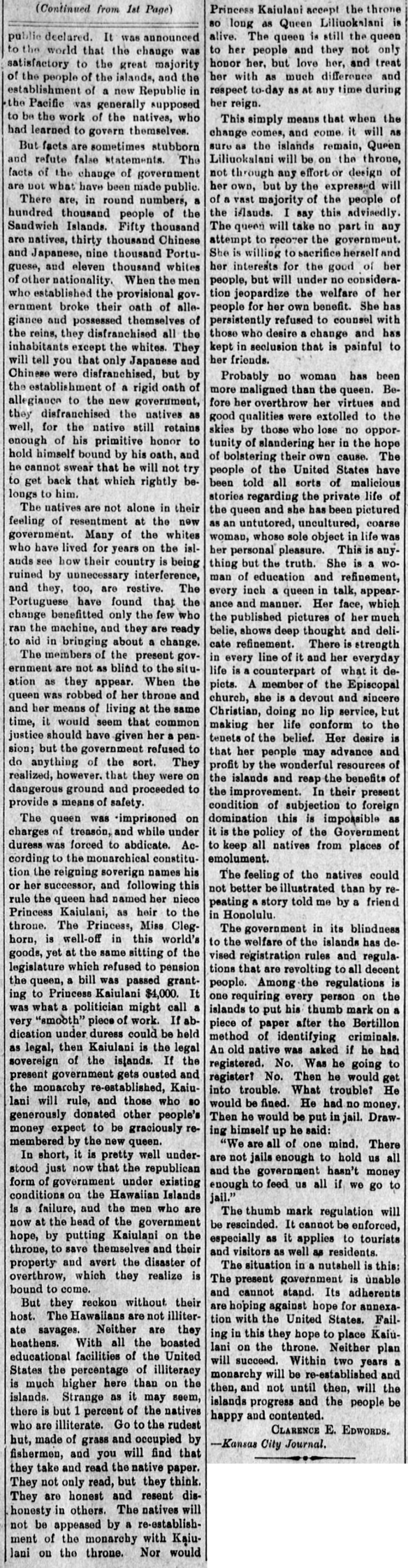
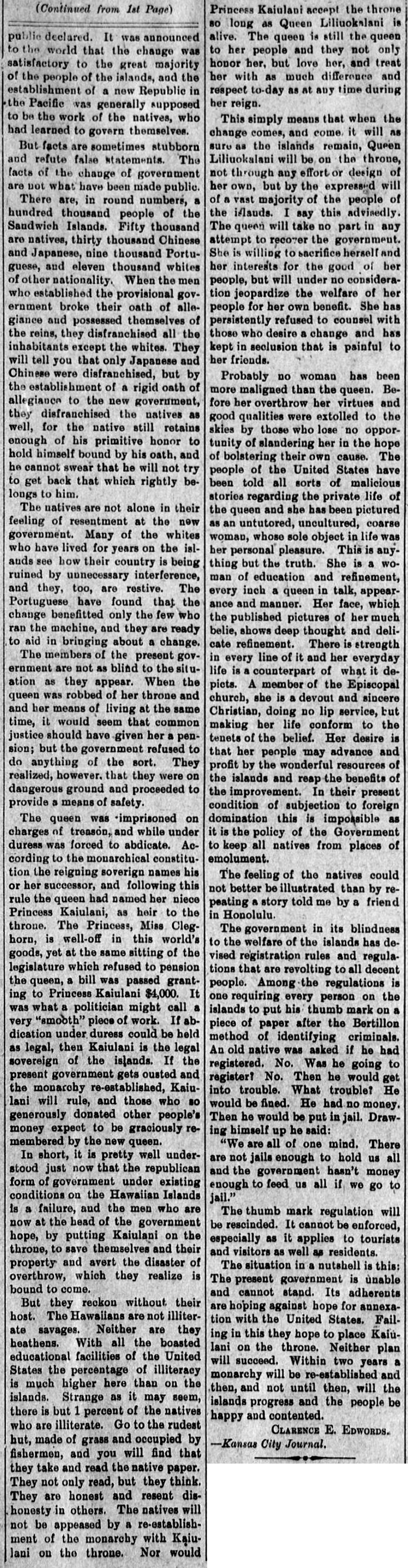
…public declared. It was announced to the world that the change was satisfactory to the great majority of the people of the islands, and the establishment of a new Republic in the Pacific was generally supposed to be the work of the natives, who had learned to govern themselves.
But facts are sometimes stubborn and refute false statements. The facts of the change of government are not what have been made public.
There are, in round numbers, a hundred thousand people of the Sandwich Islands. Fifty thousand are natives, thirty thousand Chinese and Japanese, nine thousand Portuguese, and eleven thousand whites of other nationality. When the men who established the provisional government broke their oath of allegiance and possessed themselves of the reins, they disfranchised all the inhabitants except the whites. They will tell you that only Japanese and Chinese were disfranchised, but by the establishment of a rigid oath of allegiance to the new government, they disfranchised the natives as well, for the native still retains enough of his primitive honor to hold himself bound by his oath, and he cannot swear that he will not try to get back that which rightly belongs to him.
The natives are not alone in their feeling of resentment at the new government. Many of the whites who have who have lived for years on the islands see how their country is being ruined by unnecessary interference, and they, too, are restive. The Portuguese have found that the change benefitted only the few who ran the machine, and they are ready to aid in bringing about a change.
The members of the present government are not as blind to the situation as they appear. When the queen was robbed of her throne and and her means of living at the same time, it would seem that common justice should have given her a pension; but the government refused to do anything of the sort. They realized, however, that they were on dangerous ground and proceeded to provide a means of safety.
The queen was imprisoned on charges of treason, and while under duress was forced to abdicate. According to the monarchical constitution the reigning soverign names his or her successor, and following this rule the queen had named her niece Princess Kaiulani, as heir to the throne. The Princess, Miss Cleghorn, is well-off in this world’s goods, yet at the same sitting of the legislature which refused to pension the queen, a bill was passed granting to the Princess Kaiulani $4,000. It was what a politician might call a very “smooth” piece of work. If abdication under duress could be held as legal, then Kaiulani is the legal sovereign of the islands. If the present government gets ousted and the monarchy re-established, Kaiulani will rule, and those who so generously donated other people’s money expect to be graciously remembered by the new queen.
In short, it is pretty well understood just now that the republican form of government under existing conditions on the Hawaiian Islands is a failure, and the men who are now at the head of the government hope, by putting Kaiulani on the throne, to save themselves and their property and avert the disaster of overthrow, which they realize is bound to come.
But they reckon without their host. The Hawaiians are not illiterate savages. Neither are they heathens. With all the boasted educational facilities of the United States the percentage of illiteracy is much higher here than on the islands. Strange as it may seem, there is but 1 percent of the natives who are illiterate. Go to the rudest hut, made of grass and occupied by fisherman, and you will find that they take and read the native paper. They not only read, but they think. They are honest and resent dishonesty in others. The natives will not be appeased by a re-establishment of the monarchy with Kaiulani on the throne. Nor would Princess Kaiulani accept the throne so long as Queen Liliuokalani is alive. The queen is still the queen to her people and they not only honor her, but love her, and treat her with as much difference and respect to-day as at any time during her reign.
This simply means that when the change comes, and come it will as sure as the islands remain, Queen Liliuokalani will be on the throne, not through any effort of design of her own, but by the expressed will of a vast majority of the people of the islands. I say this advisedly. The queen will take no part in any attempt to recover the government. She is willing to sacrifice herself and her interests for the good of her people, but will under no consideration jeopardize the welfare of her people for her own benefit. She has persistently refused to counsel with those who desire a change and has kept in seclusion that is painful to her friends.
Probably no woman has been more maligned than the queen. Before her overthrow her virtues and good qualities were extolled to the skies by those who lose no opportunity of slandering her in the hope of bolstering their own cause. The people of the United States have been told all sorts of malicious stories regarding the private life of the queen and she has been pictured as an untutored, uncultured, coarse woman, whose sole object in life was her personal pleasure. This is anything but the truth. She is a woman of education and refinement, every inch a queen in talk, appearance and manner. Her face, which the published pictures of her much belie, shows deep thought and delicate refinement. There is strength in every line of it and her everyday life is a counterpart of what it depicts. A member of the Episcopal church, she is a devout and sincere Christian, doing no lip service, but making her life conform to the tenets of the belief. her desire is that her people may advance and profit by the wonderful resources of the islands and reap the benefits of the improvement. In their present condition of subjection to foreign domination this is impossible as it is the policy of the Government to keep all natives from places of emolument.
The feeling of the natives could not better be illustrated than by repeating a story told me by a friend in Honolulu.
The government in its blindness to the welfare of the islands has devised registration rules and regulations that are revolting to all decent people. Among the regulations is one requiring every person on the islands to put his thumb mark on a piece of paper after the Bertillon method of identifying criminals. An old native was asked if he had registered. No. Was he going to register? No. Then he would get into trouble. What trouble? He would be fined. He had no money. Then he would be put in jail. Drawing himself up he said:
“We are all of one mind. There are not jails enough to hold us all and the government hasn’t money enough to feed us all if we go to jail.”
The thumb mark regulation will be rescinded. It cannot be enforced, especially as it applies to tourists and visitors as well as residents.
The situation in a nutshell is this: The present government is unable and cannot stand. Its adherents are hoping against hope for annexation with the United States. Failing in this they hope to place Kaiulani on the throne. Neither plan will succeed. Within two years a monarchy will be re-established and then, and not until then, will the islands progress and the people be happy and contented.
Clarence E. Edwords.
—Kansas City Journal.
(Independent, 7/11/1896, p. 4)
The Independent, Volume III, Number 323, Page 4. July 11, 1896.




 nupepa