Check out our Instagram page! The pictures are mainly from the historical Hawaiian Newspapers, and if there is a picture on Instagram, there usually is a related article here.

Check out our Instagram page! The pictures are mainly from the historical Hawaiian Newspapers, and if there is a picture on Instagram, there usually is a related article here.
FOR THE CITY AND COUNTY OF HONOLULU, AS A DEMOCRAT
JESSE PELEIHOLANI MAKAINAI
[Maybe some day soon the newspapers will all be rescanned, and pictures like this will be clearer to see!]
(Aloha Aina, 8/22/1914, p. 4)

Ke Aloha Aina, Buke XIX, Helu 46, Aoao 4. Augate 22, 1914.
Lately, there seems to be more and more people posting information from historical documents, and that is a good thing. However, there is a trend happening that people will do a post without giving any citation as to where the information is found originally. And while I do understand perhaps that people feel they are just too busy for such things, citations are important.
How else are we to differentiate between the posting (or reposting) of someone’s creative writing with claims that it is from a “historical document,” from something that actually exists.
If I were to post the following, claiming that it came from a clipping of a heretofore undiscovered Hawaiian-Language Newspaper from the 1820s, how many people would take it as fact, even if there was no source given?
Captain Cook was seen arriving here today, the 2nd of January, 1825, with a great number of mules. And it was called… [Please be aware that nothing about this example is based on truth!]

Some newspaper somewhere in the 1820s
The same goes for paintings and photographs and so forth. If the original is held at the Hawaiian Historical Society, the Bernice Pauahi Bishop Museum, the Kauai Museum, &c., let’s credit it as such, so that people know where it is being cared for; and should someone want to obtain a high-resolution copy, they will not have to spend hours looking for it. Let’s help each other out. There are more important things to research than where the original of a painting or journal entry or newspaper article can be found.
Mr. Editor of the newspaper Ke Aloha Aina.
Aloha oe:—May it please your honor to allow me some space of our precious “nupepa” for my bundle of sadness for which the title appears above, so that the friends of my child who live in the wafting Eka wind of that calm land may know.
In the evening of Friday, July 31, 1903, in Kailua, North Kona, Hawaii, the angel of death came to take the soul of my dear son, Jacob Kaleoalii, and he left silently alone on the path of no return, leaving behind his body for his mother and younger siblings to grieve over. Continue reading
O True Hawaiians, rise, stand, and give a helping hand of aloha, oh to you, Hawaii’s own, the flesh of your flesh, the bone of your bone. Call out in welcome, feed, and nourish them, so they may make it through the days of hunger.
We are a number of true Hawaiians joining together to freely help our own facing hardship and difficulty in making a living; those who we do not know, in their poor and destitute condition. Therefore we ask by way of the one named later, for assistance from our fellow kanaka and wealthy people who have aloha for you, O Hawaii’s own, to give their donations to our office in the Japanese Fish Market on the upper side of Kekaulike Street, and there will be shown the truth of this plea before you, the people, and it is there that we will stay to make it understood to each and every fellow kanaka.
Just as with the pleas of the Red Cross (Kea Ulaula), Thrift Stamps (Pooleka Kaua), Liberty Bonds (Bona Kuokoa), to which we Hawaiians gave freely to those of foreign lands; this is our own Hawaiian people who are living in poverty, widows, and elderly who were kicked out by those who are responsible under the Law for their care, that being the Board of Health, and for that reason, we announce before you all, O True Hawaiians, come see us with aloha for the good of our own people living in poverty.
We believe in being honest, true, chaste, benevolent, virtuous, and in doing good to all men; indeed, we may say that we follow the admonition of Paul-We believe all things, we hope all things, we have endured many things, and hope to be able to endure all things. If there is anything virtuous, lovely, or of good report or praiseworthy, we seek after these things.¹
JOHN E. KAHOOKAUMAHA.
¹This is the thirteenth article in the Mormon articles of faith.
(Kuokoa, 3/28/1919, p. 2)
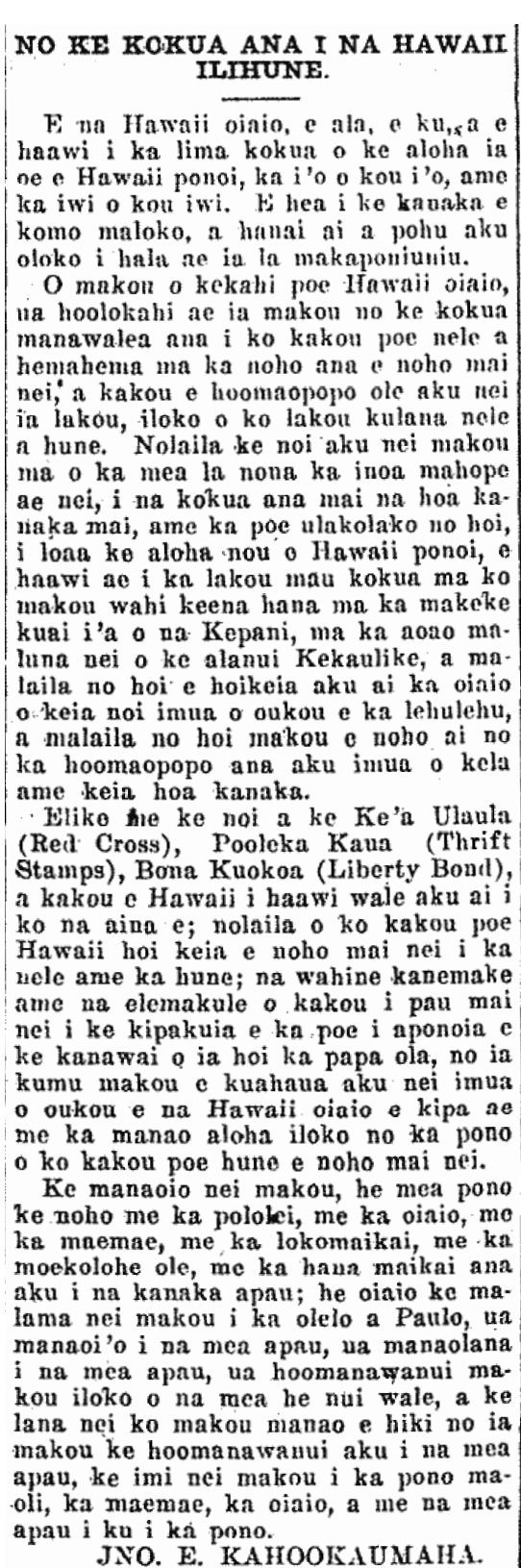
Ka Nupepa Kuokoa, Buke LVII, Helu 13, Aoao 2. Maraki 28, 1919.
[The Aloha Aina also ran this announcement, but by this time, the typesetting done in this newspaper was not carefully done. There are frequent typesetting errors throughout. This can be seen in the parallel announcement found below.
One striking change however found in the Aloha Aina announcement is the phrase: “ka Papa Make (ka Papa Ola)” replacing “ka papa ola,” where they refer to the Board of Health as “the Board of Death”.]

Ke Aloha Aina, Buke XXXIV, Helu 12, Aoao 4. Maraki 28, 1919.

Kona Historical Society will be “Saving Hawaii’s History” by auctioning off a number of fun and unique items to bid on to raise money for our educational programs. All the items in this auction will be sold online. There is no live event so if you win the online bidding you win the item! Our 2012 online auction had close to $60,000 in auction items. We hope this year’s auction will be even bigger!
[Help support the Kona Historical Society, and maybe get something fun to boot! Check out the link on the Kona Historical Society’s page.]

Check out the interesting and educational posts by the Hawaiian Historical Society found here on Facebook, and go become members as well! They are the caretakers of a great number of the original historic Hawaiian-Language Newspapers, and so much more! We need them!
Here is a link to their main homepage where you can sign up to become a member!
Perhaps the thoughts of the Kuokoa may not be the same as those of others about the way Hawaiian music is being sung these days, but because we hold dear listening to the beauty and the sweet sounds along with the joy of the voices, therefore the Kuokoa takes up this matter.
It is not something that we Hawaiians should criticize, that singing is something we are proud of, and something that makes this race famous all around the world, by tourists who visit Hawaii nei and hear us singing our enjoyable and entertaining songs, as well as by singing groups being seen travelling about America.
If we were to turn back in time, to many years past, when the Kawaihau Glee Club and many other groups were famous for singing, we will see when comparing them to those performing today, the differences between them; our admiration will be taken by the singing of the old days, which many groups in some places around Hawaii nei still practice that way of singing Hawaiian songs.
Our Hawaiian mele are composed with their many kaona, and it is by how they are sung, if it is not made clear by the lyrics, that give appreciation and admiration to the listener, from Hawaiians to those that don’t know our language, because it is only through the melody of the song that that listener is entertained.
These days however, our singers are following haole style singing; and when songs that we are used to hearing along with their tunes which fill us with energy and enthrallment are changed, when listening to that it is like ridicule, for we are not used to hearing that kind of melody, and Hawaiian songs are not famous for that style of singing.
Our people, from the men to the women are talented with fine singing voices; it is a talent not widely spread amongst other people of the world, but it is not by the the way some people now are singing, but by singing songs as they were sung in years past.
Perhaps the vibrato and the slow and drawn out of singing matches haole songs of this age, but by changing the way Hawaiian songs are sung in this way, we at the Kuokoa are not mistaken when we say that it is insulting to the listener.
We don’t wish to call this person or that one not a good singers, but should we want our goal to be to preserve this fame through song, there is only one arena for us to stand before the other races, that is through expressing what God has given to every Hawaiian man and woman, without mimicking or emulating what other people are doing; lest what is seen by us as good becomes something that is not good.
We have nothing to say to those who are studying music in books; that will be a great benefit to some, but the good seen in one aspect will not get better by changing another aspect; so it is with our Hawaiian music, by changing how they are sung, it will not make them better.
Each and every Hawaiian is the true witness, and they are the perfect judge to weigh what we now discuss, not to criticize or to assail upon someone with words of persecution, but for our affection of the grandeur and true beauty of Hawaiian mele which each and every one of us all love and cherish.
[On a somewhat related topic about tradition and kuleana and mele, there is a very thought-provoking essay for composers and non-composers alike, by Kainani Kahaunaele, printed in The Value of Hawaii 2: Ancestral Roots, Oceanic Visions, just recently out. In fact, if you haven’t got your copy yet, there are many stories by a wide range of writers in there that we should look at, and perhaps the many moolelo within the collection will then push us into thinking what we ourselves feel the value of Hawaii nei is and where we should be headed and what it is we need to do to get us there.]
(Kuokoa, 9/8/1911, p. 4)

Ka Nupepa Kuokoa, Buke XLVII, Helu 36, Aoao 4. Sepatemaba 8, 1911.
Clarifications by a Newspaper Writer about Her.
(Translated)
To “Ke Ola o Hawaii,”
Appearing in the British newspaper, The Outlook, of the other week, there were a number of awe-inspiring lines about our Queen, Liliuokalani, titled: “An American Queen.” This is how it went:
Americans sometimes forget that within one of the Territories of the United States there lives a real ex-Queen who owes the loss of her crown to the activities of American missionaries.
This Queen is, of course, Liliuokalani, of Hawaii, dethroned in the revolution of 1893. She is now a frail old lady of nearly seventy-nine years, and few but her immediate household and closest friends ever have the opportunity of meeting and talking with her.
It is interesting to record that because of one of the tragedies of the present war this aged Queen has permitted for the first time an American flag to fly over her home. The news of this incident comes to us in a letter from a correspondent in Hawaii. This correspondent writes:
It was my privilege a few days ago to attend what will possibly be the last public reception she will ever give to members of the Hawaiian Senate—some of her own race, and some sons of the missionaries who were mainly responsible for her overthrow. Although they belonged to a body absolutely democratic in form and elected by vote of the people as citizens of the United States, it was most interesting and somewhat touching to note the loyalty and love shown the aged ex-Queen: almost, one could imagine, as if she were still their reigning sovereign. Continue reading
I am a millennial and this year I am registering to vote.
The August primary will be my first opportunity to cast a ballot for publicly elected officials since I voted for Al Gore in a 1st grade presidential practice election.
I am genuinely eager to have my voice heard in the political sphere for the first time, even if it is in the form of one small piece of paper.
What makes me excited is that I’ve heard that those small pieces of paper can add up.
I am also a Hawaiian who is registering to vote…
[This obviously does not come from the the historic Hawaiian newspapers, but this same issue was written about time and time again in its pages, and it is interesting that we see this call for action being renewed today. For the entire article by Wyatt Bartlett of the island of Kama appearing on Civil Beat, see: Silent Constituencies and Building a Voice.]

