Lauhala House? Keaukaha Park, 1936.

LAUHALA HOUSE PLANNED

A typical Hawaiian lauhala house will be erected at Keaukaha park near the beach on the Hilo side of the radio station KHBC on Kalanianaole Avenue, it was announced last week by James Puuohau, secretary of the Kuhio Improvement Club who was recently appointed chairman of the lauhala house building committee.

[Might any of you Hilo people know anything further about this hale, and does anyone maybe have any pictures of this?]

(Hoku o Hawaii, 7/22/1936, p. 1)

LAUHALA HOUSE PLANNED

Ka Hoku o Hawaii, Volume XXXI, Number 12, Aoao 1. July 22, 1936.

Report of Kalakaua’s death from the “San Francisco Chronicle,” 1891.

KALAKAUA DEAD

Last Hours of the Hawaiian Monarch.

Solemn Scenes at the Royal Bedside.

The Succession and the Political Situation.

Sketches of the Dead Sovereign and of the Heirs to the Throne.

Kalakaua I., King of the Hawaiian Islands, is dead. He expired at 2:33 o’clock yesterday afternoon in his room at the Palace Hotel, where for three days he had lain unconscious on his bed. Surrounding him at the moment of his death were Col. Macfarlane, the King’s Chamberlain; Col. Hoapili Baker, His Majesty’s Equerry-in-waiting; Hawaiian Consul McKinley, Admiral Brown, U. S. N. Rev. J. Sanders Reed, Rev. F. H. Church and a number of personal friends of the King. Immediately after the death, Admiral Brown notified the Secretary of the Navy of that fact, Mayor Sanderson was also notified, and he called a meeting of the Supervisors for 9 o’clock this morning to consider proper action in the matter. The remains were embalmed and this afternoon they will be removed to the mortuary chapel of Trinity Church, where they will be guarded by a detail of United States soldiers.

At the Deathbed.

The Scenes in the Chamber of the Dying Monarch.

It was a pitiful and most impressive scene. The dying monarch lay gasping upon his bed, his emaciated body heaving convulsively with each of his labored respirations. At the bedside stood two ministers of the Gospel, physicians of the body had given way when they had come to the sad conclusion that Kalakaua was beyond mortal aid. Seated at the head of the bed, clasping the left hand of his King was Col. Baker, Kalakaua’s Aid-de-camp, whose strong frame was bent with sorrow, and who with great difficulty kept back the flood of tears which trembled in his eyes. Bending over from the right side was Col. Macfarlane, Chamberlain of the King. The suspense of the last few days had almost prostrated him, and his face bore traces of weeping. Crouched upon the floor against the wall near the bedside were the King’s valet Kahikina, an Hawaiian youth, and Kalua, a young girl from the Gilbert islands, who had been a most devoted servant to Kalakaua. They formed part of his suite on his arrival here.

Only a light coverlet of rich brown design covered the body of the King. In his struggles to throw off the firm reaper who was gradually pressing more heavily upon him, Kalakaua had thrust his arms out upon the bed. During the forenoon his faithful servant Kalua, in an endeavor to make the King as comfortable as possible, had placed beneath his chin a wide soft scarf of blue silk. There it remained until the death, seeming as it rose and fell upon the bright red undershirt to be symbolical of the wavering between this and the great beyond of the spirit of the stricken King.

Kalakaua was possessed of great vitality, and to the last he resisted the destroyer with a persistence which excited the wonder of the medical men, who knew that the King’s time had come. Though for three days past he had been unconscious and life had apparently been kept in him merely by the stimulants applied internally through natural channels or hypodermically, his constitution seemed determined to keep the spirit with the trembling body. Even after the physicians had relinquished all hope and, knowing that he must die, had ceased to apply stimulants, he continued to struggle on.

During the morning Drs. Woods, Watts, Sanger and Taylor were in attendance.

They consulted and announced that in their opinion the King would not live more than a few hours. He had then been unconscious for nearly forty hours, with the exception of one brief moment in the early morning, when he recognized Admiral Brown and spoke to Colonel Baker saying:

“Well, I am a very sick man.” Continue reading

Kamehameha School for Girls, 50th Anniversary, 1944.

50th ANNIVERSARY STORY¹

By Betty Yim

Featuring the education of the Hawaiian people from early times up to the present day, an historical pageant of authenticly staged scenes with more than 100 characters climaxed the celebration of the founding of the Kamehameha Schools for Girls.

Three performances were given, on Wednesday, December 6, for students; the others on Friday, December 8, for parents and guests and Saturday, December 9, for alumnae and alumni. Continue reading

Keelikolani’s house and valuables destroyed by fire, 1873.

Destruction by Fire of the Residence of the Governess of Hawaii.

The tedium of this dull town, was relieved a little on last Wednesday night by a rousing fire. About one quarter to eight o’clock, the dwellers on Emma street, and in the immediate neighborhood, were suddenly aroused by the shouts and cries of kanakas, the screams of wahines, and the barking of dogs; and were first led to suppose that a big fight was on hand,—that perhaps the police had mutinied and the rifles were called out; but as each anxious individual peered into the street, they soon discovered by the column of flame that was leaping up into the dark sky, that a conflagration was on hand, and farther observation showed that it was taking place at the town mansion of Her Excellency, R. Keelikolani, the Governess of Hawaii.

The fire evidently had a good start, and as soon as discovered, was beyond the control of blankets or buckets of water; but not beyond the control of a good head of water from a fire plug, if spouting on it there and then. But the hydrant for public safety was not ready till the roaring devourer was licking the roof tree of Ruth. And when it was ready, the quenching stream served only to raise an impotent fizzle of stream. And oh! had the wind been up, and this fire had been in the close built part of the town, then we would have had a dance of destruction, that would have been equal to the cost of forty reservoirs.

But we must not complain, as the Ministers were out to see the fire burn, and lend a hand if needed. Emma street was lively with the jostling of Ministers and milkmen, diplomats and deacons, judges and jews, and editors and elderly ladies. Everybody turned out,—even some of the churches turned out. These were in the midst of the regular Wednesday evening service, when the uproar began. One pastor affected by the outside outcry, and the evident anxiety of his people, “sung it short,” and he and his flock, joined the throng in the street, to see the sight; but another one, while addressing his faithful, although he saw them speak out one by one, until he was left with only two to listen, yet he stood firm like the Roman sentinel at Pompeii, while the sparks of the conflagration were falling in his vestibule, and gave the two faithful witnesses the full benefit without halt or abbreviation of good orthodox sermon.

The cause of the fire is unknown, but as there had been on hand lately, a fierce litigation about this and other property, the circumstances afford occasion for a good deal of suspicion. Much that was curious and valuable in relation to ancient Hawaiian habits and costumes were unfortunately destroyed. There was some of the famed featherwork, worn by the old chiefs, many of the old feather insignia of office, the great kahilis of Hawaiian pageants, shell and hair ornaments, tappas and fine mats, and some royal bones—all of which were a considerable loss, excepting the bones.

The residence as a property, will not be much of a loss to the wealthy Governess of Hawaii. If the trades had been blowing fresh, several houses makai of this building, would have gone with it but as it was dead calm, and a light shower had fallen a few minutes before the fire broke out, it was easy to defend the roofs of neighboring houses.

On account of the absence of mail, we give this long report of an ordinary fire.

(Hoku o Hawaii, 1o/17/1873, p. 3)

Destruction by Fire of the Residence of the Governess of Hawaii.

Nuhou, Volume II, Number 24, Page 3. October 17, 1873.

Hawaiian Language classes on Maui, 1941.

TEACHES MAUI HAWAIIAN CLASS

J. P. COCKETT

 J. P. Cockett, county treasurer of Maui, is successfully conducting a class for the study of the Hawaiian language at Wailuku, which has a total enrollment of 33.

The class is now in an advanced stage and the students are making very satisfactory progress according to Mr. Cockett.

The membership consists of the following: Frank Suzuki, Hawley Seiler, Mr. and Mrs. J. T. Correa, D. A. Correa, Mary D. Ah Sam, Mr. and Mrs. G. Furukawa, Mrs. H. Stibbard, Thomas Furukawa, Violet Chong, Ululani Collins, Elaine Matsumoto, C. Lindsay, Mrs. Abbie Baldwin, Misses Ah Lum and Mum Kyau Hew, B. Evelyn Miswander, M. Jane Gray, Miss Mildred Dean, Jack Marnie, K. Kawahara, G. Shimanuki, R. R. Omori, Mr. and Mrs. Ted Chung, Sylvester Correa, Alfred C. Franco, William A. Adams, Bella R. Martin, A. W. Langa and M. L. Carmichael.

(Star of Hawaii, April 30, 1941, p. 4)

TEACHES MAUI HAWAIIAN CLASS

The Star of Hawaii, Volume XXXVI, Number 1, Page 4. April 30, 1941.

Don Blanding poem in English, 1939.

Don Blanding Dedicates Poem To Old Hawaiians

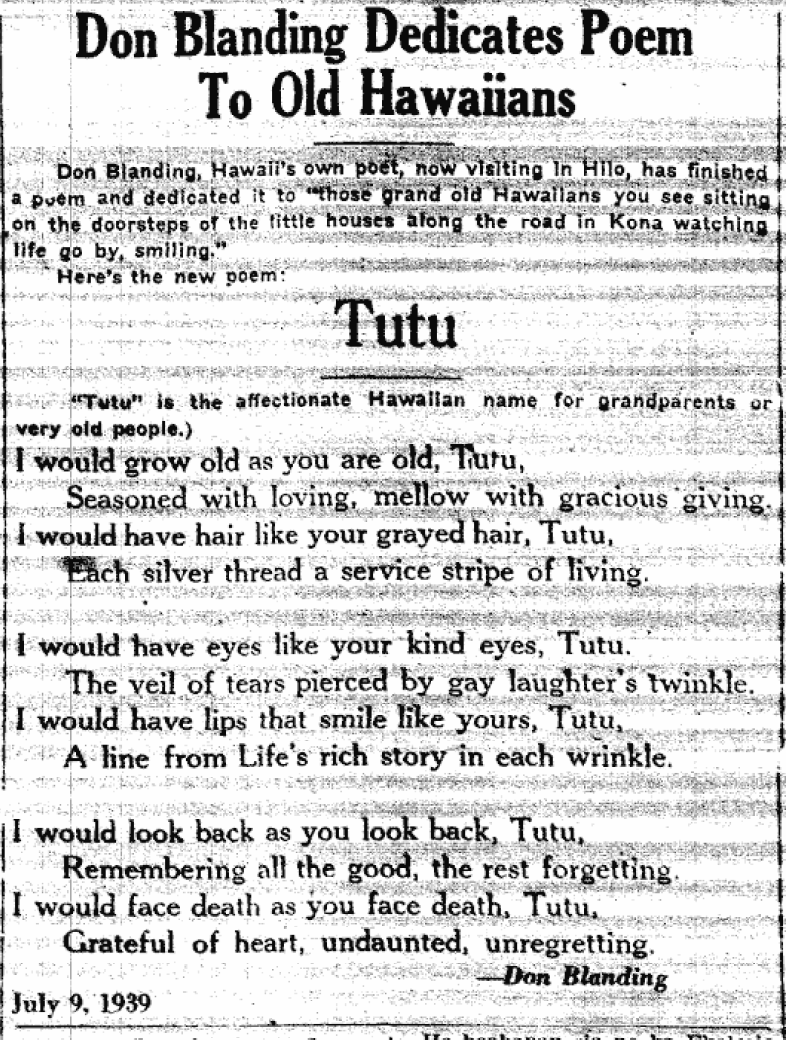
Don Blanding, Hawaii’s own poet, now visiting in Hilo, has finished a poem and dedicated it to “those grand old Hawaiians you see sitting on the doorsteps of the little houses along the road in Kona watching life go by, smiling.”

Here’s the new poem:

Tutu

“Tutu” is the affectionate Hawaiian name for grandparents or very old people.)

I would grow old as you are old, Tutu,
Seasoned with loving, mellow with gracious giving,
I would have hair like your grayed hair, Tutu,
Each silver thread a service stripe of living.

I would have eyes like your kind eyes, Tutu,
The veil of tears pierced by gay laughter’s twinkle,
I would have lips that smile like yours, Tutu,
A line from Life’s rich story in each wrinkle.

I would look back as you look back, Tutu,
Remembering all the good, the rest forgetting,
I would face death as you face death, Tutu,
Grateful of heart, undaunted, unregretting.

—Don Blanding

July 9, 1939

(Hoku o Hawaii, 7/12/1939, p. 6)

Don Blanding Dedicates Poem To Old Hawaiians

Ka Hoku o Hawaii, Volume XXXIV, Number 11, Aoao 6. July 12, 1939.

University of Hawaii Lei Day Queen, 1936.

Hilo Girl Is Lei Queen At University

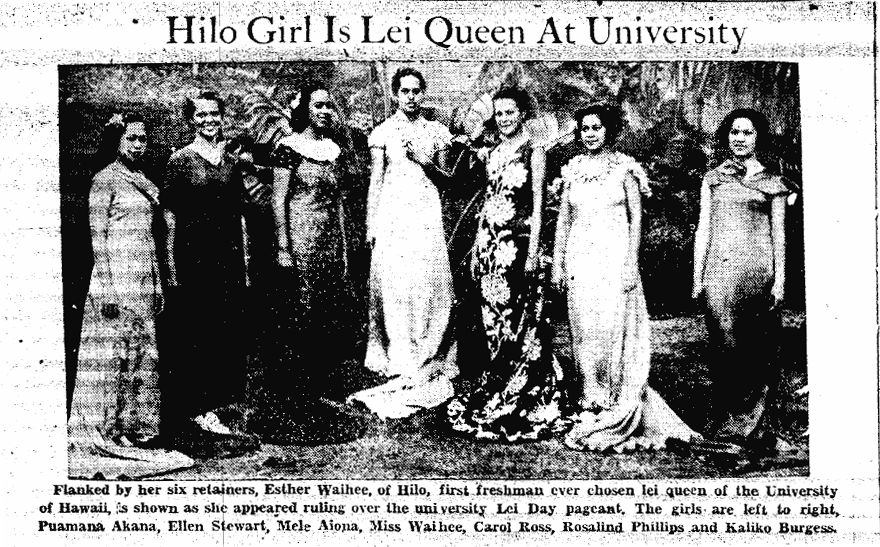
Flanked by her six retainers, Esther Waihee, of Hilo, first freshman ever chosen lei queen of the University of Hawaii, is shown as she appeared ruling over the university Lei Day pageant. The girls are left to right, Puamana Akana, Ellen Stewart, Mele Aiona, Miss Waihee, Carol Ross, Rosalind Phillips and Kaliko Burgess.

(Hoku o Hawaii, 5/13/1936, p. 1)

Hilo Girl Is Lei Queen At University

Ka Hoku o Hawaii, Volume XXXI, Number 3, Aoao 1. Mei 13, 1936.

“Those in whose memories were stored the mythologies, traditions, genealogies, proverbial wisdom, and poetry,” 1939.

The History Of The Hula Dance

(From Hawaiian Tourfax Annual)

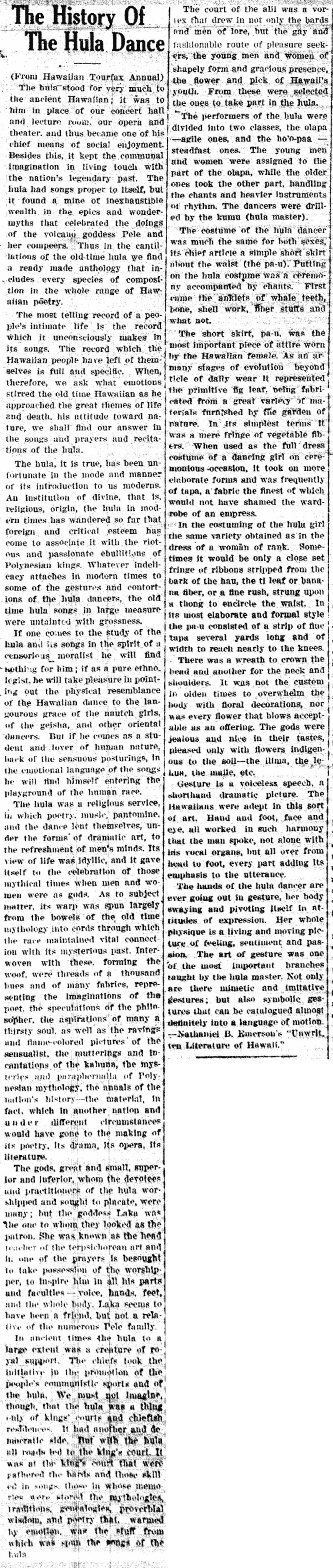
The hula stood for very much to the ancient Hawaiian; it was to him  in place of our concert hall and lecture room our opera and theater, and thus became one of his chief means of social enjoyment. Besides this, it kept the communal imagination in living touch with the nation’s legendary past. The hula had songs proper to itself, but it found a mine of inexhaustible wealth in the epics and wonder myths that celebrated the doings of the volcano goddess Pele and her compeers. Thus in the cantillations of the old time hula we find a ready made anthology that includes every species of composition in the whole range of Hawaiian poetry.

The most telling record of a people’s intimate life is the record which it unconsciously makes in its songs. The record which the Hawaiian people have left of themselves is full and specific. When, therefore, we ask what emotions stirred the old Hawaiians as he approached the great themes of life and death, his attitude toward nature, we shall find our answer in the songs and prayers and recitations of the hula.

The hula, it is true, has been unfortunate in the mode and manner of its introduction to us moderns. An institution of divine, that is, religious, origin, the hula in modern times has wandered so far that foreign and critical esteem has come to associate it with the riotours and passionate ebullitions of Polynesian kings. Whatever indelicacy attaches in modern times to some of the gestures and contortions of the hula dancers, the old time hula songs in large measure were untainted with grossness.

If one comes to the study of the hula and its songs in the spirit of a censorious moralist he will find nothing for him; if as a pure ethnologist, he will take pleasure in pointing out the physical resemblance of the Hawaiian dance to the langourous race of the nautch girls, of the geisha, and other oriental dancers. But if he comes as a student and lover of human nature, back of the sensuous posturings, in the emotional language of the songs he will find himself entering the playground of the human race.

The hula was a religious service, in which poetry, music, pantomine, and the dance lent themselves, under the forms of dramatic art, to the refreshment of men’s minds. Its view of life was idyllic, and it gave itself to the celebration of those mythical times when men and women were as gods. As to subject matter, its warp was spun largely from the bowels of the old time mythology into cords through which the race maintained vital connection with its mysterious past. Interwoven with these, forming the woof, were threads of a thousand hues and of many fabrics, representing the imaginations of the poet, the speculations of the philosopher, the aspirations of many a thirsty soul, as well as the ravings and flame-colored pictures of the sensualist, the mutterings and incantations of the kahuna, the mysteries and paraphernalia of Polynesian mythology, the annals of the nation’s history—the material, in fact, which in another nation and under different circumstances would have gone to the making of its poetry, its drama, its opera, its literature.

The gods, great and small, superior and inferior, whom the devotees and practitioners of the hula worshipped and sought to placate, were many; but the goddess Laka was the one to whom they looked as the patron. She was known as the head teacher of the terpsichorean art and its one of the prayers is besought to take possession of the worshipper, to inspire him in all his parts and faculties—voice, hands, feet, and the whole body. Laka seems to have been a friend, but not a relative of the numerous Pele family.

In ancient times the hula to a large extent was a creature of royal support. The chiefs took the initiative to the promotion of the people’s communistic sports and of the hula. We must not imagine, though, that the hula was a thing only of kings’ courts and chiefish residences. It had another and democratic side. But with the hula all roads led to the king’s court. It was at the king’s court that were gathered the bards and those skilled in songs, those in whose memories were stored the mythologies, traditions, genealogies, proverbial wisdom, and poetry that warmed by emotion, was the stuff from which spun the songs of the hula.

The court of the alii was a vortex that drew not only the bards and men of lore, but the gay and fashionable route of pleasure seekers, the young men and women of shapely form and gracious presence, the flower and pick of Hawaii’s youth. From these were selected the ones to take part in the hula.

The performers of the hula were divided into two classes, the olapa—agile ones, and the hoolapa—steadfast ones. The young men and women were assigned to the part of the olapa, while the older ones took the other part, handling the chants and heavier instruments of rhythm. The dancers were drilled by the kumu (hula master).

The costume of the hula dancer was much the same for both sexes, its chief article a simple short skirt about the waist (the pa-u). Putting on the hula costume was a ceremony accompanied by chants. First came the anklets of whale teeth, bone, shell work, fiber stuffs and what not.

The short skirt, pa-u, was the most important piece of attire worn by the Hawaiian female. As an article of daily wear it represented many stages of evolution beyond the primitive fig leaf, being fabricated from a great variety of materials furnished by the garden of nature. In its simplest terms it was a mere fringe of vegetable fibers. When used as a full dress costume of a dancing girl on ceremonious occasion, it took on more elaborate forms and was frequently of tapa, a fabric the finest of which would not have shamed the wardrobe of an empress.

In the costuming of the hula girl the same variety obtained as in the dress of a woman of rank. Sometimes it would be only a close set fringe of ribbons stripped from the bark of the hau, the ti leaf or banana fiber, or a fine rush, strung upon a thong to encircle the waist. In its most elaborate and formal style the pa-u consisted of a strip of fine tapa several yards long and of width to reach nearly to the knees.

There was a wreath to crown the head and another for the neck and shoulders. It was not the custom in olden times to overwhelm the body with floral decorations, nor was every flower that blows acceptable as an offering. The gods were jealous and nice in their tastes, pleased only with flowers indigenous to the soil—the ilima, the lehua, the maile, etc.

Gesture is a voiceless speech, a shorthand dramatic picture. The Hawaiians were adept in this sort of art. Hand and foot, face and eye, all worked in such harmony that the man spoke, not alone with his vocal organs, but all over from head to foot, every part adding its emphasis to the utterance.

The hands of the hula dancer are ever going out in gesture, her body swaying and pivoting itself in attitudes of expression. Her whole physique is a living and moving picture of feeling, sentiment and passion. The art of gesture was one of the most important branches taught by the hula master. Not only are there mimetic and imitative gestures; but also symbolic gestures that can be catalogued almost definitely into a language of motion.—Nathaniel B. Emerson’s “Unwritten Literature of Hawaii.”

(Hoku o Hawaii, 4/26/1939, p. 3)

The History Of The Hula Dance

Ka Hoku o Hawaii, Volume XXXIII, Number 52, Aoao 3. April 26, 1939.
Mrs. Emma Moniz opens hula studio, 1936.

Hula Studio Is Opened In Hilo

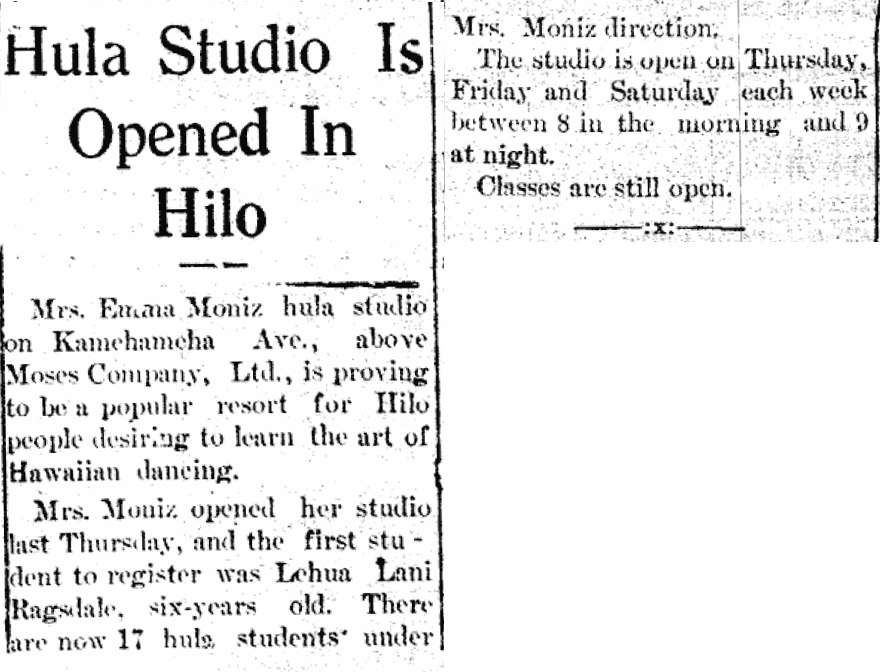
Mrs. Emma Moniz hula studio on Kamehameha Ave., above Moses Company, Ltd., is proving to be a popular resort for Hilo people desiring to learn the art of Hawaiian dancing.

Mrs. Moniz opened her studio last Thursday, and the first student to register was Lehua Lani Ragsdale, six-years old. There are now 17 hula students under Mrs. Moniz direction.

The studio is open on Thursday, Friday and Saturday each week between 8 in the morning and 9 at night.

Classes are still open.

(Hoku o Hawaii, 7/1/1936, p. 1)

Hula Studio Is Opened In Hilo

Ka Hoku o Hawaii, Volume XXXI, Number 10, Aoao 1. July 1, 1936.

On Aloha Aina, 1893.

“Breathes there a man with soul so dead,
Who never to himself hath said,
This is my own my native land.”
(Scott.)

Many of those who support honestly the present state of affairs, have done so in the full hope and belief, that thereby the flag of their country—the Stars and Stripes—will float over the land in perpetuity. Not a single Hawaiian, however, even those few whose signatures to annexation petitions (not 200 in number and mostly convicts.) have been bought or forced by necessity from them, desires to see any foreign flag replace his own. Continue reading