The Progressive News, 1914.

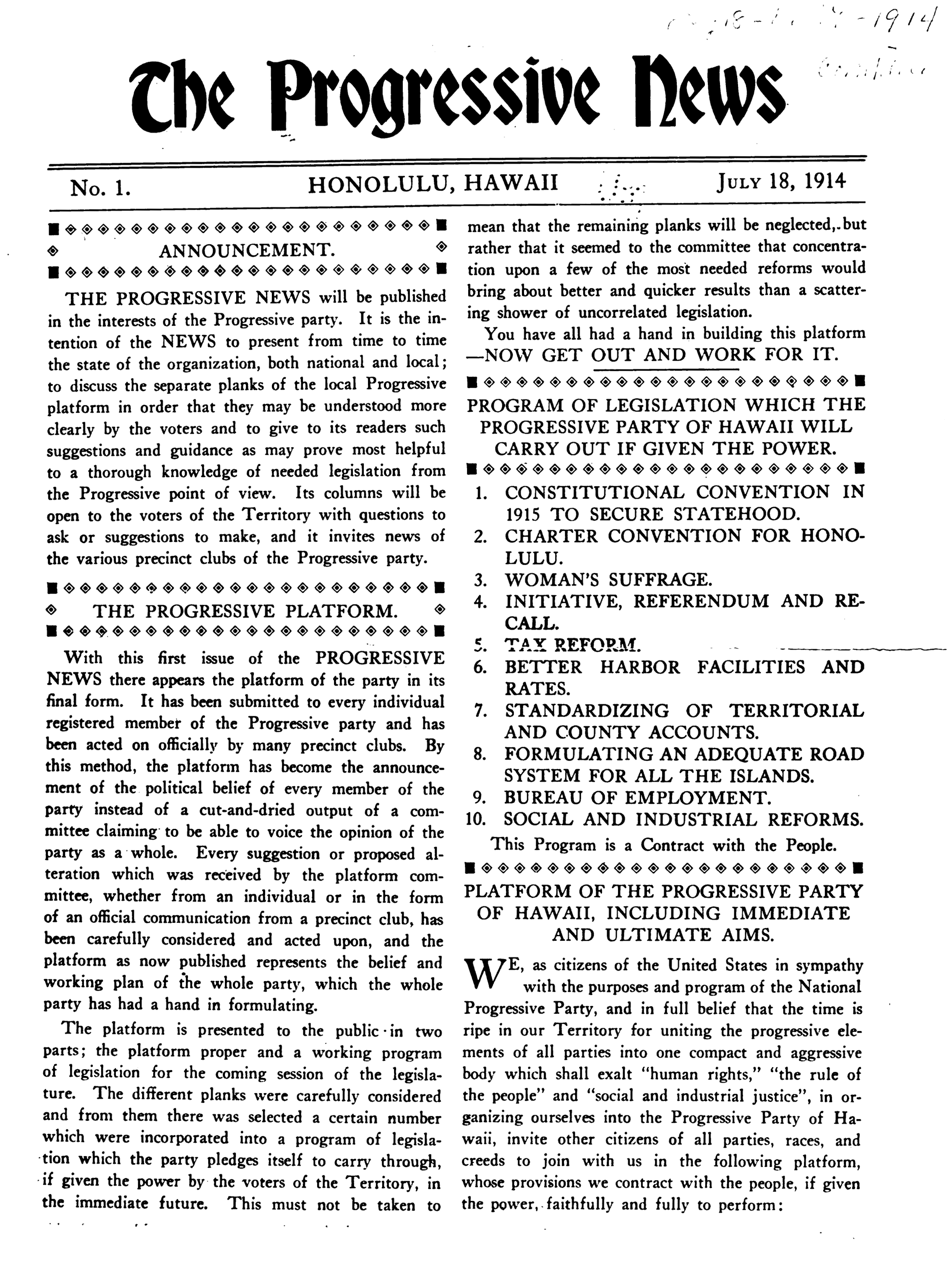
[Other than Chronicling America, you can also find newspapers from Hawaii on Google Books. Here below for instance is an image of the first page of the first issue of “The Progressive News”; Publisher: Howard M. Ballou, Editor: Francis J. Green, and Assistant Editor: John Uilani Joseph.  It is printed partially in English and in Hawaiian.

There is also the Hawaiian-Language Newspaper, “Ka Holomua: The Progressive” printed during the same time period; Owner and Editor: Gulstan K. Poepoe; Owner and Business Manager: John N. Keola; and Owner and Publisher: Samuel Kanio.]

The Progressive News

The Progressive News, Number 1, Page 1. July 18, 1914.

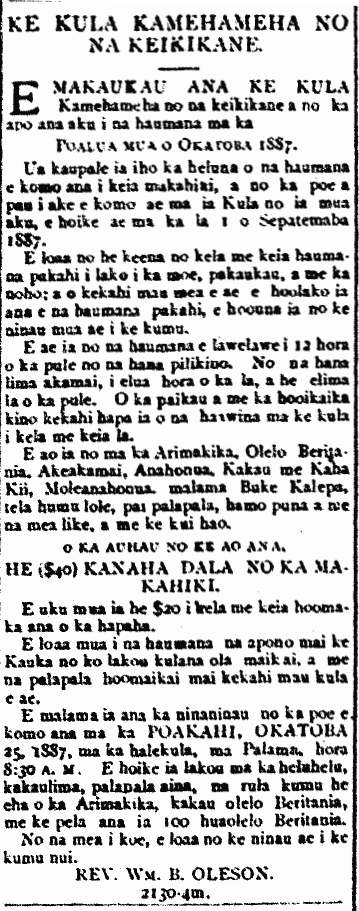
Announcement for the opening of Kamehameha School for Boys, 1887.

THE KAMEHAMEHA SCHOOL FOR
BOYS

THE KAMEHAMEHA SCHOOL FOR BOYS
will be ready for the admission of students on the

First Tuesday of October, 1887

Only a limited number of Students will be received this year, and those desiring to enter the School in the future must apply on the 1st day of September 1887.

Each student will occupy a separate room furnished with bed, table, and chair; and a list of items to be furnished by each student will be sent if asked for in advanced to the teacher.

Each student will be allowed to carry out 12 hours a week of manual labor. For industrial arts, two hours a day, and five days a week. Military drilling and physical education will be a portion of the curriculum everyday.

Arithmetic, English Language, Popular Science [Akeakamai], Elementary Algebra [Anahonua], Free-hand and Mechanical Drawing [Kakau me Kaha Kii], Practical Geometry [Moleanahonua], Bookkeeping [malama Buke Kalepa], tailoring [tela humu lole], printing [pai palapala], masonry [hamo puna], and other similar things, and blacksmithing.

tuition for the schooling.

($40) FORTY DOLLARS PER YEAR.

$20 to be paid at the beginning of each quarter.

The students must get prior approval from the Doctor attesting to their good health, and letters of recommendation from other schools.

Examinations for those entering will be held on MONDAY, OCTOBER 25, 1887, at the schoolhouse at Palama, 8:30 A. M. They will show their knowledge in reading, writing, geography, the four rules of Arithmetic, writing in English, and the spelling of 100 English words.

As for anything else, you may find out by asking the principal.

REV. WILLIAM B. OLESON.

[See also the English-language announcement found in the May 24th issue of the Hawaiian Gazette. It is interesting to note especially the difference in the wording for the part about manual labor.]

(Kuokoa 5/28/1887, p. 2)

KE KULA KAMEHAMEHA NO NA KEIKIKANE.

Ka Nupepa Kuokoa, Buke XXVI, Helu 22, Aoao 2. Mei 28, 1887.

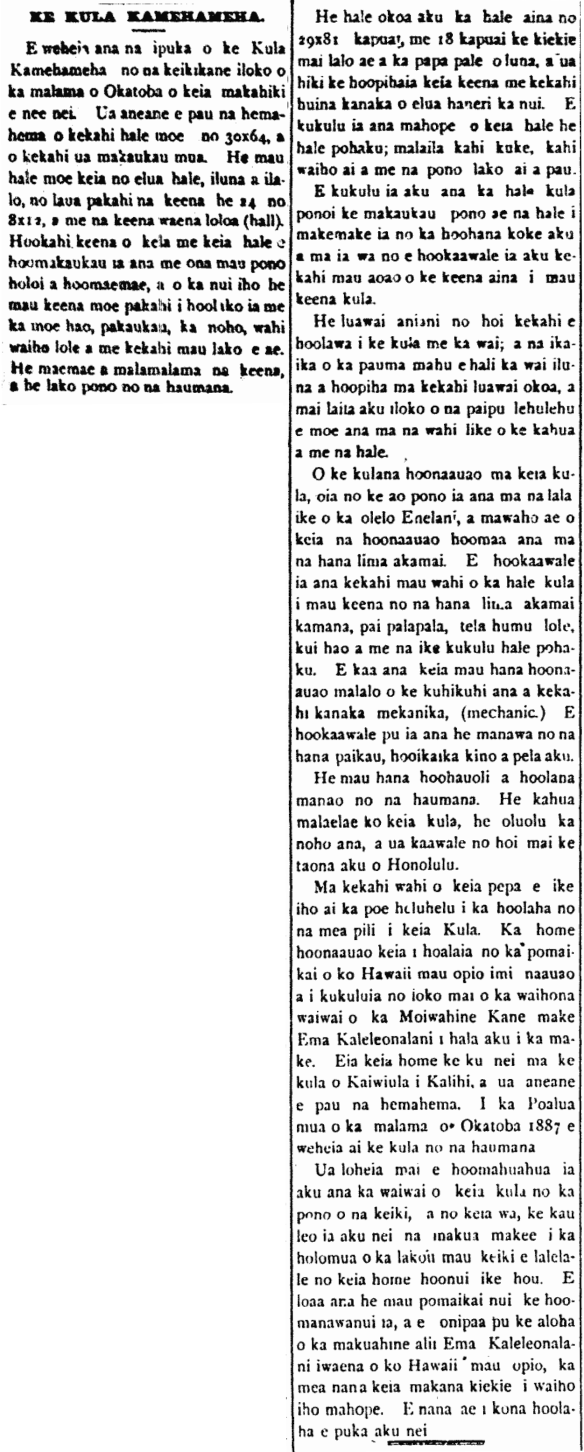
E o, e Kaleleonalani! Queen Emma and Kamehameha Schools, 1887.

KAMEHAMEHA SCHOOL.

The gates of the Kamehameha School for boys will open in October of this current year. The imperfections of one of the dormitories of 30 x 64 [feet] are almost smoothed out, and another was complete before. These dormitories are two storied, bottom floor and top floor, and each of them have 24 rooms of 8 x 12, and a hallway [keena waena loloa]. One room of each house is furnished with facilities to wash up and clean, and the rest of the rooms are bedrooms, each being supplied with a iron bed, desk, chair, closet, and some other furnishings. The rooms are clean and lighted, and well-furnished for the student.

The dining hall of 29 x 81 feet is a separate building, and it is 18 feet from the bottom to the ceiling, and it will fit two-hundred people. A stone building will be built behind this, which will be the kitchen and and a place to store the food and all cookware and dinnerware.

A proper schoolhouse will be built after the buildings that are desired to be completed quickly are done, and in the meantime, parts of the dining hall will be set aside as school rooms.

A clear spring will supply the school with water and it is by steam pumps that the water will be brought up and filled into a separate water tank, and from there into many pipes laid all over the grounds and buildings.

The curriculum at this school teaches thoroughly the branches of the English language; and outside of that are the teaching of industrial arts. Some rooms of the school house will be set aside as rooms for carpentry, printing, tailoring, blacksmithing, and masonry. The instruction will take place under the direction of a mechanic [mekanika]. Some time will also be set aside for military drilling, physical development, and so forth.

There are fun and cheerful activities for the students. This school sits on a serene site, living there is pleasant, and it is separated from the town of Honolulu.

In a section of this paper, the reader will see the advertisement dealing with this School. This is the educating home established for the benefit of Hawaii’s children who seek education, and built by way of the estate of the late Dowager Queen Ema Kaleleonalani. This home stands in the plain of Kaiwiula in Kalihi, and it is near completion. On the first Tuesday of October 1887, this school will open to students.

It has been heard that the assets of the school will be increased for the good of the children, and for now, parents who want their children to progress forward are being urged to rush to this new home where knowledge is increased. Much benefits will be gained if patient and if the aloha of the royal parent Ema Kaleleonalani is held resolute as well by Hawaii’s children, the one who left this great gift behind. Look at its published notice.

[On this, the day after Queen Emma’s 177th birthday, i thought it would be a good thing  to look back at her role in the establishment of the Kamehameha Schools, a role which she is not recognized often for today.

Notice the difference between the article appearing in the May 24th edition of the Hawaiian Gazette, “The Kamehameha Schools.” (probably what the article is based upon) and this Hawaiian-Language article.]

(Kuokoa, 5/28/1887, p. 2)

KE KULA KAMEHAMEHA.

Ka Nupepa Kuokoa, Buke XXVI, Helu 22, Aoao 2. Mei 28, 1887.

A glimpse into the beginnings of Kuokoa Home Rula, 1902.

NEW EPITHET APPLIED

“MISSIONARY PROTESTANT REPUBLICANS” NOW.

The Organ of the Home Rule Party Draws the Color and the Sectarian Line.

The “Kuokoa Home Rula” contains the following based on the statement that efforts are being made in Congress to amend the electoral qualification in Hawaii.

The Kuokoa Home Rula is the organ of the Home Rule party and is said to be edited by George Markham and Senator Kalauokalani.

“On the Tuesday just passed information was received by us which is important news for the Hawaiian people, and which may cause us all to weep. This will result if the task of strangling us, a la pig, is successfully accomplished by the mercenaries of our enemies, who are struggling in their efforts to influence the Congress of United States of America, Hartwell was sent by the rattle-brained Governor Dole and the Missionary Protestant Republican party to oppose us and deprive us of ‘manhood suffrage,’ the right which was given us by the United States of America, our Father Government—the right to vote.

“A bill has been prepared by these parties to be presented to Congress; to the Senate and the House of Representatives; limiting the qualifications of the native Hawaiian in the right of suffrage. The Nation should be ever watchful in the future and should jealously guard and protect this precious right, for it means our existence or our destruction. These are the doing of the Protestant Missionary Republicans, who are so unreasonably embittered and so venomous that we may be poisoned by their touch—like unto the fangs of the death-dealing snake. This is really the work of a venomous snake, with jealousies and animosities emplanted within its breast and which with malice seeks the destruction of we of the Hawaiian Race. Not satisfied with our being buried alive in Kalaupapa and Kalawao, they are now doing all in their power to deprive the Hawaiians, we of the brown skins, of all of our rights.

“Auwe! Auwe! Ka make o ka Lahui e. Here we are; whither are we floating? The graves for our burial are now being dug by the Republicans.

“These people are hunting us down to strangle us as pigs; they are all of the same flock. Therefore they must be remembered at the next election (Then follows a list of senators and representatives of the Republican party.) They must be remembered by the people. You supported them and carried them through at the last campaign, and as a result of your work they turned upon you and spat in your eyes.

“You should not be carried away again by the smoothness of their talk. They are now perpetrating one of the blackest of deeds, worse than the committing of murder, for this reason, that the only life taken is that of the person murdered, but in this case it will be the death of all the race.

“This political party is now making an effort to take away from us our rights to the ballot, and now they have turned to smite those who voted for them at the last election.

“Therefore ye must be sound in the teachings of the race, and must remember those who are downing you, the open hearted Hawaiians, with such injustice and ingratitude.”

In addition it is stated that a representative will be sent to Washington to oppose any such measure, and that petitions against it are being circulated for signatures among the Hawaiians.

[I wonder what the rest of the Kuokoa Home Rula was like in its early days! Hopefully, there are still originals hiding somewhere in the world and they will be unearthed soon!!]

(Hawaiian Star, 2/5/1902, p. 5)

NEW EPITHET APPLIED

The Hawaiian Star, Volume IX, Number 3085, Page 5. February 5, 1902.

King Kalakaua’s Arrival in Japan, 1881.

His Majesty the King of Hawaii arrived here yesterday (Friday) morning at 8 a. m. in the Oceanic. As the steamer moved up to her anchorage, the men-of-war in harbour dressed ship and manned yards, the crews of the Russian and Japanese vessels also cheering heartily as the Oceanic passed them. His Majesty was visited on board by Mr. Hachisuka, ex-Daimiyo of Awa, Admiral Nakamura, Mr. Ishibashi, Secretary of the Foreign Office and others, as well as by the Russian Admiral and Staff. He subsequently embarked in the Emperor’s State barge and proceeded to the Port Admiral’s Office, where he was received by Mr. Daté, Ex-Daimiyo of Uwajima, Mr. Hijikata, Vice Minister of the Household Department, Mr. Sannomiya, Mr. Nagasaki and several Naval and Military officers, Mr. R. Irwin, Consul for Hawaii in Japan, and Mr. Stevens, secretary of the U. S. Legation also waited on his Majesty. From the Port Admiral’s Office His Majesty proceeded in a state carriage to the Summer Palace at Iséyama, which has been paled at his disposal by the Emperor. He was there visited by H. I. H. Prince Fushimi, Mr. Uyeno, Vice Minister of Foreign Affairs, and many other officials of high rank. To-day (Saturday) he proceeded to Tokiyo by the 12 o’clock train and was met at Shimbashi terminus by four Imperial Princes, who accompanied him first to an audience with His Majesty the Emperor and afterwards to their own houses, whence he ultimately proceeded to the Yenriyokwan, which has been prepared for his reception during the period of his sojourn here. The King’s name is Kalakauwa, which may be translated, “The day of battle.” His Majesty is nearly fifty years old, having been born in 1831. In personal appearance he is about the middle height, thickset, but of really handsome personal appearance. His complexion is not darker than that of an ordinary Japanese. When but a child he was received into the boarding school, kept for many years by Mr. and Mrs. Cook of the American Board’s Mission, for the exclusive reception of all the young chiefs of the highest blood. Here he received a good education, and being at the time he was first sent there one of the youngest received into this family of some dozen or more pupils, he had acquired, at the conclusion of his scholastic career, not only a through knowledge of English, but also an accurate pronunciation of that language. Previous to his election, in 1874, to fill the throne rendered vacant by the death of King William Lunalilo, he served as Post-Master General, and in other Government positions.

[This is an article appearing in one of Japan’s English-language newspapers of the time, The Japan Weekly Mail, which started in 1879.]

(Japan Weekly Mail, 3/5/1881, p. 1)

His Majesty the King of Hawaii arrived...

The Japan Weekly Mail, Volume V, Number 9, Page 1. March 5, 1881.

And yet another on Liliu and the Red Cross, 1917.

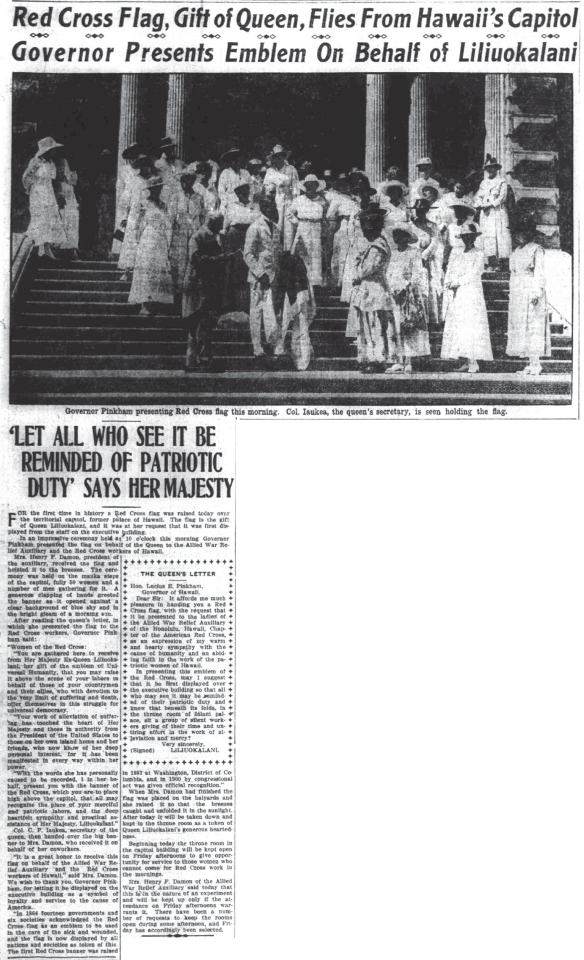
Red Cross Flag, Gift of Queen, Flies From Hawaii’s Capitol

Governor Presents Emblem On Behalf of Liliuokalani

Governor Pinkham presenting Red Cross flag this morning. Col. Iaukea, the queen’s secretary, is seen holding the flag.

‘LET ALL WHO SEE IT BE REMINDED OF PATRIOTIC DUTY’ SAYS HER MAJESTY

FOR the first time in history a Red Cross flag was raised today over the territorial capitol, former palace of Hawaii. The flag is the gift of Queen Liliuokalani, and it was at her request that it was first displayed from the staff on the executive building.

In an impressive ceremony held at 10 o’clock this morning Governor Pinkham presented the flag on behalf of the Queen to the Allied War Relief Auxiliary and the Red Cross workers of Hawaii.

Mrs. Henry F. Damon, president of the auxiliary, received the flag and hoisted it to the breezes. The ceremony was held on the mauka steps of the capitol, fully 50 women and a number of men gathering for it. A generous clapping of hands greeted the banner as it opened against a clear background of blue sky and in the bright gleam of a morning sun.

After reading the queen’s letter, in which she presented the flag to the Red Cross workers, Governor Pinkham said:

“Women of the Red Cross:

“You are gathered here to receive from Her Majesty Ex-Queen Liliuokalani, her gift of the emblem of Universal Humanity, that you may raise it above your labors in behalf of those your countrymen and their allies, who with devotion to the very limit of suffering and death, offer themselves in this struggle for universal democracy.

“Your work of alleviation of suffering has touched the heart of Her Majesty and those in authority from the President of the United STates to those on her own island home and her friends, who now know of her deep personal interest, for it has been manifested in every way within her power.

“With the words she has personally caused to be recorded, I in her behalf, present you with the banner of the Red Cross, which you are to place high above the capitol, that all may recognize the place of your merciful and patriotic labors, and the deep heartfelt sympathy and practical assistance of Her Majesty, Liliuokalani.”

Col. C. P. Iaukea, secretary of the queen, then handed over the big banner to Mrs. Damon, who received it on behalf of her coworkers.

“It is a great honor to receive this flag on behalf of the Allied War Relief Auxiliary and the Red Cross workers of Hawaii,” said Mrs. Damon. We wish to thank you, Governor Pinkham, for letting it be displayed on the executive building as a symbol of loyalty and service to the cause of America.

“In 1864 fourteen governments and six societies acknowledged the Red Cross flag as an emblem to be used in the care of the sick and wounded, and the flag is now displayed by all nations and societies as token of this. The first Red Cross banner was raised in 1881 at Washington, District of Columbia, and in 1900 by congressional act was given official recognition.”

When Mrs. Damon had finished the flag was placed on the halyards and she raised it so that the breezes caught and unfolded it in the sunlight. After today it will be taken down and kept in the throne room as a token of Queen Liliuokalani’s generous heartedness.

Beginning today the throne room in the capitol building will be kept open on Friday afternoons to give opportunity for service to those women who cannot come for Red Cross work in the mornings.

Mrs. Henry F. Damon of the Allied War Relief Auxiliary said today that this is in the nature of an experiment and will be kept up only if the attendance on Friday afternoons warrants it. There have been a number of requests to keep the rooms open during some afternoons, and Friday has accordingly been selected.

THE QUEEN’S LETTER

Hon. Lucius E. Pinkham,

Governor of Hawaii.

Dear Sir: It affords me much pleasure in handing you a Red Cross flag, with the request that it be presented to the ladies of the Allied War Relief Auxiliary of the Honolulu, Hawaii, Chapter of the American Red Cross, as an expression of my warm and hearty sympathy with the cause of humanity and an abiding faith in the work of the patriotic women of Hawaii.

In presenting this emblem of the Red Cross, may I suggest that it be first displayed over the executive building so that all who may see it may be reminded of their patriotic duty and know that beneath its folds, in the throne room of Iolani palace, sit a group of silent workers giving of their time and untiring effort in the work of alleviation and mercy?

Very sincerely,

(Signed) LILIUOKALANI.

(Honolulu Star-Bulletin, 9/14/1917, p. 3)
Red Cross Flag, Gift of Queen, Flies From Hawaii's Capitol

Honolulu Star-Bulletin, Volume XXV, Number 7932, Page 3. September 14, 1917.

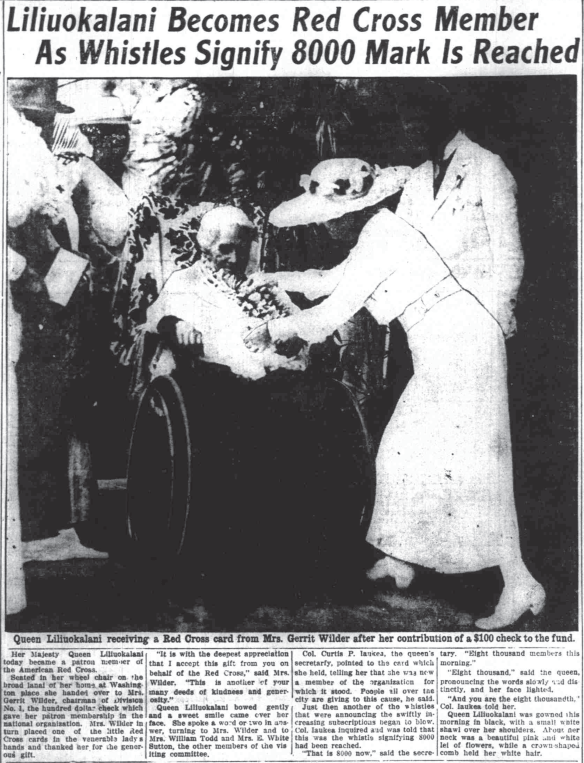
More on Queen Liliuokalani and the Red Cross, 1917.

Liliuokalani Becomes Red Cross Member As Whistles Signify 8000 Mark Is Reached

Queen Liliuokalani receiving a Red Cross card from Mrs. Gerrit Wilder after her contribution of a $100 check to the fund.

Her Majesty Queen Liliuokalani today became a patron member of the American Red Cross.

Seated in her wheel chair on the broad lanai of her home at Washington Place she handed over to Mrs. Gerrit Wilder, chairman of Division No. 1, the hundred dollar check which gave her patron membership in the national organization. Mrs. Wilder in turn placed one of the little Red Cross cards in the venerable lady’s hands and thanked her for the generous gift.

“It is with the deepest appreciation that I accept this gift from you on behalf of the Red Cross,” said Mrs. Wilder. “This is another of your many deeds of kindness and generosity.”

Queen Liliuokalani bowed gently and a sweet smile came over her face. She spoke a word or two in answer, turning to Mrs. Wilder and to Mrs. William Todd and Mrs. E. White Sutton, the other member of the visiting committee.

Curtins P. Iaukea, the queen’s secretary, pointed to the card which she held, telling her that she was now a member of the organization for which it stood. People all over the city are giving to this cause, he said.

Just then another of the whistles that were announcing the swiftly increasing subscriptions began to blow. Col. Iaukea inquired and was told that this was the whistle signifying 8000 had been reached.

“That is 8000 now,” said the secretary. “Eight thousand members this morning.”

“Eight thousand,” said the queen, pronouncing the words slowly and distinctly, and her face lighted.

“And you are the eight thousandth,” Col. Iaukea told her.

Queen Liliuokalani was gowned this morning in black, with a small white shawl over her shoulders. About her neck was a beautiful pink and white lei of flowers, while a crown-shaped comb held her white hair.

(Honolulu Star-Bulletin, 9/29/1917, p. 2)

Liliuokalani Becomes Red Cross Member As Whistles Signify 8000 Mark Is Reached

Honolulu Star-Bulletin, Volume XXV, Number 7945, Page 2. September 29, 1917.

In response to gas illumination at the opening of Iolani Palace, 1913.

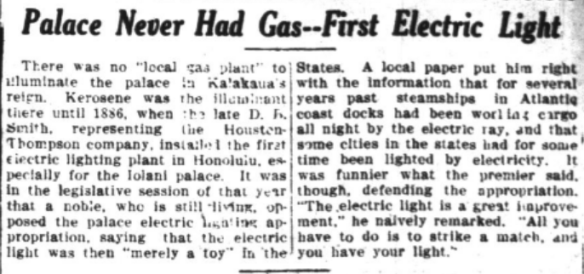
Palace Never Had Gas–First Electric Light

There was no “local gas plant” to illuminate the palace in Kalakaua’s reign. Kerosene was the illuminant there until 1886, when the late D. P. Smith, representing the Houston-Thompson company, installed the first electric lighting plant in Honolulu, especially for the Iolani palace. It was in the legislative session of that year that a noble, who is still living, opposed the palace electric lighting appropriation, saying that the electric light was then “merely a toy” in the States. A local paper put him right with the information that for several years past steamships in Atlantic coast docks had been working cargo all night by the electric ray, and that some cities in the states had for some time been lighted by electricity. It was funnier what the premier said, though, defending the appropriation. “The electric light is a great improvement,” he naively remarked. “All you have to do is to strike a match, and you have your light.”

(Honolulu Star-Bulletin, 1/11/1913, p. 8)

Palace Never Had Gas--First Electric Light

Honolulu Star-Bulletin, Volume XX, Number 6482, Page 8. January 11, 1913.

More on the Palace mirrors, 1913.

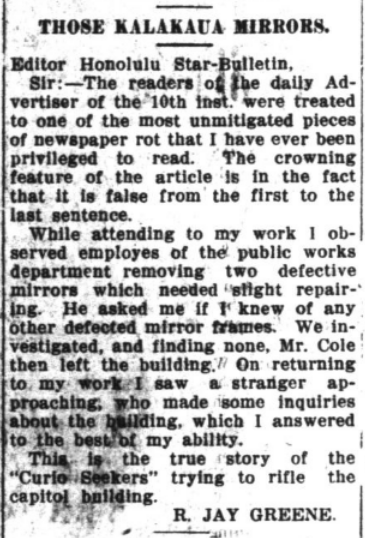
THOSE KALAKAUA MIRRORS.

Editor Honolulu Star-Bulletin,

Sir:—The readers of the daily Advertiser of the 10th inst. were treated to one of the most unmitigated pieces of newspaper rot that I have ever been privileged to read. The crowning feature of the article is in the fact that it is false from the first to the last sentence.

While attending to my work I observed employees of the public works department removing two defective mirrors which needed slight repairing. He asked me if I knew of any other defected mirror frames. We investigated, and finding none, Mr. Cole then left the building. On returning to my work I saw a stranger approaching, who made some inquiries about the building, which I answered to the best of my ability.

This is the true story of the “Curio Seekers” trying to rifle the capitol building.

R. JAY GREENE.

[Here is an interesting response from the “Roland Green” of the previous articles.]

(Honolulu Star-Bulletin, 1/11/1913, p. 4)

THOSE KALAKAUA MIRRORS.

Honolulu Star-Bulletin, Volume XX, Number 6482, Page 4. January 11, 1913.

Mahalo to Zita Cup Choy for pointing out this related article in the Pacific Commercial Advertiser, 1913.

CURIO SEEKERS TRY TO RIFLE CAPITOL

King Kalakaua’s Mirrors the Pet Object of Souvenir Hunters—Kamehameha Knocked.

Daring souvenir collectors, willing to run the risk of a term in prison to gratify their desires, made a bold attempt to carry off a number of mirrors and bronze frames from the Capitol Building some time Wednesday night. It is believed that the collectors were frightened while at work and for that reason did not accomplish their purpose.

Roland Green, keeper of the Capitol, yesterday morning discovered the work of the would-be souvenir owners on the first terrace of the Ewa side of the building. They had succeeded in partially breaking two of the mirrors from their fastenings on the wall. A board holding one of the glasses in place was broken in two in tearing it from its lodgment. Green had the glasses and bronze frames removed to the basement of the Capitol where they will be repaired, resilvered and returned to their positions on the Capitol wall.

During the past few years several of these mirrors have been torn from their fastenings and carried away. Though malihinis, sightseeing and treasure hunting on the island, have been accused of the depredations it is said that kamaainas have had knowledge of at least one or two of them.

Kamehameha’s statue has not escaped the destructive onslaughts of the vandals. Several heads of the little bronze images at the base of the statue have been knocked off and carried away by the curio-seekers.

The mirrors, however, seem to have the most attraction. These mirrors are set in elaborate circular bronze frames surmounted by the coat of arms of King Kalakaua, bearing the initials of that monarch supported by two perfectly carved cherubs. It is stated that these frames originally cost $250 each and many were installed around the terraces of each floor of the palace. The idea of putting them in place is said to have originated with the King and were designed for the purpose of aiding in illuminating the palace grounds.

This was in 1883. Gas was then the modern method of illumination in Honolulu as well as on the mainland. Gas fixtures were arranged in front of each of the glasses. When these were lighted the mirrors were intended to cast the reflection to the surrounding grounds. It is said that this innovation cost the monarchy about $20,000.

For a year after the completion of the new palace it is said that King Kalakaua had one of the best illuminated palaces in the world, though practically the full capacity of the local gas plant was required to accomplish this purpose. By that time the good King learned that, after all, his bright mirrors were not the success they should be. Soon afterward the electric lights came and the gas fixtures were removed. Since then the mirrors have not only been sought after by curio hunters but have been the object of much speculation on the part of tourists.

Many of these strangers have figured that the mirrors were installed on the palace walls by the King with a view of aweing visiting native subjects, many of whom, according to fiction, had never gazed into a looking-glass.

It remained for Keeper Green to give the true version of their cause of their installation.

“It is strange how some people look upon this Capitol Building as a curio pile,” said a territorial official yesterday. “The fact that the former palace of the King is being used as the seat of a democratic government seems to appeal to them strongly and but for the vigilance used by the watchman and others the entire building would be carried off by souvenir hunters within a few years.”

[This is most likely the basis of the Hawaiian-Language article in the Kuokoa, 1/17/1913, p. 6.]

(Pacific Commercial Advertiser, 1/10/1913, p. 6)

CURIO SEEKERS TRY TO RIFLE CAPITOL

Pacific Commercial Advertiser, Volume LVII, Number 9494, Page 6. January 10, 1913.