More English-language Hawaii papers to be searchable online! 2012.

The UH Manoa Library has received $265,018 from the National Endowment for the Humanities (NEH) to digitize and upload the predecessor newspapers of the Honolulu Star-Advertiser on the Chronicling America website.  The publications are:
Pacific Commercial Advertiser (1856-1921)
Honolulu Star-Bulletin (1917-1922)

Something to see, 1868.

[Found under: “LOCAL NEWS: Oahu.”]

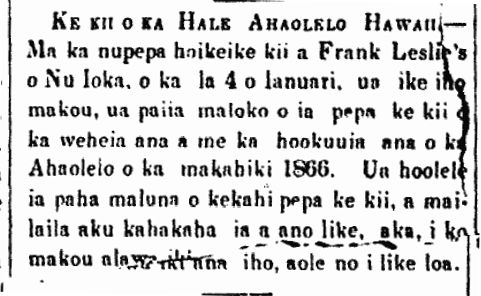
A picture of the Legislature of Hawaii.—In Frank Leslie’s Illustrated Newspaper of New York, on the 4th of January, we just saw that there was printed in that paper a picture of the opening and the adjourning of the Legislature of 1866. Perhaps it was disseminated by a newspaper, and from there its likeness was drawn, however, when we gave it a glance, it wasn’t similar at all.

(Kuokoa, 2/29/1868, p. 2)

Ke kii o ka Hale Ahaolelo Hawaii.

Ka Nupepa Kuokoa, Buke VII, Helu 9, Aoao 2. Feberuari 29, 1868.

“The Hawaiian,” a monthly journal, 1872.

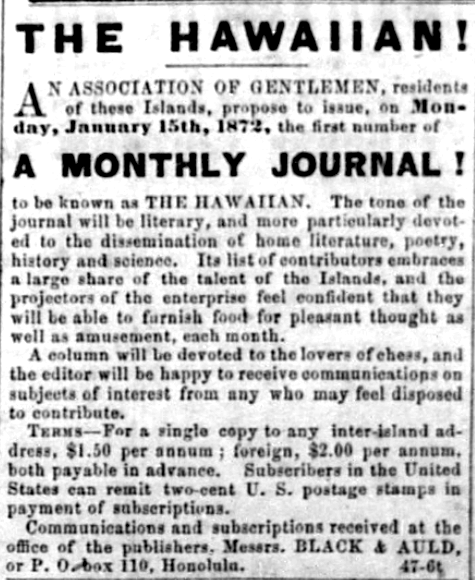
THE HAWAIIAN!

AN ASSOCIATION OF GENTLEMEN, residents of these Islands, propose to issue, on Monday, of January 15th, 1872, the first number of

A MONTHLY JOURNAL!

to be known as THE HAWAIIAN. The tone of the journal will be literary, and more particularly devoted to the dissemination of home literature, poetry, history and science. Its list of contributors embraces a large share of the talent of the Islands, and the projectors of the enterprise fell confident that they will be able to furnish food for pleasant thought as well as amusement, each month.

A column will be devoted to the lovers of chess, and the editor will be happy to receive communications on subjects of interest from any who may feel disposed to contribute.

Terms—For a single copy to any inter-island address, $1.50 per annum; foreign, $2.00 per annum, both payable in advance. Subscribers in the United States can remit two-cent U. S. postage stamps in payment of subscriptions.

Communications and subscriptions received at the office of the publishers, Messrs. BLACK & AULD, or P. O. box 110, Honolulu.  47-6t

(Hawaiian Gazette, 1/3/1872, p. 4)

THE HAWAIIAN!

Hawaiian Gazette, Volume VII, Number 51, Page 4. January 3, 1872.

Unknown newspaper begins, 1872.

[Found under: “Local News: Oahu.”]

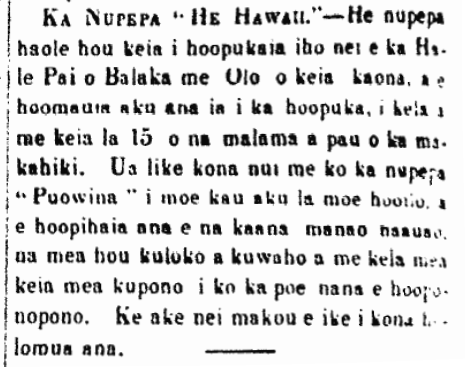
The Newspaper “He Hawaii.” [The Hawaiian]—This is a new haole newspaper just published by the Printers of Black and Auld of this town, and it will continue to be published on the 15th of every month throughout the year. It is the same size as “Puowina” [Punchbowl], which rests the eternal rest; and it will be full of intelligent offerings, foreign and domestic news, and other matter found fit by the editors. We hope to see it progress.

[Although there are extant copies of “Punchbowl” held by the Hawaiian Historical Society, it seems that there are no surviving copies of “The Hawaiian”.]

(Kuokoa, 1/27/1872, p. 2)

Ka Nupepa "He Hawaii."

Ka Nupepa Kuokoa, Buke XI, Helu 4, Aoao 2. Ianuari 27, 1872.

And more on the Maori, 1920.

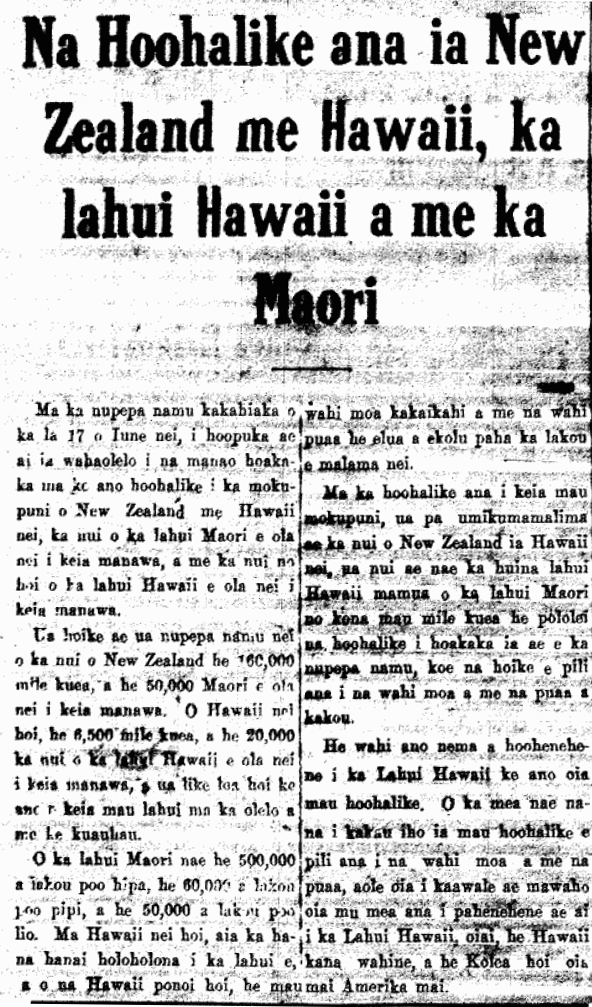
Comparison of New Zealand and Hawaii, the Hawaiian People and the Maori.

In the English morning newspaper [Pacific Commercial Advertiser] of the 17th of June, that mouthpiece published a clarification between the island of New Zealand and Hawaii, the population of the Maori lahui living today and that of the Hawaiian lahui.

That English paper said the area of New Zealand is 160,000 square miles, and that there are 50,00 Maori living today. As for Hawaii, it is 6,500 square miles, and there are 20,000 of its lahui living currently; and these two people are very much alike in language and genealogy.

However, the Maori have 500,000 heads of sheep, 60,000 heads of cattle, and 50,000 heads of horses. In Hawaii nei, the job of raising livestock is left to the other ethnicities, and the Hawaiians themselves, they raise a few chickens and a couple or three pigs.

In comparing these islands, New Zealand is fifteen times as big as Hawaii nei, but the total Hawaiians are more than the Maori per square miles; the comparisons put forth by the English paper are correct, all but what was said about our few chickens and pigs.

That comparison criticizes  and ridicules the Hawaiian people. But the one who wrote these comparisons pertaining to the chickens and pigs is not far from these things of which he mocks the Hawaiian people about, for his wife is a Hawaiian, and he is a Kolea bird¹ from America.

¹The kolea is the migrating plover, that is used to symbolize people who come to Hawaii, and like these birds, feed off of the riches only to leave after getting fat.

[I will have to check on who the writer was. Too bad the Advertiser is not online!]

(Aloha Aina, 7/4/1920, p. 4)

Na Hoohalike ana ia New Zealand me Hawaii, ka lahui Hawaii a me ka Maori

Ke Aloha Aina, Buke XXXX, Helu 43, Aoao 4. July 3, 1920.

More on Maori visit, 1920.

[Found under: “On The Other Islands”]

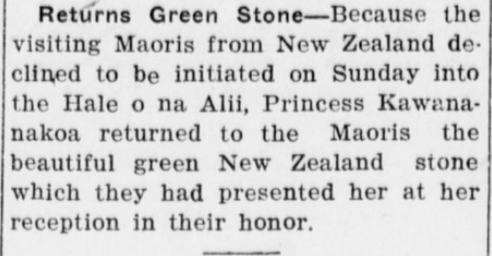
Returns Green Stone—Because the visiting Maoris from New Zealand declined to be initiated on Sunday into the Hale o na Alii, Princess Kawananakoa returned to the Maoris the beautiful green New Zealand stone which they had presented her at her reception in their honor.

(Maui News, 7/2/1920, p. 6)

Returns Green Stone

The Maui News. 21st Year, Number 1059, Page 6. July 2, 1920.

Different view of the seal of the republic, 1896.

Great Seal of the Republic of Hawaii.

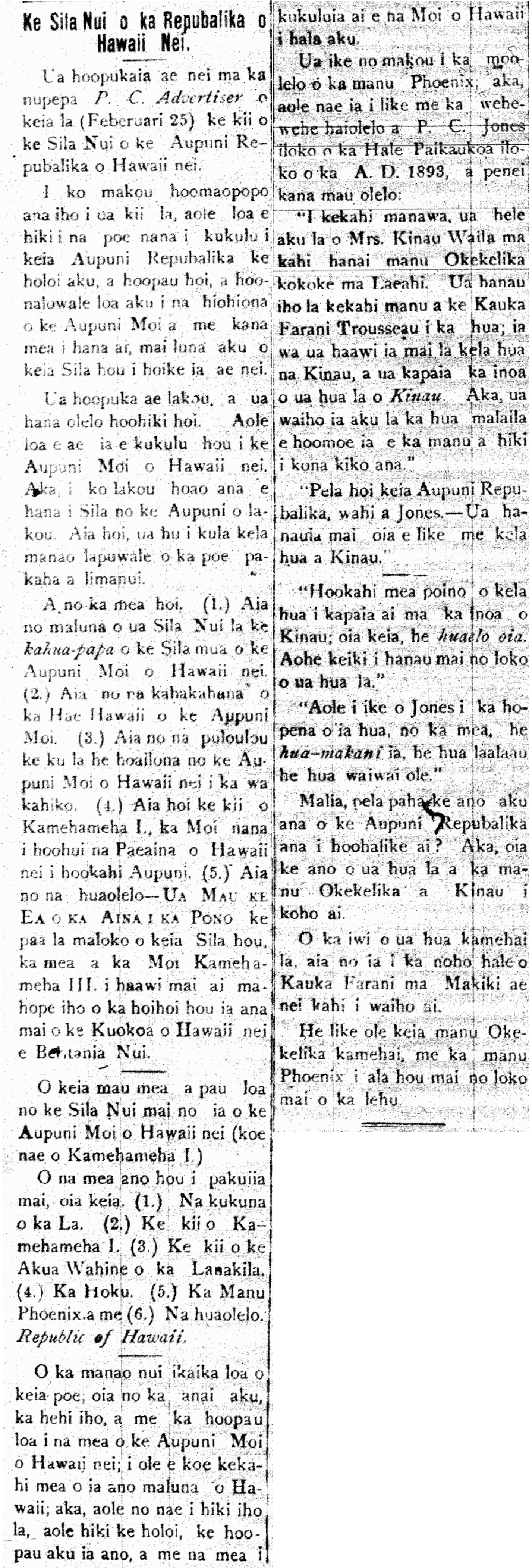
In today’s P. C. Advertiser (February 25), a picture of the Great Seal of the Republic of Hawaii was printed.

By our understanding of that image, there is no way that those who established this Republic can erase or end or eradicate visages of the Monarchy and its accomplishments, from the seal mentioned above.

They stated and vowed that there will be no way that the reestablishment of the Kingdom of Hawaii nei will be allowed. However, when they set out to create a Seal for their Government. And now, that foolish idea of the plunderers and thugs has gone awry.

Being that, (1.) On that Great Seal, is the foundation of the first Seal of the Monarchy of Hawaii nei. (2.) There is the stripes of the Hawaiian Flag of the Monarchy. (3.) There stand puloulou, a symbol of the Hawaiian Monarchy of old. (4.) There is an image of Kamehameha I., the King who unified the Hawaiian Archipelago into one Nation. (5.) There are the words—”Ua Mau ke Ea o ka Aina i ka Pono” affixed onto this new Seal, the words given by King Kamehameha III after the restoration of the Independence of Hawaii nei by Great Britain.

All these things were from the Great Seal of the Monarchy of Hawaii nei (except Kamehameha I.)

The new things added are these. (1.) Rays of the Sun. (2.) The image of Kamehameha I. (3.) The image of the Goddess of Victory. (4.) The Star. (5.) The Phoenix Bird, and (6.) The words, Republic of Hawaii.

Their intense desire is to rub out, to stomp out, and to end for all time, things of the Monarchy of Hawaii nei, lest vestiges of that sort remain in Hawaii; but that is not possible: there is no erasing, nor putting end to deeds done by the past Monarchs of Hawaii.

We know the story of the Phoenix, but it is not the same as the explanatory speech by P. C. Jones at the Armory [Hale Paikaukoa] in the year 1893, and these are his words:

“Once, Mrs. Kinau Wilder [Waila] went to where Ostrich were raised near Diamond Head [Laeahi]. One of the birds of the French Doctor Trousseau laid an egg, and it was on that occasion given to Kinau, and the egg was called Kinau. However, it was left there to be sat on by a bird until it hatched.

“This is similar to this Republic,” according to Jones. “It was born like that egg, Kinau.”

There is one unfortunate thing about that egg called by the name of Kinau, that being, it was a rotten egg [huaelo]. There was no chick born from that egg.

Jones didn’t know of the outcome of that egg, for it was but a yolk-less egg [hua makani], a hua laalaau?, a worthless egg.

Perhaps this will be the outcome of the Republic to which he compares it to? But at any rate, that is the kind of Ostrich egg that Kinau chose.

The shell of that astonishing egg is kept at the residence of Trousseau [Kauka Farani] in Makiki.

This astonishing Ostrich is not the same as a Phoenix which rises from the ashes.

(Aloha Aina, 2/29/1896, p. 4)

Ke Sila Nui o ka Repubalika o Hawaii Nei.

Ke Aloha Hawaii, Buke II, Helu 9, Aoao 4. Feberuari 29, 1896.

Use of tradition for propaganda, 1896.

SEAL OF THE REPUBLIC.

Design Submitted by the “Anglo-Dane.”

A FINE PIECE OF WORK.

Some Features of the Old Seal. The Old and the New Blended. The Lone Star of the Pacific. To be Considered on Wednesday.

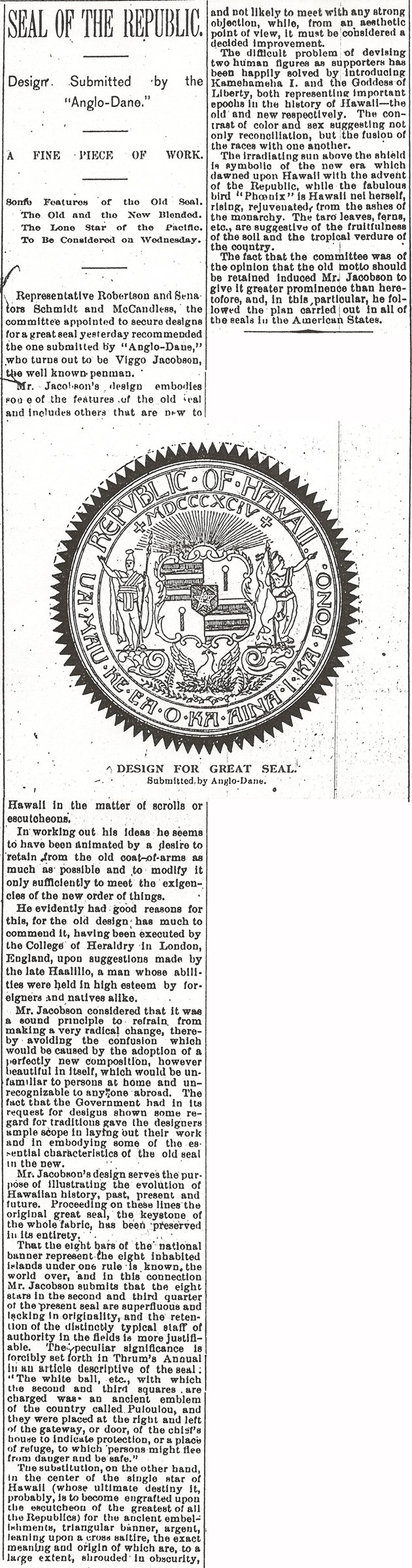
Representative Robertson and Senators Schmidt and McCandless, the committee appointed to secure designs for a great seal yesterday recommended the one submitted by “Anglo-Dane,” who turns out to be Viggo Jacobson, the well known penman.

Mr. Jacobson’s design embodies some of the features of the old seal and includes others that are new to Hawaii in the matter of scrolls or escutcheons.

In working out his ideas he seems to have been animated by a desire to retain from the old coat-of-arms as much as possible and to modify it only sufficiently to meet the exigencies of the new order of things.

He evidently had good reasons for this, for the old design has much to commend it, having been executed by the College of Heraldry in London, England, upon suggestions made by the late Haalilio, a man whose abilities were held in high esteem by foreigners and natives alike.

Mr. Jacobson considered that it was a sound principle to refrain from making a very radical change, thereby avoiding the confusion which would be caused by the adoption of a perfectly new composition, however beautiful in itself, which would be unfamiliar to persons at home and unrecognizable to anyone abroad. The fact that the Government had in its request for designs shown some regard for traditions gave the designers ample scope in laying out their work and in embodying some of the essential characteristics of the old seal in the new.

Mr. Jacobson’s design serves the purpose of illustrating the evolution of Hawaiian history, past, present and future. Proceeding on these lines the original great seal, the keystone of the whole fabric, has been preserved in its entirety.

That the eight bars of the national banner represent the eight inhabited islands under one rule is known, the world over, and in this connection Mr. Jacobson submits that the eight stars in the second and third quarter of the present seal are superfluous and lacking in originality, and the retention of the distinctly typical staff of authority in the fields is more justifiable. The peculiar significance is forcibly set forth in Thrum’s Annual in an article descriptive of the seal: “The white ball, etc., with which the second and third squares are charged was an ancient emblem of the country called Puloulou, and they were placed at the right and left of the gateway, or door, of the chief’s house to indicate protection, or a place of refuge, to which persons might flee from danger and be safe.”

The substitution, on the other hand, in the center of the single star of Hawaii (whose ultimate destiny it, probably, is to become engrafted upon the escutcheon of the greatest of all the Republics) for the ancient embellishments, triangular banner, argent, leaning upon a cross saltire, the exact meaning and origin of which are, to a large extent, shrouded in obscurity, and not likely to meet with any strong objection, while, from an aesthetic point of view, it must be considered a decided improvement.

The difficult problem of devising two human figures as supporters has been happily solved by introducing Kamehameha I. and the Goddess of Liberty, both representing important epochs in the history of Hawaii—the old and new respectively. The contrast of color and sex suggesting not only reconciliation, but the fusion of the races with one another.

The irradiating sun above the shield is symbolic of the new era which dawned upon Hawaii with the advent of the Republic, while the fabulous bird “Phœnix” is Hawaii nei herself, rising, rejuvenated, from the ashes of the monarchy. The taro leaves, ferns, etc., are suggestive of the fruitfulness of the soil and the tropical verdure of the country.

The fact that the committee was of the opinion that the old motto should be retained induced Mr. Jacobson to give it greater prominence than theretofore, and, in this particular, he followed the plan carried out in all of the seals in the American States.

(Pacific Commercial Advertiser, 2/25/1896, p. 1)

SEAL OF THE REPUBLIC.

The Pacific Commercial Advertiser, Volume XXIII, Number 4234, Page 1. February 25, 1896.

Response to Ernest A. Mott-Smith’s Letter in San Francisco Call, 1912.

THE STATE OF LEPROSY IN HAWAII NEI

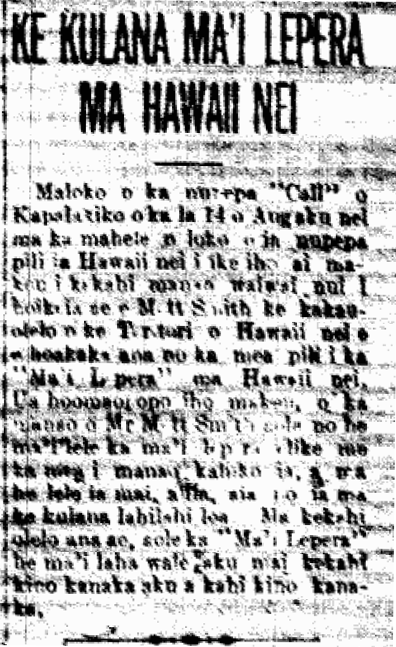
In the newspaper, the “Call” of San Francisco, of the 14th of August, in a section of that newspaper dealing with Hawaii, is where we saw a very important idea given by Mott-Smith, the secretary of the Territory of Hawaii, describing matters related to Leprosy in Hawaii nei. We understand the thoughts of Mr. Mott-Smith that Leprosy isn’t a contagious disease like what was believed long ago; it is only weakly transmitted. In other words, “Leprosy” is not transmittable from one person to another.

[The article referred to here from the San Francisco Call, “ON GUARD AGAINST DISEASE,” can be found here at Chronicling America.

Also, i could barely read the Aloha Aina article, because the image online is so unclear, as you can see for yourself. There are so many pages like this that need to be shot clearly before it is too late…]

(Aloha Aina, 9/14/1912, p. 1)

KE KULANA MA'I LEPERA MA HAWAII NEI

Ke Aloha Aina, Buke XVII, Helu 37, Aoao 1. Sepatemaba 14, 1912.

One more related article on Kalaupapa, 1867.

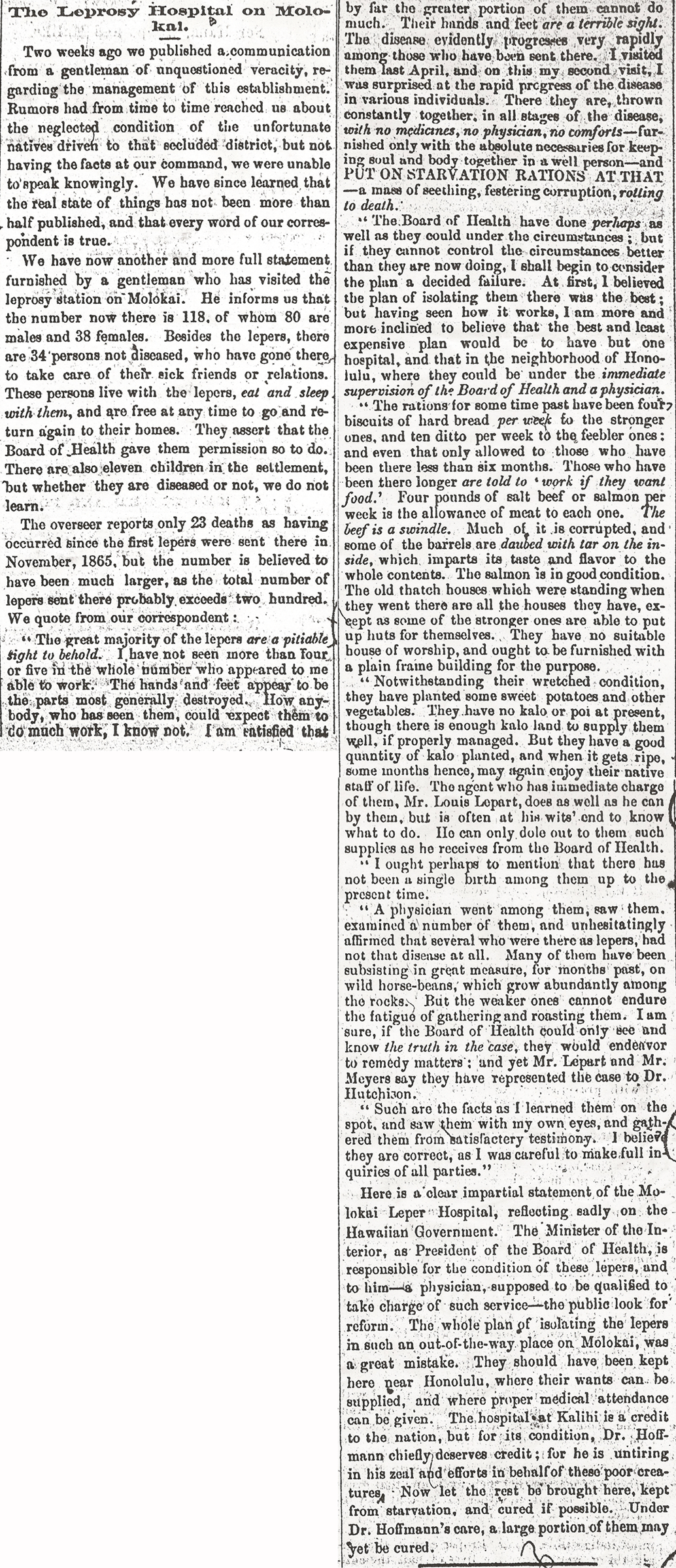
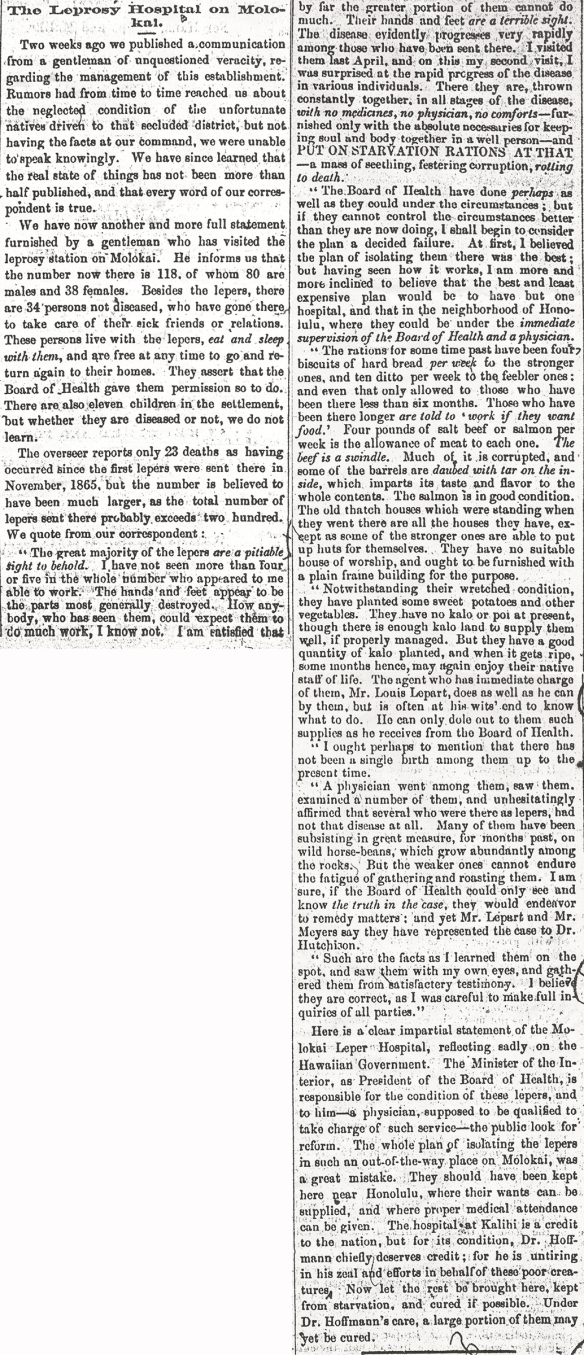
The Leprosy Hospital on Molokai.

Two weeks ago we published a communication from a gentleman of unquestioned veracity, regarding the management of this establishment. Rumors had from time to time reached us about the neglected conditions of the unfortunate natives driven to that secluded district, but not having the facts at our command, we were unable to speak knowingly. We have since learned that the real state of things has not been more than half published, and that every word of our correspondent is true.

We have no another and more full statement furnished by a gentleman who has visited the leprosy station on Molokai. He informs us that the number now there is 118, of whom 80 are males and 38 females. Besides the lepers, there are 34 persons not diseased, who have gone there to take care of their sick friends or relations. These persons live with the lepers, eat and sleep with them, and are free at any time to go and return again to their homes. They assert that the Board of Health gave them permission so to do. There are also eleven children in the settlement, but whether they are diseased or not, we do not learn.

The overseer reports only 23 deaths as having occurred since the first lepers were sent there in November, 1865, but the number is believed to have been much larger, as the total number of lepers sent there probably exceeds two hundred. We quote from our correspondent:

“The great majority of the lepers are a pitiable sight to behold. I have not seen more than four or five in the whole number who appeared to me able to work. The hands and feet appear to be the parts most generally destroyed. How anybody, who has seen them, could expect them to do much work, I know not. I am satisfied that by far the greater portion of them cannot do much. Their hands and feet are a terrible sight. The disease evidently progresses very rapidly among those who have been sent there. I visited them last April, and on this my second visit, I was surprised at the rapid progress of the disease in various individuals. There they are, thrown constantly together, in all stages of the disease, with no medicines, no physicians, no comforts—furnished only with the absolute neccessaries for keeping soul and body together in a well person—and PUT ON STARVATION RATIONS AT THAT—a mass of seething, festering corruption, rotting to death.

“The Board of Health have done perhaps as well as they could under the circumstances; but if they cannot control the circumstances better than they are now doing, I shall begin to consider the plan a decided failure. At first, I believed the plan of isolating them there was the best; but having seen how it works, I am more and more inclined to believe that the best and least expensive plan would be to have but one hospital, and that in the neighborhood of Honolulu, where they could be under the immediate supervision of the Board of Health and a physician.

“The rations for some time past have been four biscuits of hard bread per week to the stronger ones, and ten ditto per week to the feebler ones: and even that only allowed to those who have been there less than six months. Those who have been there longer are told to ‘work if they want food.’ Four pounds of salt beef or salmon per week is the allowance of meat to each one. The beef is a swindle. Much of it is corrupted, and some of the barrels are daubed with tar on the inside, which imparts its taste and flavor to the whole contents. The salmon is in good condition. The old thatch houses which were standing when they went there are all the houses they have, except as some of the stronger ones are able to put up huts for themselves. They have no suitable house of worship, and ought to be furnished with a plain frame building for the purpose.

“Notwithstanding their wretched condition, they have planted some sweet potatoes and other vegetables. They have no kalo or poi at present, though there is enough kalo land to supply them well, if properly managed. But they have a a good quantity of kalo planted, and when it gets ripe, some months hence, may again enjoy their native staff of life. The agent who has immediate charge of them, Mr. Louis Lepart, does as well as he can by them, but is often at his wits’ end to know what to do. He can only dole out to them such supplies as he receives from the Board of Health.

“I ought perhaps to mention that there has not been a single birth among them up to the present time.

“A physician went among them, saw them, examined a number of them, and unhesitatingly affirmed that several who were there as lepers, had not that disease at all. Many of them have been subsisting in great measure, for months past, on wild horse-beans, which grow abundantly among the rocks. But the weaker ones cannot endure the fatigue of gathering and roasting them. I am sure, if the Board of Health could only see and know the truth in the case, they would endeavor to remedy matters; and yet Mr. Lepart and Mr. Meyers say they have represented the case to Dr. Hutchison.

“Such are the facts as I learned them on the spot, and saw them with my own eyes, and gathered them from satisfactery testimony. I believe they are correct, as I was careful to make full inquiries of all parties.”

Here is a clear impartial statement of the Molokai Leper Hospital, reflecting sadly on the Hawaiian Government. The Minister of the Interior, as President of the Board of Health, is responsible for the condition of these lepers, and to him—a physician, supposed to be qualified to take charge of such a service—the public look for reform. The whole plan of isolating the lepers in such an out-of-the-way place on Molokai, was a great mistake. They should have been kept here near Honolulu, where their wants can be supplied, and where proper medical attendance can be given. The hospital at Kalihi is a credit to the nation, but for its condition, Dr. Hoffmann chiefly deserves credit; for he is untiring in his zeal and efforts in behalf of these poo creatures. Now let the rest be brought here, kept from starvation, and cured if possible. Under Dr. Hoffmann’s care, a large portion of them may yet be cured.

(Pacific Commercial Advertiser, 1/12/1867, p. 3)
The Leprosy Hospital on Molokai.

The Pacific Commercial Advertiser, Volume XI, Number 28, Page 3. January 12, 1867.