Critique on Conditions at Kalaupapa, 1866.

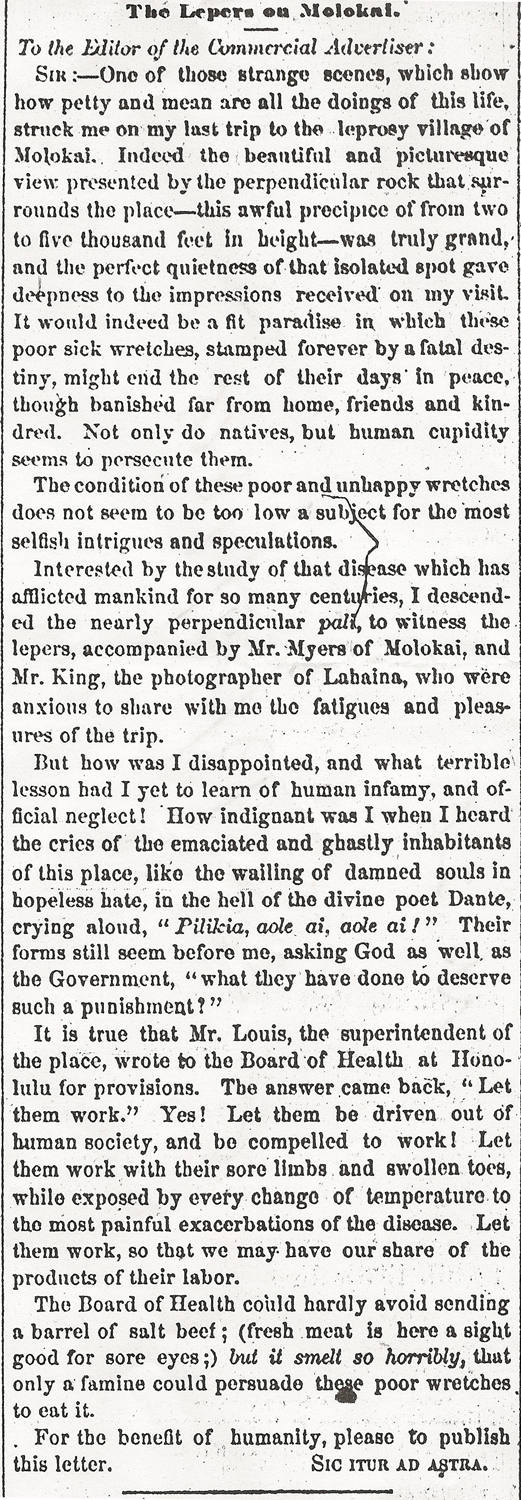
The Lepers on Molokai.

To the Editor of the Commercial Advertiser:

Sir:—One of those strange scenes, which show how petty and mean are all the doings of this life, struck me on my last trip to the leprosy village of Molokai. Indeed the beautiful and picturesque view presented by the perpendicular rock that surrounds the place—this awful precipice of from two to five thousand feet in height—was truly grand, and the perfect quietness of that isolated spot gave deepness to the impression received on my visit. It would indeed be a fit paradise in which these poor sick wretches, stamped forever by a fatal destiny, might end the rest of their days in peace, though banished far from home, friends and kindred. Not only do natives, but human cupidity seems to persecute them.

The condition of these poor and unhappy wretches does not seem to be too low a subject for the most selfish intrigues and speculations.

Interested by the study of that disease which has afflicted mankind for so many centuries, I descended the nearly perpendicular pali, to witness the lepers, accompanied by Mr. Myers of Molokai, and Mr. King, the photographer of Lahaina, who were anxious to share with me the fatigues and pleasures of the trip.

But how was I disappointed, and what terrible lesson had I yet to learn of human infamy, and official neglect! How indignant was I when I heard the cries of the emaciated and ghastly inhabitants of this place, like the wailing of damned souls in hopeless hate, “Pilikia, aole ai, aole ai!” Their forms still seem before me, asking God as well as the Government, “what they have done to deserve such a punishment?”

It is true that Mr. Louis, the superintendent of the place, wrote to the Board of Health at Honolulu for provisions. The answer came back, “Let them work.” Yes! Let them be driven out of human society, and be compelled to work! Let them work with their sore limbs and swollen toes, while exposed by every change of temperature to the most painful exacerbations of the disease. Let them work, so that we may have our share of the products of their labor.

The Board of Health could hardly avoid sending a barrel of salt beef; (fresh meat is here a sight good for sore eyes;) but it smelt so horribly, that only a famine could persuade these poor wretches to eat it.

For the benefit of humanity, please to publish this letter.  Sic itur ad astra.

(Pacific Commercial Advertiser, 12/29/1866, p. 3)
The Lepers on Molokai.

The Pacific Commercial Advertiser, Volume XI, Number 26, Page 3. December 29, 1866.
Critique of Government Policy to Isolate Leprosy Patients, 1867.

[Found under: “English Column.: Island News.”]

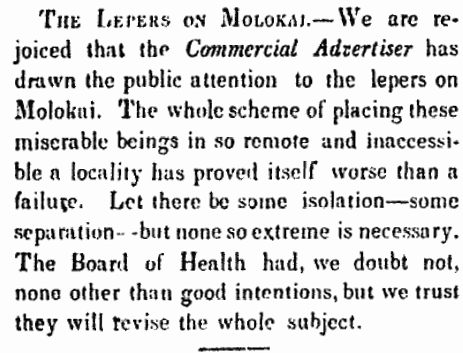
The Lepers on Molokai.—We are rejoiced that the Commercial Advertiser has drawn the public attention to the lepers on Molokai. The whole scheme of placing these miserable beings in so remote and inaccessible locality has proved itself worse than a failure. Let there be some isolation—some separation—but none so extreme is necessary. The Board of Health had, we doubt not, none other than good intentions, but we trust they will revise the whole subject.

[This article comes out soon after the policy to isolate the patients in Kalawao and Kalaupapa. It is a response to articles appearing in the Pacific Commercial Advertiser (predecessor of the Honolulu Advertiser). See following two posts.]

(Kuokoa, 1/19/1867, p. 2)

The Lepers on Molokai...

Ka Nupepa Kuokoa, Buke VI, Helu 3, Aoao 2. Ianuari 19, 1867.

Hawaiians are all over Oregon. This should be a good place to look for English sources! 2012.

uodigcol's avatarOregon Digital Newspaper Program

Over 40,000 pages of new content have just been added to the Historic Oregon Newspapers online database!

New titles include:

As well as additional content from:

~~~

Stay tuned for future announcements and highlights, and happy searching!


View original post

English version of David Kanewanui’s Death Announcement, 1902.

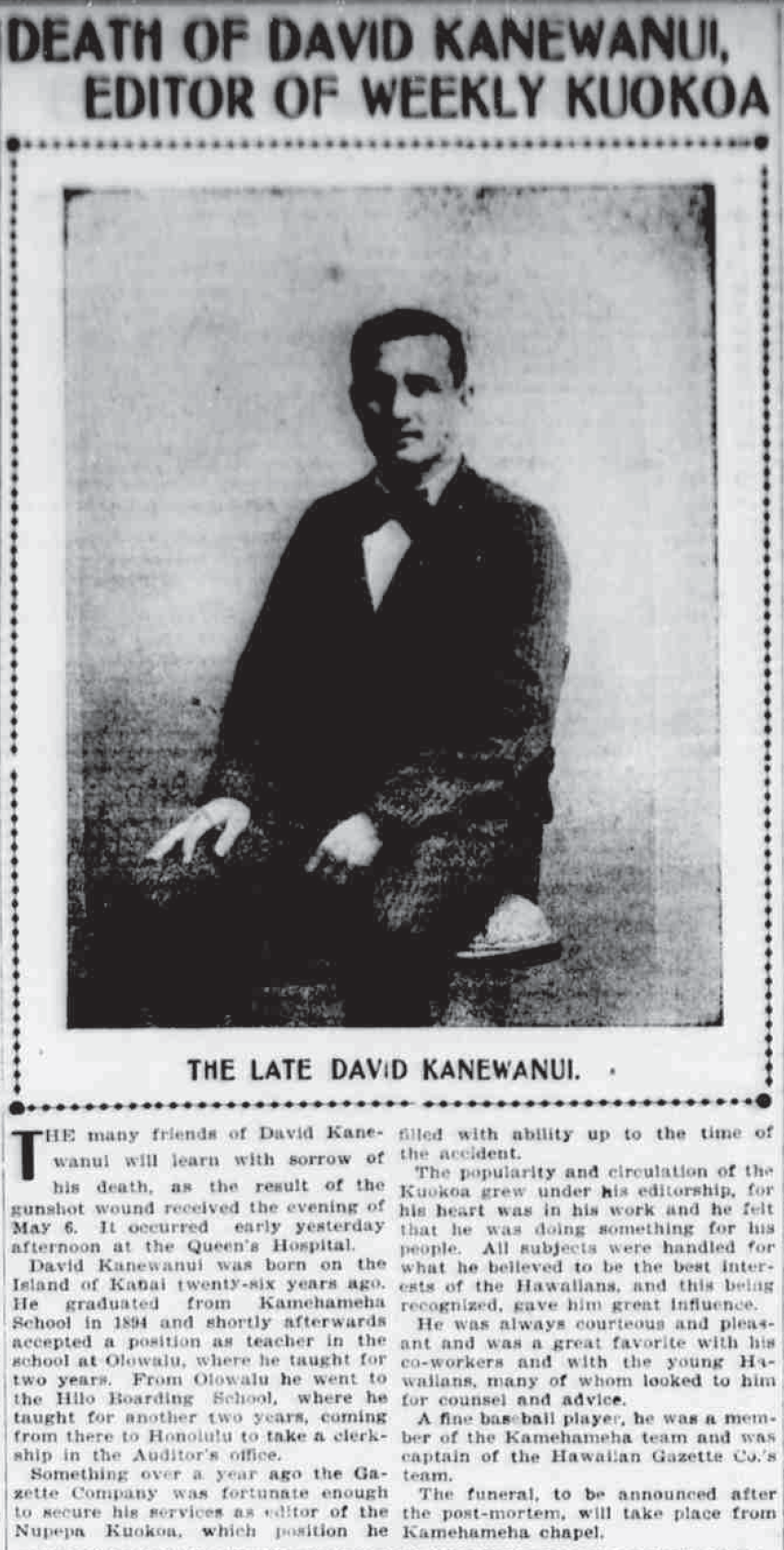
DEATH OF DAVID KANEWANUI, EDITOR OF WEEKLY KUOKOA

THE LATE DAVID KANEWANUI.

THE many friends of David Kanewanui will learn with sorrow of his death, as the result of the gunshot wound received the evening of May 6. It occured early yesterday afternoon at the Queen’s Hospital.

David Kanewanui was born on the Island of Kauai twenty-six years ago. He graduated from Kamehameha School in 1894 and shortly afterwards accepted a position as teacher in the school at Olowalu, where he taught for two years. From Olowalu he went to the Hilo Boarding School, where he taught for another two years, coming from there to Honolulu to take a clerkship in the Auditor’s office.

Something over a year ago the Gazette Company was fortunate enough to secure his services as editor of the Nupepa Kuokoa, which position he filled with ability up to the time of the accident.

The popularity and circulation of the Kuokoa grew under his editorship, for his heart was in his work and he felt that he was doing something for his people. All subjects were handled for what he believed to be the best interests of the Hawaiians, and this being recognized, gave him great influence.

He was always courteous and pleasant and was a great favorite with his co-workers and with the young Hawaiians, many of whom looked to him for counsel and advice.

A fine baseball player, he was a member of the Kamehameha team and was captain of the Hawaiian Gazette Co.’s team.

The funeral, to be announced after the post-mortem, will take place from Kamehameha chapel.

(Hawaiian Gazette, 5/23/1902, p. 5)

DEATH OF DAVID KANEWANUI, EDITOR OF WEEKLY KUOKOA

The Hawaiian Gazette, Volume XXXVII, Number 39, Page 5. May 23, 1902.

Strange report, 1902.

David Kanewanui, of the editorial staff of the Kuokoa, accidently shot himself last evening while handling a revolver which he didn’t know was loaded. The ball entered his cheek, so it is reported, and is now lodged in the back of his head, and to probe it at present is very much feared.

[It is best to check all sources and not to rely on just one article!]

(Independent, 5/7/1902, p. 3)

David Kanewanui...

The Independent, Volume XIV, Number 2201, Page 3. May 7, 1902.

The new and improved St. Louis College, 1881.

THE COLLEGE
OF SAINT LOUIS
—and the—
COMMERCIAL AND BUSINESS ACADEMY
HONOLULU, OAHU, H. I.

This institution being remote from city allurements, is an acknowledged safeguard for morals—for salubrity of climate, is unrivalled. The buildings are large and commodious, while the grounds afford the pupils opportunities for healthful exercises.

Unremitting attention will be given to the intellectual and moral culture of the pupils. Non-Catholic pupils will be free to attend the religious exercises or not, according as their parents or guardians may desire.

Pupils are received at any time during the year. No reduction will be made from regular charges, except for absence caused by protracted illness.

No leave of absence during the scholastic year, except at the College vacations or by special permission.

Each pupil must on entering obtain one suit of uniform, which with all other necessary clothing, &c., &c., will be furnished at moderate cost by the College; but none of these will be provided by the College unless by special arrangement.

Payments are to be made quarterly, and invariably in advance.

The course of study is Classical, Scientific and Commercial; Latin, Greek, French, Spanish, German and Italian are taught.

Particular attention will be paid to the English Language in all its branches. Literature, Pure and Mixed Mathematics, History, Geography, Chemistry and Natural Philosophy, &c.

TERMS:

For Board, Lodging, Tuition and Washing, per Scholastic Year…$200.00

Entrance fee…10.00

Vacation at College…40.00

Music, vocal and instrumental, Drawing and Modern Languages—extras.

DAY PUPILS—Senior Class…$60.00

Junior Class…40.00

The Scholastic Year consists of two Sessions, each comprising a period of five months. The first session commences on the 20th of August; the second on the 20th of January.

For all further particulars, apply to

REV. W. J. LARKIN, President.

No. 73 Beretania St.

Evening School Department of St. Louis College.

The President has decided to include this branch in the curriculum of the College.

Its object is to afford all classes of the community the means of acquiring a theoretical and practical knowledge of all commercial and business transactions in daily use; and also to give an insight into the workings and applications of the different Trades, which it is so essential to do in these Islands.

The Theoretical Branch will be under the supervision of the President and Professors of the College. The Practical and most important Branch will be specially attended to by volunteers from the various master artizans among us, who have kindly and generously promised their services to this useful and valuable enterprise.

They will, alternately, devote half and hour each evening to the task of imparting knowledge to the students. All the implements necessary to each trade, and to Agriculture, will be furnished by the College.

Each master-artizan, while connected with the College, will be entitled to name one Free-Life-Scholarship to the privileges of this Evening School Department.

TERMS—Each student per week, 50 cts. The Evening School will open at 7 o’clock p. m.

(Elele Poakolu, 2/2/1881, p. 5)

KE KULA NUI O SANA LUI

Ka Elele Poakolu, Buke I, Helu 22, Aoao 5. Feberuari 2, 1881.

[This is an advertisement for the recently moved Saint Louis College, back in 1881. The English is taken from the English advertisement appearing on page 5 of the Hawaiian Gazette, 2/9/1881.

This Hawaiian ad appears in the newspaper Ka Elele Poakolu, which for some reason is not available online as of yet, even if it has been available on microfilm for years…]

Harper’s New Monthly Magazine and Kekuanaoa, 1871.

Here is the short piece described in the last post:

The last that we have from “the Pacific slope” speaks of a practice that prevailed some years since at the Sandwich Islands, when it was the custom of the American consuls to be present at the trials of American sailors for breaches of the peace. The consul, at a trial before the sturdy old magistrate and native Governor Kekuanoa [Kekuanaoa], objected to the testimony of an islander on the grounds that it was false. The Governor replied, “Yes, I’m perfectly aware of that; but so was the sailor’s. Let us hear both sides, and then decide the matter.” A mere “question of veracity.”

(Harper’s New Monthly, 4/1871, p. 797)

The last that we have from...

Harper’s New Monthly Magazine, Volume 42, Issue 251, Page 797. April 1871.

In praise of Mataio Kekuanaoa, 1871.

The different Father of Chiefs.

In the monthly magazine, Harper’s of New York, we came across in the April edition, a short story about something done by the Alii Father [Makua Alii] who has passed, and it reports:—

The latest received from the “Pacific String of Hills” speaks of a regular practice carried out in the Hawaiian Islands; during the times when it was a regular thing for the American Consul to sit at court when an American sailor was on trial for disturbing the peace. When a case came before the traditional judge, the Governor Kekuanaoa, the American Consul objected to the testimony of a Hawaiian on the grounds of perjury. At which the Governor replied, “Yes, I am aware of this; but the same may be true of the sailor. The two of us must hear both sides and then rule on this matter.”

When we read this, we recalled that is the different way the Father of Chiefs did things; he listened to both sides first, and when that was finished, he would decide what was proper. Aloha to him and his deeds of steadfast righteousness.

(Au Okoa, 4/13/1871, p. 1)

O ka Makua Alii okoa no.

Ke Au Okoa, Buke VI, Helu 52, Aoao 1. Aperila 13, 1871.

English-Language Newspaper articles less important than Hawaiian-Language articles? 2012

Here is something to consider…

There are many who believe that English-Language articles are somehow less important than Hawaiian-Language ones. We should not turn our noses up at any history passed down by those who lived it—in any language. Although it is important to take into account who wrote the information and under what circumstances, any information is better than no information!

Here for instance is the coverage the first Kamehameha Girls School graduation received in The Hawaiian Gazette of July 6, 1897, p. 2, “CLOSING EXERCISES”.

Compare this to what we saw earlier from the Kuokoa of July 2, 1897, p. 2, “KA HOIKE O KE KULA KAIKAMAHINE O KAMEHAMEHA”.