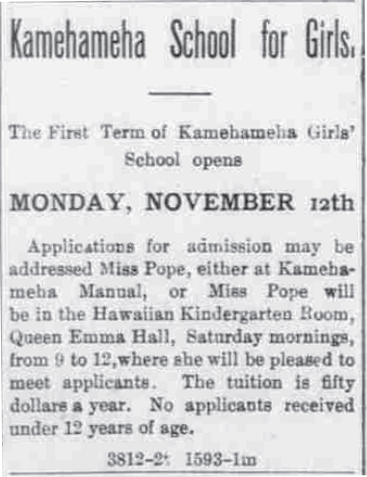
Kamehameha School for Girls advertisement, 1894.

Kamehameha School for Girls.

The First Term of Kamehameha Girls’ School opens

MONDAY, NOVEMBER 12th

Applications for admission may be addressed Miss Pope, either at Kamehameha Manual, or Miss Pope will be in the Hawaiian Kindergarten Room, Queen Emma Hall, Saturday mornings, from 9 to 12, where she will be pleased to meet applicants. The tuition is fifty dollars a year. No applicants received under 12 years of age.

[How things have changed!]

(Hawaiian Gazette, 10/23/1894, p. 6)

Kamehameha School for Girls.

The Hawaiian Gazette, Volume XXIX, Number 84, Page 6. October 23, 1894.

Wow, this sounds like a pretty awesome opportunity for the young people! There is a lot of priceless information available in the English Newspapers as well, much of it dealing with Hawaii nei!

uodigcol's avatarOregon Digital Newspaper Program

As part of the National Digital Newspaper Program (NDNP) and provider of historic Oregon newspaper content for the Chronicling America historic American newspapers website (hosted by the Library of Congress and the National Endowment for the Humanities), the Oregon Digital Newspaper Program (ODNP) is pleased to spread the word about a new opportunity for recognition of middle and high school students with a passion for history.

The following press release was published today on the National Endowment for the Humanities website at http://www.neh.gov/news/press-release/2012-06-14:

WASHINGTON (June 14, 2012) —  The National Endowment for the Humanities (NEH) today announced a new contest to encourage middle and high school students to use Chronicling America, the NEH and Library of Congress-supported digital archive of historic newspapers, in their projects for National History Day.

At the closing ceremonies of National History Day, held on the University of Maryland campus in College Park, Maryland…

View original post 502 more words

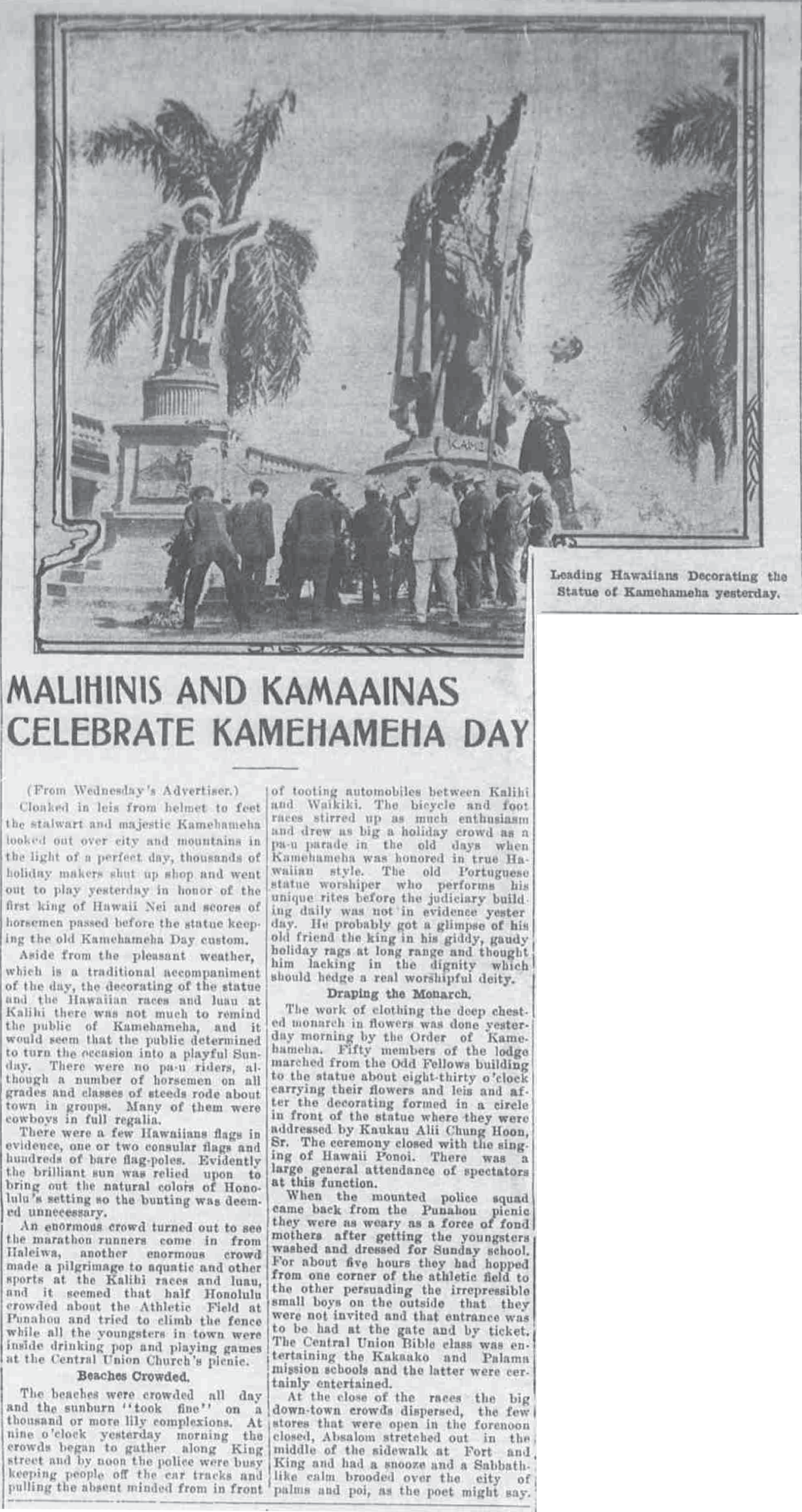
More Decorating the Kamehameha Statue, 1912.

MALIHINIS AND KAMAAINAS CELEBRATE KAMEHAMEHA DAY

Leading Hawaiians Decorating the Statue of Kamehameha yesterday.

(From Wednesday’s Advertiser.)

Cloaked in leis from helmet to feet the stalwart and majestic Kamehameha looked out over city and mountains in the light of a perfect day, thousands of holiday makers shut up shop and went out to play yesterday in honor of the first king of Hawaii Nei and scores of horsemen passed before the statue keeping the old Kamehameha Day custom.

Aside from the pleasant weather, which is a traditional accompaniment of the day, the decorating of the statue and the Hawaiian races and luau at Kalihi there was not much to remind the public of Kamehameha, and it would seem that the public determined to turn the occasion into a playful Sunday. There were no pa-u riders, although a number of horsemen on all grades and classes of steeds rode about town in groups. Many of them were cowboys in full regalia.

There were a few Hawaiian flags in evidence, one or two consular flags and hundreds of bare flag-poles. Evidently the brilliant sun was relied upon to bring out the natural colors of Honolulu’s setting so the bunting was deemed unnecessary.

An enormous crowd turned out to see the marathon runners come in from Haleiwa, another enormous crowd made a pilgrimage to aquatic and other sports at the Kalihi races and luau, and it seemed that half of Honolulu crowded about the Athletic Field at Punahou and tried to climb the fence while all the youngsters in town were inside drinking pop and playing games at the Central Union Church’s picnic.

Beaches Crowded.

The beaches were crowded all day and the sunburn “took fine” on a thousand or more lily complexions. At nine o’clock yesterday morning the crowds began to gather along King street and by noon the police were busy keeping people off the car tracks and pulling the absent minded from in front of tooting automobiles between Kalihi and Waikiki. The bicycle and foot races stirred up as much enthusiasm and drew as big a holiday crowd as a pa-u parade in the old days when Kamehameha was honored in true Hawaiian style. The old Portuguese statue worshiper who performs his unique rites before the judiciary building daily was not in evidence yesterday. He probably got a glimpse of his old friend the king in his giddy, gaudy holiday rags at long range and thought him lacking in the dignity which should hedge a real worshipful deity.

Draping the Monarch.

The work of clothing the deep chested monarch in flowers was done yesterday morning by the Order of Kamehameha. Fifty members of the lodge marched from the Odd Fellows building to the statue about eight-thirty o’clock carrying their flowers and leis and after the decorating formed in a circle in front of the statue where they were addressed by Kaukau Alii Chung Hoon, Sr. The ceremony closed with the singing of Hawaii Ponoi. There was a large general attendance of spectators at this function.

When the mounted police squad came back from the Punahou picnic they were as weary as a force of fond mothers after getting the youngsters washed and dressed for Sunday school. For about five hours they had hopped from one corner of the athletic field to the other persuading the irrepressible small boys on the outside that they were not invited and that entrance was to be had at the gate and by ticket. The Central Union Bible class was entertaining the Kakaako and Palama mission schools and the latter were certainly entertained.

At the close of the races the big down-town crowds dispersed, the few stores that were open in the forenoon closed, Absalom stretched out in the middle of the sidewalk at Fort and King and had a snooze and a Sabbath-like calm brooded over the city of palms and poi, as the poet might say.

[Found on Chronicling America!]

(Hawaiian Gazette, 6/14/1912, p. 2)

MALIHINIS AND KAMAAINAS CELEBRATE KAMEHAMEHA DAY

The Hawaiian Gazette, Volume LV, Number 39, Page 2. June 14, 1912.

We still haven’t learned today what they knew a hundred years ago?

Remember the article on snakes we posted just a couple of weeks ago? Out today is a current related article…

How sad is it when Hawaii already had the answer a hundred years ago, that today, the State of Hawaii doesn’t think keeping alien pests out of Hawaii is important enough to fund! See this article out today by Audrey McAvoy: Alien pests risk fewer inspectors upon entry.

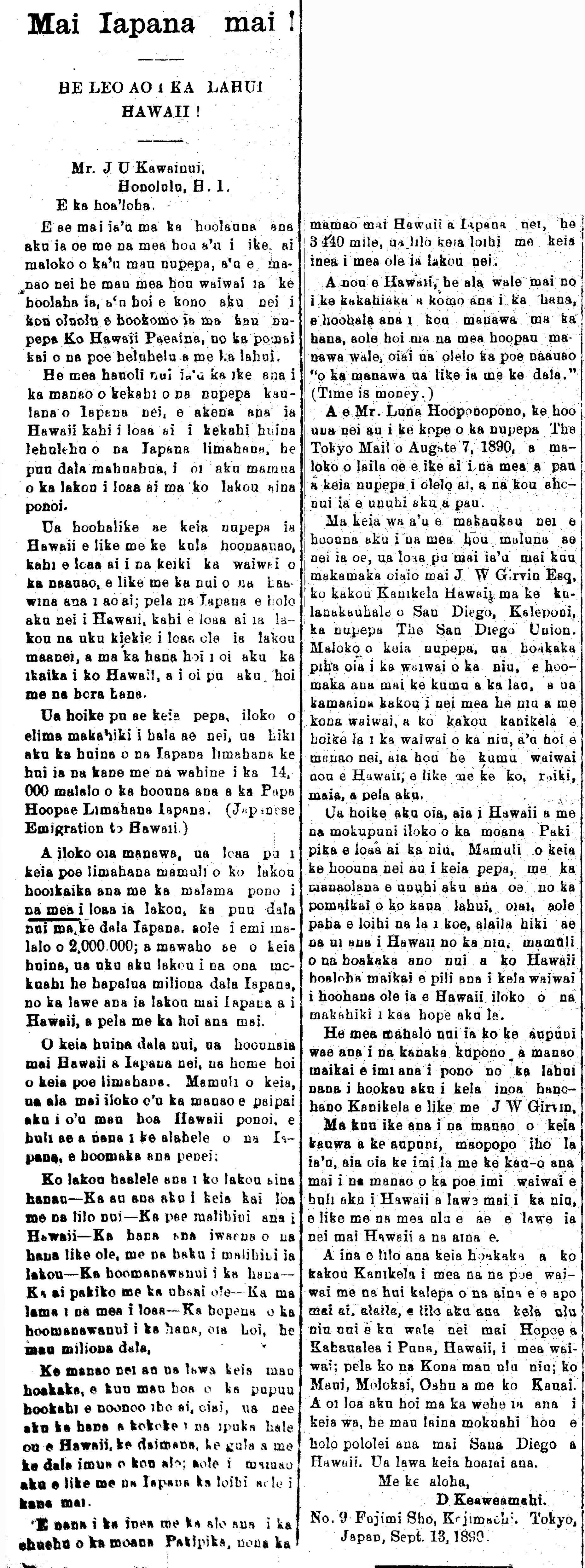
More from David Keaweamahi on Japanese contract laborers, 1890.

From Japan!

INFORMATION FOR THE HAWAIIAN PEOPLE!

Mr. J. U. Kawainui,

Honolulu, H. I.

O Friend,

Please allow me to introduce you to the new things I have seen in my newspaper which I believe are new information important to spread; which I invite you to kindly insert into your newspaper, Ko Hawaii Pae Aina, for the benefit of the readers and the nation.

I was pleased to see the thoughts of a famous newspaper of Japan, praising Hawaii as the place where a great number of Japanese laborers obtained a big sum of money, more than they’d receive in their homeland.

This newspaper likened Hawaii to a school of education, where a child receives the wealth of knowledge, equal to the amount of lessons he studies; so too with the Japanese who are going to Hawaii, where they get high salaries that they’d not get here, and for more intense work than in Hawaii, along with more hours.

This paper also stated that within the past five years, the total number of Japanese laborers including men and women has reached 14,000, sent by the Board for Emigration of Japanese Laborers.

And within this period, these laborers, as a result of their effort and their saving of what they earned, made a great amount in Japanese money, not less than 2,000,000 yen; and not included with this, they paid the ship owners half a million yen to take them from Japan to Hawaii and return.

This great sum of money was sent from Hawaii to here in Japan, the home of these laborers. As a result, there rose within me the desire to encourage my own Hawaiian friends to take a look at the path taken by the Japanese, starting like this:

Their departure from the land of their birth—Their travelling across the great ocean at great expense—The landing as strangers in Hawaii—Working all sorts of jobs for a boss who is a stranger—Enduring the work—Eating only a little without wasting—Caring for what they have—The results of their putting up with the work, that being millions of dollars.

I believe that this is ample explanation, O Friends of the same womb, for you to think about; for the work has come to your door O Hawaiians—diamonds, gold, and money, right before your eyes; it is not far away like for the Japanese for whom it is far, far away.

Look at the hardships and the facing of the spray of the Pacific Ocean whose distance from Hawaii to Japan is 3,440 miles; this distance and hardships became nothing to them.

And you, O Hawaiians, you wake up in the morning and take up your work, and put in your time working, and not with things that waste your time, as goes the saying of the educated people: “Time is like money.”

And O Mr. Editor, I am sending a copy of the newspaper, “The Tokyo Mail” of August 7th, 1890, and within it you will see all of what this paper has said, and it is for you to patiently translate it all.

As I am preparing to send to you the news above, I have also received from my true friend, J. W. Girvin, Esq., our Hawaiian Consul in the city of San Diego, California, the newspaper “The San Diego Union”. Within this paper, he explained fully the value of coconuts, starting from the trunk to the leaves; we are familiar with coconuts and its value; and with our consul explaining the value of the coconut, I am thinking that there are also other sources of wealth for you, O Hawaiians, like sugarcane, rice, bananas, and so forth.

He explains that coconuts can be found in Hawaii and the islands of the Pacific Ocean. Therefore, I am sending this paper with hopes that you will translate it for the good of our people, being that it should not be long before Hawaii starts receiving inquiries for coconuts because of this important description of Hawaii’s good friend dealing with the asset not put to use by Hawaiians in the past years.

It is a very admirable thing that the government selects good people with good ideas to search after the well being of the people that conferred upon him that honorable title, Consul, like J. W. Girvin.

When I look at the ideas of this servant of the nation, I know that he is searching while pulling along the minds of entrepreneurs to look to Hawaii to export coconuts, like the other produce exported from Hawaii to other lands.

And should this description of our Consul become something that the wealthy people and trade companies of foreign lands latch on to, then those great fields of coconut from Hopoe until Kahaualea in Puna, Hawaii will become a source of wealth; so too the stands of coconut in the Kona districts, along with those of Maui, Molokai, Oahu and Kauai. And even more so, with the opening these days of new steamship lines which go directly from San Diego to Hawaii. This clarification should be sufficient.

With aloha,

D. Keaweamahi.

No. 9 Fujimi Sho [Fujimi-cho], Kojimachi, Tokyo, Japan, Sept. 13, 1890.

[As we celebrate Merrie Monarch week, Japanese contract laborers is one of Kalakaua’s many legacies…]

(Ko Hawaii Pae Aina, 9/27/1890, p. 2)
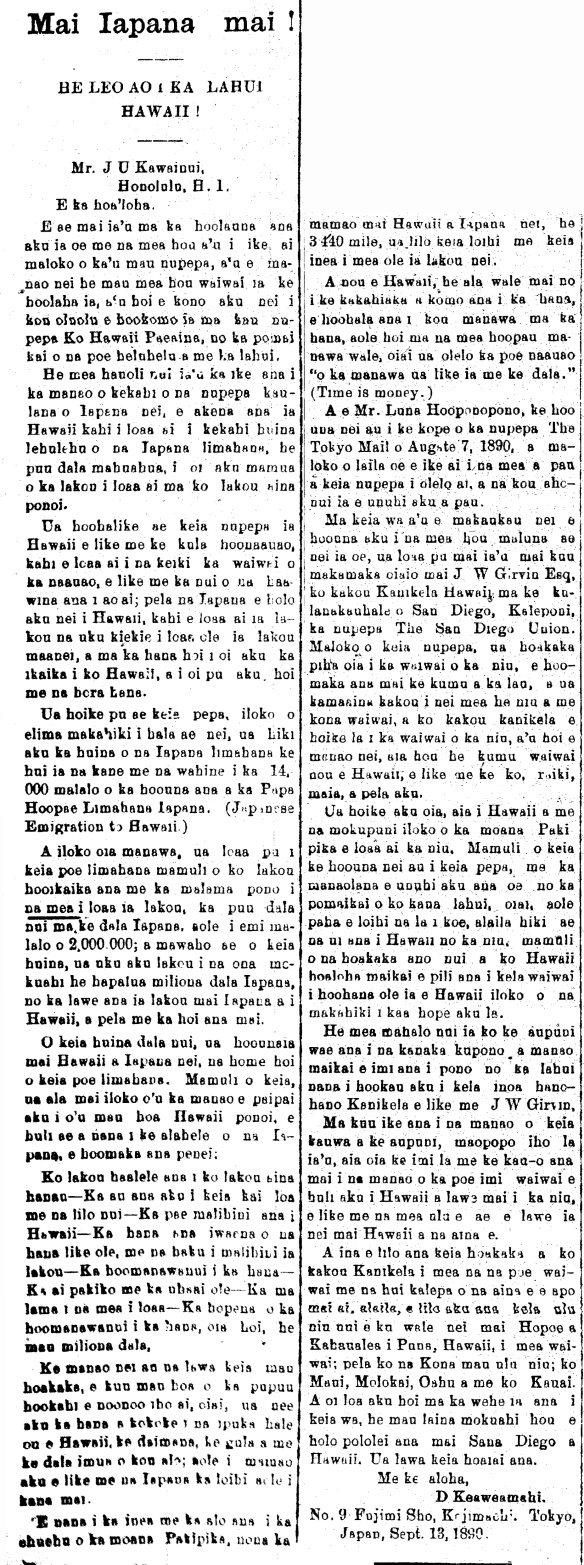
Mai Iapana mai!

Ko Hawaii Pae Aina, Buke XIII, Helu 39, Aoao 2. Sepatemaba 27, 1890.
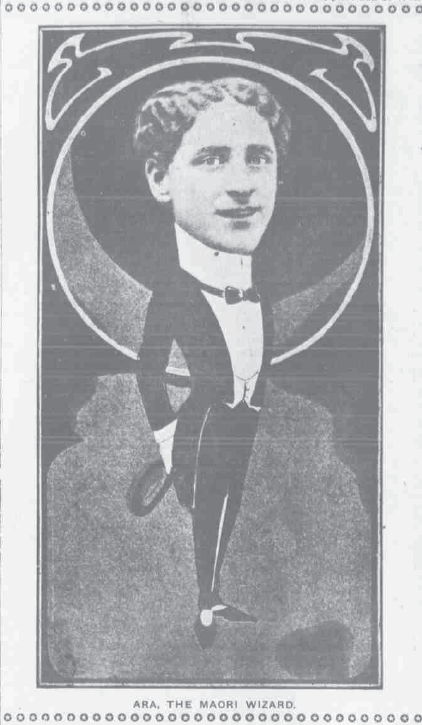
Ara, the Maori Wizard, 1912.

ARA, THE MAORI WIZARD

[Here is an image of Ara, mentioned in the previous post. See the rest of the article here: A Trip Around the World.

Also see more English-language coverage in Chronicling America!]

(Hawaiian Star, 2/10/1912, p. 12)

ARA, THE MAORI WIZARD

The Hawaiian Star, Volume XIX, Number 6198, Page 12. February 10, 1912.

Hawaiians all over America! 1913.

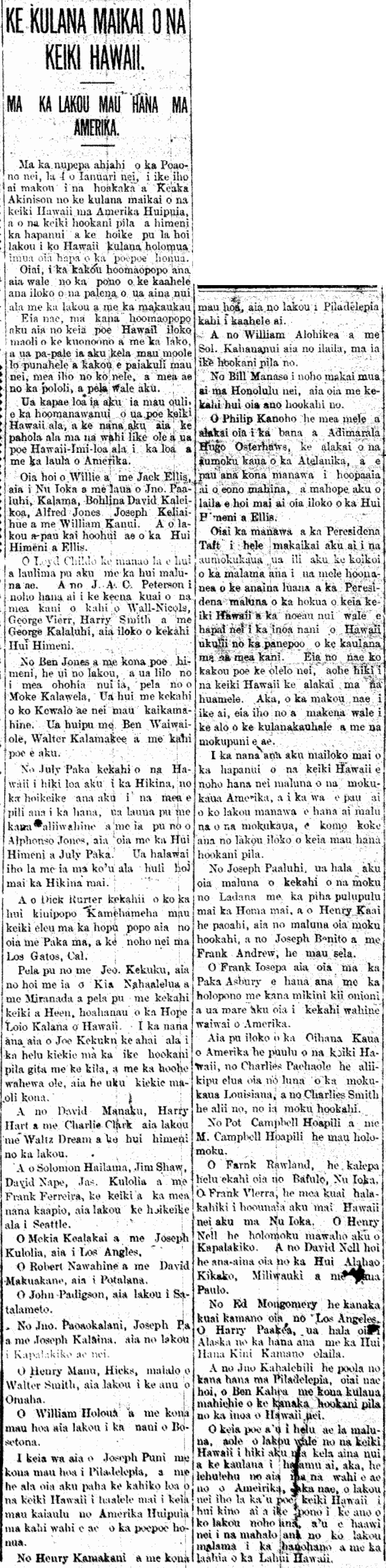
THE GOOD STANDING OF THE HAWAIIAN YOUTHS.

IN THEIR EMPLOYMENT IN AMERICA.

[The issue of this Aloha Aina is misprinted as 1/11/1912, but it should be 1/11/1913! This sort of thing happens once in a while, and if you are not careful, it can lead to wild goose chases. Case in point: i don’t know how long i spent looking for the English article that this was taken from because i was looking in 1912… This article originates from the Honolulu Star-Bulletin (1/4/1913).

See the Star-Bulletin article here.]

(Aloha Aina, 1/11/1912 [1913], p. 1)

KE KULANA MAIKAI O NA KEIKI HAWAII.

Ke Aloha Aina, Buke XVII, Helu 2, Aoao 1. Ianuari 11, 1912* (1913).

One more on the Hawaiian Flag issue of the Kuokoa. 1862.

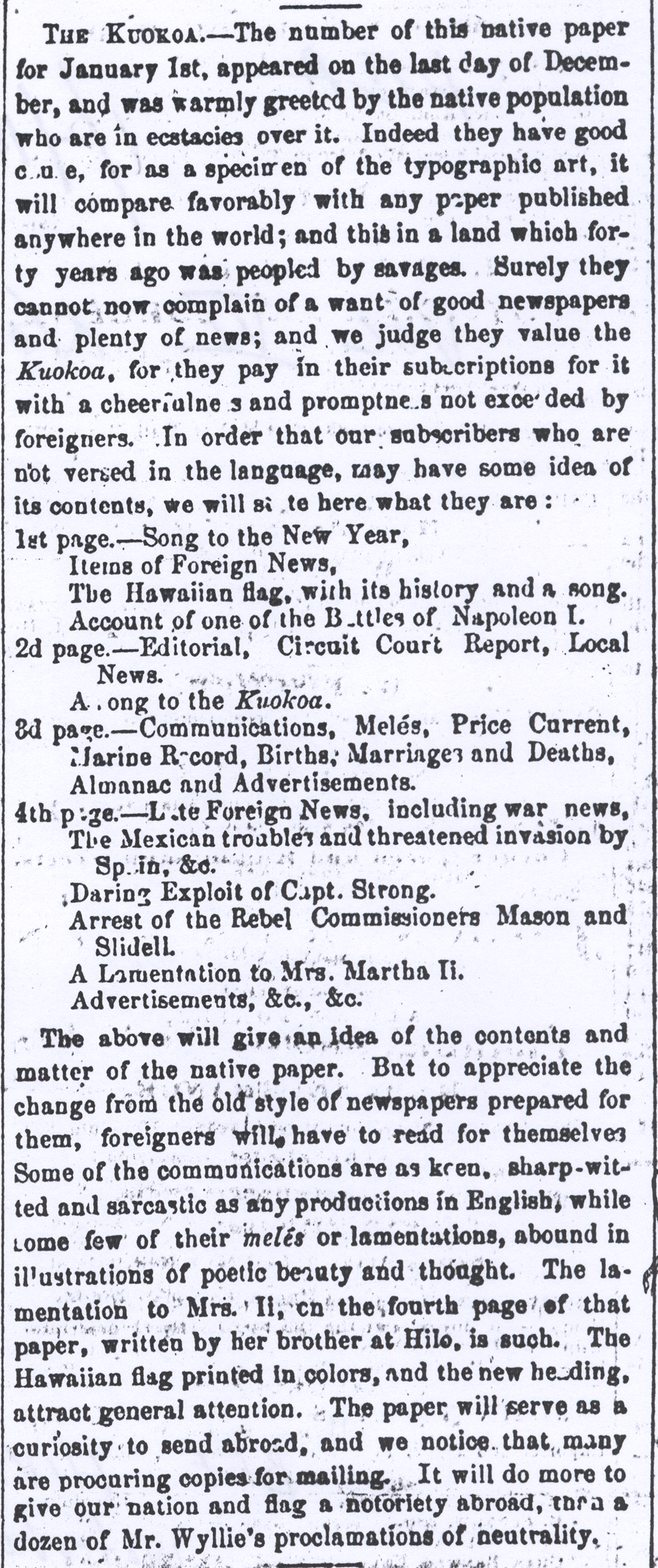
THE KUOKOA.—The number of this native paper for January 1st, appeared on the last day of December, and was warmly greeted by the native population who are in ecstacies over it. Indeed they have good cause, for as a specimen of the typographic art, it will compare favorably with any paper published anywhere in the world; and this in a land which forty years ago was peopled by savages. Surely they cannot now complain of a want of good newspapers and plenty of news; and we judge they value the Kuokoa, for they pay in their subscriptions for it with a cheerfulness and promptness not exceeded by foreigners. In order that our subscribers who are not versed in the language may have some idea of its contents, we will state here what they are:

1st page.—Song to the New Year,

Items of Foreign News,

The Hawaiian flag, with its history and a song.

Account of one of the Battles of Napoleon I.

2d page.—Editorial, Circuit Court Report, Local News.

A song to the Kuokoa.

3d page.—Communications, Meles, Price Current,

Marine Record, Births, Marriages and Deaths,

Almanac and Advertisements.

4th page.—Late Foreign News, including war news,

The Mexican troubles and threatened invasion by Spain, &c.

Daring Exploit of Capt. Strong.

Arrest of the Rebel Commissioners Mason and Slidell.

A Lamentation to Mrs. Martha Ii.

Advertisements, &c., &c.

The above will give an idea of the contents and matter of the native paper. But to appreciate the change from the old style of newspapers prepared for them, foreigners will have to read for themselves. Some of the communications are as keen, sharp-witted and sarcastic as any productions in English, while some few of their meles or lamentations, abound in illustrations of poetic beauty and thought. The lamentation to Mrs. Ii, on the fourth page of that paper, written by her brother at Hilo, is such. The Hawaiian flag printed in colors, and the new heading, attract general attention. The paper will serve as a curiosity to send abroad, and we notice that many are procuring copies for mailing. It will do more to give our nation and flag a notoriety abroad, then a dozen of Mr. Wyllie’s proclamations of neutrality.

[There actually was a replica done of this issue of the Kuokoa by Hoolaupai: Hawaiian Newspaper Resource (which currently either lies dormant or has gone defunct). I heard word that it was going to be reprinted once again a number of months ago, but it seems that did not happen…]

(Pacific Commercial Advertiser, 1/2/1862, p. 2)

The Kuokoa.

The Pacific Commercial Advertiser, Volume VI, Number 27, Page 2. January 2, 1862.

More on the Hawaiian Flag in the Kuokoa. 1861.

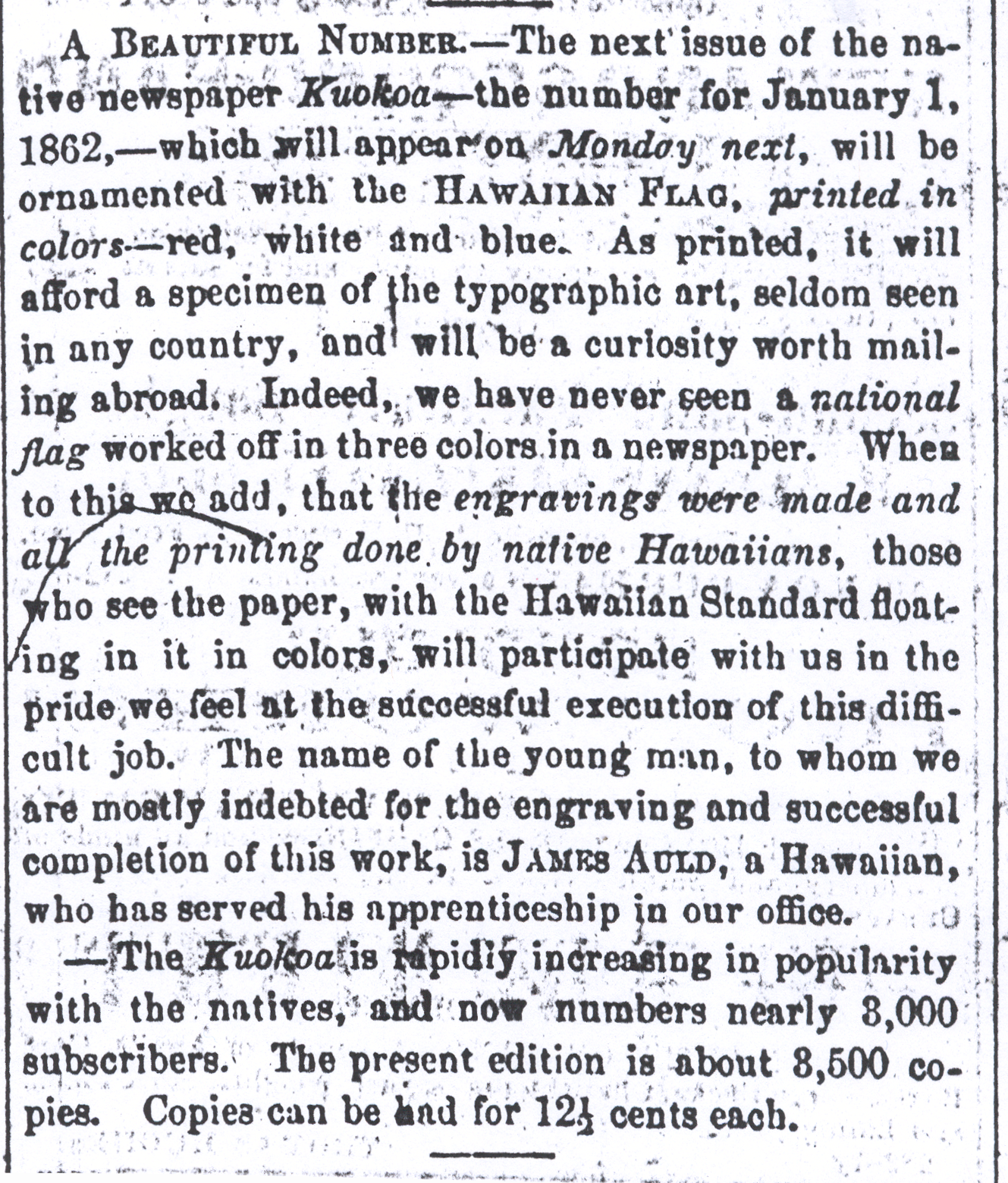
A BEAUTIFUL NUMBER.—The next issue of the native newspaper Kuokoa—the number for January 1, 1862,—which will appear on Monday next, will be ornamented with the HAWAIIAN FLAG, printed in colors—red, white and blue. As printed, it will afford a specimen of the typographic art, seldom seen in any country, and will be a curiosity worth mailing abroad. Indeed, we have never seen a national flag worked off in three colors in a newspaper. When to this we add, that the engravings were made and all the printing done by native Hawaiians, those who see the paper, with the Hawaiian Standard floating in it in colors, will participate with us in the pride we feel at the successful execution of this difficult job. The name of the young man, to whom we are mostly indebted for the engraving and successful completion of this word, is JAMES AULD, a Hawaiian, who has served his apprenticeship in our office.

—The Kuokoa is rapidly increasing in popularity with the natives, and now numbers nearly 3,000 subscribers. The present edition is about 3,500 copies. Copies can be had for 12½ cents each.

[The added information of James Auld here shows that it is important to not only get information from the Hawaiian-Language Newspapers, but the other language papers hold good information as well!]

(Pacific Commercial Advertiser, 12/26/1861, p. 2)

A Beautiful Number.

The Pacific Commercial Advertiser. Volume VI, Number 26, Page 2. December 26, 1861.

History of the Hawaiian Flag. 1880.

In Thrum’s Hawaiian Almanac and Annual for 1880, pp. 24–26, appears this article:

THE HAWAIIAN FLAG.

We exceedingly regret to report an unsuccessful search for the History of the present Flag of these Islands, the time of its adoption and the parties interested in its formation; but after diligent inquiries and research through volumes of voyages, histories, periodicals and manuscript journals during the past three years, we have to acknowledge the main fact lost in oblivion, while references thereto in various voyages and histories are confusing and contradictory.

There is a general idea and belief among many of our old residents that the present Hawaiian Flag was made by the late Capt. Alexander Adams before his voyage to China in the brig “Kaahumana, [Kaahumanu]” in 1817, and was by him first flown, not only in the Chinese waters, but on the coast of California. Others again have the impression that a flag was brought from China by him; but we can gather no information corroborative as to who was authorized in Chinese waters to design a flag for this, even small kingdom, though the description given viz: a St. George and St. Andrew’s cross in the corner filled in with blue, with field consisting of red and white stripes, shows almost virtually the East India Flag. Refering to Capt. Adams’ Journal we find the following mention only, that touches upon the points in question: ” April, 1816, The King of these Islands having a strong passion to purchase the brig, (‘Forrester,’ of London) and expressing the same, myself and Capt. Ebbetts was accordingly deputed to treat with him, but he would not purchase her without I would enter his service as her commander. I resultingly acquiesced, the brig being given up to him at Kealakekua, and called by him Kaahumanu * * *. I was accordingly honored on taking command with the Flag of his Majesty and a salute of 11 guns.”

This certainly refutes the general belief that the flag was made by Capt. Adams, as his own narrative shows a flag to have been here before him ; but
whether the present one or some other we cannot gather, for it is evident that there have been more than one. In another portion of his journal is an allusion to a flag—but also without description—that has no doubt given rise to the idea of his making the flag; where at Waimea, Kauai, at which port he had touched from Honolulu for supplies, en route for China, he notes: “Mch. 12, 1817, * * * Gave the King our ensign to hoist in lieu of the Russian, who said it was on account of his having no other.”

It is to be borne in mind that the allusion here is to the king of Kauai, and not Kamehameha, as Kauai was under its own King till 1821, and his possession of a Russian flag while the principal town was occupied by a Russian colony was not strange.

Finding these theories of Capt. Adams’ authorship exploded by his own writings, search was made in other directions with the following result. Vancouver, in his last visit, (1793) when he assured Kamehameha of England’s friendship and protection, gave him an English flag, which we find by Archibald Campbell, in his “Voyage round the World, 1806-1812,” arriving at these Islands Dec. 1808, that the English colors were used, for he says: “The King’s residence, built close upon the shore, and surrounded by a palisade upon the land side, was distinguished by the British colors.”

Jarvis [Jarves] states, (pp. 96) describing the period of about 1816, speaks of the flag, as somewhat similiar to the present, viz: “English Union, with seven alternated red, white and blue stripes.” This however is not coroborated by Lord Byron, in his “Voyage of the Blonde,” in 1825, in which he describes the flag as follows: “On all days of ceremony the Sandwich flag is hoisted on the forts; it has seven white and red stripes with a Union Jack in the corner.” (P. 121.)

This is almost the East India flag before described, and confuses the searcher after truth as to when the several changes took place. If Jarvis is correct in the flag he describes, and he certainly was in a position to know whereof he wrote, it is a grave error in the recorder of the “Voyage of the Blonde” to give so different a one nine years later. The present flag has eight stripes representing the Islands of the group-white, red and blue, with Union Jack in the corner. Capt. Hunt, who was here in the Baselisk [Basilisk] in 1845, is said to have changed the relative position of the colors of the stripes by placing the white on top instead of at the bottom, though there is a possibility of this being the time of adding the eighth stripe, Jarvis and Byron mentioning only seven. Capt. Hunt is also accredited with designing the Royal Standard now in use.

We leave the above subject as here recorded, trusting it will meet the eye of some one whose knowledge and memory will be freshened thereby to account the true history of the Hawaiian Flag, its origin, and parties interested in its formation.

[The original of this article is downloadable here at the University of Hawaii at Manoa’s EVOLS page! This publication is very useful for many random facts about Hawaii at the time. If you have not seen it before, you should go check it out!!]